DonateMembershipVisit Heritage
  • Tūrangawaewae
    Places
  • Tira Māori
    Māori Heritage
  • Poutairangahia
    Archaeology
  • Rauemi
    Resources
  • Mō Tātou
    About Us
  • New Zealand Heritage List
  • Nominate and submit
  • Explore the List
  • National Historic Landmarks
  • Plaques
  • Rainbow List Project
  • Lost heritage
  • Visit Heritage
  • Our properties
  • Turnbull House Project
  • Collections
  • Shop
  • Tohu Whenua
  • Tira Māori
  • Conserving Māori heritage
  • Marae built heritage
  • Māori heritage on the List
  • Hinemihi—Te Hokinga Mai
  • What is archaeology?
  • Is there a site on my property?
  • What are my legal requirements?
  • Affecting an archaeological site
  • Declaring an archaeological site
  • Archaeology FAQs
  • Archaeology Digital Library
  • Archaeology guidelines and templates
  • Resources
  • Funding
  • Publications
  • Sustainable management guides
  • Disaster recovery
  • Podcasts & digital resources
  • Education Hub
  • Conservation plans
  • About
  • Board
  • Māori Heritage Council
  • Senior Staff
  • Offices
  • Contact us
  • Careers
  • Covenants
  • Fast-track
  • Corporate documents
  • Currently consulting on
  • Our submissions
  • News
  • Covid-19 response
Quick links
Rārangi Kōrero | The List
Explore the List
National Historic Landmarks
Ngā Manawhenua o Aotearoa me ōna Kōrero Tūturu
Quick links
Tapuwae
A Vision for Places of Māori Heritage
Funding for Māori Heritage
Resources
Quick links
Archaeological Authority Portal
Applying for an archaeological authority
Archaeology FAQs
Browse the most frequently asked questions about archaeological authorities and the archaeological process.
Quick links
Quick links
News
News Keep up to date with Heritage New Zealand Pouhere Taonga
Membership
Membership Find out more and sign up today
DonateMembershipVisit Heritage
  • Tūrangawaewae
    Places
  • Tira Māori
    Māori Heritage
  • Poutairangahia
    Archaeology
  • Rauemi
    Resources
  • Mō Tātou
    About Us
  • New Zealand Heritage List
  • Nominate and submit
  • Explore the List
  • National Historic Landmarks
  • Plaques
  • Rainbow List Project
  • Lost heritage
  • Visit Heritage
  • Our properties
  • Turnbull House Project
  • Collections
  • Shop
  • Tohu Whenua
  • Tira Māori
  • Conserving Māori heritage
  • Marae built heritage
  • Māori heritage on the List
  • Hinemihi—Te Hokinga Mai
  • What is archaeology?
  • Is there a site on my property?
  • What are my legal requirements?
  • Affecting an archaeological site
  • Declaring an archaeological site
  • Archaeology FAQs
  • Archaeology Digital Library
  • Archaeology guidelines and templates
  • Resources
  • Funding
  • Publications
  • Sustainable management guides
  • Disaster recovery
  • Podcasts & digital resources
  • Education Hub
  • Conservation plans
  • About
  • Board
  • Māori Heritage Council
  • Senior Staff
  • Offices
  • Contact us
  • Careers
  • Covenants
  • Fast-track
  • Corporate documents
  • Currently consulting on
  • Our submissions
  • News
  • Covid-19 response
Quick links
Rārangi Kōrero | The List
Explore the List
National Historic Landmarks
Ngā Manawhenua o Aotearoa me ōna Kōrero Tūturu
Quick links
Tapuwae
A Vision for Places of Māori Heritage
Funding for Māori Heritage
Resources
Quick links
Archaeological Authority Portal
Applying for an archaeological authority
Archaeology FAQs
Browse the most frequently asked questions about archaeological authorities and the archaeological process.
Quick links
Quick links
News
News Keep up to date with Heritage New Zealand Pouhere Taonga
Membership
Membership Find out more and sign up today
  • Places
  • Nominate and submit
  • National Historic Landmarks
  • Places
  • Nominate and submit
  • National Historic Landmarks
  • Tira Māori
  • Conserving Māori heritage
  • Marae built heritage
  • Tira Māori
  • Conserving Māori heritage
  • Marae built heritage
  • Archaeological authorities
  • Archaeology Digital Library
  • Archaeological authorities
  • Archaeology Digital Library
  • All resources
  • Publications
  • Funding
  • All resources
  • Publications
  • Funding
  • FAQs
  • FAQs
Follow us on:
Places
  • Places
  • Nominate and submit
  • National Historic Landmarks
Tira Māori
  • Tira Māori
  • Conserving Māori heritage
  • Marae built heritage
Archaeology
  • Archaeological authorities
  • Archaeology Digital Library
Resources
  • All resources
  • Publications
  • Funding
FAQs
  • FAQs
Follow us on
HomePrivacyTerms and conditionsAbout this site
© Heritage New Zealand Pouhere Taonga 2026.
 
Edmonds’ Clock Tower

Chester Street East and Madras Street, CHRISTCHURCH

Public

Historic Place Category 2

List No. 3106

Quick links:
List GalleryLocationDetails
The Edmonds’ Clock Tower on the corner of Chester Street East and Madras Street, Christchurch, was built in 1929 as part of a riverbank beautification scheme funded by prominent businessman and philanthropist, Thomas Edmonds, to mark the completion of 50 years’ of his residing in Christchurch. It is part of a wider heritage complex and has historical, aesthetic and architectural significance.

Famous for his company’s product, Edmonds’ ‘Sure to Rise’ Baking Powder, Thomas Edmonds was an enlightened employer and civic-minded. Towards the end of his career, he donated large sums of money for various civic improvement projects. One such project was the 1928-29 riverside beautification scheme at the newly named ‘Poplar Crescent’, so-named due to the poplar trees already planted there and also referencing Poplar, the London district where Edmonds was born. The key features of the scheme were a band rotunda, rest house and balustrades beside Cambridge Terrace and the Manchester Street Bridge, and a clock tower and nearby telephone cabinet beside Oxford Terrace/Chester Street East and the Madras Street Bridge. All items were completed in 1929.

The Edmonds’ Clock Tower was designed by architect Francis Willis in the ‘Free Style’, an architectural style characteristic of the interwar period, with sculptural elements created by well-known sculptor, William Trethewey. It was constructed in stone and reinforced concrete by the Rennell Brothers as builders. The stone used was widely sourced. A newspaper account at the time of its unveiling stated that the clock tower is constructed of stone brought from Halswell, the Rakaia Gorge, Glenmore, Otira Gorge, Lake Kanieri, Heathcote Valley, the Buller Gorge, Nelson, Alford Forest, Gore Bay, Peninsula Bays, Connemara (Ireland) and from the Vatican, Rome. The clock tower is just under ten metres in height. Buttresses extend from each corner of its square plan. A timber door on the east side allows entry into the tower, the paving in front of which is the wording ‘Poplar Crescent 1929’. Louvered windows are situated on each elevation, above the line of the buttresses and in the roof, and on the east and west sides are two clock faces. Sculptural elements include stylised acanthus leaves and fauna, lion head gargoyles, classically inspired inscriptions FAITH, HOPE, PEACE and CHARITY and, a pair of identical medallions portraying Thomas Edmonds as ‘Father Time’.

The Edmonds’ Clock Tower suffered damage in the Canterbury Earthquakes of 2010-11. In May 2012 the upper portion of the tower was temporarily removed and over 2013-15 repairs and strengthening was carried out.
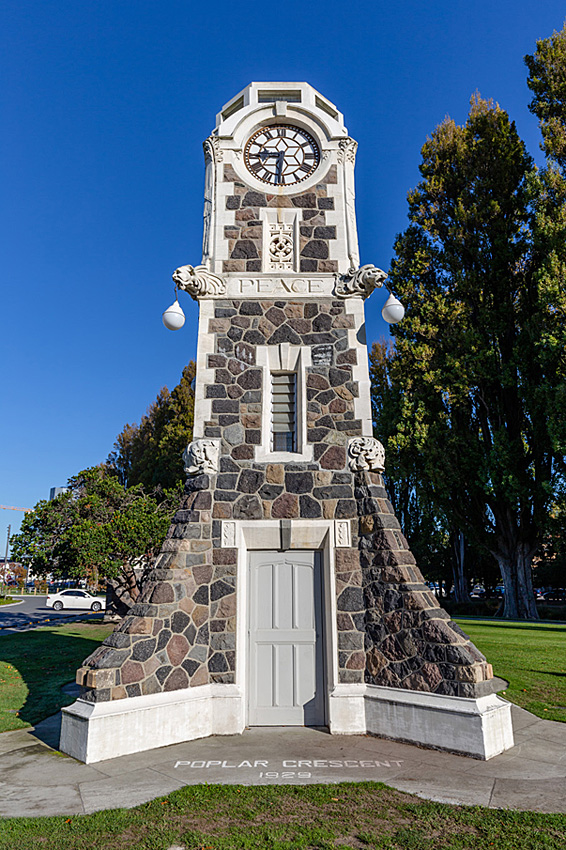
Edmonds' Clock Tower, Christchurch. CC BY-SA 4.0 Image courtesy of www.flickr.com | Michal Klajban | 16/04/2019 | Michal Klajban - Wikimedia Commons
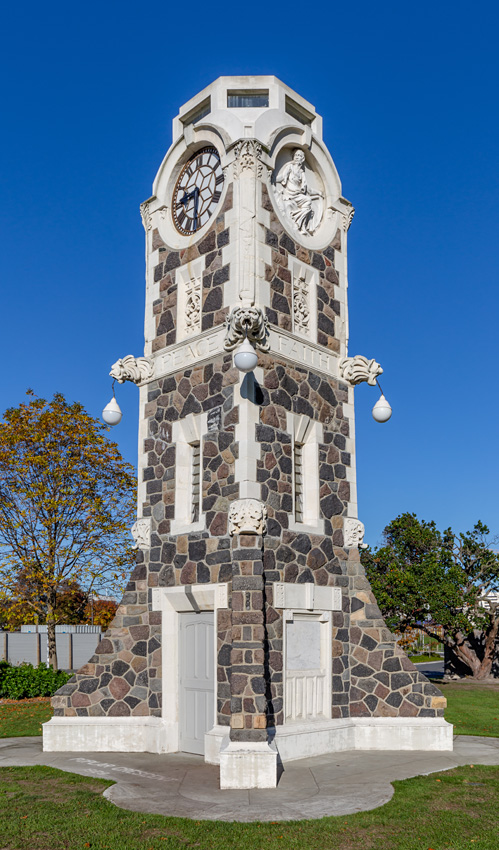
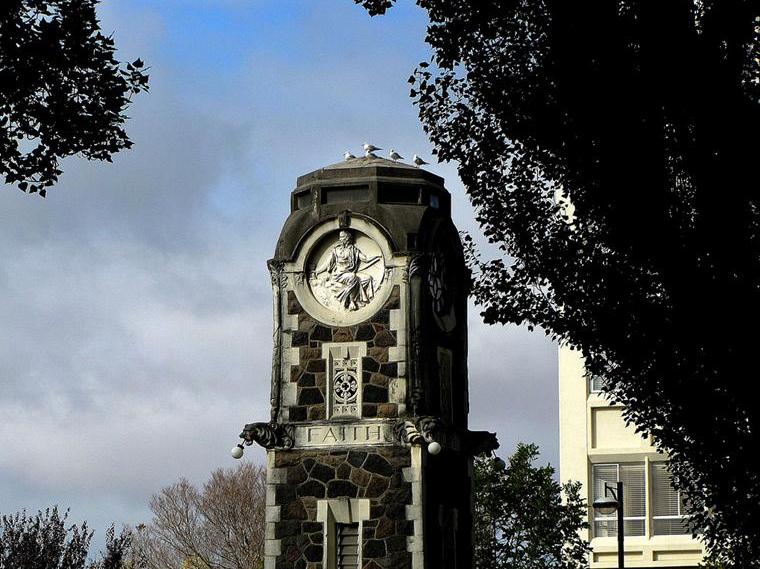
Edmonds’ Clock Tower, Christchurch. Clock detail. Image courtesy of www.flickr.com | walgert | 18/04/2010 | walgert
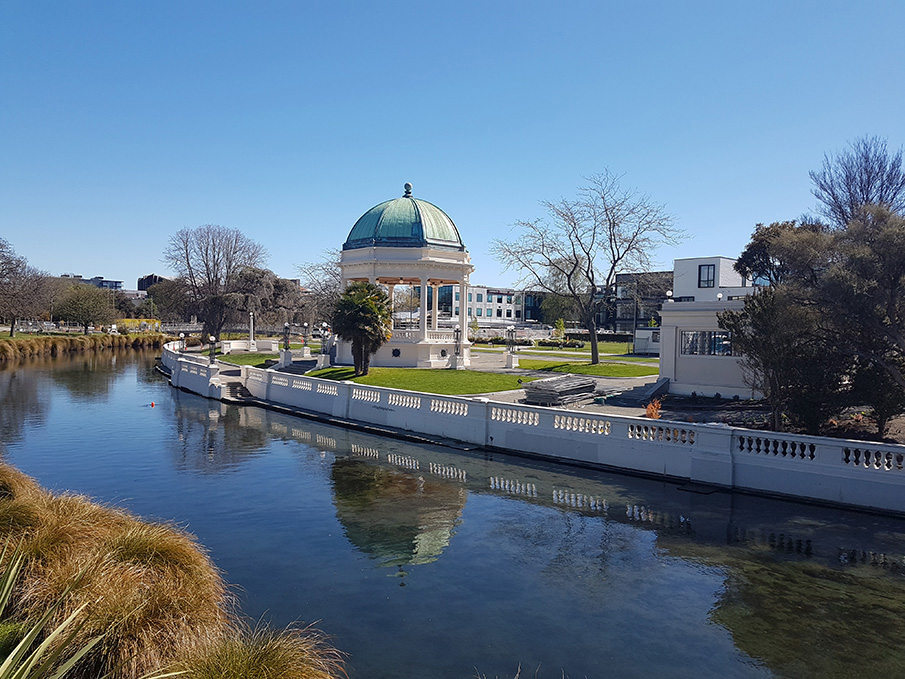
Edmonds' Clock Tower, Christchurch. CC BY-SA 4.0 Image courtesy of www.flickr.com | Michal Klajban | 16/04/2019 | Michal Klajban - Wikimedia Commons
Edmonds’ Clock Tower, Christchurch. Clock detail. Image courtesy of www.flickr.com | walgert | 18/04/2010 | walgert


List Entry Information

Overview

Status
Listed

List Entry Status
Historic Place Category 2

Access
Able to Visit

List Number
3106

Date Entered
26th November 1981

Date of Effect
26th November 1981

City/District Council
Christchurch City

Region
Canterbury Region

Extent of List Entry

Extent includes part of the land described as Sec 1 SO 19042 (Schedule 3(32) Christchurch City (Reserves) Empowering Act 1971), Canterbury Land District, and the structure known as Edmonds’ Clock Tower thereon.

Legal description

Sec 1 SO 19042 (Schedule 3(32) Christchurch City (Reserves) Empowering Act 1971), Canterbury Land District

Location Description

The Christchurch City Council have the primary address as 295F Madras Street, Christchurch.

Detailed List Entry

Construction Professional

Name

Rennell Brothers

Type

Builder

Biography

No biography is currently available for this construction professional

Name

H Francis Willis

Type

Architect

Biography

No biography is currently available for this construction professional

Name

Trethewey, William

Type

Sculptor

Biography

William Trethewey (1892-1956) was born in Christchurch. He left school at the age of 13 and began work as a wood carver, studying at night at the Canterbury College School of Art, where he came into contact with Frederick Gurnsey. In 1914 he moved to Wellington and studied life modelling under J. Ellis. Trethewey returned to Christchurch and decided to shift from wood carving to stone, and for the remainder of his life worked as a monumental mason, 'supplying angels and carving headstones for the people of Canterbury'. He became aware of the potential for memorial sculptures at the end of the First World War and his first commission in this line was a St Andrews cross as a memorial for Elmwood School. In 1920 he submitted a piece, 'The Bomb-thrower', to the annual Christchurch Art Society exhibition. This piece aroused a great deal of public interest, and the Society purchased it for their collection. It was considered unsuitable for a war memorial, because it was a realistic portrait of a New Zealand soldier about to hurl a grenade, rather than the idealised image of heroic youth that was preferred for war memorials. Despite this, in 1920, Trethewey was awarded the commission for the Kaiapoi war memorial, which, when unveiled in 1922, was described by the mayor as being a 'typical Anzac' down to the 'broken boot-lace'. Other sculptures of Trethewey's between 1920 and the early 1930s include a bust of Hyman Marks, the statue of Captain James Cook, in Victoria Square, Christchurch and a statue of Maui Pomare for Manukorihi Pa in Waitara. He began his most famous work, the Citizens War Memorial in Christchurch, in 1933 and it was unveiled in 1937. This memorial is, arguably, the finest public monument in New Zealand. Subsequently he was commissioned to sculpt most of the statuary for the centennial exhibition in Wellington. The only piece of this to survive is the statue of Kupe. The interest in monumental sculpture waned over the course of the twentieth century, and Trethewey spent the last years of his life making clocks. He died in 1956. (Chris Maclean and Jock Phillips, 'The Sorrow and the Pride : New Zealand War Memorials', Wellington, 1990.)

Construction Details

Start Year

1929

Type

Original Construction

Reference

Completion Date

11th October 2016

Report Written By

Robyn Burgess

Information Sources

Christchurch City Council

Christchurch City Council

Report Written By

This place was identified as significant under previous legislation with different information requirements. It remains significant under the current legislation. There is opportunity under our legislation and policies to add to this information. Further information about this place may be available from the Southern Regional Office of Heritage New Zealand Pouhere Taonga. Please note that entry on the New Zealand Heritage List/Rarangi Korero identifies only the heritage values of the property concerned, and should not be construed as advice on the state of the property, or as a comment of its soundness or safety, including in regard to earthquake risk, safety in the event of fire, or insanitary conditions. A fully referenced upgrade report is available on request from the Southern Region Office of Heritage New Zealand.

Further Information

Current Usages

Former Usages

General Usage:: Civic Facilities

Specific Usage: Clocktower/ clock

Themes

Web Links

Overview

Status

Listed

List Entry Status

Historic Place Category 2

Access

Able to Visit

List Number

3106

Date Entered

26th November 1981

Date of Effect

26th November 1981

City/District Council

Christchurch City

Region

Canterbury Region

Extent of List Entry

Extent includes part of the land described as Sec 1 SO 19042 (Schedule 3(32) Christchurch City (Reserves) Empowering Act 1971), Canterbury Land District, and the structure known as Edmonds’ Clock Tower thereon.

Legal description

Sec 1 SO 19042 (Schedule 3(32) Christchurch City (Reserves) Empowering Act 1971), Canterbury Land District

Location Description

The Christchurch City Council have the primary address as 295F Madras Street, Christchurch.

Status

Listed

List Entry Status

Historic Place Category 2

Access

Able to Visit

List Number

3106

Date Entered

26th November 1981

Date of Effect

26th November 1981

City/District Council

Christchurch City

Region

Canterbury Region

Extent of List Entry

Extent includes part of the land described as Sec 1 SO 19042 (Schedule 3(32) Christchurch City (Reserves) Empowering Act 1971), Canterbury Land District, and the structure known as Edmonds’ Clock Tower thereon.

Legal description

Sec 1 SO 19042 (Schedule 3(32) Christchurch City (Reserves) Empowering Act 1971), Canterbury Land District

Location Description

The Christchurch City Council have the primary address as 295F Madras Street, Christchurch.

Construction Information

Construction Professional

Name

Rennell Brothers

Type

Builder

Biography

No biography is currently available for this construction professional

Name

H Francis Willis

Type

Architect

Biography

No biography is currently available for this construction professional

Name

Trethewey, William

Type

Sculptor

Biography

William Trethewey (1892-1956) was born in Christchurch. He left school at the age of 13 and began work as a wood carver, studying at night at the Canterbury College School of Art, where he came into contact with Frederick Gurnsey. In 1914 he moved to Wellington and studied life modelling under J. Ellis. Trethewey returned to Christchurch and decided to shift from wood carving to stone, and for the remainder of his life worked as a monumental mason, 'supplying angels and carving headstones for the people of Canterbury'. He became aware of the potential for memorial sculptures at the end of the First World War and his first commission in this line was a St Andrews cross as a memorial for Elmwood School. In 1920 he submitted a piece, 'The Bomb-thrower', to the annual Christchurch Art Society exhibition. This piece aroused a great deal of public interest, and the Society purchased it for their collection. It was considered unsuitable for a war memorial, because it was a realistic portrait of a New Zealand soldier about to hurl a grenade, rather than the idealised image of heroic youth that was preferred for war memorials. Despite this, in 1920, Trethewey was awarded the commission for the Kaiapoi war memorial, which, when unveiled in 1922, was described by the mayor as being a 'typical Anzac' down to the 'broken boot-lace'. Other sculptures of Trethewey's between 1920 and the early 1930s include a bust of Hyman Marks, the statue of Captain James Cook, in Victoria Square, Christchurch and a statue of Maui Pomare for Manukorihi Pa in Waitara. He began his most famous work, the Citizens War Memorial in Christchurch, in 1933 and it was unveiled in 1937. This memorial is, arguably, the finest public monument in New Zealand. Subsequently he was commissioned to sculpt most of the statuary for the centennial exhibition in Wellington. The only piece of this to survive is the statue of Kupe. The interest in monumental sculpture waned over the course of the twentieth century, and Trethewey spent the last years of his life making clocks. He died in 1956. (Chris Maclean and Jock Phillips, 'The Sorrow and the Pride : New Zealand War Memorials', Wellington, 1990.)

Construction Details

Start Year

1929

Type

Original Construction

Construction Professional

Name

Rennell Brothers

Type

Builder

Biography

No biography is currently available for this construction professional

Name

H Francis Willis

Type

Architect

Biography

No biography is currently available for this construction professional

Name

Trethewey, William

Type

Sculptor

Biography

William Trethewey (1892-1956) was born in Christchurch. He left school at the age of 13 and began work as a wood carver, studying at night at the Canterbury College School of Art, where he came into contact with Frederick Gurnsey. In 1914 he moved to Wellington and studied life modelling under J. Ellis. Trethewey returned to Christchurch and decided to shift from wood carving to stone, and for the remainder of his life worked as a monumental mason, 'supplying angels and carving headstones for the people of Canterbury'. He became aware of the potential for memorial sculptures at the end of the First World War and his first commission in this line was a St Andrews cross as a memorial for Elmwood School. In 1920 he submitted a piece, 'The Bomb-thrower', to the annual Christchurch Art Society exhibition. This piece aroused a great deal of public interest, and the Society purchased it for their collection. It was considered unsuitable for a war memorial, because it was a realistic portrait of a New Zealand soldier about to hurl a grenade, rather than the idealised image of heroic youth that was preferred for war memorials. Despite this, in 1920, Trethewey was awarded the commission for the Kaiapoi war memorial, which, when unveiled in 1922, was described by the mayor as being a 'typical Anzac' down to the 'broken boot-lace'. Other sculptures of Trethewey's between 1920 and the early 1930s include a bust of Hyman Marks, the statue of Captain James Cook, in Victoria Square, Christchurch and a statue of Maui Pomare for Manukorihi Pa in Waitara. He began his most famous work, the Citizens War Memorial in Christchurch, in 1933 and it was unveiled in 1937. This memorial is, arguably, the finest public monument in New Zealand. Subsequently he was commissioned to sculpt most of the statuary for the centennial exhibition in Wellington. The only piece of this to survive is the statue of Kupe. The interest in monumental sculpture waned over the course of the twentieth century, and Trethewey spent the last years of his life making clocks. He died in 1956. (Chris Maclean and Jock Phillips, 'The Sorrow and the Pride : New Zealand War Memorials', Wellington, 1990.)

Construction Details

Start Year

1929

Type

Original Construction

Reference

Historical and Associated Iwi / Hapū / Whānau

Completion Date

11th October 2016

Report Written By

Robyn Burgess

Information Sources

Christchurch City Council

Christchurch City Council

Other Information

This place was identified as significant under previous legislation with different information requirements. It remains significant under the current legislation. There is opportunity under our legislation and policies to add to this information. Further information about this place may be available from the Southern Regional Office of Heritage New Zealand Pouhere Taonga. Please note that entry on the New Zealand Heritage List/Rarangi Korero identifies only the heritage values of the property concerned, and should not be construed as advice on the state of the property, or as a comment of its soundness or safety, including in regard to earthquake risk, safety in the event of fire, or insanitary conditions. A fully referenced upgrade report is available on request from the Southern Region Office of Heritage New Zealand.

Historical and Associated Iwi / Hapū / Whānau

Completion Date

11th October 2016

Report Written By

Robyn Burgess

Information Sources

Christchurch City Council

Christchurch City Council

Other Information

This place was identified as significant under previous legislation with different information requirements. It remains significant under the current legislation. There is opportunity under our legislation and policies to add to this information. Further information about this place may be available from the Southern Regional Office of Heritage New Zealand Pouhere Taonga. Please note that entry on the New Zealand Heritage List/Rarangi Korero identifies only the heritage values of the property concerned, and should not be construed as advice on the state of the property, or as a comment of its soundness or safety, including in regard to earthquake risk, safety in the event of fire, or insanitary conditions. A fully referenced upgrade report is available on request from the Southern Region Office of Heritage New Zealand.

Further Information

Former Usages

General Usage: Civic Facilities

Specific Usage: Clocktower/ clock

Former Usages

General Usage: Civic Facilities

Specific Usage: Clocktower/ clock

Location

Loading
Related listings
Edmonds Band Rotunda, Christchurch
Edmonds Band Rotunda, Poplar Crescent Building and Balustrades
Edmonds Band Rotunda, Christchurch
Edmonds Band Rotunda, Poplar Crescent Building and Balustrades
Stay up to date with Heritage this month