Quick links


Quick links
Quick links
Quick links
Quick links
Quick links
6 Peartree Lane, Hillsborough, CHRISTCHURCH
Private
Historic Place Category 2
List No. 3109

List Entry Information
Status
Listed
List Entry Status
Historic Place Category 2
Access
Private/No Public Access
List Number
3109
Date Entered
14th April 2005
Date of Effect
14th April 2005
City/District Council
Christchurch City
Region
Canterbury Region
Extent of List Entry
Registration includes the house, its fittings and fixtures, and the land on CB42D/484.
Legal description
Lot 11 DP 74110 (RT CB42D/484), Canterbury Land District
Status
Listed
List Entry Status
Historic Place Category 2
Access
Private/No Public Access
List Number
3109
Date Entered
14th April 2005
Date of Effect
14th April 2005
City/District Council
Christchurch City
Region
Canterbury Region
Extent of List Entry
Registration includes the house, its fittings and fixtures, and the land on CB42D/484.
Legal description
Lot 11 DP 74110 (RT CB42D/484), Canterbury Land District
Why is this place significant?
Historic Significance
Historical Significance or Value Glenmore, begun early in the 1850s, has historical significance for its association with Henry Selfe Selfe, the Canterbury Association's agent in London who owned the property though he never lived there. From 1865 to 1880 it was the town house of the prominent Acland family, pioneering settlers at Mt Peel in South Canterbury where descendants still live in the Category 1 registered homestead. As the Glenmore Brickworks manager's home the house is an important reminder of the once extensive brick-making industry along the Port Hills.
Why is this place Category 1 / Category 2?
Detail Of Assessed Criteria
(e) the community has esteem for the property as evidenced by the public outcry when the house was threatened by subdivision; (g) it is a good example of a large townhouse built by the wealthy landed elite; (h) it serves to commemorate the once extensive brick-making industry along the Port Hills; (i) the 1850s date of the earliest part of the house makes it one of the oldest, continuously occupied residences in Christchurch.
Why is this place significant?
Historic Significance
Historical Significance or Value Glenmore, begun early in the 1850s, has historical significance for its association with Henry Selfe Selfe, the Canterbury Association's agent in London who owned the property though he never lived there. From 1865 to 1880 it was the town house of the prominent Acland family, pioneering settlers at Mt Peel in South Canterbury where descendants still live in the Category 1 registered homestead. As the Glenmore Brickworks manager's home the house is an important reminder of the once extensive brick-making industry along the Port Hills.
Why is this place Category 1 / Category 2?
Detail Of Assessed Criteria
(e) the community has esteem for the property as evidenced by the public outcry when the house was threatened by subdivision; (g) it is a good example of a large townhouse built by the wealthy landed elite; (h) it serves to commemorate the once extensive brick-making industry along the Port Hills; (i) the 1850s date of the earliest part of the house makes it one of the oldest, continuously occupied residences in Christchurch.
Construction Details
Start Year
1857
startYearCirca
Type
Original Construction
Description
Construction of single storey section.
Type
Modification
Description
Addition of two-storey section.
Period
1886-1880
Type
Modification
Description
Addition of brick floor and balustrades to verandah.
Period
1920-1930s
Start Year
1993
Type
Modification
Description
Renovations, including extension of first floor over single storey section.
Start Year
1996
Finish Year
1999
Type
Modification
Description
Further internal renovations.
Construction Materials
Weatherboard with a corrugated iron roof . The floor of the ground floor verandah and the balustrades are brick.
Construction Details
Start Year
1857
startYearCirca
Type
Original Construction
Description
Construction of single storey section.
Type
Modification
Description
Addition of two-storey section.
Period
1886-1880
Type
Modification
Description
Addition of brick floor and balustrades to verandah.
Period
1920-1930s
Start Year
1993
Type
Modification
Description
Renovations, including extension of first floor over single storey section.
Start Year
1996
Finish Year
1999
Type
Modification
Description
Further internal renovations.
Construction Materials
Weatherboard with a corrugated iron roof . The floor of the ground floor verandah and the balustrades are brick.
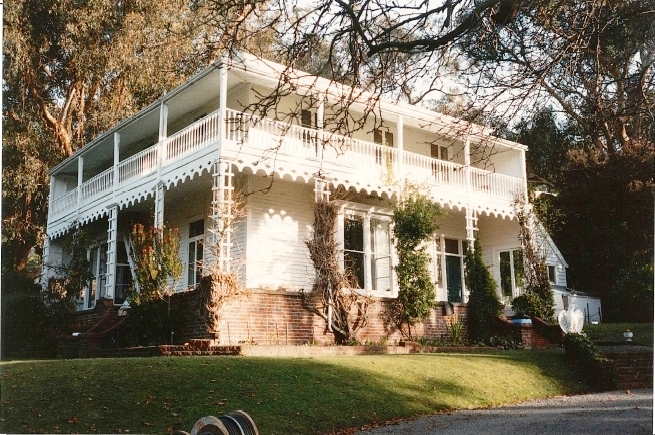
Glenmore is a two-storey weatherboard colonial villa with a low-pitched hipped roof and box bay windows. It is rectangular in form, facing north, with double height verandahs across the frontage and the eastern side. French doors open to both levels of the verandahs, which are decorated with turned timber balusters and fretwork. The lower level of the verandah has a brick floor, and a balustraded terrace extending out from the northern elevation. Despite recent renovations, the colonial character of the house has been retained.
Glenmore is a two-storey weatherboard colonial villa with a low-pitched hipped roof and box bay windows. It is rectangular in form, facing north, with double height verandahs across the frontage and the eastern side. French doors open to both levels of the verandahs, which are decorated with turned timber balusters and fretwork. The lower level of the verandah has a brick floor, and a balustraded terrace extending out from the northern elevation. Despite recent renovations, the colonial character of the house has been retained.
Historical and Associated Iwi / Hapū / Whānau
Information Sources
Acland, 1975
L.G.D. Acland, The Early Canterbury Runs, 4th ed., Christchurch, 1975
Christchurch City Council
Christchurch City Council
Christchurch Press
Hendry, 1968
J.A. Hendry (text) and A.J. Mair (drawings), Homes of the Pioneers, Christchurch, 1968.
MacDonald Biographies
G.R. MacDonald, Dictionary of Canterbury Biographies, Canterbury Museum, n.d.
McIntyre, 1980
W McIntyre, The Journal of Henry Sewell 1853-7 Christchurch: Whitcoulls, 1980
New Zealand Historic Places
New Zealand Historic Places
Observer
Observer, 21 Dec 1918, p.3.
Ogilvie, 1990
G. Ogilvie, Banks Peninsula; the Cradle of Canterbury, GP Books, 1990
Other Information
A fully referenced version of this report is available from the NZHPT Southern Region Office. Please note that entry on the New Zealand Heritage List/Rarangi Korero identifies only the heritage values of the property concerned, and should not be construed as advice on the state of the property, or as a comment of its soundness or safety, including in regard to earthquake risk, safety in the event of fire, or insanitary conditions.
Historical and Associated Iwi / Hapū / Whānau
Information Sources
Acland, 1975
L.G.D. Acland, The Early Canterbury Runs, 4th ed., Christchurch, 1975
Christchurch City Council
Christchurch City Council
Christchurch Press
Hendry, 1968
J.A. Hendry (text) and A.J. Mair (drawings), Homes of the Pioneers, Christchurch, 1968.
MacDonald Biographies
G.R. MacDonald, Dictionary of Canterbury Biographies, Canterbury Museum, n.d.
McIntyre, 1980
W McIntyre, The Journal of Henry Sewell 1853-7 Christchurch: Whitcoulls, 1980
New Zealand Historic Places
New Zealand Historic Places
Observer
Observer, 21 Dec 1918, p.3.
Ogilvie, 1990
G. Ogilvie, Banks Peninsula; the Cradle of Canterbury, GP Books, 1990
Other Information
A fully referenced version of this report is available from the NZHPT Southern Region Office. Please note that entry on the New Zealand Heritage List/Rarangi Korero identifies only the heritage values of the property concerned, and should not be construed as advice on the state of the property, or as a comment of its soundness or safety, including in regard to earthquake risk, safety in the event of fire, or insanitary conditions.
Current Usages
Uses: Accommodation
Specific Usage: House
Former Usages
General Usage: Accommodation
Specific Usage: House
Current Usages
Uses: Accommodation
Specific Usage: House
Former Usages
General Usage: Accommodation
Specific Usage: House
Location
Get the latest heritage news, features and events delivered
straight to your inbox.
