

In 1859 Stack accepted the offer by Bishop Harper to take up the work of the newly founded Maori mission of the diocese of Christchurch. He was ordained a deacon in 1860, and a priest in 1862. Stack settled on land gifted by Maori at Tuahiwi, near Kaiapoi, from where he travelled extensively. His long-term hope was to set up a Maori Church within the Church of England. However the mission suffered through the 1870s from a lack of funds, competitive teachings, and the loss of confidence of Maori due to the alienation of land. After the mission house was destroyed by fire in 1870, the Stack family moved first to Kaiapoi, and then to Christchurch in 1874. Stack leased town section 337 (now 56 Armagh St) from the Church Property Trustees, and had a house built. He purchased the freehold of the property in 1892 for £600.
From 1860 Stack, with his proficiency in Maori, supplemented his clerical income by acting as a government interpreter. Later he became inspector of native schools in the South Island, and an advisor to the Native Department. With retrenchment in 1880, Stack lost his government employment, but compensated by assuming the European parish of Duvauchelle. After a visit to England in 1883, Stack moved successively to St Albans parish, Kaiapoi and Woodend parish, and finally Fendalton. He retired from the Maori Mission in 1888, and became an honorary canon of Christ Church Cathedral in 1894. Vacating Fendalton parish in 1898, Canon and Mrs Stack left New Zealand to reside in Italy until 1907, and then in Worthing, England, where Stack died in 1919. As a writer, lecturer, collector, interpreter and minister, Stack was a persistent and eloquent advocate for Maori for more than 45 years.
In 1905 Stack (by then resident in Italy) sold 56 Armagh St to Dr William Irving (1870-1951) for £1, 310. Architect Cyril Mountfort made substantial alterations, to the value of £600, for Irving in 1908. It would appear that the eastern gable, kitchen, and single storey consulting rooms were added at this time, giving the house a symmetrical appearance, and effectively doubling its size. Many of the interior fittings also date from this period. Cyril Mountfort (1852-1920), the son of eminent Canterbury architect Benjamin Woolfield Mountfort, assisted his father until Benjamin's death, then took over the practice. Stylistically, Cyril's architecture resembled that of his father, but is regarded as being generally less successful. Two of his important ecclesiastical designs were those for the Church of St. Luke the Evangelist, Christchurch (1908-9, Cat II), and St. Johns, Hororata (1910). Cyril also extended his father's Church of the Good Shepherd at Phillipstown (ext. 1906-7, Cat I), and built the neighbouring vicarage (1883, Cat II).
English born, William Irving came to Christchurch as a boy in 1879. His father, Dr James Irving, was a prominent doctor in the city. After attending Christ's College, William returned to England about 1888 to study at Cambridge. Subsequently he studied medicine at Middlesex Hospital, London, before returning to Christchurch about 1897. Irving practised in the city until 1934 when he left for Britain, to settle at Winchester. Whilst in Christchurch he served as president of the NZ branch of the British Medical Association for a term, vice president of the NZ Obstetricians and Gynaecologists Society, and as a Fellow of Christ's College. In 1934 he became a foundation member of the British College of Obstetricians and Gynaecologists. Dr Irving died on the Isle of Wight.
Dr Irving sold 56 Armagh St (and his practice) in 1934 to Dr Francis Oswald Bennett (1897-1976), another medical practitioner, for £2, 000. Francis Bennett was born in Timaru, and educated at Timaru Boys High School. During World War II he served with a field ambulance. Returning to NZ in 1919, he attended the Otago Medical School, graduating with an MB ChB in 1925. Dr Bennett served successively as a general practitioner in Te Aroha, Blackball and Greymouth, before moving to Christchurch in 1933. In 1940 he became an honorary staff member at Christchurch Hospital, then in 1947 anaesthetist and assistant physician. Later Dr Bennett became senior visiting physician, a position from which he retired in 1958 to become a consulting physician and medical officer to the hospital board's homes for the aged. He was still practising as a geriatric physician at the time of his death, at the age of 79. A medical historian, Bennett wrote the centennial history of Christchurch Hospital Hospital on the Avon in 1962, and a posthumously published autobiography A Canterbury Tale (1980).
One of Dr Bennett's more infamous patients was convicted murderer, Pauline Parker. Bennett gave evidence at the Parker-Hume trial in 1954. When Heavenly Creatures (1994), Peter Jackson's film of the episode was made, scenes were filmed in the former surgery with an actor playing Dr Bennett.
During World War II Dr Bennett served initially as Commanding Officer of the 3rd Field Ambulance at Burnham, before becoming second-in-command of the 22nd Field Ambulance in New Caledonia. Bennett also saw service in the Solomons, Guadalcanal and Vella la Vella, before being posted back to New Caledonia as Commanding Officer of the convalescent depot. He reached the rank of Lieutenant Colonel, and was awarded the OBE in 1945 for war services.
In his autobiography, Dr Bennett described 56 Armagh St as 'a house for mistresses and maids, a house built around the conventions of society and an established order, a house rapidly stepping back into social history'. After taking possession in 1934, Bennett added a room to the surgery for his growing midwifery practice. Later, as his family grew, living spaces were altered. About 1950 the house was divided into two flats. Dr and Mrs Bennett moved to a newly built house in Mt Pleasant in 1959, though Mrs Pearl Bennett’s mother, Mrs Brash, remained in the downstairs flat at 56 Armagh Street. John and Wendy De la Bere were long time tenants of Dr Bennett, living at the house from early 1959 until 1976. Following Mrs Pearl Bennett's death in 1979, 56 Armagh St was transferred to daughter Kathleen Lorna Hollobon and her husband, a lecturer at the School of Music at the University of Canterbury. The former surgery was turned into a self-contained flat during 1981.
56 Armagh St remained a family home until 1993, when Mrs Hollobon transferred the property to Lex Burrell, an insurance agent, and his wife Gillian Mary, a childcare centre director. Lex died six months later, and Mary transferred the property at the beginning of 1994 to Gibraltar Shelf No. 41 Ltd. Gibraltar director Paul Simpson added three ensuites and renovated the kitchen during 1994, in order to open the house as bed and breakfast accommodation the following year. The house was named 'The Grange' at this time.
In 1996 the first of a series of threats to the integrity of the house was initiated. Paul Simpson applied for resource consent to demolish or move 56 Armagh St to make way for eight Stewart Ross designed units. An outcry ensued, with Christchurch architect Peter Beaven saying that demolition would be an 'absolute disgrace'. Simpson responded by lambasting the City Council and other heritage campaigners for their lack of financial support. The Council expressed a desire to see the house retained on site, and the development proposal eventually lapsed. Further proposals were floated and then mothballed in succeeding years. In 1998 an application was made to relocate the house, in order to construct a 25 unit Peter Beaven designed block. Then in 1999 an application was made to relocate the house on the site, and create two separate titles.
In 2003, Gibraltar transferred the property to Desmond Ramsay, Tracey Ramsay and Shelley Crowhurst. The D B Ramsay Family Trust applied for consent at the beginning of 2004 to build a freestanding block of eight self-contained guest units behind the house. In the interim however, 56 Armagh St continues to operate as bed and breakfast accommodation. Eight of the bedrooms now have ensuites.
List Entry Information
Status
Listed
List Entry Status
Historic Place Category 2
Access
Private/No Public Access
List Number
3116
Date Entered
14th April 2005
Date of Effect
14th April 2005
City/District Council
Christchurch City
Region
Canterbury Region
Extent of List Entry
Registration includes the house, its fittings and fixtures, and the land on RT CB403/70.
Legal description
Lot 1 DP 7510 (RT CB403/70), Canterbury Land District
Status
Listed
List Entry Status
Historic Place Category 2
Access
Private/No Public Access
List Number
3116
Date Entered
14th April 2005
Date of Effect
14th April 2005
City/District Council
Christchurch City
Region
Canterbury Region
Extent of List Entry
Registration includes the house, its fittings and fixtures, and the land on RT CB403/70.
Legal description
Lot 1 DP 7510 (RT CB403/70), Canterbury Land District
Why is this place significant?
Cultural Significance
Social significance as an illustration of the social standing of medical practitioners in Edwardian New Zealand, and of the frequent proximity of surgery and home for many doctors until comparatively.
Historic Significance
Historical Significance or Value Historical significance as the residence and workplace of (consecutively) prominent Anglican clergyman Canon Stack, and Drs Irving and Bennett - who between them practised from the premises for more than 70 years recently.
Physical Significance
56 Armagh St has architectural significance as an example of a large Victorian/Edwardian townhouse, and as an early example of sympathetic addition.
Why is this place Category 1 / Category 2?
Detail Of Assessed Criteria
(b) is associated with prominent Anglican clergyman, Maori Missioner Canon James Stack, and prominent medical practitioners Drs William Irving and Francis Bennett; (g) reflects in its design the form of early twentieth century general practice, where surgery and residence were usually located in the same building. It is also an example of a Victorian house with Edwardian additions which have been sensitive to the house's original design.
Why is this place significant?
Cultural Significance
Social significance as an illustration of the social standing of medical practitioners in Edwardian New Zealand, and of the frequent proximity of surgery and home for many doctors until comparatively.
Historic Significance
Historical Significance or Value Historical significance as the residence and workplace of (consecutively) prominent Anglican clergyman Canon Stack, and Drs Irving and Bennett - who between them practised from the premises for more than 70 years recently.
Physical Significance
56 Armagh St has architectural significance as an example of a large Victorian/Edwardian townhouse, and as an early example of sympathetic addition.
Why is this place Category 1 / Category 2?
Detail Of Assessed Criteria
(b) is associated with prominent Anglican clergyman, Maori Missioner Canon James Stack, and prominent medical practitioners Drs William Irving and Francis Bennett; (g) reflects in its design the form of early twentieth century general practice, where surgery and residence were usually located in the same building. It is also an example of a Victorian house with Edwardian additions which have been sensitive to the house's original design.
Construction Professional
Name
Mountfort, Cyril Julian
Type
Architect
Biography
C J Mountfort (1852-1920) was the second son of Benjamin Woolfield Mountfort (1825-1898), the notable nineteenth century Gothic Revival architect in New Zealand. He assisted in his father's practice in the 1880s and 1890s before taking over the practice after 1898. C J Mountfort's architecture tended to resemble that of his father, although it was usually less successful. Two of his important ecclesiastical designs were those for the Church of St Luke The Evangelist, Christchurch (1908-9) and St John's Anglican Church, Hororata (1910).
Construction Details
Start Year
1874
Type
Original Construction
Start Year
1908
Type
Modification
Description
Addition of east gable and surgery, doubling size of house.
Start Year
1934
startYearCirca
Type
Modification
Description
Minor additions to surgery.
Start Year
1950
startYearCirca
Type
Modification
Description
Conversion into 2 flats.
Start Year
1981
Type
Modification
Description
Conversion of former surgery to flat.
Start Year
1994
Type
Modification
Description
Insertion of 3 ensuite bathrooms, alterations to kitchen.
Construction Materials
Timber (kauri and totara according to Dr Bennett) with an iron roof.
Construction Professional
Name
Mountfort, Cyril Julian
Type
Architect
Biography
C J Mountfort (1852-1920) was the second son of Benjamin Woolfield Mountfort (1825-1898), the notable nineteenth century Gothic Revival architect in New Zealand. He assisted in his father's practice in the 1880s and 1890s before taking over the practice after 1898. C J Mountfort's architecture tended to resemble that of his father, although it was usually less successful. Two of his important ecclesiastical designs were those for the Church of St Luke The Evangelist, Christchurch (1908-9) and St John's Anglican Church, Hororata (1910).
Construction Details
Start Year
1874
Type
Original Construction
Start Year
1908
Type
Modification
Description
Addition of east gable and surgery, doubling size of house.
Start Year
1934
startYearCirca
Type
Modification
Description
Minor additions to surgery.
Start Year
1950
startYearCirca
Type
Modification
Description
Conversion into 2 flats.
Start Year
1981
Type
Modification
Description
Conversion of former surgery to flat.
Start Year
1994
Type
Modification
Description
Insertion of 3 ensuite bathrooms, alterations to kitchen.
Construction Materials
Timber (kauri and totara according to Dr Bennett) with an iron roof.
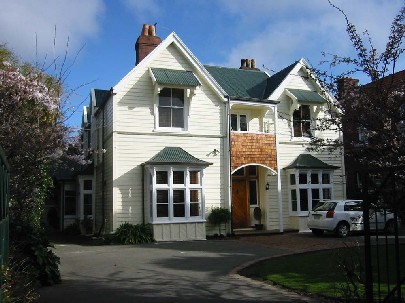
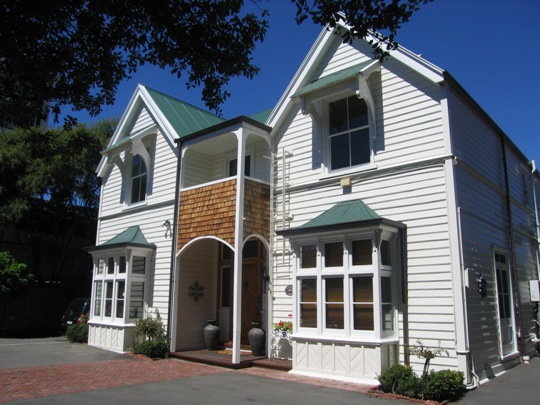
A two storey weatherboard colonial vernacular house. The front elevation consists of two gables divided by a shingled two-level entrance porch. On the ground floor, each gable has a three-light square bay window with casement sashes and a concave roof. At first floor level, each gable has a double-hung sash window, surmounted by a hood with decorative brackets. The east elevation has a single bay window on the ground floor, and two dormer windows breaking the ridgeline at first floor level. A single storey former surgery wing projects from the south east corner. Both the east and west elevations feature a small gable on the roof, containing a timber-framed circular ventilator. This is a distinctive motif of the architect Cyril Mountfort.
A two storey weatherboard colonial vernacular house. The front elevation consists of two gables divided by a shingled two-level entrance porch. On the ground floor, each gable has a three-light square bay window with casement sashes and a concave roof. At first floor level, each gable has a double-hung sash window, surmounted by a hood with decorative brackets. The east elevation has a single bay window on the ground floor, and two dormer windows breaking the ridgeline at first floor level. A single storey former surgery wing projects from the south east corner. Both the east and west elevations feature a small gable on the roof, containing a timber-framed circular ventilator. This is a distinctive motif of the architect Cyril Mountfort.
Historical and Associated Iwi / Hapū / Whānau
Information Sources
Archives New Zealand (Chch)
Archives New Zealand (Christchurch)
Bennett, 1980
F Bennett, A Canterbury Tale: The Autobiography of Dr Francis Bennett Wellington: Oxford University Press, 1980.
Christchurch City Council
Christchurch City Council
Christchurch Press
Cyclopedia of New Zealand, 1903
Cyclopedia Company, Industrial, descriptive, historical, biographical facts, figures, illustrations, Wellington, N.Z, 1897-1908, Vol. 3, Canterbury Provincial District, Christchurch, 1903
Dictionary of New Zealand Biography
Dictionary of New Zealand Biography
MacDonald Biographies
G.R. MacDonald, Dictionary of Canterbury Biographies, Canterbury Museum, n.d.
New Zealand Historic Places Trust (NZHPT)
New Zealand Historic Places Trust
New Zealand Medical Journal
New Zealand Medical Journal
Other Information
A fully referenced version of this report is available from the NZHPT Southern Region Office. Please note that entry on the New Zealand Heritage List/Rarangi Korero identifies only the heritage values of the property concerned, and should not be construed as advice on the state of the property, or as a comment of its soundness or safety, including in regard to earthquake risk, safety in the event of fire, or insanitary conditions.
Historical and Associated Iwi / Hapū / Whānau
Information Sources
Archives New Zealand (Chch)
Archives New Zealand (Christchurch)
Bennett, 1980
F Bennett, A Canterbury Tale: The Autobiography of Dr Francis Bennett Wellington: Oxford University Press, 1980.
Christchurch City Council
Christchurch City Council
Christchurch Press
Cyclopedia of New Zealand, 1903
Cyclopedia Company, Industrial, descriptive, historical, biographical facts, figures, illustrations, Wellington, N.Z, 1897-1908, Vol. 3, Canterbury Provincial District, Christchurch, 1903
Dictionary of New Zealand Biography
Dictionary of New Zealand Biography
MacDonald Biographies
G.R. MacDonald, Dictionary of Canterbury Biographies, Canterbury Museum, n.d.
New Zealand Historic Places Trust (NZHPT)
New Zealand Historic Places Trust
New Zealand Medical Journal
New Zealand Medical Journal
Other Information
A fully referenced version of this report is available from the NZHPT Southern Region Office. Please note that entry on the New Zealand Heritage List/Rarangi Korero identifies only the heritage values of the property concerned, and should not be construed as advice on the state of the property, or as a comment of its soundness or safety, including in regard to earthquake risk, safety in the event of fire, or insanitary conditions.
Current Usages
Uses: Accommodation
Specific Usage: Boarding/ Guest House
Former Usages
General Usage: Accommodation
Specific Usage: House
Web Links
description:
Current Usages
Uses: Accommodation
Specific Usage: Boarding/ Guest House
Former Usages
General Usage: Accommodation
Specific Usage: House
Web Links
description:
Location
Sign up to hear more
Get the latest heritage news, features and events delivered
straight to your inbox.
