Current Description
Setting
The area surrounding Cambrians is known for the extensive gold-mining claims during the 19th and early 20th century. The scarred landscape following the west side of Loop Road from Cambrian to St Bathans was created through the hydraulic sluicing and elevating gold-mining method that literally carved out the hillside and flats. In 1884, the gold-mining magnate of Otago John Ewing began to invest heavily in hydraulic sluicing at Vinegar Hill and Cambrian with £10,700 alone being invested at Vinegar Hill in the same year. Between 60-100 men were employed by Ewing at his Otago gold claims at any one time and included miners, race-men, stable-hands, blacksmiths and message-boys. Also mining in this area were the Chinese miners who would work over the already mined areas of the Europeans using the more basic machinery of pumps, cradles, pans and shovels. Gold-mining continued in this area (mainly at St Bathans) through to the early 20th century. Historic records regarding gold-mining around Cambrians are detailed where the names of actual gold miners who worked the various flats, creeks and streams are known. Although farming activities such as ploughing have destroyed areas of tailings, sluiced faces and tailraces around Cambrians, well preserved areas of gold mining are still present today that are a good example of hydraulic sluicing here during the nineteenth century. The large water races that cross the pastoral leases surrounding Cambrians were originally built for the purpose of gold-mining with some of these races used today for irrigation.
Cambrians is located in the Manuherikia Valley in Central Otago. Cambrians is the remnant of a small settlement that grew up close to the gold mining workings around Welshman’s Gully and Vinegar Hill at the foot of the Dunstan Range. Like its near neighbours, St Bathans (a settlement still with its hotel, old post office and churches remaining), Drybread (of which the cemetery remains), and Tinkers (now Matakanui, with its cluster of mudbrick buildings), Cambrians recalls the bustling days of the gold rushes in the 1860s and 1870s when small towns sprung up to service the miners. Unlike Matakanui and St Bathans, no commercial buildings survive in Cambrians, and the only public building surviving is the school, shifted back to its original site. Like Matakanui, Cambrians is off the main road, both places giving a sense of being quiet relics of a busier past. St Bathans is more well known, and has a greater number of visitors.
Cambrians grew up beside the mine workings on Welshman’s Creek. Cambrians Road runs the length of the settlement. In the nineteenth century, the buildings were strung out along the length of the road with the Welsh Harp Hotel marking the east end and Coal Pit Road stretching toward the workings closer to the foothills. The houses, store and hotel were largely located on the south of the road, with the workings on the north side. There were a few small residences on the same side of the road as the workings.
The houses that remain are built of materials typical of gold mining settlements and of this area – mud brick, corrugated iron and stone. They represent the vernacular materials of the region and period. Also represented in the history of the Cambrians buildings is the typical adaptation of the buildings. Mudbrick buildings were extended as need demanded, the corrugated iron houses were added to (like the Owen Owens’ house with its mudbrick addition) or abandoned, like William Swinney’s house. The school’s relocation for use elsewhere and subsequent return is also a typical story of this region where timber was scarce. The ruins of the Welsh Harp Hotel are typical of the decay of mud brick buildings once the roof is gone. Materials were valuable and often reused – this is the story of both the Welsh Harp Hotel and the ruins of the McGregor residence at opposite ends of the settlement. The gaps in the teeth of the settlement are also typical as buildings were removed and used elsewhere – the teacher’s residence, for example, was removed. Such was the fate for other houses in the settlement.
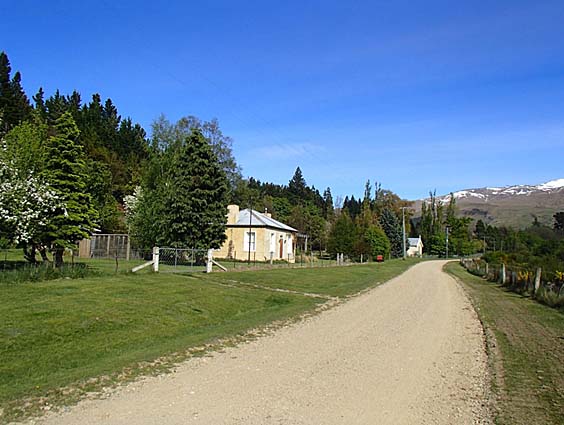
In 2014, the remaining buildings are dotted out along Cambrian Road, over about a kilometre. The houses are the remnants of the settlement, with old plantings, hedge rows and other archaeological material indicating the old house sites. There are several new residences along Cambrian Road but these are small and unobtrusive. The tailings on the north side of the road are overgrown with gorse and broom. The surrounding land is farmland. Sluicing faces and water races show how extensive the mining was. The Dunstan Range provides the backdrop for the settlement, which has a sense of being a forgotten place.
Welsh Harp Hotel Ruins and associated cottage
This cottage and the associated ruins of the Welsh Harp Hotel to the east are what remain of a complex of buildings associated with the hotel.
Pierce and Washer seem to be the first owners of the hotel at Welshman’s Gully. They advertise in the Mount Ida Chronicle in 1870. Benjamin Washer advertised the ‘HOTEL, STORE, BILLIARD ROOM, Billiard Table, Stable and other Premises’ for sale in December 1870. Washer had been a storekeeper in Welshman’s Gully since around 1865.
R. Jones (John Jones) bought the hotel and the adjoining store from Benjamin Washer in 1874. He planned alterations to make the Welsh Harp ‘one of the best up-country Hotels.’
The hotel and store burnt down in 1875. The hotel was rebuilt and was taken over by ‘Mr Beatty’ (formerly of ‘German Hill’) in 1879. Beattie, as his name was more commonly spelled, ran the hotel and butchery, and slaughteryard. Alexander Harley held the license for a period. An 1884 survey shows Beattie’s hotel, garden, stable and butcher’s shop on Section 1, with an application to purchase that land. Beattie’s title was issued in 1886, one of the few freehold sections in Cambrians. The residence does not appear on the 1884 survey, which suggests that it may have been built later.
A license application in 1904 described the Welsh Harp Hotel as ‘containing 16 rooms, exclusive of those required for the use of the family.’ Frederick Haig took over the Welsh Harp Hotel from John Beattie in 1909 and held the licence until around 1914, when James Rutherford took over.
In 1918, the hotel closed and its chattels and building materials auctioned off. The auction notice advertised five acres of freehold land with a ‘comfortable 4-roomed COTTAGE and garden.’ In addition, the building materials of the Welsh Harp Hotel were sold: ‘consisting of 561 sheets galvanised roofing iron (5ft and 9ft lengths), ridging spouting, and piping, 20 pairs window sashes, frames, and fittings, 24 doors and frames, register grates, mantelpieces, stoves and large range, bar counter, shelves, fountains, and panelled kauri ceilings, flooring, rafters, and studs, skylights, and large shop windows, Pelton wheel, sausage machine and tools’ as well as the furniture and effects. The buildings had been ‘carefully taken down’ to be sold in lots.
In 1920, the land was transferred to Cambrians miner Joseph Morgan. In 1930 the property was bought by miner Cleaton Griffiths Davies. Davies held the land until 1946 when Dunedin miner David Jones bought it. The Dunstan Downs Rabbit Board bought the house in 1951. In 1961, the house was purchased as a holiday home.
In 2014, the cottage remains a holiday home, while the piles of mudbricks to the east are what remain of the Welsh Harp Hotel.
Cambrian School (Former)
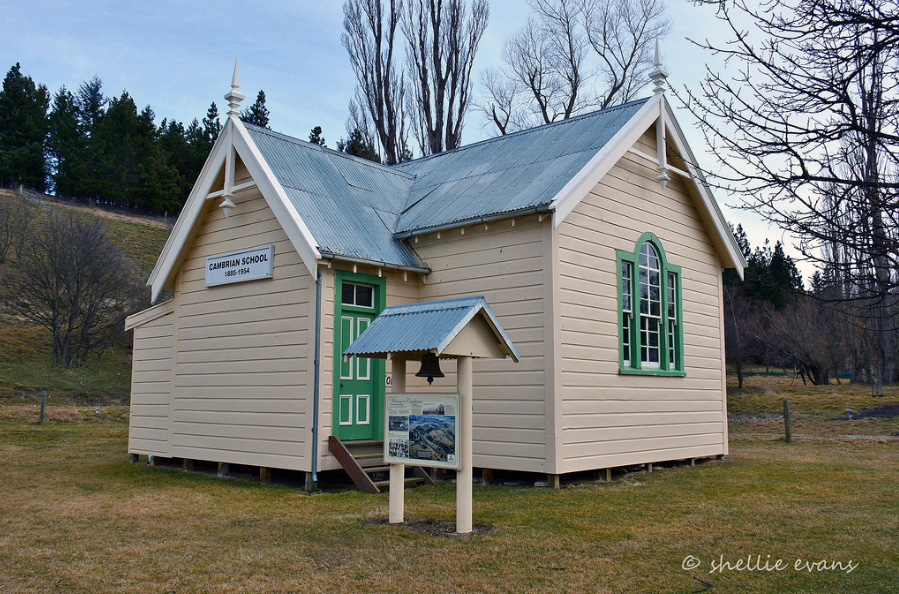
The first school, Welshman’s School, opened in 1873. Fundraising, including the St David’s Day picnic, helped pay off the debt. The school was renamed Cambrian School in 1878. A new and larger school building was built in the 1880s. E. Clark’s £504 3s 7d tender for the ‘Cambrian school and residence’ was accepted in October 1885.
The school closed in 1954. The school building was moved to nearby Becks, where it housed the Sunday School of St Paul’s Union Church. The associated teacher’s residence was moved to Lauder Station and used as shearers’ quarters. In 2006, after the church closed, the Cambrian Valley Trust bought the building and shifted it back to Cambrians and its original site.
In 2014, the school remains a meeting place and houses a collection of material on the history of Cambrians. It is open to the public.
Morgan House (Former)
Oral history records that this house was built for Tom Morgan and his family in 1922. Tom Morgan was a mine manager. He was the son of one of the original Cambrians settlers, Samuel Morgan. Thomas Morgan did have a residence site license for an acre on Cambrian Road in 1931.
The house was described in 1964 as follows: there is ‘a sundried brick house on this property comprising sitting room, 2 bedrooms, kitchen, pantry and bathroom and fitted electric water pump, power and telephone. The house is quite sound.’ The Dunstan Downs Rabbit Board’s license for the property expired in 1964.
In 2014, Tom Morgan’s former home remains a private residence.
Owen Owens’ House (Former)
This house was the home of another of Cambrians’ early miners, Owen Owens, and his family. The early portion (built of corrugated iron) may date from the 1860s-1870s. A mud brick addition was added to west side, possibly in the 1940s. The house sat on one acre that Owens probably leased as a residence area, as was the most common tenure for residential land within mining districts. The surrounding area was part of Lauder Station. Owen Owens had permission to fence off a further two acres from the station owners. This was another case of unrecorded early tenure, with the Cromwell Mining Registrar finding no record of Owen Owens ‘ever having a Residence Site License’, though he found earlier sites for Griffith Jones Owens and David Owens.
Owen Jones Owens was born in Carnarvonshire in North Wales in 1830. He worked as a quarryman from the age of twelve at the Llamberis Slate quarries. He married Ann Jones from Bangor and after eight years together they sailed for Melbourne, where they settled at Stony Creek near Williamstown. When gold was discovered at Gabriel’s Gully in 1861 Owen Owens left his wife and sailed for Otago where he mined at Waitahuna and Gabriel’s Gully before moving to Clyde. Ann followed. After a year in Clyde, they moved to Welshman’s Gully. He and Ann raised a family of three sons and a daughter in Cambrians. The couple lived in this house until their deaths. Owen Owens died in 1911. Ann Owens died at Cambrians in 1917.
After Ann’s death, her son John owned the residence area, letting it to Percy and Margaret Davies. John Owens intended to retire to Cambrians (he was working in Wanaka as an irrigator) but felt he was too old to make good use of the land, and sold the lease to the Davies family in 1933. He thought himself lucky to get the purchase price, as these were ‘hard times. Money is scarce.’
The Davies moved to Dunedin in 1947 and sold the lease to David and Joyce Monro. David Monro was a lecturer at Otago University and the family planned to spend the summer holidays at Cambrians. The transfer records that the house had five rooms, an iron roof and two chimneys. The outbuildings were a coal-house, wash-house and dairy. The Monros had to get an exemption from the residence requirement for licenses to occupy but as there was little demand for property in the region, this was no problem.
In 1953, Section 115 was reserved for Rabbit Board buildings, and vested in the Dunstan Downs Rabbit Board. Presumably, the house accommodated rabbiters during this time. The gazettal was revoked in 1964, as the land was no longer required.
In 2014, the house remains a private residence.
Morgan House (Former)
This small mudbrick cottage was likely to have been built for Bill Morgan, son of early Cambrians miner Samuel Morgan (brother of Tom who had a house at 101 Cambrian Road). Oral history information indicates that the house may have been built as late as the 1920s. Little else is known about the house.
Haig House (Former)
This mudbrick house was possibly the home of Frederick Haig and family. Frederick Andrew Haig had a one-acre residence site on the south west side of Cambrian Road in Cambrians in 1900. He had married the daughter of Thomas Hughes of Cambrians in 1898. Haig took over the Welsh Harp Hotel from John Beattie in 1909 and held the licence until around 1914. Jack Morgan lived there in later years.
In the 1960s, the Dunstan Downs Rabbit Board owned the house, providing accommodation for rabbiters. It was described in 1964 as having ‘3 bedrooms, sitting room, kitchen etc., There is a fairly new extension to the house providing excellent washhouse, bathroom and toilet facilities. Electric power and telephone are installed’.
Later the Electricity Department surveyor lived in the house. In 2014, it remains a private residence.
Robert Swinney Residence (Former)
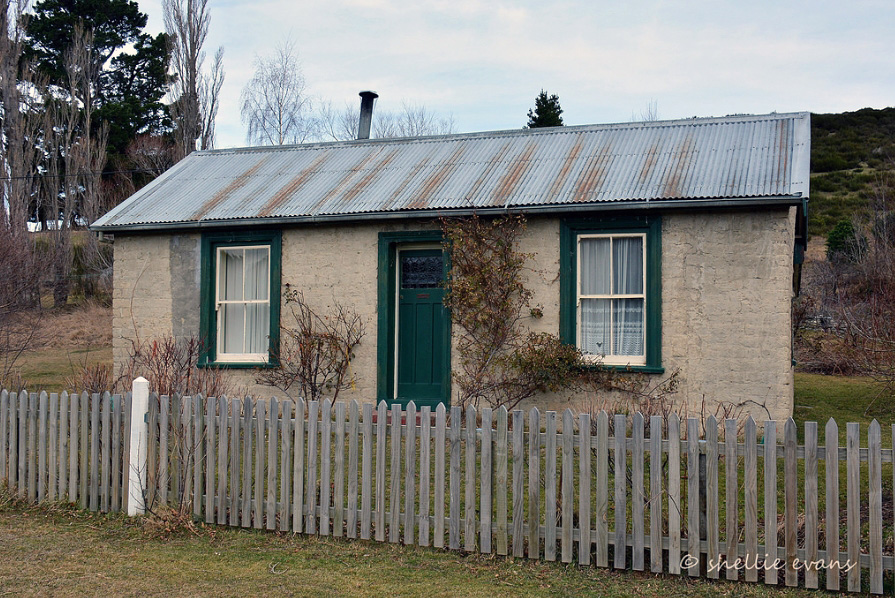
This was the home of miner Robert Swinney. The original stone cottage is encased in later alterations which have seen the house rough-cast and the roofline altered. Robert Swinney died in 1917 and his wife Mary lived in the cottage. On her death in 1960, son Herb Seddon Swinney purchased the freehold of the residence area. He lived in the cottage until his death in 1981. Early photographs show a single gabled stone cottage with a mud brick lean-to to the east elevation. Robert’s daughter Violetta married Albert McGregor and lived in William Gay’s cottage.
William Swinney’s House (Former)
This small corrugated iron cottage was the home of miner William Swinney. Its corrugated iron and timber construction was typical of the first residences built by miners at Cambrians. In the 1879 electoral roll William Swinney is described as having a house of timber and iron.
In the 1990s, the house was used as a garage. Inside were the remains of a ‘concave tongue and groove ceiling and some original wallpapers, hung on sacking which has been stretched over the corrugated iron. At least one old wooden fire surround remains and one six-light sash window, albeit in an advanced stage of decay.’
In 2014, Swinney’s old house is unoccupied.
William Gay’s House (Former)
This small mudbrick cottage was the home of miner William Gay. Gay lived in Cambrians from at least the early 1870s. The first reference to Gay in the Otago Nominal Index is in 1871. The first reference to his residence is to a ‘sod and iron house’ on leasehold land in the electoral roll of 1876-1877.
Land records confirm that this section was granted to William Gay in August 1920 and that the section was assigned to Violetta McGregor in October 1929. Gay probably lived there before 1920, but it seems that many of the miner’s residences had no record of their tenure. The land was first surveyed in the 1930s.
The next owners of the house were Albert (Bert) and Violetta McGregor. Bert McGregor was the son of Frank McGregor whose family lived across the road. Violetta sold the property to Dunedin factory foreman Allan Anderson and wife Audrey in 1973.
In 2014, Gay’s old house remains a private residence.
Dungey Cottage Ruin (McGregor Residence (Former))
This ruin was the home of miner Caleb Dongee (variously spelt Dungey, Dungee). Caleb Dongee had a coal lease in Welshman’s Gully in the 1870s, and applied for a residence area in 1871.
Later it became the home of Frank McGregor and his family.
In the 1930s the residence site license 4501, described as ‘one acre Crown lands situate north end of Cambrians and adjoining Main Road’ was granted to Helen Macgregor. It was granted in 1924 for a 42-year term.
It is likely that the house fell into a ruined state when the roof iron was removed, probably during the Second World War.