

Meldrum was born in 1842, at New Deer, Aberdeenshire, Scotland, and served his apprenticeship in Fraserborough. He arrived in Port Chalmers in 1874, aboard the Invercargill, and came direct to Oamaru, where he worked at his trade before establishing his own business. Andrew Meldrum went into business as a baker in 1879.
Architectural historian Conal McCarthy attributes the design of the bakehouse to Forrester and Lemon on stylistic grounds. John Lemon does advertise for tenders for the ‘Erection of a Baker’s Oven and Bakehouse’ in July 1880, so a Forrester and Lemon design is entirely possible.
Meldrum lived and worked on Usk Street, with his premises consisting of a shop and bakehouse, and residence and out buildings, all built of Oamaru stone. He conducted ‘a considerable local trade in bread and biscuits.’ He was involved in public affairs, and was for thirteen years a member of the North school committee, and was one of the managers of St. Paul's Presbyterian Church. Mr. Meldrum was married in 1865 to Helen Davidson of Aden, Old Deer, Aberdeenshire. The couple had six sons and four daughters.
Helen Meldrum died in 1918, and Andrew Meldrum died in August 1919. The couple’s son Norman took over the bakery. It is not clear for how long the bakery operated, but the property remained in the Meldrum family until 1979. The bakery was subdivided from the house in 1942. The subdivision plan shows what is presumably the stone house set back from the street and the long narrow stone structure to the street front. Photographs indicate that the ovens were at the rear of the bakehouse.
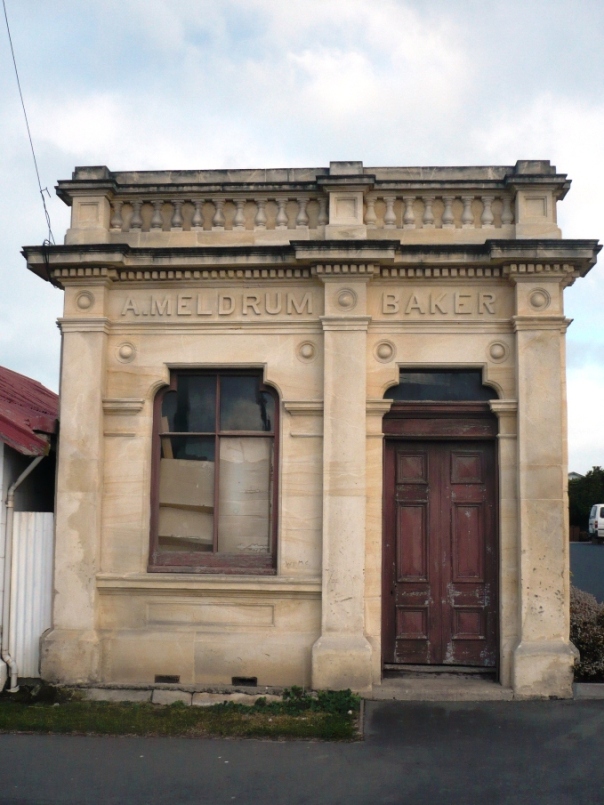
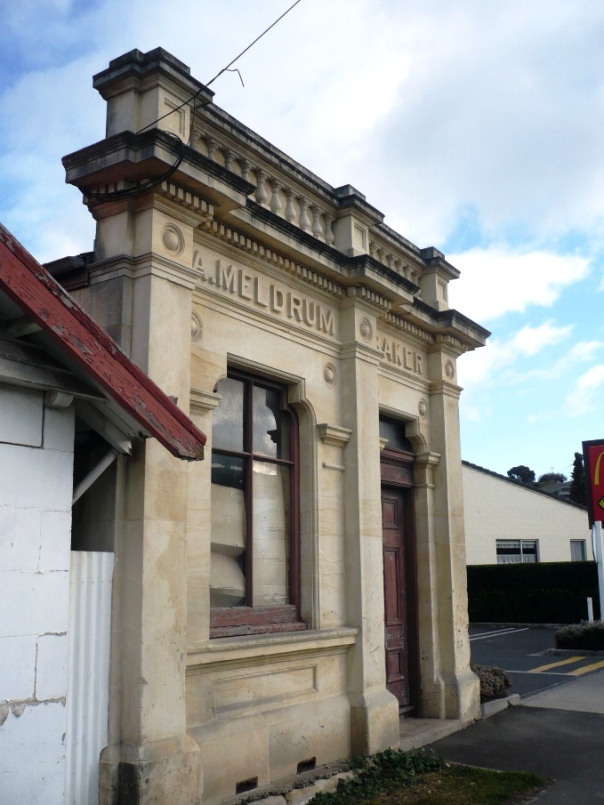
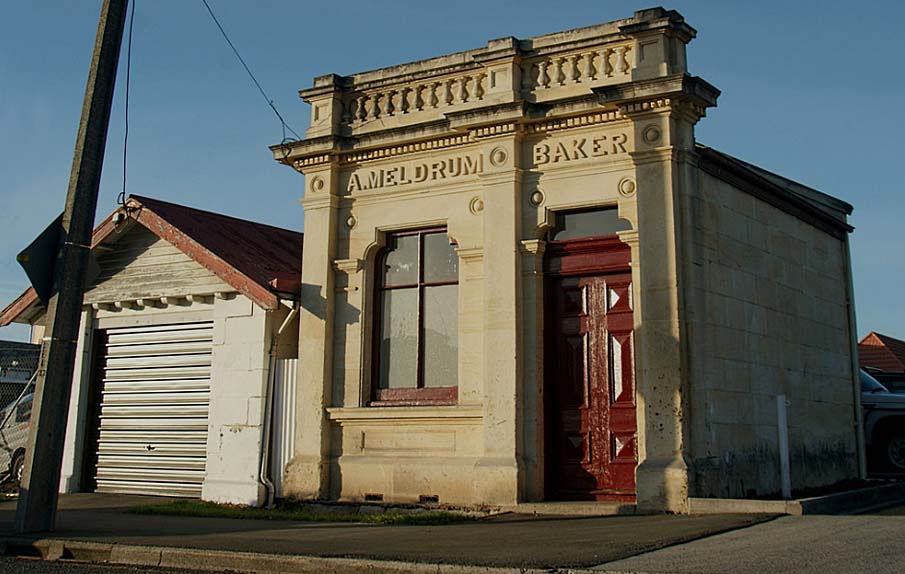
McDonalds Restaurant bought the section in 1995, demolishing the rear half of the bakery, including the ovens. Only the front part of this building, facing Usk Street, now remains of Andrew Meldrum's premises. The name of the business "A Meldrum Baker" appears in relief on the structure. Historian Gavin McLean describes the building as "the spruce but sad stump of Meldrum's Bakery . . . butchered to provide access to a fast-food carpark".
In 2015, the former Meldrum Bakehouse continues to catch the eye of passers-by, a small and unoccupied building.
List Entry Information
Status
Listed
List Entry Status
Historic Place Category 2
Access
Private/No Public Access
List Number
3218
Date Entered
7th April 1983
Date of Effect
7th April 1983
City/District Council
Waitaki District
Region
Otago Region
Extent of List Entry
Extent includes part of the land described as Lot 2 DP 5699 (RT OT17A/1172), Otago Land District, and the building known as Meldrum’s Bakehouse (Former) thereon. (Refer to the extent map tabled at the Heritage List/ Rārangi Kōrero Committee meeting on 11 February 2016).
Legal description
Lot 2 DP 5699 (RT OT17A/1172), Otago Land District
Status
Listed
List Entry Status
Historic Place Category 2
Access
Private/No Public Access
List Number
3218
Date Entered
7th April 1983
Date of Effect
7th April 1983
City/District Council
Waitaki District
Region
Otago Region
Extent of List Entry
Extent includes part of the land described as Lot 2 DP 5699 (RT OT17A/1172), Otago Land District, and the building known as Meldrum’s Bakehouse (Former) thereon. (Refer to the extent map tabled at the Heritage List/ Rārangi Kōrero Committee meeting on 11 February 2016).
Legal description
Lot 2 DP 5699 (RT OT17A/1172), Otago Land District
Construction Professional
Name
Forrester & Lemon
Type
Architectural Partnership
Biography
The architectural partnership of Forrester and Lemon was established in Oamaru in 1872. Thomas Forrester (1838-1907) was born in Glasgow and educated at the Glasgow School of Art. Emigrating to New Zealand in 1861 he settled in Dunedin and worked under William Mason (1810-97) and William Henry Clayton (1823-77) and later Robert Arthur Lawson (1833-1902). In 1865 he superintended the Dunedin Exhibition and from 1870 he became involved with the supervision of harbour works. Some time after 1885 he became Engineer to the Oamaru Harbour Board and in this capacity designed the repairs to the breakwater following storm damage in 1886 and later the Holmes Wharf. On his death in 1907 he was still in the employ of the Harbour Board. John Lemon (1828-1890) was born in Jamaica and travelled to England before emigrating to New Zealand in 1849. He settled in Oamaru in 1860 and with his brother Charles established a timber merchant's business. By 1869 he was in partnership with his father-in-law, George Sumpter calling themselves "Timber and General Merchants, Land and Commission Agents". This partnership was dissolved in 1872 and Lemon entered into partnership with Forrester. Lemon had no architectural experience at all, but had a wide circle of business contacts and was an efficient administrator. Buildings designed by the partnership of Forrester and Lemon include St Paul's Church (1875-76), the Harbour Board Offices (1876), Queen's (later Brydone) Hotel (1881), Waitaki Boys' High School (1883), The Courthouse (1883) and the Post Office (1883-84), all in Oamaru. Forrester and Lemon contributed greatly to Oamaru's nineteenth century character. On Lemon's death in 1890 the practice was taken over by Forrester's son, John Megget Forrester (1865-1965).
Construction Details
Start Year
1880
startYearCirca
Type
Original Construction
Start Year
1995
startYearCirca
Type
Partial Demolition
Description
Rear of bakehouse demolished
Construction Professional
Name
Forrester & Lemon
Type
Architectural Partnership
Biography
The architectural partnership of Forrester and Lemon was established in Oamaru in 1872. Thomas Forrester (1838-1907) was born in Glasgow and educated at the Glasgow School of Art. Emigrating to New Zealand in 1861 he settled in Dunedin and worked under William Mason (1810-97) and William Henry Clayton (1823-77) and later Robert Arthur Lawson (1833-1902). In 1865 he superintended the Dunedin Exhibition and from 1870 he became involved with the supervision of harbour works. Some time after 1885 he became Engineer to the Oamaru Harbour Board and in this capacity designed the repairs to the breakwater following storm damage in 1886 and later the Holmes Wharf. On his death in 1907 he was still in the employ of the Harbour Board. John Lemon (1828-1890) was born in Jamaica and travelled to England before emigrating to New Zealand in 1849. He settled in Oamaru in 1860 and with his brother Charles established a timber merchant's business. By 1869 he was in partnership with his father-in-law, George Sumpter calling themselves "Timber and General Merchants, Land and Commission Agents". This partnership was dissolved in 1872 and Lemon entered into partnership with Forrester. Lemon had no architectural experience at all, but had a wide circle of business contacts and was an efficient administrator. Buildings designed by the partnership of Forrester and Lemon include St Paul's Church (1875-76), the Harbour Board Offices (1876), Queen's (later Brydone) Hotel (1881), Waitaki Boys' High School (1883), The Courthouse (1883) and the Post Office (1883-84), all in Oamaru. Forrester and Lemon contributed greatly to Oamaru's nineteenth century character. On Lemon's death in 1890 the practice was taken over by Forrester's son, John Megget Forrester (1865-1965).
Construction Details
Start Year
1880
startYearCirca
Type
Original Construction
Start Year
1995
startYearCirca
Type
Partial Demolition
Description
Rear of bakehouse demolished
Historical and Associated Iwi / Hapū / Whānau
Completion Date
2nd December 2015
Report Written By
Heather Bauchop
Information Sources
McCarthy, 2002
Conal McCarthy, Forrester and Lemon of Oamaru, architects, Oamaru, 2002
McLean, 2002
Gavin McLean, Oamaru History & Heritage, University of Otago Press, Dunedin, 2002
Other Information
This place was identified as significant under previous legislation with different information requirements. It remains significant under the current legislation. There is opportunity under our legislation and policies to add to this information. Further information about this place may be available from the Otago/Southland Office of Heritage New Zealand Pouhere Taonga. Please note that entry on the New Zealand Heritage List/Rarangi Korero identifies only the heritage values of the property concerned, and should not be construed as advice on the state of the property, or as a comment of its soundness or safety, including in regard to earthquake risk, safety in the event of fire, or insanitary conditions. A fully referenced upgrade report is available on request from the Otago/Southland Office of Heritage New Zealand
Historical and Associated Iwi / Hapū / Whānau
Completion Date
2nd December 2015
Report Written By
Heather Bauchop
Information Sources
McCarthy, 2002
Conal McCarthy, Forrester and Lemon of Oamaru, architects, Oamaru, 2002
McLean, 2002
Gavin McLean, Oamaru History & Heritage, University of Otago Press, Dunedin, 2002
Other Information
This place was identified as significant under previous legislation with different information requirements. It remains significant under the current legislation. There is opportunity under our legislation and policies to add to this information. Further information about this place may be available from the Otago/Southland Office of Heritage New Zealand Pouhere Taonga. Please note that entry on the New Zealand Heritage List/Rarangi Korero identifies only the heritage values of the property concerned, and should not be construed as advice on the state of the property, or as a comment of its soundness or safety, including in regard to earthquake risk, safety in the event of fire, or insanitary conditions. A fully referenced upgrade report is available on request from the Otago/Southland Office of Heritage New Zealand
Current Usages
Uses: Vacant
Specific Usage: Vacant
Former Usages
General Usage: Manufacturing
Specific Usage: Bakery
Current Usages
Uses: Vacant
Specific Usage: Vacant
Former Usages
General Usage: Manufacturing
Specific Usage: Bakery
Location
Sign up to hear more
Get the latest heritage news, features and events delivered
straight to your inbox.
