Quick links


Quick links
Quick links
Quick links
Quick links
Quick links
Star and Garter Hotel (Former)
13-17 Itchen Street, OAMARU
Private
Historic Place Category 1
List No. 3219
Quick links:
List GalleryLocationDetails
13-17 Itchen Street, OAMARU
Private
Historic Place Category 1
List No. 3219
List Entry Information
Status
Listed
List Entry Status
Historic Place Category 1
Access
Private/No Public Access
List Number
3219
Date Entered
22nd August 1991
Date of Effect
22nd August 1991
City/District Council
Waitaki District
Region
Otago Region
Extent of List Entry
Extent includes the land described as Pt Lot 2 (RT OT194/26), and part of the land described as Pt Lot 2 and Lots 3-7 DP 2633 (OT194/27), Otago Land District, and the buildings associated with the Star and Garter Hotel (Former) thereon. (Refer to the extent map tabled at the Heritage List / Rārangi Kōrero Committee meeting on 12 November 2015).
Legal description
Pt Lot 2 (RT OT194/26), Pt Lot 2 and Lots 3-7 DP 2633 (OT194/27), Otago Land District
Status
Listed
List Entry Status
Historic Place Category 1
Access
Private/No Public Access
List Number
3219
Date Entered
22nd August 1991
Date of Effect
22nd August 1991
City/District Council
Waitaki District
Region
Otago Region
Extent of List Entry
Extent includes the land described as Pt Lot 2 (RT OT194/26), and part of the land described as Pt Lot 2 and Lots 3-7 DP 2633 (OT194/27), Otago Land District, and the buildings associated with the Star and Garter Hotel (Former) thereon. (Refer to the extent map tabled at the Heritage List / Rārangi Kōrero Committee meeting on 12 November 2015).
Legal description
Pt Lot 2 (RT OT194/26), Pt Lot 2 and Lots 3-7 DP 2633 (OT194/27), Otago Land District
Why is this place significant?
Historic Significance
Historical Significance or Value Occupying the site of Oamaru's first accommodation house, the Star and Garter operated as a hotel for 47 years (1867-1914). The building also incorporated a Masonic Hall (later Lyric Hall) which has catered for live entertainment since it was built. It continues to operate in that function as a repertory theatre.
Physical Significance
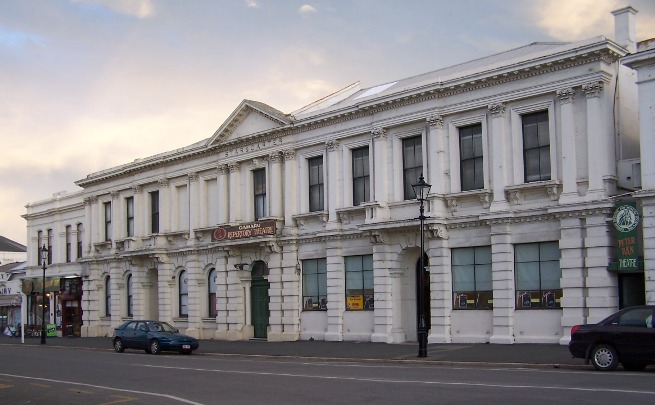
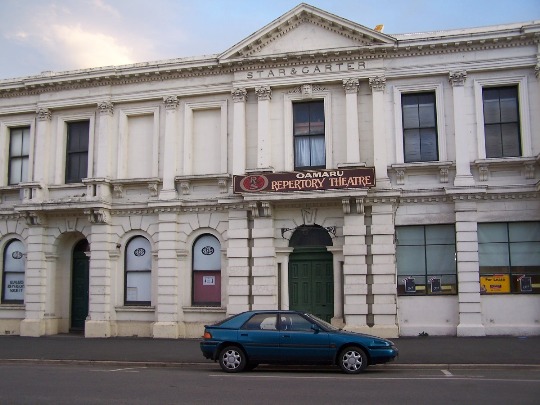
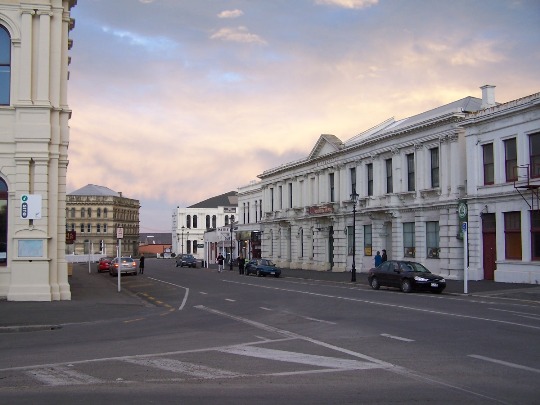
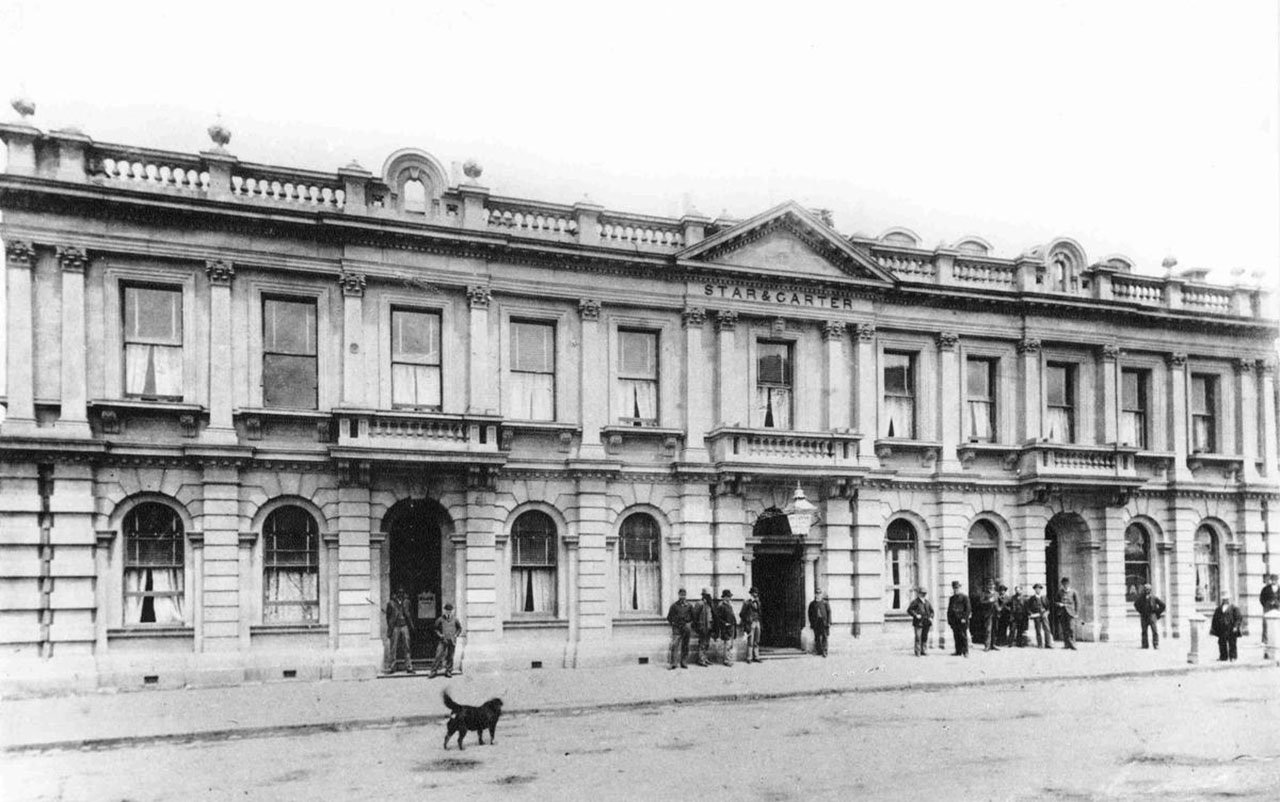
ARCHITECTURAL QUALITY: While the interior was rebuilt following a fire in 1915, the exterior of the Star and Garter is a good example of Victorian Italianate architecture other than the windows which have been replaced. While the Italianate style was used repeatedly for commercial buildings in New Zealand, this building is distinguished by its Oamaru stone construction and long, symmetrical facade. It is also a significant part of the Harbour/Tyne Street conservation area, New Zealand's most important collection of Victorian streetscapes. TOWNSCAPE/LANDMARK VALUE: The Star and Garter is a prominent building, its facade dominating the Itchen Street streetscape.
Why is this place significant?
Historic Significance
Historical Significance or Value Occupying the site of Oamaru's first accommodation house, the Star and Garter operated as a hotel for 47 years (1867-1914). The building also incorporated a Masonic Hall (later Lyric Hall) which has catered for live entertainment since it was built. It continues to operate in that function as a repertory theatre.
Physical Significance
ARCHITECTURAL QUALITY: While the interior was rebuilt following a fire in 1915, the exterior of the Star and Garter is a good example of Victorian Italianate architecture other than the windows which have been replaced. While the Italianate style was used repeatedly for commercial buildings in New Zealand, this building is distinguished by its Oamaru stone construction and long, symmetrical facade. It is also a significant part of the Harbour/Tyne Street conservation area, New Zealand's most important collection of Victorian streetscapes. TOWNSCAPE/LANDMARK VALUE: The Star and Garter is a prominent building, its facade dominating the Itchen Street streetscape.
Construction Professional
Name
Macdonald and Searle
Type
Builder
Biography
No biography is currently available for this construction professional
Name
Lawson, Robert Arthur
Type
Architect
Biography
Born in Scotland, Lawson (1833-1902) began his professional career in Perth. At the age of 25 he moved to Melbourne and was engaged in goldmining and journalism before resuming architectural practice. In 1862 Lawson sailed for Dunedin, where his sketch plans had won the competition for the design of First Church. This was built 1867-73. Lawson went on to become one of the most important architects in New Zealand. First Church is regarded as his masterpiece and one of the finest nineteenth century churches in New Zealand. He was also responsible for the design of the Trinity Church (now Fortune Theatre), Dunedin (1869-70), the East Taieri Presbyterian Church (1870), and Knox Church, Dunedin (1874). He designed Park's School (1864) and the ANZ Bank (originally Union Bank, 1874). In Oamaru he designed the Bank of Otago (later National Bank building, 1870) and the adjoining Bank of New South Wales (now Forrester Gallery, 1881). See also: Ledgerwood, Norman, 2013. 'R.A. Lawson: Victorian Architect of Dunedin'. Historic Cemeteries Conservation NZ.
Construction Details
Start Year
1866
Finish Year
1868
Type
Original Construction
Start Year
1876
startYearCirca
Type
Modification
Description
Masonic hall converted to bedrooms.
Start Year
1915
Type
Modification
Description
Interior rebuilt following fire.
Type
Modification
Description
Parapet removed. Balustrading of first floor balconies removed. Two first floor windows boarded over. Four ground floor arched windows replaced.
Start Year
1867
Type
Other
Description
Masonic Hall opened
Start Year
1915
Type
Damaged
Description
ire closes hotel
Construction Materials
Oamaru stone masonry. Roof clad with corrugated steel.
Notable Features
Oamaru stone details including corbels, capitals, architraves and rustication. Spikes at sill height of ground floor arched windows.
Construction Professional
Name
Macdonald and Searle
Type
Builder
Biography
No biography is currently available for this construction professional
Name
Lawson, Robert Arthur
Type
Architect
Biography
Born in Scotland, Lawson (1833-1902) began his professional career in Perth. At the age of 25 he moved to Melbourne and was engaged in goldmining and journalism before resuming architectural practice. In 1862 Lawson sailed for Dunedin, where his sketch plans had won the competition for the design of First Church. This was built 1867-73. Lawson went on to become one of the most important architects in New Zealand. First Church is regarded as his masterpiece and one of the finest nineteenth century churches in New Zealand. He was also responsible for the design of the Trinity Church (now Fortune Theatre), Dunedin (1869-70), the East Taieri Presbyterian Church (1870), and Knox Church, Dunedin (1874). He designed Park's School (1864) and the ANZ Bank (originally Union Bank, 1874). In Oamaru he designed the Bank of Otago (later National Bank building, 1870) and the adjoining Bank of New South Wales (now Forrester Gallery, 1881). See also: Ledgerwood, Norman, 2013. 'R.A. Lawson: Victorian Architect of Dunedin'. Historic Cemeteries Conservation NZ.
Construction Details
Start Year
1866
Finish Year
1868
Type
Original Construction
Start Year
1876
startYearCirca
Type
Modification
Description
Masonic hall converted to bedrooms.
Start Year
1915
Type
Modification
Description
Interior rebuilt following fire.
Type
Modification
Description
Parapet removed. Balustrading of first floor balconies removed. Two first floor windows boarded over. Four ground floor arched windows replaced.
Start Year
1867
Type
Other
Description
Masonic Hall opened
Start Year
1915
Type
Damaged
Description
ire closes hotel
Construction Materials
Oamaru stone masonry. Roof clad with corrugated steel.
Notable Features
Oamaru stone details including corbels, capitals, architraves and rustication. Spikes at sill height of ground floor arched windows.
ARCHITECTURAL DESCRIPTION: This two-storeyed building with basement below is Victorian Italianate in style and the street (north) facade is symmetrical about a pedimented entrance bay. The entrance consists of double doors with a circular column on either side bridged by a round arch. Each column is flanked by a pair of rusticated pilasters, the inner ones with two corbels supporting a dentilled stringcourse. At first floor this central bay has one double-hung sash window with a carved stone face fixed to the centre of the moulded architrave. The window is flanked by a pair of Corinthian pilasters on either side, directly above the rusticated pilasters at ground floor level. The inner pilasters have pedestals corresponding to the corbels below. Above this arrangement is a moulded architrave, a frieze with the inscription "STAR & GARTER", a cornice with dentils and modillions and a pediment which originally formed the central section of a parapet. The parapet, consisting of a series of carved stone urns, has been removed. On either side of this central bay the street facade has a series of five similar bays. The ground floor is rusticated and of the five bays, the central one incorporates an entrance while the other four originally had a single round headed window. These windows are still in place on the east side but have been replaced with simple square-headed ones on the west side. Those on the east side have spikes at sill height to dissuade loiterers. At first floor level each of the ten bays has a single square-headed window with a Corinthian pilaster between. Two windows on the east side have been boarded over. At either end of the facade is a pair of rusticated pilasters at ground floor level and a pair of Corinthian pilasters at first floor level. The interior of the building has been considerably altered. MODIFICATIONS: c.1876 - Masonic hall converted to bedrooms. 1915 - Interior rebuilt following fire. Dates not known: - Parapet removed - Balustrading of first floor balconies removed - Two first floor windows boarded over - Four ground floor arched windows replaced
ARCHITECTURAL DESCRIPTION: This two-storeyed building with basement below is Victorian Italianate in style and the street (north) facade is symmetrical about a pedimented entrance bay. The entrance consists of double doors with a circular column on either side bridged by a round arch. Each column is flanked by a pair of rusticated pilasters, the inner ones with two corbels supporting a dentilled stringcourse. At first floor this central bay has one double-hung sash window with a carved stone face fixed to the centre of the moulded architrave. The window is flanked by a pair of Corinthian pilasters on either side, directly above the rusticated pilasters at ground floor level. The inner pilasters have pedestals corresponding to the corbels below. Above this arrangement is a moulded architrave, a frieze with the inscription "STAR & GARTER", a cornice with dentils and modillions and a pediment which originally formed the central section of a parapet. The parapet, consisting of a series of carved stone urns, has been removed. On either side of this central bay the street facade has a series of five similar bays. The ground floor is rusticated and of the five bays, the central one incorporates an entrance while the other four originally had a single round headed window. These windows are still in place on the east side but have been replaced with simple square-headed ones on the west side. Those on the east side have spikes at sill height to dissuade loiterers. At first floor level each of the ten bays has a single square-headed window with a Corinthian pilaster between. Two windows on the east side have been boarded over. At either end of the facade is a pair of rusticated pilasters at ground floor level and a pair of Corinthian pilasters at first floor level. The interior of the building has been considerably altered. MODIFICATIONS: c.1876 - Masonic hall converted to bedrooms. 1915 - Interior rebuilt following fire. Dates not known: - Parapet removed - Balustrading of first floor balconies removed - Two first floor windows boarded over - Four ground floor arched windows replaced
Historical and Associated Iwi / Hapū / Whānau
Public NZAA Number
J41/306
Completion Date
5th August 2015
Report Written By
Heather Bauchop
Information Sources
Cyclopedia of New Zealand, 1905
Cyclopedia Company, Industrial, descriptive, historical, biographical facts, figures, illustrations, Wellington, N.Z, 1897-1908, Vol. 4 Otago and Southland, Cyclopedia Company, Christchurch, 1905
Land Information New Zealand (LINZ)
Land Information New Zealand
McDonald, 1962
K C McDonald, 'White Stone Country', Oamaru, 1962
North Otago Times
North Otago Times
Oamaru Mail
22 Mar 1882, p. 2.
Syd Muirhead Collection
Syd Muirhead Collection, Oamaru (Copy held at NZHPT)
Ledgerwood (2013)
Norman Ledgerwood, R.A. Lawson: Victorian Architect of Dunedin, Historic Cemeteries Conservation Trust of New Zealand, Dunedin, 2013
Other Information
This registration is also included in the Harbour/Tyne Street Historic Area (Record no. 7064). This historic place was registered under the Historic Places Act 1980. This report includes the text from the original Building Classification Committee report considered by the NZHPT Board at the time of registration. Please note that entry on the New Zealand Heritage List/Rarangi Korero identifies only the heritage values of the property concerned, and should not be construed as advice on the state of the property, or as a comment of its soundness or safety, including in regard to earthquake risk, safety in the event of fire, or insanitary conditions. A fully referenced upgrade report is available on request from the Otago/Southland Office of Heritage New Zealand
Historical and Associated Iwi / Hapū / Whānau
Public NZAA Number
J41/306
Completion Date
5th August 2015
Report Written By
Heather Bauchop
Information Sources
Cyclopedia of New Zealand, 1905
Cyclopedia Company, Industrial, descriptive, historical, biographical facts, figures, illustrations, Wellington, N.Z, 1897-1908, Vol. 4 Otago and Southland, Cyclopedia Company, Christchurch, 1905
Land Information New Zealand (LINZ)
Land Information New Zealand
McDonald, 1962
K C McDonald, 'White Stone Country', Oamaru, 1962
North Otago Times
North Otago Times
Oamaru Mail
22 Mar 1882, p. 2.
Syd Muirhead Collection
Syd Muirhead Collection, Oamaru (Copy held at NZHPT)
Ledgerwood (2013)
Norman Ledgerwood, R.A. Lawson: Victorian Architect of Dunedin, Historic Cemeteries Conservation Trust of New Zealand, Dunedin, 2013
Other Information
This registration is also included in the Harbour/Tyne Street Historic Area (Record no. 7064). This historic place was registered under the Historic Places Act 1980. This report includes the text from the original Building Classification Committee report considered by the NZHPT Board at the time of registration. Please note that entry on the New Zealand Heritage List/Rarangi Korero identifies only the heritage values of the property concerned, and should not be construed as advice on the state of the property, or as a comment of its soundness or safety, including in regard to earthquake risk, safety in the event of fire, or insanitary conditions. A fully referenced upgrade report is available on request from the Otago/Southland Office of Heritage New Zealand
Current Usages
Uses: Civic Facilities
Specific Usage: Theatre
Former Usages
General Usage: Accommodation
Specific Usage: Hotel
General Usage: Civic Facilities
Specific Usage: Pub/bar/tavern/public hotel
Current Usages
Uses: Civic Facilities
Specific Usage: Theatre
Former Usages
General Usage: Accommodation
Specific Usage: Hotel
General Usage: Civic Facilities
Specific Usage: Pub/bar/tavern/public hotel
Location
Get the latest heritage news, features and events delivered
straight to your inbox.