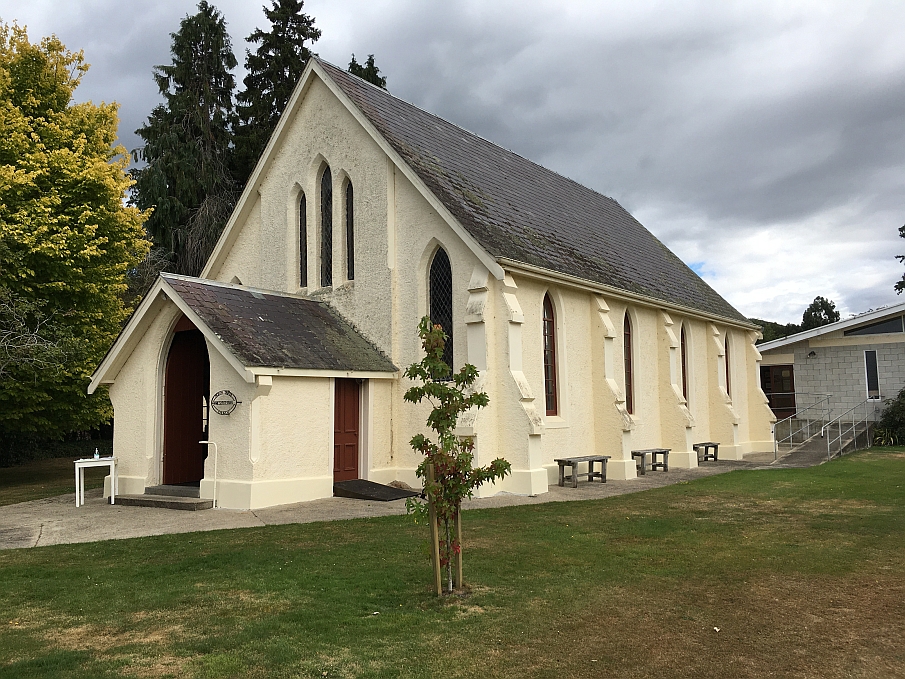
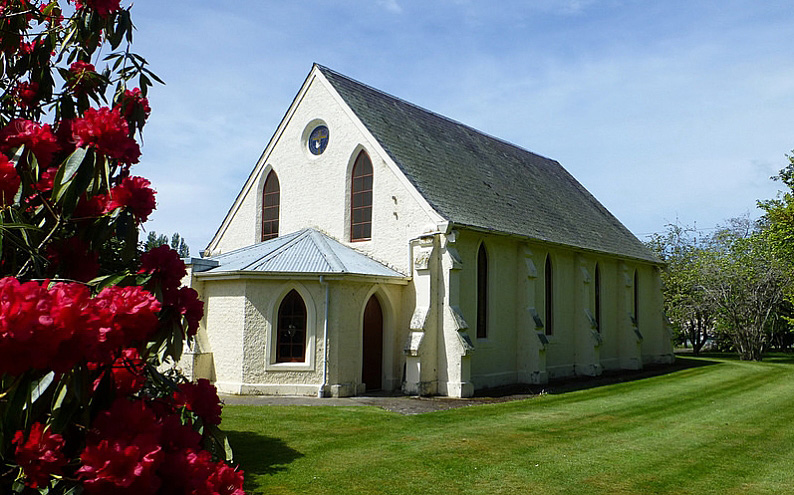
Late in 1866 the new management committee decided to build a new church. R.A. Lawson of Dunedin was the architect, and William Smith the builder; the construction cost about ₤700. North Taieri Presbyterian Church is one of Lawson's simplest designs, befitting a small country parish. Its simplicity gives it a certain charm and, as historian of church buildings Charles Croot has noted, its "pleasing proportions and attractive lancet windows mark it as yet another successful design by R.A. Lawson."
Unfortunately, like other buildings designed by Lawson, the church had structural faults, and most of the alterations made since its original construction have resulted from these. Early photographs show a belfry atop the gable but this was removed. The date of its removal is unknown, but it is not present in photographs dating from the 1910s, when the gable is instead topped with a Celtic cross.
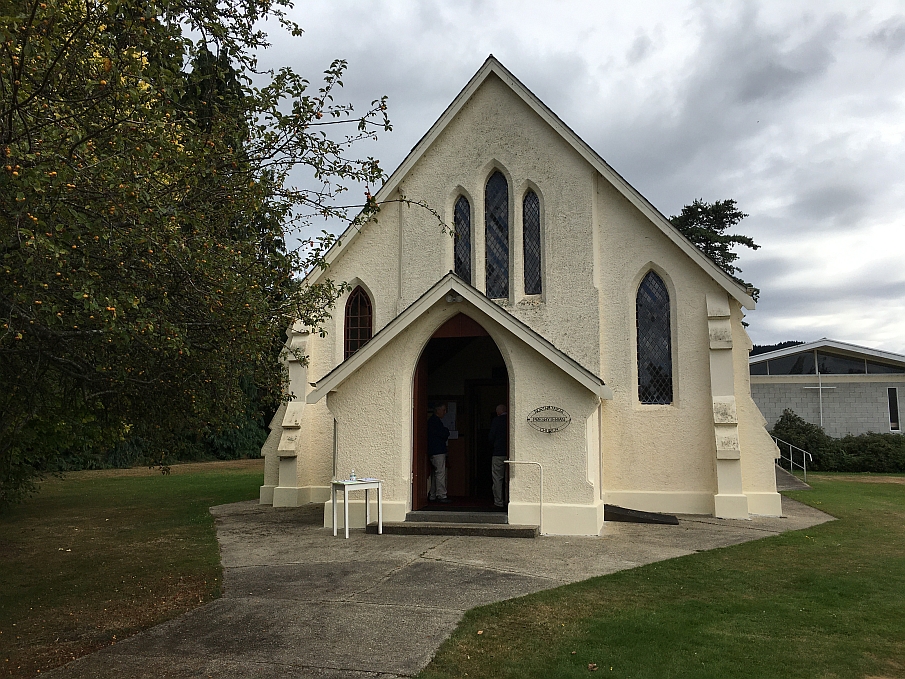
In 1930 the parish undertook extensive renovations. The ivy which liberally covered the church was removed: it had damaged the soft brickwork and grown through the joints, staining the interior walls. The exterior walls were then plastered. There were problems with the roof leaking, and in 1946, to prevent further water damage the eaves were lengthened, to increase the overhang. It was probably at this time that the parapets and cross were removed from the gable, thus allowing for the eaves to also extend over the front wall of the church.
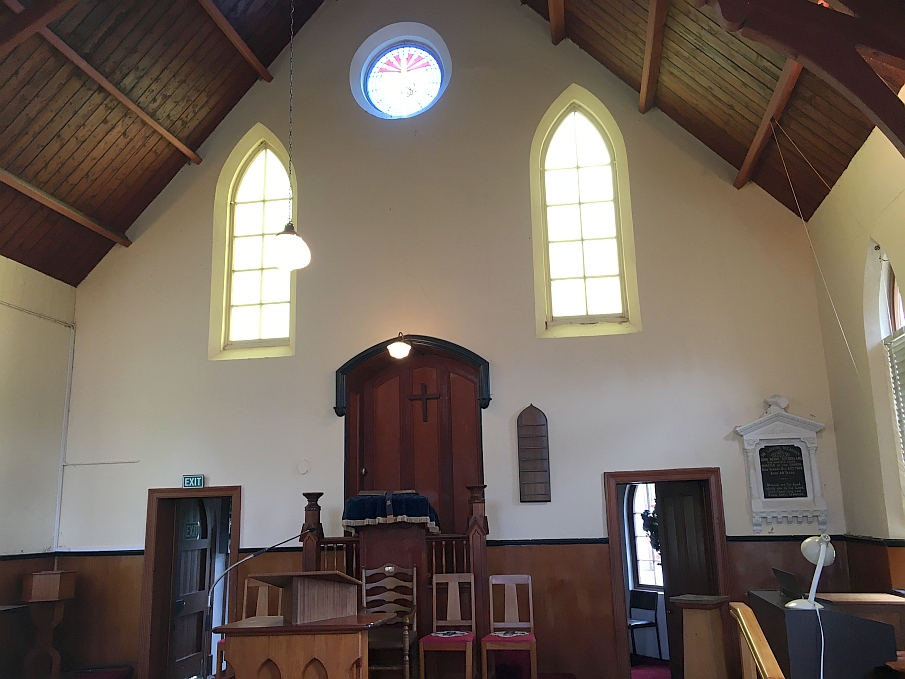
Apart from these changes, the church today differs very little from the original. It remains much as it was when the residents of North Taieri first worshipped there in 1867. Minor changes to the interior include alterations to the choir stalls in the 1930s, and their later removal. In the early 1990s the plain circular window above the pulpit was replaced with a stained-glass window featuring a dove flying in front of a cross.
There have been significant changes to the parish over the years. In the 1870s settlement grew rapidly at Mosgiel, centred on the woollen mill. The North Taieri parish started a preaching station there in 1873 and in 1885 Mosgiel became a separate parish. In the 1920s the North Taieri charge was downgraded to a mission station and in 1965 it merged with Mosgiel to form the Mosgiel-North Taieri Parish.
At this point the parish sold the adjacent manse and the bulk of their original ten acres of land, retaining just over one acre. Proceeds of the sale helped fund the building of a hall adjacent to the church. Probably the most notable historic figure to have a close association with the church was Donald Reid, who donated the land whereon it was built and served as one of the first elders. Reid, who came to Otago from Scotland as a child, rose from small beginnings to become a large landowner, politician and businessman, founding the stock and station agency which still bears his name. He made his home in North Taieri for 56 years. There is a plaque remembering Donald Reid in the church, and also a memorial plaque for Rev J.M. Sutherland, minister from 1874 to 1893. The porch features a plaque noting significant dates in the church's history and some historic photographs.

List Entry Information
Status
Listed
List Entry Status
Historic Place Category 2
Access
Private/No Public Access
List Number
3234
Date Entered
14th April 2005
Date of Effect
14th April 2005
City/District Council
Dunedin City
Region
Otago Region
Extent of List Entry
Registration includes the land, building, fixtures and fittings in Certificate of Title OT2C/326. The registration applies to the North Taieri Presbyterian Church only, and not to the hall which is also on this section (See plan in Appendix 4 of registration report).
Legal description
Pt Sec 11 Blk XV East Taieri District (RT OT2C/326), Otago Land District
Status
Listed
List Entry Status
Historic Place Category 2
Access
Private/No Public Access
List Number
3234
Date Entered
14th April 2005
Date of Effect
14th April 2005
City/District Council
Dunedin City
Region
Otago Region
Extent of List Entry
Registration includes the land, building, fixtures and fittings in Certificate of Title OT2C/326. The registration applies to the North Taieri Presbyterian Church only, and not to the hall which is also on this section (See plan in Appendix 4 of registration report).
Legal description
Pt Sec 11 Blk XV East Taieri District (RT OT2C/326), Otago Land District
Why is this place significant?
Historic Significance
Historical Significance or Value In 1966 R.T. Dodds described it as "a comely, simple, dignified house of God set in a bieldy [sheltered] place"; and it remains so today. The simple elegance of the building is a monument to the skills of its architect, R.A. Lawson, generally remembered for his larger and more ornate designs. The oldest surviving church building on the Taieri, it is still used, as it has been continuously since 1867, for Presbyterian worship. It reflects the simple sober style of nineteenth century Presbyterianism. It stands as a reminder of the significance of Presbyterianism to the development of the Taieri, and Otago as a whole.
Why is this place Category 1 / Category 2?
Detail Of Assessed Criteria
(a) The North Taieri Presbyterian Church is representative of the significance of Christianity, and more specifically Presbyterianism, in colonial Otago. It has survived without major changes since 1867, and as such stands as a fine example of the simple and sober style of mid-nineteenth century Presbyterian spirituality. It is the oldest surviving church on the Taieri. (e) It has been valued by its congregation and the local community for over 130 years. (g) The building was designed by noted Victorian architect R.A. Lawson. While Lawson is best known for his ornate Gothic revival churches, this church demonstrates his versatility in creating a design for a simple country church.
Why is this place significant?
Historic Significance
Historical Significance or Value In 1966 R.T. Dodds described it as "a comely, simple, dignified house of God set in a bieldy [sheltered] place"; and it remains so today. The simple elegance of the building is a monument to the skills of its architect, R.A. Lawson, generally remembered for his larger and more ornate designs. The oldest surviving church building on the Taieri, it is still used, as it has been continuously since 1867, for Presbyterian worship. It reflects the simple sober style of nineteenth century Presbyterianism. It stands as a reminder of the significance of Presbyterianism to the development of the Taieri, and Otago as a whole.
Why is this place Category 1 / Category 2?
Detail Of Assessed Criteria
(a) The North Taieri Presbyterian Church is representative of the significance of Christianity, and more specifically Presbyterianism, in colonial Otago. It has survived without major changes since 1867, and as such stands as a fine example of the simple and sober style of mid-nineteenth century Presbyterian spirituality. It is the oldest surviving church on the Taieri. (e) It has been valued by its congregation and the local community for over 130 years. (g) The building was designed by noted Victorian architect R.A. Lawson. While Lawson is best known for his ornate Gothic revival churches, this church demonstrates his versatility in creating a design for a simple country church.
Construction Professional
Name
Smith, William
Type
Builder
Biography
No biography is currently available for this construction professional
Name
Lawson, Robert Arthur
Type
Architect
Biography
Born in Scotland, Lawson (1833-1902) began his professional career in Perth. At the age of 25 he moved to Melbourne and was engaged in goldmining and journalism before resuming architectural practice. In 1862 Lawson sailed for Dunedin, where his sketch plans had won the competition for the design of First Church. This was built 1867-73. Lawson went on to become one of the most important architects in New Zealand. First Church is regarded as his masterpiece and one of the finest nineteenth century churches in New Zealand. He was also responsible for the design of the Trinity Church (now Fortune Theatre), Dunedin (1869-70), the East Taieri Presbyterian Church (1870), and Knox Church, Dunedin (1874). He designed Park's School (1864) and the ANZ Bank (originally Union Bank, 1874). In Oamaru he designed the Bank of Otago (later National Bank building, 1870) and the adjoining Bank of New South Wales (now Forrester Gallery, 1881). See also: Ledgerwood, Norman, 2013. 'R.A. Lawson: Victorian Architect of Dunedin'. Historic Cemeteries Conservation NZ.
Construction Details
Start Year
1946
Type
Designed
Description
Roof extended over walls.
Start Year
1867
Type
Original Construction
Type
Modification
Description
(pre-1910, possibly much earlier) Belfry removed.
Start Year
1930
Type
Modification
Description
Exterior plastered.
Construction Materials
The original brick construction was later plastered over. The interior is also plastered, with wood panelling, ceiling and floors. The roof is of slate. The vestry has an iron roof.
Construction Professional
Name
Smith, William
Type
Builder
Biography
No biography is currently available for this construction professional
Name
Lawson, Robert Arthur
Type
Architect
Biography
Born in Scotland, Lawson (1833-1902) began his professional career in Perth. At the age of 25 he moved to Melbourne and was engaged in goldmining and journalism before resuming architectural practice. In 1862 Lawson sailed for Dunedin, where his sketch plans had won the competition for the design of First Church. This was built 1867-73. Lawson went on to become one of the most important architects in New Zealand. First Church is regarded as his masterpiece and one of the finest nineteenth century churches in New Zealand. He was also responsible for the design of the Trinity Church (now Fortune Theatre), Dunedin (1869-70), the East Taieri Presbyterian Church (1870), and Knox Church, Dunedin (1874). He designed Park's School (1864) and the ANZ Bank (originally Union Bank, 1874). In Oamaru he designed the Bank of Otago (later National Bank building, 1870) and the adjoining Bank of New South Wales (now Forrester Gallery, 1881). See also: Ledgerwood, Norman, 2013. 'R.A. Lawson: Victorian Architect of Dunedin'. Historic Cemeteries Conservation NZ.
Construction Details
Start Year
1946
Type
Designed
Description
Roof extended over walls.
Start Year
1867
Type
Original Construction
Type
Modification
Description
(pre-1910, possibly much earlier) Belfry removed.
Start Year
1930
Type
Modification
Description
Exterior plastered.
Construction Materials
The original brick construction was later plastered over. The interior is also plastered, with wood panelling, ceiling and floors. The roof is of slate. The vestry has an iron roof.
This simple brick church building lies on a flat rural site, surrounded by lawns, shrubs, and old trees. It has a simple rectangular plan, with a porch in the front and a small vestry in the rear. There are corner buttresses, with three additional buttresses of matching design along the side walls. The original belfry has been removed, as have the gable parapet and cross which replaced it. The plastered walls are painted cream. The porch in front is a smaller version of the main body of the church, with a matching slate roof. It has a lancet-shaped door at the front and another, now unused, at one side and two small lancet windows. The upper part of the interior walls is plastered, while the lower part of the wall has painted wooden panelling. From the porch, wooden doors lead into the main church. This is of rectangular plan, with steps leading to a raised platform at the front. The walls are of painted plaster, with varnished wooden panelling. Behind the central pulpit is a slightly recessed area of high wooden panelling. The floor is apparently of Baltic pine and according to congregation member Huia Ockwell its timber came to Otago from the United States as packing around cargo. The ceiling and trusses are timber. The original wooden pews sit on either side of a central aisle. The windows are lancets characteristic of Lawson's Gothic Revival designs. The side walls each have four lancets with simple timber frames. The gable at the porch end has a single lancet at each side, with three central lead-lighted lancets at a higher level all glazed with coloured glass. At the altar wall of the church, above the pulpit are two lancets with a round stained-glass window between them. On either side of the pulpit matching doors lead to the vestry; one of these doors is no longer used. The vestry is a small room with plastered walls, in the shape of half a decagon. Two of the angled walls feature lancet windows and a door on one side is also lancet-shaped.
Historical and Associated Iwi / Hapū / Whānau
Information Sources
Dodds, 1966
R. T. Dodds, The Fragrant and Fruitful Years: A Century of Presbyterianism in North Taieri, Mosgiel: North Taieri Parish, [1966].
Knight, 1993
Hardwicke Knight, Church Building in Otago, Dunedin, 1993.
Land Information New Zealand (LINZ)
Land Information New Zealand
Lemon, 1970
Daphne Lemon, Taieri Buildings: with drawings by Audrey Bascand, McIndoe Print, Dunedin, 1970
Otago Daily Times
Otago Daily Times, 1 Jun 1915, p.10.
Otago Witness
Otago Witness
Presbyterian Church Archives
Waugh, 2001
June Waugh and Hazel McAdam, Mosgiel Presbyterian Church: Celebrating 125 Years 1877-2002, 2001
Other Information
A fully referenced version of this report is available from the NZHPT Southern Region Office. Please note that entry on the New Zealand Heritage List/Rarangi Korero identifies only the heritage values of the property concerned, and should not be construed as advice on the state of the property, or as a comment of its soundness or safety, including in regard to earthquake risk, safety in the event of fire, or insanitary conditions.
Historical and Associated Iwi / Hapū / Whānau
Information Sources
Dodds, 1966
R. T. Dodds, The Fragrant and Fruitful Years: A Century of Presbyterianism in North Taieri, Mosgiel: North Taieri Parish, [1966].
Knight, 1993
Hardwicke Knight, Church Building in Otago, Dunedin, 1993.
Land Information New Zealand (LINZ)
Land Information New Zealand
Lemon, 1970
Daphne Lemon, Taieri Buildings: with drawings by Audrey Bascand, McIndoe Print, Dunedin, 1970
Otago Daily Times
Otago Daily Times, 1 Jun 1915, p.10.
Otago Witness
Otago Witness
Presbyterian Church Archives
Waugh, 2001
June Waugh and Hazel McAdam, Mosgiel Presbyterian Church: Celebrating 125 Years 1877-2002, 2001
Other Information
A fully referenced version of this report is available from the NZHPT Southern Region Office. Please note that entry on the New Zealand Heritage List/Rarangi Korero identifies only the heritage values of the property concerned, and should not be construed as advice on the state of the property, or as a comment of its soundness or safety, including in regard to earthquake risk, safety in the event of fire, or insanitary conditions.
Current Usages
Uses: Religion
Specific Usage: Church
Former Usages
General Usage: Religion
Specific Usage: Church
Current Usages
Uses: Religion
Specific Usage: Church
Former Usages
General Usage: Religion
Specific Usage: Church
Location
Stay up to date with Heritage this month

