DonateMembershipVisit Heritage
  • Tūrangawaewae
    Places
  • Tira Māori
    Māori Heritage
  • Poutairangahia
    Archaeology
  • Rauemi
    Resources
  • Mō Tātou
    About Us
  • New Zealand Heritage List
  • Nominate and submit
  • Explore the List
  • National Historic Landmarks
  • Plaques
  • Rainbow List Project
  • Lost heritage
  • Visit Heritage
  • Our properties
  • Turnbull House Project
  • Collections
  • Shop
  • Tohu Whenua
  • Tira Māori
  • Conserving Māori heritage
  • Marae built heritage
  • Māori heritage on the List
  • Hinemihi—Te Hokinga Mai
  • What is archaeology?
  • Is there a site on my property?
  • What are my legal requirements?
  • Affecting an archaeological site
  • Declaring an archaeological site
  • Archaeology FAQs
  • Archaeology Digital Library
  • Archaeology guidelines and templates
  • Resources
  • Funding
  • Publications
  • Sustainable management guides
  • Disaster recovery
  • Podcasts & digital resources
  • Education Hub
  • Conservation plans
  • About
  • Board
  • Māori Heritage Council
  • Senior Staff
  • Offices
  • Contact us
  • Careers
  • Covenants
  • Fast-track
  • Corporate documents
  • Currently consulting on
  • Our submissions
  • News
  • Covid-19 response
Quick links
Rārangi Kōrero | The List
Explore the List
National Historic Landmarks
Ngā Manawhenua o Aotearoa me ōna Kōrero Tūturu
Quick links
Tapuwae
A Vision for Places of Māori Heritage
Funding for Māori Heritage
Resources
Quick links
Archaeological Authority Portal
Applying for an archaeological authority
Archaeology FAQs
Browse the most frequently asked questions about archaeological authorities and the archaeological process.
Quick links
Quick links
News
News Keep up to date with Heritage New Zealand Pouhere Taonga
Membership
Membership Find out more and sign up today
DonateMembershipVisit Heritage
  • Tūrangawaewae
    Places
  • Tira Māori
    Māori Heritage
  • Poutairangahia
    Archaeology
  • Rauemi
    Resources
  • Mō Tātou
    About Us
  • New Zealand Heritage List
  • Nominate and submit
  • Explore the List
  • National Historic Landmarks
  • Plaques
  • Rainbow List Project
  • Lost heritage
  • Visit Heritage
  • Our properties
  • Turnbull House Project
  • Collections
  • Shop
  • Tohu Whenua
  • Tira Māori
  • Conserving Māori heritage
  • Marae built heritage
  • Māori heritage on the List
  • Hinemihi—Te Hokinga Mai
  • What is archaeology?
  • Is there a site on my property?
  • What are my legal requirements?
  • Affecting an archaeological site
  • Declaring an archaeological site
  • Archaeology FAQs
  • Archaeology Digital Library
  • Archaeology guidelines and templates
  • Resources
  • Funding
  • Publications
  • Sustainable management guides
  • Disaster recovery
  • Podcasts & digital resources
  • Education Hub
  • Conservation plans
  • About
  • Board
  • Māori Heritage Council
  • Senior Staff
  • Offices
  • Contact us
  • Careers
  • Covenants
  • Fast-track
  • Corporate documents
  • Currently consulting on
  • Our submissions
  • News
  • Covid-19 response
Quick links
Rārangi Kōrero | The List
Explore the List
National Historic Landmarks
Ngā Manawhenua o Aotearoa me ōna Kōrero Tūturu
Quick links
Tapuwae
A Vision for Places of Māori Heritage
Funding for Māori Heritage
Resources
Quick links
Archaeological Authority Portal
Applying for an archaeological authority
Archaeology FAQs
Browse the most frequently asked questions about archaeological authorities and the archaeological process.
Quick links
Quick links
News
News Keep up to date with Heritage New Zealand Pouhere Taonga
Membership
Membership Find out more and sign up today
  • Places
  • Nominate and submit
  • National Historic Landmarks
  • Places
  • Nominate and submit
  • National Historic Landmarks
  • Tira Māori
  • Conserving Māori heritage
  • Marae built heritage
  • Tira Māori
  • Conserving Māori heritage
  • Marae built heritage
  • Archaeological authorities
  • Archaeology Digital Library
  • Archaeological authorities
  • Archaeology Digital Library
  • All resources
  • Publications
  • Funding
  • All resources
  • Publications
  • Funding
  • FAQs
  • FAQs
Follow us on:
Places
  • Places
  • Nominate and submit
  • National Historic Landmarks
Tira Māori
  • Tira Māori
  • Conserving Māori heritage
  • Marae built heritage
Archaeology
  • Archaeological authorities
  • Archaeology Digital Library
Resources
  • All resources
  • Publications
  • Funding
FAQs
  • FAQs
Follow us on
HomePrivacyTerms and conditionsAbout this site
© Heritage New Zealand Pouhere Taonga 2026.
 
St Mary's Church (Anglican)

22A Church Street, TIMARU

Private

Historic Place Category 1

List No. 328

Quick links:
List GalleryLocationDetails
Constructed in stages between 1880 and 1886 and then substantially extended in 1909, St Mary’s Church (Anglican) at 22A Church Street in central Timaru is a well-crafted notable Gothic Revival style bluestone building designed by a leading colonial architect, William Armson and seen to completion by his successors, J.J. Collins and Richard Harman. Particularly high-quality features of note within the church are 35 stained glass windows and extensive timber carvings by noted carver, Frederick George Gurnsey. The church is held in high esteem as a long-standing place of worship and local landmark, and it has high aesthetic, architectural, cultural, historical, social, spiritual and technological significance.

Timaru was an integral component of the extensive Ngāi Tahu network of kāinga nohoanga (settlement) and kāinga mahinga kai (food-gathering places) located throughout South Canterbury. Situated south of the prominent Te Waiateruati pā, Hoani Kahu from Arowhenua described Timaru as 'he pā nō mua, he kāinga nohoaka tūturu, he tūahu tapu, he urupā tūpapa, and he tauranga waka. The foods gathered at Timaru included ika (fish), makō (shark), hāpuku (groper), pipi, pāua, kina, and kaeo.

Whalers were attracted to Timaru in the 1830s, some staying to settle on the land. In 1850, William and George Rhodes took up ‘The Levels run’, a vast tract of land in South Canterbury, and subsequently began to use the shoreline at Timaru to ship goods in and out. The Rhodes brothers were responsible for the initial land purchase and survey a town in 1853. Not to be outdone, the government surveyed its own settlement immediately to the south of this in 1856. Colonial settlers began to arrive in significant numbers from 1859, and Timaru’s population and prosperity grew on the back of farming and the port. With the increase in population came the need for the building of a church. The first St Mary’s Church, completed by April 1861, was a small timber building with a shingle roof and small timber spire. A stone extension, incorporating new chancel (replacing the original timber chancel), transept and a small vestry, was complete in late 1869. However, in less than a decade the congregation had outgrown that building and in 1876 it was decided to erect an entirely new church to adjoin the existing one. The foundation stone for the new St Mary’s was laid in 1880 and this new church, built on the site of the original church, was considered sufficiently complete in 1886 to be consecrated. Architect William Armson designed the new building but he died in 1883 while it was still being constructed. The successors to his firm, Collins and Harman became the architects to see the new church through to completion.

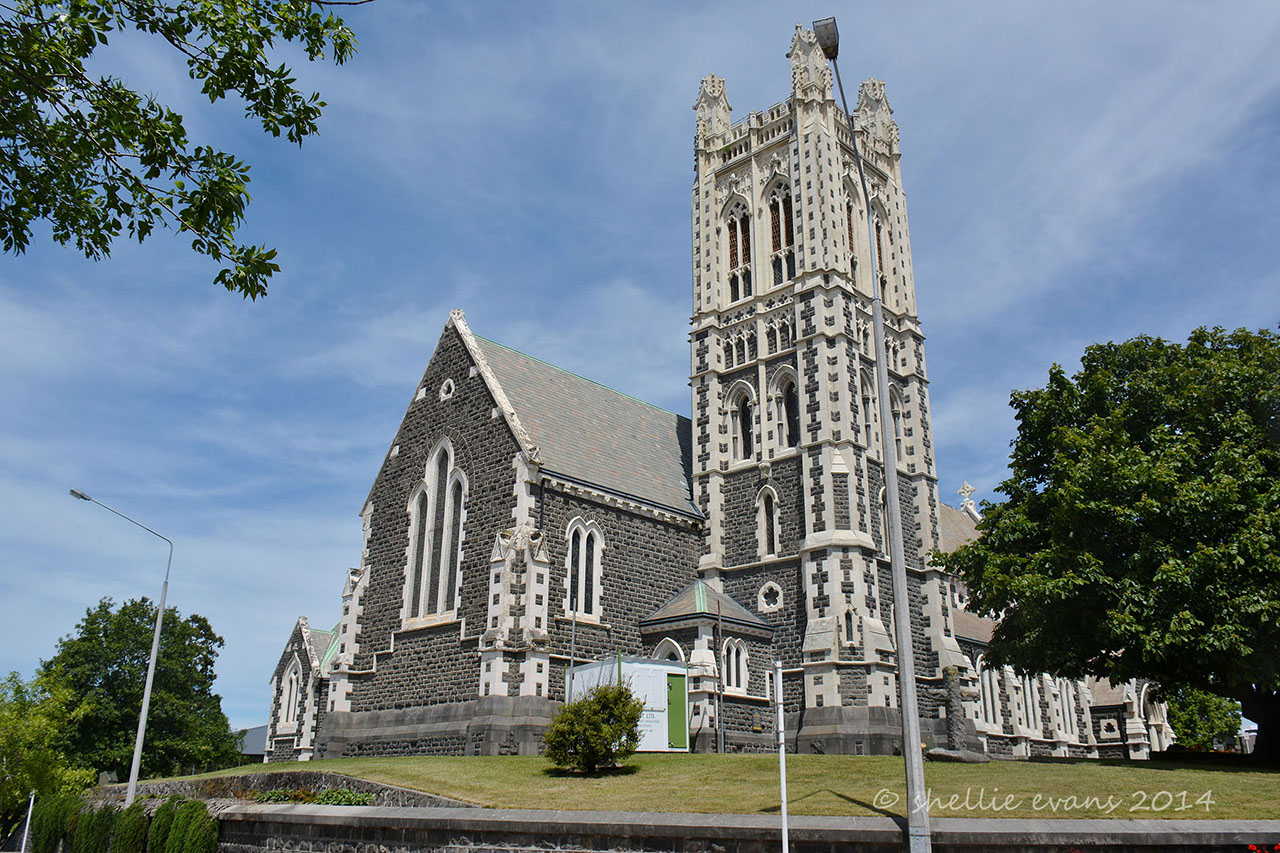
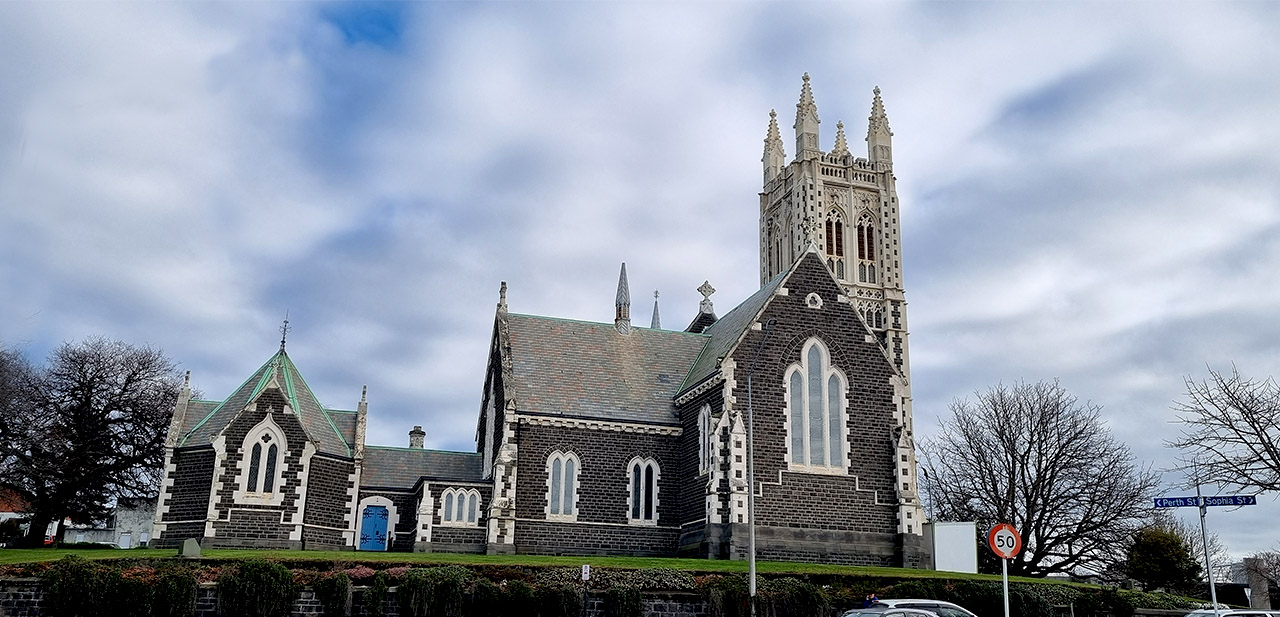
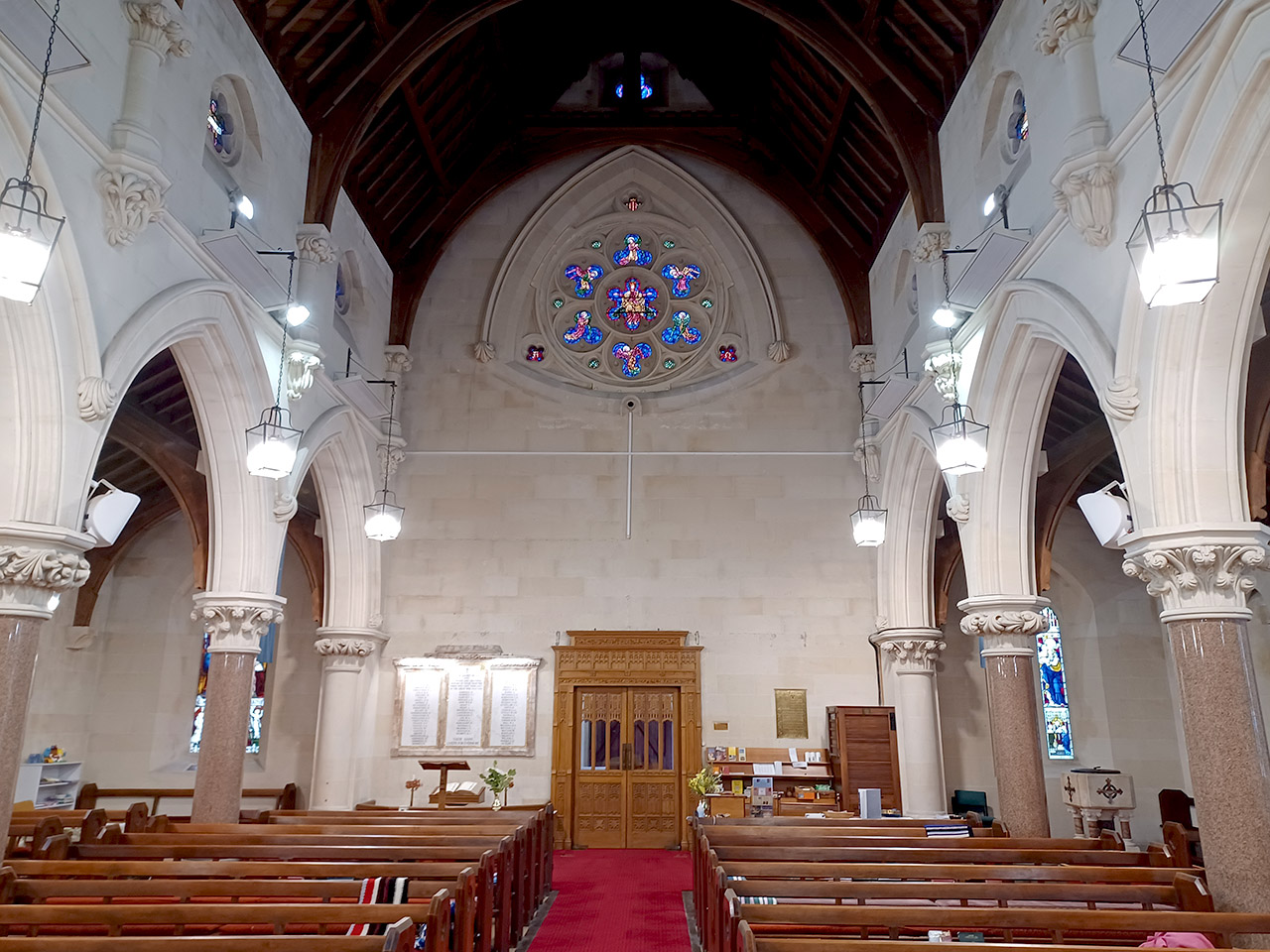
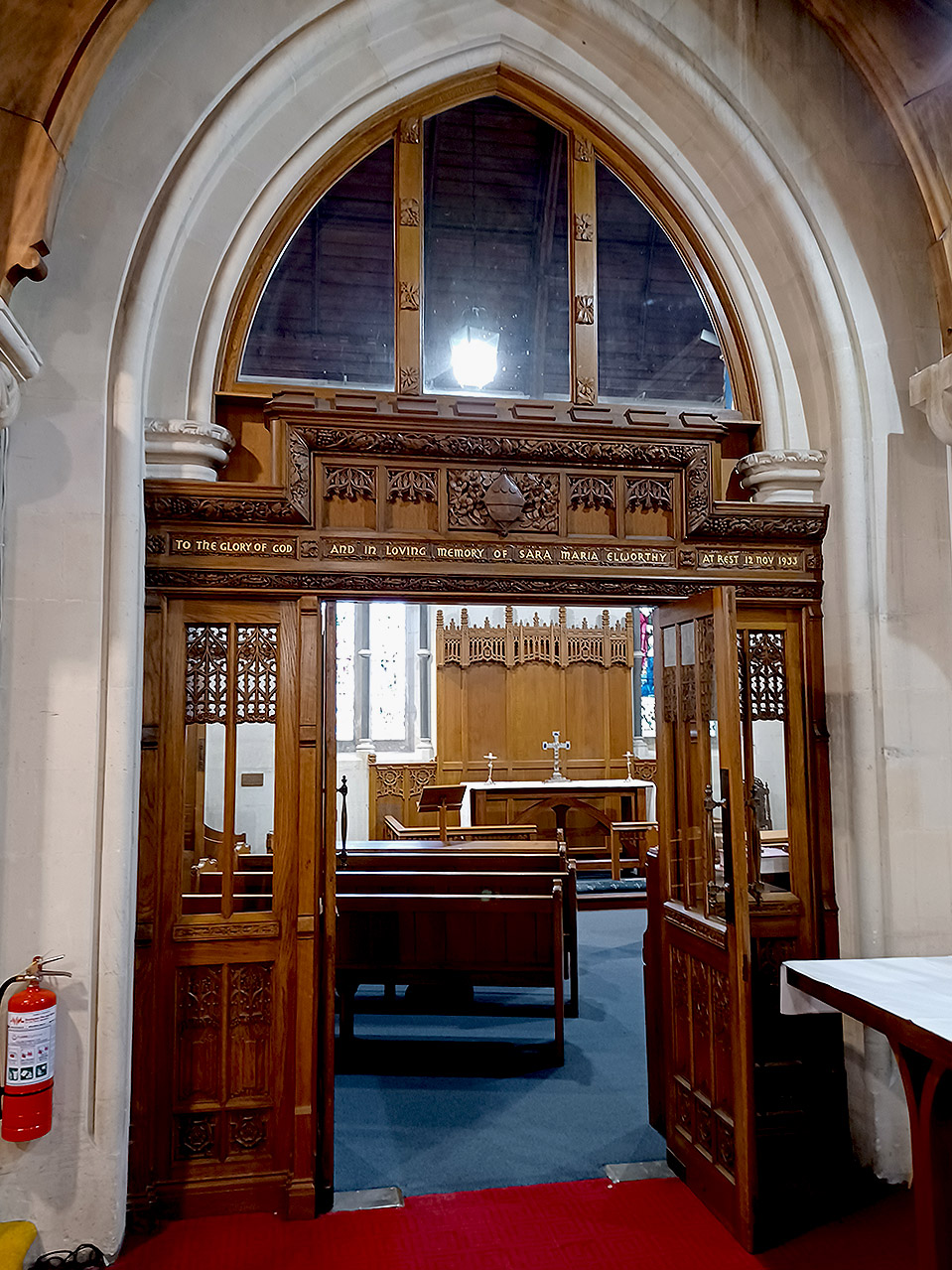
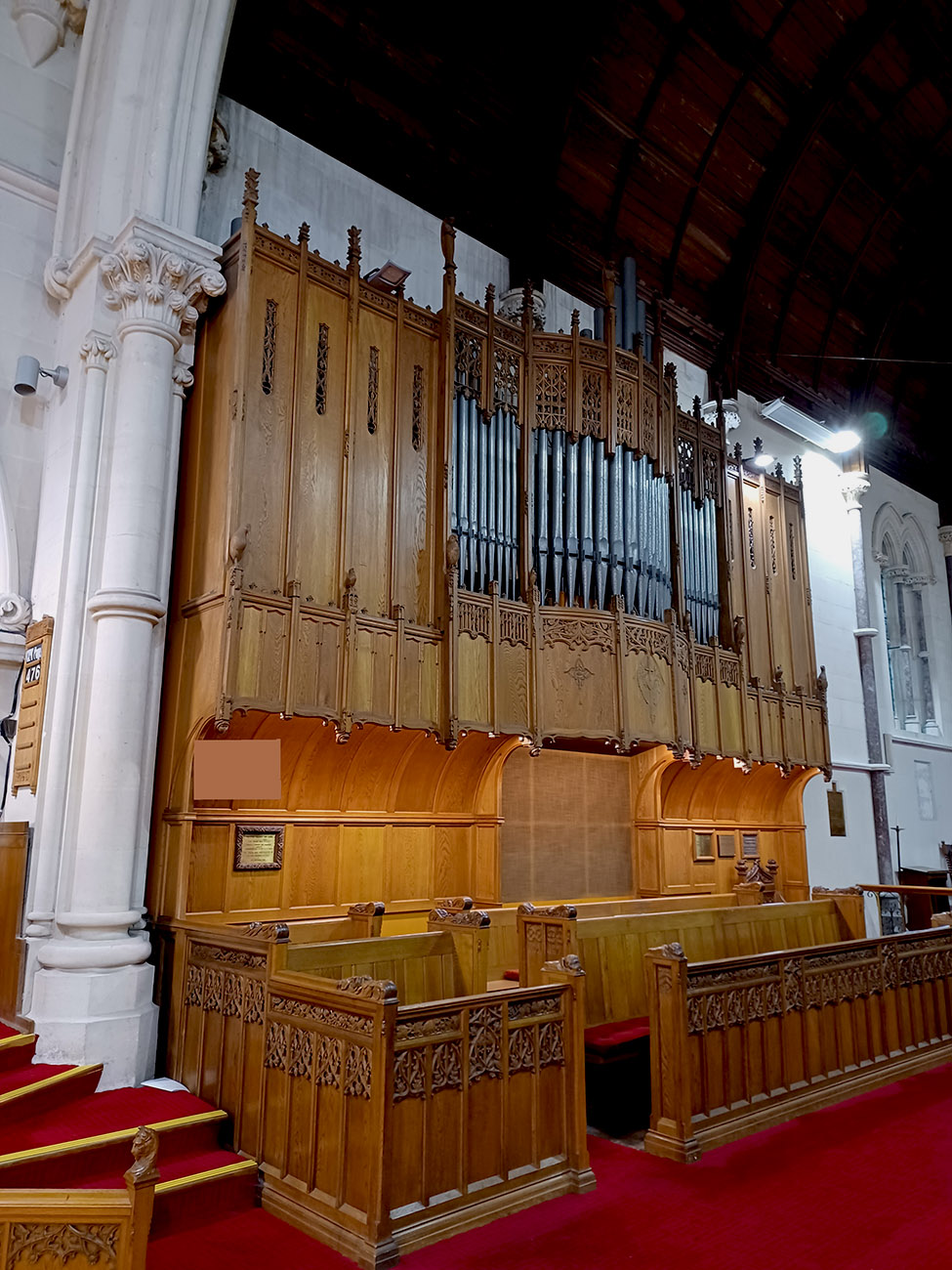
Situated on an elevated position on the corner of Church Street, Sophia Street and Perth Street, St Mary’s Church (Anglican) is constructed of local basalt, known as bluestone, grey dolerite, and Ōamaru and Mount Somers stone, and a slate roof. Typical of Gothic Revival ecclesiastical architecture, the building has irregular stonework, pointed windows and steeply pitched roof and open timberwork on the interior. Its square tower is surmounted by four carved stone crockets. The main body of the church is the nave, built in the 1880s to Armson’s design, which has a large circular stained glass window on its west elevation. The tower and rectangular chancel of 1907-1909 reflect changes Collins and Harman made to Armson’s original design. The rectangular chancel extension has three tall lancet windows on its east elevation. The square tower, 30 metres tall is finished with an open balustrade and four crockets. To the south of the chancel is a single transept, now the Memorial Chapel of St Michael and All Angels to those who served and died in World War II. Through the Chapel and further south is a hall leading to a small clergy vestry, flower room and toilet, and a large octagonal choir room at the southern end. On the interior, the broad aisled nave has polished red Aberdeen (Peterhead) granite columns and Gothic arches and with clerestorey windows above. Both nave and flanking aisles have open timber roofs of rimu. Walls are mostly Ōamaru stone and there are significant timber elements, including some structural (floors, roof framing) and exquisitely carved timberwork for screens, doors, panelling and moveable items such as seating. This includes original pews from the 1880s and a wealth of other carvings by Frederick Gurnsey including pews, pulpit, chairs and seating for the priests, choir stalls, organ and other panels, war memorial wall, reredos, altar, and doors throughout. Stained and coloured glass windows contribute to the interior’s atmosphere, many being deemed exceptional examples of the English School. Of particular significance is the three light war memorial windows set in the south wall to commemorate the fallen of the two World Wars.

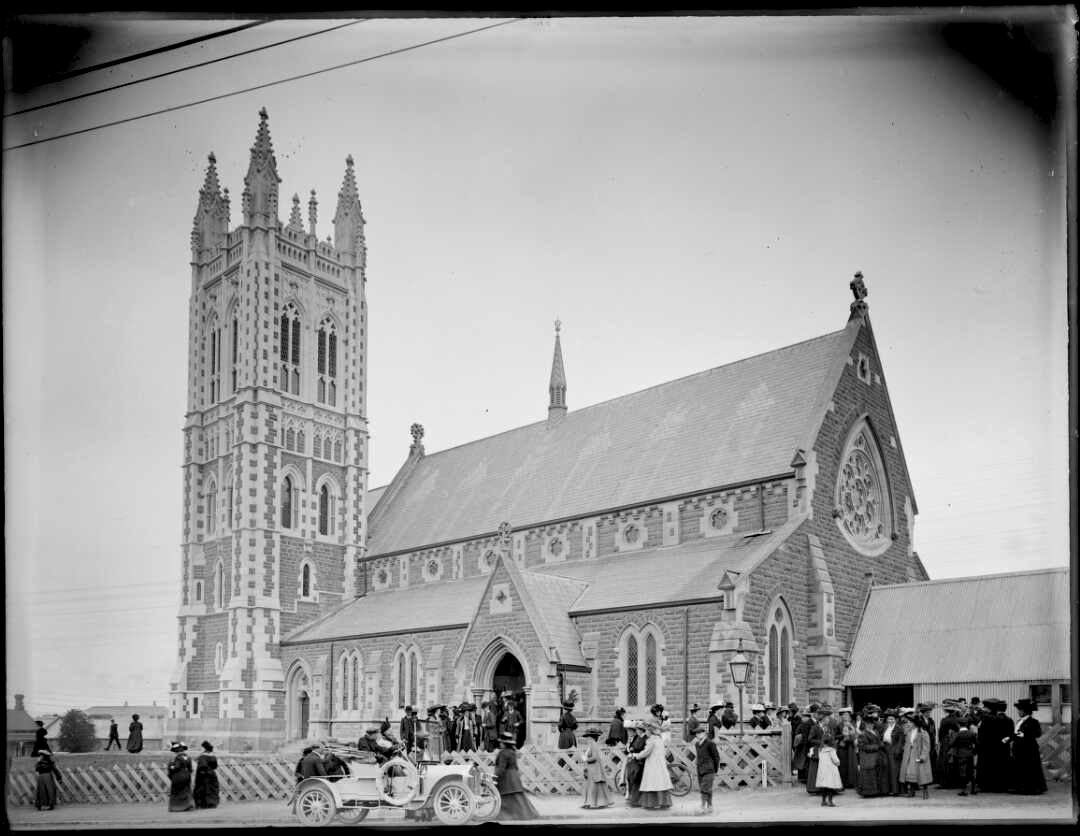
In 1907, construction began to complete the east end of the church and tower, including the chancel, a new side-chapel, vestry and an octagonal room. The grand opening of the completed St Mary’s took place in May 1909. Gurnsey’s high quality carvings were added in the church over a period of 23 years, from 1924 until 1947. In 1961 a new porch, with matching masonry, was added to the western entrance. Seismic strengthening of the rose window, tower was undertaken in 2019-2023. The tower crockets were removed in 2010-2011 after the Canterbury Earthquakes and reconstructed limestone replacements were installed on the tower in 2023.
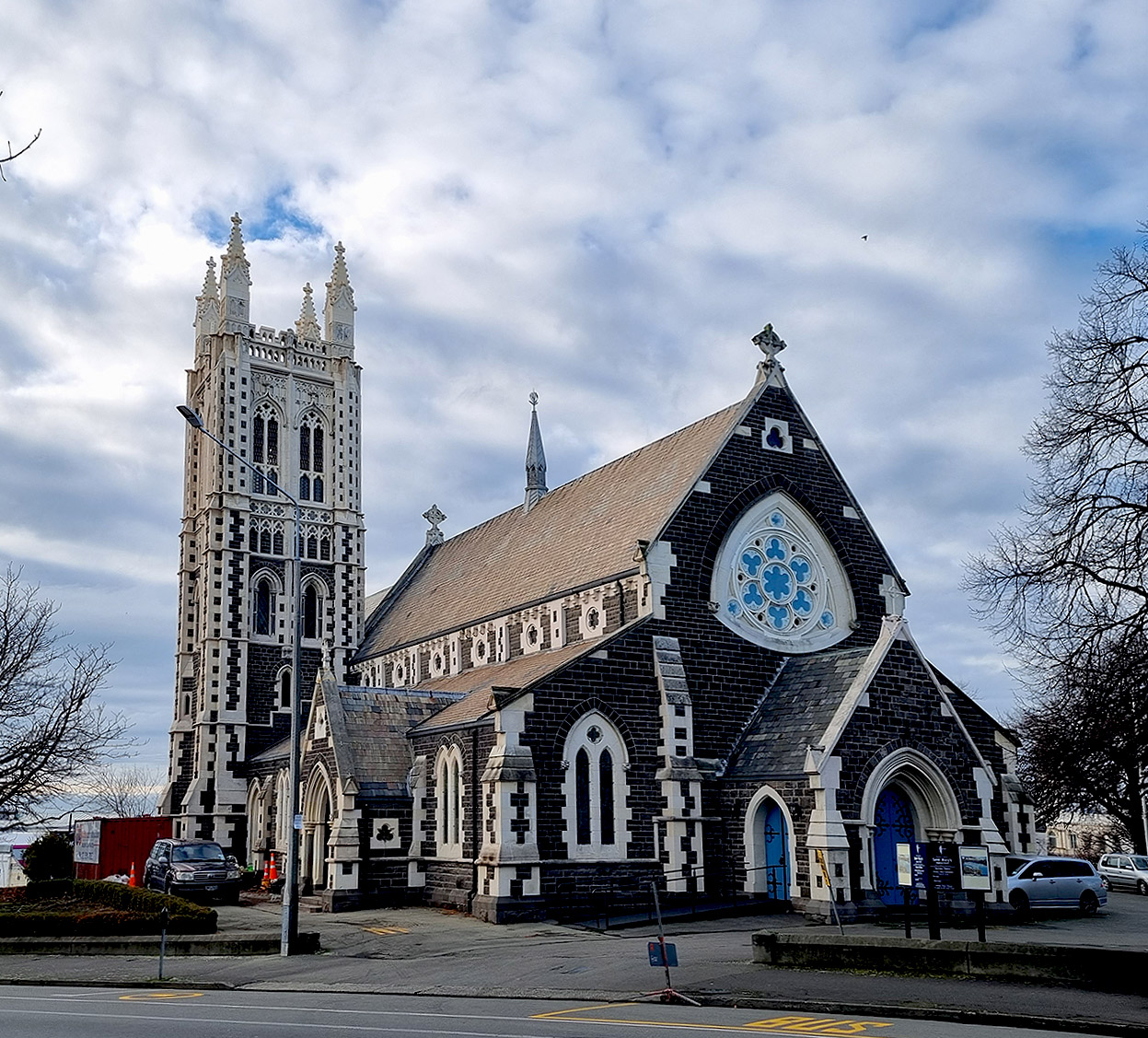
St Mary's Church (Anglican), Timaru | R Burgess | 11/07/2023 | Heritage New Zealand Pouhere Taonga
St Mary's Church (Anglican), Timaru. CC BY-NC-ND 2.0 Image courtesy of www.flickr.com | Shellie Evans - flyingkiwigirl | 02/12/2013 | Shellie Evans
St Mary's Church (Anglican), Timaru | R Burgess | 11/07/2023 | Heritage New Zealand Pouhere Taonga
St Mary's Church (Anglican), Timaru | R Burgess | 09/05/2023 | Heritage New Zealand Pouhere Taonga
St Mary's Church (Anglican), Timaru. c.1910 with crowds of people and a motor car out the front. Ref: 1/1-008664-G. Permission of the Alexander Turnbull Library, Wellington, New Zealand, must be obtained before any re-use of this image | Unknown | Alexander Turnbull Library, Wellington
St Mary's Church (Anglican), Timaru | R Burgess | 11/07/2023 | Heritage New Zealand Pouhere Taonga
St Mary's Church (Anglican), Timaru. CC BY-NC-ND 2.0 Image courtesy of www.flickr.com | Shellie Evans - flyingkiwigirl | 02/12/2013 | Shellie Evans
St Mary's Church (Anglican), Timaru | R Burgess | 11/07/2023 | Heritage New Zealand Pouhere Taonga
St Mary's Church (Anglican), Timaru | R Burgess | 09/05/2023 | Heritage New Zealand Pouhere Taonga
St Mary's Church (Anglican), Timaru. c.1910 with crowds of people and a motor car out the front. Ref: 1/1-008664-G. Permission of the Alexander Turnbull Library, Wellington, New Zealand, must be obtained before any re-use of this image | Unknown | Alexander Turnbull Library, Wellington

List Entry Information

Overview

Status
Listed

List Entry Status
Historic Place Category 1

Access
Private/No Public Access

List Number
328

Date Entered
2nd April 1985

Date of Effect
2nd April 1985

City/District Council
Timaru District

Region
Canterbury Region

Extent of List Entry

Extent includes the land described as Lot 1 DP 81293, Pt Lot 323 DP 1, Pt Lot 1 DP 1739, Pt Lot 1 DP 8897 (RTs 47A/1040, CB171/180, CB171/81, CB412/262), Canterbury Land District and St Mary’s Church (Anglican) thereon. (Refer to extent map tabled at the Rārangi Kōrero Committee meeting on 1st June 2023)

Legal description

Lot 1 DP 81293, Pt Lot 323 DP 1, Pt Lot 1 DP 1739, Pt Lot 1 DP 8897 (RTs 47A/1040, CB171/180, CB171/81, CB412/262), Canterbury Land District

Location Description

[further location information: corner 22A Church Street, Sophia Street and Perth Street, TIMARU]

Detailed List Entry

Construction Professional

Name

Collins & Harman

Type

Architectural Partnership

Biography

One of the two oldest architectural firms in New Zealand, Armson, Collins and Harman was established by William Barnett Armson in 1870. After serving his articles with Armson, John James Collins (1855-1933) bought the practice after the former's death in 1883 and subsequently took Richard Dacre Harman (1859-1927) into partnership four years later. Collins' son, John Goddard Collins (1886-1973), joined the firm in 1903. Armson, Collins and Harman was one of Christchurch's leading architectural practices in the early years of this century. Notable examples of the firm's work include the Christchurch Press Building (1909), Nazareth House (1909), the former Canterbury College Students Union (1927), the Nurses Memorial Chapel at Christchurch Public Hospital (1927) and the Sign of the Takahe (1936). Their domestic work includes Blue Cliffs Station Homestead (1889) and Meadowbank Homestead, Irwell. In 1928 the firm's name was simplified to Collins and Harman and the firm continues today as Collins Architects Ltd. With a versatility and competence that betrayed the practice's debt to Armson's skill and professionalism, Collins and Harman designed a wide variety of building types in a range of styles.

Name

Gurnsey, Frederick George

Type

Carver

Biography

Frederick George Gurnsey (1868 - 1953) was born in Wales. He was apprenticed to Harry Hems and Company, a leading ecclesiastical carving firm in Exeter, and worked for them once his apprenticeship was complete. Gurnsey visited New Zealand in 1904-1905 and returned in 1907 when he was appointed as an instructor at the Canterbury College School of Art in Christchurch. At the School of Art he taught carving, modelling, casting, enamelling and metalwork, and was the acting director of the school from September 1917 to April 1920. He resigned in 1923 to become a full-time carver. Gurnsey executed thousands of carvings, in both wood and stone, for churches, civic buildings, public monuments and various private commissions. Some of his more prominent carvings include the reredos in the Christchurch cathedral, his work in the Chapel of St Michael and St George, the carvings on the Bridge of Remembrance in Christchurch (1924), those on the Massey Memorial in Wellington (1930), and those in the Church of the Good Shepherd at Tekapo.(1935). During the Depression Gurnsey diversified into making domestic furniture. He has been described as 'one of the greatest European carvers ever to have worked in New Zealand', although due to his personal modesty and the way in which carving falls somewhere between fine arts and craft, his achievements have, until recently, largely been unrecognised. Confident with carving in both wood and stone, Gurnsey was responsible for many beautiful works, particularly in the South Island.

Name

Armson, William Barnett

Type

Architect

Biography

Armson (1832/3?-83) was born in England and emigrated to New Zealand with his family in around 1852. They shifted to Australia two years later and settled in Melbourne. Here Armson was articled to the architectural and civil engineering firm of Purchas and Swyer for a period of six years. He was trained in architecture, engineering and surveying. Armson returned to New Zealand in 1862 during the Otago gold rushes. He was appointed architectural draughtsman in the Provincial Engineer's Department and was soon promoted to Assistant Architect. Made redundant in 1864, Armson practised in Dunedin before superiving construction of St Luke's Church at Oamaru in 1865. Armson moved to Hokitika in 1866 and practised on his own account, designing a wide variety of buildings. These include bank branch offices in towns around the West Coast, and the Hokitika Town Hall (1869). He moved to Christchurch in 1870 and it was here that he prospered as an architect. His buildings include the former Public Library (1875), the Bank of New Zealand, Lyttelton (1878), the Bank of New Zealand, Princes Street, Dunedin (1879), Christchurch Girls' High School (1880), St Mary's Church, Timaru (1880) as well as many shops and offices. From 1870 until his death, Armson was unrivalled as a commercial architect in Christchurch. He was also known for his professionalism and in 1872 was one of the founding members of the Canterbury Association of Architects. The practice founded by Armson in 1870 continued as Collins Architects Limited.

Construction Details

Start Year

1907

Finish Year

1909

Type

Original Construction

Description

construction of east end of the church and tower, including chancel, new side-chapel, vestry and octagonal room. (Temporary chancel removed by this time).

Start Year

1924

Finish Year

1927

Type

Modification

Description

high quality carvings by Frederick Gurnsey added in church

Start Year

1961

Type

Addition

Description

new porch added on west side

Start Year

2019

Finish Year

2023

Type

Structural upgrade

Description

seismic strengthening of rose window and tower, and replacement of tower crockets

Start Year

1880

Finish Year

1886

Type

Original Construction

Description

First portion of the new St Mary’s Church built on part of the site of previous church (still incorporating part of earlier church as temporary chancel)

Reference

Completion Date

31st August 2023

Report Written By

Robyn Burgess

Information Sources

Button, 2010

John Button, Love and Faithfulness – Stories of St Mary’s Timaru 1860-2010

Cochran, 1999

Chris Cochran, Conservation Report, St Mary’s Church, 24 Church Street, Timaru, 31 July 1999

Report Written By

This place was identified as significant under previous legislation with different information requirements. It remains significant under the current legislation. There is opportunity under our legislation and policies to add to this information. Further information about this place may be available from the Southern Regional Office of Heritage New Zealand Pouhere Taonga. A fully referenced copy of the Upgrade Report is available upon request from the Southern Regional Office of Heritage New Zealand Pouhere Taonga Please note that entry on the New Zealand Heritage List/Rarangi Korero identifies only the heritage values of the property concerned, and should not be construed as advice on the state of the property, or as a comment of its soundness or safety, including in regard to earthquake risk, safety in the event of fire, or insanitary conditions.

Further Information

Current Usages

Uses: Religion

Specific Usage: Church

Former Usages

General Usage:: Religion

Specific Usage: Church

Themes

Web Links

Overview

Status

Listed

List Entry Status

Historic Place Category 1

Access

Private/No Public Access

List Number

328

Date Entered

2nd April 1985

Date of Effect

2nd April 1985

City/District Council

Timaru District

Region

Canterbury Region

Extent of List Entry

Extent includes the land described as Lot 1 DP 81293, Pt Lot 323 DP 1, Pt Lot 1 DP 1739, Pt Lot 1 DP 8897 (RTs 47A/1040, CB171/180, CB171/81, CB412/262), Canterbury Land District and St Mary’s Church (Anglican) thereon. (Refer to extent map tabled at the Rārangi Kōrero Committee meeting on 1st June 2023)

Legal description

Lot 1 DP 81293, Pt Lot 323 DP 1, Pt Lot 1 DP 1739, Pt Lot 1 DP 8897 (RTs 47A/1040, CB171/180, CB171/81, CB412/262), Canterbury Land District

Location Description

[further location information: corner 22A Church Street, Sophia Street and Perth Street, TIMARU]

Status

Listed

List Entry Status

Historic Place Category 1

Access

Private/No Public Access

List Number

328

Date Entered

2nd April 1985

Date of Effect

2nd April 1985

City/District Council

Timaru District

Region

Canterbury Region

Extent of List Entry

Extent includes the land described as Lot 1 DP 81293, Pt Lot 323 DP 1, Pt Lot 1 DP 1739, Pt Lot 1 DP 8897 (RTs 47A/1040, CB171/180, CB171/81, CB412/262), Canterbury Land District and St Mary’s Church (Anglican) thereon. (Refer to extent map tabled at the Rārangi Kōrero Committee meeting on 1st June 2023)

Legal description

Lot 1 DP 81293, Pt Lot 323 DP 1, Pt Lot 1 DP 1739, Pt Lot 1 DP 8897 (RTs 47A/1040, CB171/180, CB171/81, CB412/262), Canterbury Land District

Location Description

[further location information: corner 22A Church Street, Sophia Street and Perth Street, TIMARU]

Construction Information

Construction Professional

Name

Collins & Harman

Type

Architectural Partnership

Biography

One of the two oldest architectural firms in New Zealand, Armson, Collins and Harman was established by William Barnett Armson in 1870. After serving his articles with Armson, John James Collins (1855-1933) bought the practice after the former's death in 1883 and subsequently took Richard Dacre Harman (1859-1927) into partnership four years later. Collins' son, John Goddard Collins (1886-1973), joined the firm in 1903. Armson, Collins and Harman was one of Christchurch's leading architectural practices in the early years of this century. Notable examples of the firm's work include the Christchurch Press Building (1909), Nazareth House (1909), the former Canterbury College Students Union (1927), the Nurses Memorial Chapel at Christchurch Public Hospital (1927) and the Sign of the Takahe (1936). Their domestic work includes Blue Cliffs Station Homestead (1889) and Meadowbank Homestead, Irwell. In 1928 the firm's name was simplified to Collins and Harman and the firm continues today as Collins Architects Ltd. With a versatility and competence that betrayed the practice's debt to Armson's skill and professionalism, Collins and Harman designed a wide variety of building types in a range of styles.

Name

Gurnsey, Frederick George

Type

Carver

Biography

Frederick George Gurnsey (1868 - 1953) was born in Wales. He was apprenticed to Harry Hems and Company, a leading ecclesiastical carving firm in Exeter, and worked for them once his apprenticeship was complete. Gurnsey visited New Zealand in 1904-1905 and returned in 1907 when he was appointed as an instructor at the Canterbury College School of Art in Christchurch. At the School of Art he taught carving, modelling, casting, enamelling and metalwork, and was the acting director of the school from September 1917 to April 1920. He resigned in 1923 to become a full-time carver. Gurnsey executed thousands of carvings, in both wood and stone, for churches, civic buildings, public monuments and various private commissions. Some of his more prominent carvings include the reredos in the Christchurch cathedral, his work in the Chapel of St Michael and St George, the carvings on the Bridge of Remembrance in Christchurch (1924), those on the Massey Memorial in Wellington (1930), and those in the Church of the Good Shepherd at Tekapo.(1935). During the Depression Gurnsey diversified into making domestic furniture. He has been described as 'one of the greatest European carvers ever to have worked in New Zealand', although due to his personal modesty and the way in which carving falls somewhere between fine arts and craft, his achievements have, until recently, largely been unrecognised. Confident with carving in both wood and stone, Gurnsey was responsible for many beautiful works, particularly in the South Island.

Name

Armson, William Barnett

Type

Architect

Biography

Armson (1832/3?-83) was born in England and emigrated to New Zealand with his family in around 1852. They shifted to Australia two years later and settled in Melbourne. Here Armson was articled to the architectural and civil engineering firm of Purchas and Swyer for a period of six years. He was trained in architecture, engineering and surveying. Armson returned to New Zealand in 1862 during the Otago gold rushes. He was appointed architectural draughtsman in the Provincial Engineer's Department and was soon promoted to Assistant Architect. Made redundant in 1864, Armson practised in Dunedin before superiving construction of St Luke's Church at Oamaru in 1865. Armson moved to Hokitika in 1866 and practised on his own account, designing a wide variety of buildings. These include bank branch offices in towns around the West Coast, and the Hokitika Town Hall (1869). He moved to Christchurch in 1870 and it was here that he prospered as an architect. His buildings include the former Public Library (1875), the Bank of New Zealand, Lyttelton (1878), the Bank of New Zealand, Princes Street, Dunedin (1879), Christchurch Girls' High School (1880), St Mary's Church, Timaru (1880) as well as many shops and offices. From 1870 until his death, Armson was unrivalled as a commercial architect in Christchurch. He was also known for his professionalism and in 1872 was one of the founding members of the Canterbury Association of Architects. The practice founded by Armson in 1870 continued as Collins Architects Limited.

Construction Details

Start Year

1907

Finish Year

1909

Type

Original Construction

Description

construction of east end of the church and tower, including chancel, new side-chapel, vestry and octagonal room. (Temporary chancel removed by this time).

Start Year

1924

Finish Year

1927

Type

Modification

Description

high quality carvings by Frederick Gurnsey added in church

Start Year

1961

Type

Addition

Description

new porch added on west side

Start Year

2019

Finish Year

2023

Type

Structural upgrade

Description

seismic strengthening of rose window and tower, and replacement of tower crockets

Start Year

1880

Finish Year

1886

Type

Original Construction

Description

First portion of the new St Mary’s Church built on part of the site of previous church (still incorporating part of earlier church as temporary chancel)

Construction Professional

Name

Collins & Harman

Type

Architectural Partnership

Biography

One of the two oldest architectural firms in New Zealand, Armson, Collins and Harman was established by William Barnett Armson in 1870. After serving his articles with Armson, John James Collins (1855-1933) bought the practice after the former's death in 1883 and subsequently took Richard Dacre Harman (1859-1927) into partnership four years later. Collins' son, John Goddard Collins (1886-1973), joined the firm in 1903. Armson, Collins and Harman was one of Christchurch's leading architectural practices in the early years of this century. Notable examples of the firm's work include the Christchurch Press Building (1909), Nazareth House (1909), the former Canterbury College Students Union (1927), the Nurses Memorial Chapel at Christchurch Public Hospital (1927) and the Sign of the Takahe (1936). Their domestic work includes Blue Cliffs Station Homestead (1889) and Meadowbank Homestead, Irwell. In 1928 the firm's name was simplified to Collins and Harman and the firm continues today as Collins Architects Ltd. With a versatility and competence that betrayed the practice's debt to Armson's skill and professionalism, Collins and Harman designed a wide variety of building types in a range of styles.

Name

Gurnsey, Frederick George

Type

Carver

Biography

Frederick George Gurnsey (1868 - 1953) was born in Wales. He was apprenticed to Harry Hems and Company, a leading ecclesiastical carving firm in Exeter, and worked for them once his apprenticeship was complete. Gurnsey visited New Zealand in 1904-1905 and returned in 1907 when he was appointed as an instructor at the Canterbury College School of Art in Christchurch. At the School of Art he taught carving, modelling, casting, enamelling and metalwork, and was the acting director of the school from September 1917 to April 1920. He resigned in 1923 to become a full-time carver. Gurnsey executed thousands of carvings, in both wood and stone, for churches, civic buildings, public monuments and various private commissions. Some of his more prominent carvings include the reredos in the Christchurch cathedral, his work in the Chapel of St Michael and St George, the carvings on the Bridge of Remembrance in Christchurch (1924), those on the Massey Memorial in Wellington (1930), and those in the Church of the Good Shepherd at Tekapo.(1935). During the Depression Gurnsey diversified into making domestic furniture. He has been described as 'one of the greatest European carvers ever to have worked in New Zealand', although due to his personal modesty and the way in which carving falls somewhere between fine arts and craft, his achievements have, until recently, largely been unrecognised. Confident with carving in both wood and stone, Gurnsey was responsible for many beautiful works, particularly in the South Island.

Name

Armson, William Barnett

Type

Architect

Biography

Armson (1832/3?-83) was born in England and emigrated to New Zealand with his family in around 1852. They shifted to Australia two years later and settled in Melbourne. Here Armson was articled to the architectural and civil engineering firm of Purchas and Swyer for a period of six years. He was trained in architecture, engineering and surveying. Armson returned to New Zealand in 1862 during the Otago gold rushes. He was appointed architectural draughtsman in the Provincial Engineer's Department and was soon promoted to Assistant Architect. Made redundant in 1864, Armson practised in Dunedin before superiving construction of St Luke's Church at Oamaru in 1865. Armson moved to Hokitika in 1866 and practised on his own account, designing a wide variety of buildings. These include bank branch offices in towns around the West Coast, and the Hokitika Town Hall (1869). He moved to Christchurch in 1870 and it was here that he prospered as an architect. His buildings include the former Public Library (1875), the Bank of New Zealand, Lyttelton (1878), the Bank of New Zealand, Princes Street, Dunedin (1879), Christchurch Girls' High School (1880), St Mary's Church, Timaru (1880) as well as many shops and offices. From 1870 until his death, Armson was unrivalled as a commercial architect in Christchurch. He was also known for his professionalism and in 1872 was one of the founding members of the Canterbury Association of Architects. The practice founded by Armson in 1870 continued as Collins Architects Limited.

Construction Details

Start Year

1907

Finish Year

1909

Type

Original Construction

Description

construction of east end of the church and tower, including chancel, new side-chapel, vestry and octagonal room. (Temporary chancel removed by this time).

Start Year

1924

Finish Year

1927

Type

Modification

Description

high quality carvings by Frederick Gurnsey added in church

Start Year

1961

Type

Addition

Description

new porch added on west side

Start Year

2019

Finish Year

2023

Type

Structural upgrade

Description

seismic strengthening of rose window and tower, and replacement of tower crockets

Start Year

1880

Finish Year

1886

Type

Original Construction

Description

First portion of the new St Mary’s Church built on part of the site of previous church (still incorporating part of earlier church as temporary chancel)

Reference

Historical and Associated Iwi / Hapū / Whānau

Completion Date

31st August 2023

Report Written By

Robyn Burgess

Information Sources

Button, 2010

John Button, Love and Faithfulness – Stories of St Mary’s Timaru 1860-2010

Cochran, 1999

Chris Cochran, Conservation Report, St Mary’s Church, 24 Church Street, Timaru, 31 July 1999

Other Information

This place was identified as significant under previous legislation with different information requirements. It remains significant under the current legislation. There is opportunity under our legislation and policies to add to this information. Further information about this place may be available from the Southern Regional Office of Heritage New Zealand Pouhere Taonga. A fully referenced copy of the Upgrade Report is available upon request from the Southern Regional Office of Heritage New Zealand Pouhere Taonga Please note that entry on the New Zealand Heritage List/Rarangi Korero identifies only the heritage values of the property concerned, and should not be construed as advice on the state of the property, or as a comment of its soundness or safety, including in regard to earthquake risk, safety in the event of fire, or insanitary conditions.

Historical and Associated Iwi / Hapū / Whānau

Completion Date

31st August 2023

Report Written By

Robyn Burgess

Information Sources

Button, 2010

John Button, Love and Faithfulness – Stories of St Mary’s Timaru 1860-2010

Cochran, 1999

Chris Cochran, Conservation Report, St Mary’s Church, 24 Church Street, Timaru, 31 July 1999

Other Information

This place was identified as significant under previous legislation with different information requirements. It remains significant under the current legislation. There is opportunity under our legislation and policies to add to this information. Further information about this place may be available from the Southern Regional Office of Heritage New Zealand Pouhere Taonga. A fully referenced copy of the Upgrade Report is available upon request from the Southern Regional Office of Heritage New Zealand Pouhere Taonga Please note that entry on the New Zealand Heritage List/Rarangi Korero identifies only the heritage values of the property concerned, and should not be construed as advice on the state of the property, or as a comment of its soundness or safety, including in regard to earthquake risk, safety in the event of fire, or insanitary conditions.

Further Information

Current Usages

Uses: Religion

Specific Usage: Church

Former Usages

General Usage: Religion

Specific Usage: Church

Current Usages

Uses: Religion

Specific Usage: Church

Former Usages

General Usage: Religion

Specific Usage: Church

Location

Loading
Stay up to date with Heritage this month