

George was the son of Robert Heaton Rhodes (1815-1884), an important early Canterbury colonist. Educated at Christ's College, Christchurch, George then studied at Oxford and later fought in the South African (Boer) War with the 'Rough Riders', the Third Contingent, New Zealand Mounted Rifles. George married Ellen Laura Amy Perry (?-1931), also known as Nellie, in November 1890, the same year he purchased the Meadowbank estate. The Rhodes' large three-storey timber homestead was constructed the following year and George developed Meadowbank into a model farm. He specialised in breeding Southdown sheep and Berkshire pigs and also used Meadowbank to fatten stock. Many of the mature exotic trees on the estate were planted by George. In the Cyclopaedia of New Zealand (1903) Meadowbank was described as an estate of 1000 acres (around 405 hectares), much improved by George Rhodes. His house was described as a 'large and commodious mansion...situated on rising ground commanding a noble view of the Southern Alps and the intervening plains'.
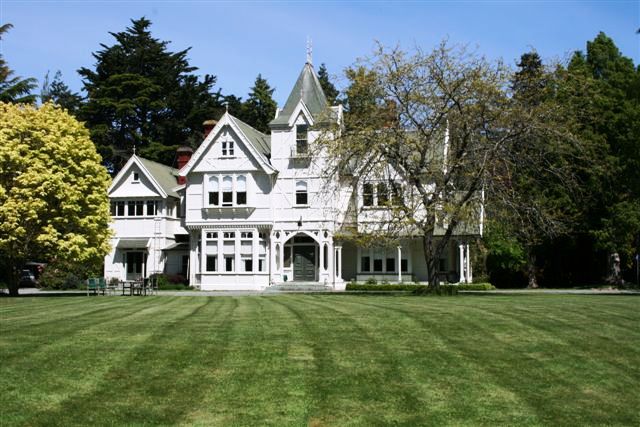
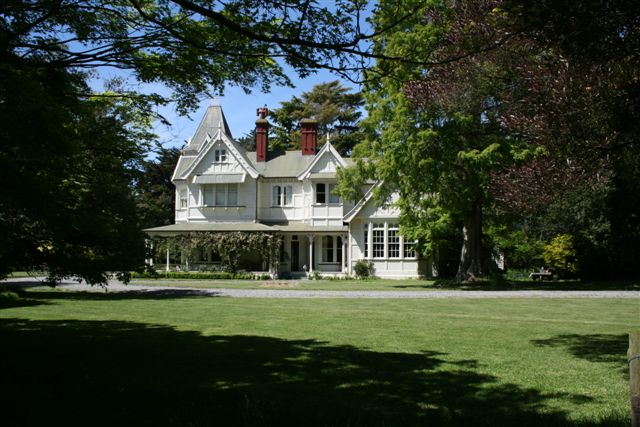
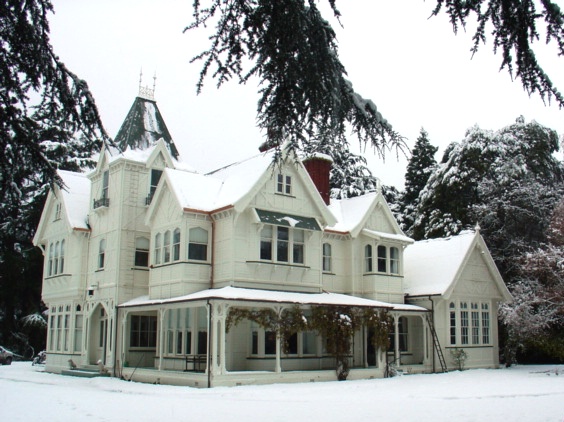
Meadowbank Homestead was designed by architectural firm, Collins and Harman, and is a large, eclectic, timber mansion. Collins and Harman designed many dwellings around the Canterbury region and were well-known for their domestic designs as well as for such Christchurch buildings as the Press building (1909) and the Nurses' Memorial Chapel (1927) . The house designed for Meadowbank is three-storeyed, asymmetrical in plan and dominated by the many, various sized gables. The gables have bargeboards and are topped with either timber or cast iron finials. The main entrance to the house, on the north facade, is situated under a square tower with a pavilion roof. With its mock half timbering, Tudor arches, bay and oriel windows, verandah and square tower, Meadowbank is a picturesque and rambling house blending elements of various English architectural styles.
The Rhodes sold Meadowbank in 1916 and moved first to Elmwood and then 'Beverley' in Riccarton. Meadowbank changed hands a number of times between 1916 and 1923. It was then purchased by (Arthur) Tahu (Grovenor) Rhodes (1893-1947), George's second cousin. Tahu and his wife were noted for the lavish entertaining and parties they threw for the social elite of Canterbury. They were friends of Dame Ngaio Marsh (1895-1982), the world-renowned crime writer. She often stayed at Meadowbank and described it in her autobiography as a 'house, twenty miles away in the country. Its doors opened into a life whose scale of values, casual grandeur, cockeyed gaiety and vague friendliness will bewilder and delight me for the rest of my days'. Tahu Rhodes sold Meadowbank in 1926.
After being owned and farmed by I. K. Buchanan for 14 years Meadowbank was bought by Henry Neave in 1940. At this stage the estate had been reduced to 146 hectares (just over 360 acres). Neave was well-known in the local area and later became the director of the Canterbury Seed Company. He established a South Suffolk stud at Meadowbank. His son Gordon took over the estate in 1953. It remained in the Neave family until 1994 when they subdivided the land and sold the homestead with around 10 hectares (25 acres) of land.
Meadowbank Homestead is a fine example of the large rambling country houses beloved of the elite in Victorian New Zealand. Its architectural associations with various historic English styles linked the second and third generations of Pakeha New Zealanders to the place they still knew as 'Home'. Meadowbank has been owned by two branches of the Rhodes family, who played a significant part in the development of Canterbury, and the homestead was immortalised in the autobiography of Dame Ngaio Marsh as the house of the Lampreys (her nickname for the Rhodes). Meadowbank had a long association with the Neave family and remains one of Canterbury's finest country houses.
List Entry Information
Status
Listed
List Entry Status
Historic Place Category 1
Access
Private/No Public Access
List Number
3346
Date Entered
22nd August 1991
Date of Effect
22nd August 1991
City/District Council
Selwyn District
Region
Canterbury Region
Extent of List Entry
The extent includes part of the land described as Lot 1 DP 66124 (RT CB38D/820), Canterbury Land District and the building known as Meadowbank Homestead thereon. [The extent does not include the 1950s flat, 2013 tank shed and the septic tank]. Refer to the extent map tabled at the Rārangi Kōrero Committee meeting on 13 February 2024.
Legal description
Lot 1 DP 66124 (RT CB38D/820), Canterbury Land District
Status
Listed
List Entry Status
Historic Place Category 1
Access
Private/No Public Access
List Number
3346
Date Entered
22nd August 1991
Date of Effect
22nd August 1991
City/District Council
Selwyn District
Region
Canterbury Region
Extent of List Entry
The extent includes part of the land described as Lot 1 DP 66124 (RT CB38D/820), Canterbury Land District and the building known as Meadowbank Homestead thereon. [The extent does not include the 1950s flat, 2013 tank shed and the septic tank]. Refer to the extent map tabled at the Rārangi Kōrero Committee meeting on 13 February 2024.
Legal description
Lot 1 DP 66124 (RT CB38D/820), Canterbury Land District
Why is this place significant?
Historic Significance
Historical Significance or Value This historic place was registered under the Historic Places Act 1980. The following text is from the original Building Classification Committee report considered by the NZHPT Board at the time of registration: The Rhodes family were prominent in the settlement of New Zealand, particularly Canterbury, with brothers including William Barnard (1807-78), Robert Heaton (1815-84), George (1816-64) and Joseph (1826-1905). Meadowbank Homestead had a 30 year association with descendants of this family (1891-1916, 1921-26) and has now been in the Neave family for 50 years (1940-90).
Physical Significance
This historic place was registered under the Historic Places Act 1980. The following text is from the original Building Classification Committee report considered by the NZHPT Board at the time of registration: ARCHITECTURAL QUALITY: With its large scale and "casual grandeur", Meadowbank Homestead is a fine example of lavish, late Victorian domestic architecture. Its collection of gabled roofs, bay and oriel windows, Tudor arches, mock half-timbering and the pavilion-roofed tower is somewhat eclectic. The tower, in particular, is stylistically estranged from the rest of the house. The overall form, however, is a generally homogenous representation of imitation Tudor architecture. It is one of the finest of Canterbury's many outstanding homesteads. TOWNSCAPE/LANDMARK VALUE: Meadowbank Homestead most attractively is sited in an expansive mature garden setting.
Why is this place significant?
Historic Significance
Historical Significance or Value This historic place was registered under the Historic Places Act 1980. The following text is from the original Building Classification Committee report considered by the NZHPT Board at the time of registration: The Rhodes family were prominent in the settlement of New Zealand, particularly Canterbury, with brothers including William Barnard (1807-78), Robert Heaton (1815-84), George (1816-64) and Joseph (1826-1905). Meadowbank Homestead had a 30 year association with descendants of this family (1891-1916, 1921-26) and has now been in the Neave family for 50 years (1940-90).
Physical Significance
This historic place was registered under the Historic Places Act 1980. The following text is from the original Building Classification Committee report considered by the NZHPT Board at the time of registration: ARCHITECTURAL QUALITY: With its large scale and "casual grandeur", Meadowbank Homestead is a fine example of lavish, late Victorian domestic architecture. Its collection of gabled roofs, bay and oriel windows, Tudor arches, mock half-timbering and the pavilion-roofed tower is somewhat eclectic. The tower, in particular, is stylistically estranged from the rest of the house. The overall form, however, is a generally homogenous representation of imitation Tudor architecture. It is one of the finest of Canterbury's many outstanding homesteads. TOWNSCAPE/LANDMARK VALUE: Meadowbank Homestead most attractively is sited in an expansive mature garden setting.
Construction Professional
Name
Collins & Harman
Type
Architectural Partnership
Biography
One of the two oldest architectural firms in New Zealand, Armson, Collins and Harman was established by William Barnett Armson in 1870. After serving his articles with Armson, John James Collins (1855-1933) bought the practice after the former's death in 1883 and subsequently took Richard Dacre Harman (1859-1927) into partnership four years later. Collins' son, John Goddard Collins (1886-1973), joined the firm in 1903. Armson, Collins and Harman was one of Christchurch's leading architectural practices in the early years of this century. Notable examples of the firm's work include the Christchurch Press Building (1909), Nazareth House (1909), the former Canterbury College Students Union (1927), the Nurses Memorial Chapel at Christchurch Public Hospital (1927) and the Sign of the Takahe (1936). Their domestic work includes Blue Cliffs Station Homestead (1889) and Meadowbank Homestead, Irwell. In 1928 the firm's name was simplified to Collins and Harman and the firm continues today as Collins Architects Ltd. With a versatility and competence that betrayed the practice's debt to Armson's skill and professionalism, Collins and Harman designed a wide variety of building types in a range of styles.
Construction Details
Type
Addition
Description
Addition of single-storey gable extension at east end
Start Year
1920
Finish Year
1940
Type
Addition
Description
'Sunroom' added to top of east end extension
Construction Materials
Timber frame clad with rusticated weatherboards. Concrete walls to cellar. Corrugated iron roof cladding.
Notable Features
Interior woodwork including balustraded staircase Repeated use of oriel and bay windows and gabled roofs. Mock half-timbering and Tudor arches
Construction Professional
Name
Collins & Harman
Type
Architectural Partnership
Biography
One of the two oldest architectural firms in New Zealand, Armson, Collins and Harman was established by William Barnett Armson in 1870. After serving his articles with Armson, John James Collins (1855-1933) bought the practice after the former's death in 1883 and subsequently took Richard Dacre Harman (1859-1927) into partnership four years later. Collins' son, John Goddard Collins (1886-1973), joined the firm in 1903. Armson, Collins and Harman was one of Christchurch's leading architectural practices in the early years of this century. Notable examples of the firm's work include the Christchurch Press Building (1909), Nazareth House (1909), the former Canterbury College Students Union (1927), the Nurses Memorial Chapel at Christchurch Public Hospital (1927) and the Sign of the Takahe (1936). Their domestic work includes Blue Cliffs Station Homestead (1889) and Meadowbank Homestead, Irwell. In 1928 the firm's name was simplified to Collins and Harman and the firm continues today as Collins Architects Ltd. With a versatility and competence that betrayed the practice's debt to Armson's skill and professionalism, Collins and Harman designed a wide variety of building types in a range of styles.
Construction Details
Type
Addition
Description
Addition of single-storey gable extension at east end
Start Year
1920
Finish Year
1940
Type
Addition
Description
'Sunroom' added to top of east end extension
Construction Materials
Timber frame clad with rusticated weatherboards. Concrete walls to cellar. Corrugated iron roof cladding.
Notable Features
Interior woodwork including balustraded staircase Repeated use of oriel and bay windows and gabled roofs. Mock half-timbering and Tudor arches
This historic place was registered under the Historic Places Act 1980. The following text is from the original Building Classification Committee report considered by the NZHPT Board at the time of registration: DESCRIPTION: In 1862 a large block of land at Irwell, including the land on which Meadowbank Homestead stands, was granted to Thomas Overton who gave the name Meadowbank to the estate and built the first homestead there. Following his death the property passed to Henry Hoare, an English banker, in 1874 and then in 1890 it was sold to George Edward Rhodes. Rhodes had the present homestead built the following year at a cost of œ2,753. George Rhodes was the son of Robert Heaton Rhodes (1815-84), an important South Canterbury settler, and he used Meadowbank for the fattening of stock including Hereford cattle. He also kept Shorthorn cows and Berkshire pigs. Many staff were employed. The property including the homestead block was to change hands several times from 1916 to 1940, although the homestead block was returned to the Rhodes family for five years (1921-26) when purchased by (Arthur) Tahu (Gravenor) Rhodes and the Honourable Mrs Tahu Rhodes. Tahu and G.E. Rhodes were first cousins once removed. In 1940 the homestead block was purchased by Henry Neave. His son [Gordon] is the present owner, having taken over the property in 1953.
This historic place was registered under the Historic Places Act 1980. The following text is from the original Building Classification Committee report considered by the NZHPT Board at the time of registration: DESCRIPTION: In 1862 a large block of land at Irwell, including the land on which Meadowbank Homestead stands, was granted to Thomas Overton who gave the name Meadowbank to the estate and built the first homestead there. Following his death the property passed to Henry Hoare, an English banker, in 1874 and then in 1890 it was sold to George Edward Rhodes. Rhodes had the present homestead built the following year at a cost of œ2,753. George Rhodes was the son of Robert Heaton Rhodes (1815-84), an important South Canterbury settler, and he used Meadowbank for the fattening of stock including Hereford cattle. He also kept Shorthorn cows and Berkshire pigs. Many staff were employed. The property including the homestead block was to change hands several times from 1916 to 1940, although the homestead block was returned to the Rhodes family for five years (1921-26) when purchased by (Arthur) Tahu (Gravenor) Rhodes and the Honourable Mrs Tahu Rhodes. Tahu and G.E. Rhodes were first cousins once removed. In 1940 the homestead block was purchased by Henry Neave. His son [Gordon] is the present owner, having taken over the property in 1953.
This historic place was registered under the Historic Places Act 1980. The following text is from the original Building Classification Committee report considered by the NZHPT Board at the time of registration: ARCHITECTURAL DESCRIPTION: With its mock half-timbering and Tudor arches, this Victorian residence can be described as imitation Tudor. It is three-storeyed, asymmetrical and dominated by its many gabled roofs. The north facade has a centrally placed tower with a steep pavilion roof, cast iron cresting and finials, sprockets and small gables. Each tower gable caps a double-hung sash window below which is a cast iron balustraded balcony supported on three large brackets. Beneath the tower at ground floor level is the formal entrance with a small porch framed by a pointed arch with a foiled surround. To the west of the porch and returning along the west facade is a verandah. The verandah roof is supported on chamfered posts with simple brackets. Elements used repeatedly at Meadowbank Homestead include gables and bay windows. The gables employ sprockets to decorative effect, have bargeboards adorned with small battens and are surmounted with a variety of turned wooden and cast iron finials. Within the gable ends, the mock half-timbering is quite detailed. Below the gables are either oriel windows, supported by large brackets, or two-storeyed bay windows, some with simple hoods. While the windows themselves are mostly double-hung sashes, the ground floor has a series of Tudor arched fanlights. The upper sashes at first floor are generally Tudor arched while those at second floor are simply square headed. Further decorative elements include the repeated use of eaves brackets, and there is an unusual stringcourse above the bay windows to the left of the main entrance. Large brick chimneys add to the complex roof line. The interior has a large hall with a balustraded timber staircase. Timber doors are heavy and panelled and a tongue-and-groove dado is used extensively. There are numerous fireplaces, some of which are boarded over, and rooms used for entertaining, such as the dining and drawing rooms, have moulded cornices. The first floor includes six bedrooms and from the landing a narrow staircase leads to the tower above. MODIFICATIONS: Dates not known:- - Single storey gabled extension to east end of north facade - Sunroom added on top of extension to east end of north facade - Lean-to added to south facade - Two-storeyed structure, single men's quarters, built at rear of house - Stained glass windows removed from dining room and billiard room bays. Post 1953:- - Frosted windows at the east end of north facade replaced with sliding door. - Two bedrooms at east side of first floor converted into one large room.
This historic place was registered under the Historic Places Act 1980. The following text is from the original Building Classification Committee report considered by the NZHPT Board at the time of registration: ARCHITECTURAL DESCRIPTION: With its mock half-timbering and Tudor arches, this Victorian residence can be described as imitation Tudor. It is three-storeyed, asymmetrical and dominated by its many gabled roofs. The north facade has a centrally placed tower with a steep pavilion roof, cast iron cresting and finials, sprockets and small gables. Each tower gable caps a double-hung sash window below which is a cast iron balustraded balcony supported on three large brackets. Beneath the tower at ground floor level is the formal entrance with a small porch framed by a pointed arch with a foiled surround. To the west of the porch and returning along the west facade is a verandah. The verandah roof is supported on chamfered posts with simple brackets. Elements used repeatedly at Meadowbank Homestead include gables and bay windows. The gables employ sprockets to decorative effect, have bargeboards adorned with small battens and are surmounted with a variety of turned wooden and cast iron finials. Within the gable ends, the mock half-timbering is quite detailed. Below the gables are either oriel windows, supported by large brackets, or two-storeyed bay windows, some with simple hoods. While the windows themselves are mostly double-hung sashes, the ground floor has a series of Tudor arched fanlights. The upper sashes at first floor are generally Tudor arched while those at second floor are simply square headed. Further decorative elements include the repeated use of eaves brackets, and there is an unusual stringcourse above the bay windows to the left of the main entrance. Large brick chimneys add to the complex roof line. The interior has a large hall with a balustraded timber staircase. Timber doors are heavy and panelled and a tongue-and-groove dado is used extensively. There are numerous fireplaces, some of which are boarded over, and rooms used for entertaining, such as the dining and drawing rooms, have moulded cornices. The first floor includes six bedrooms and from the landing a narrow staircase leads to the tower above. MODIFICATIONS: Dates not known:- - Single storey gabled extension to east end of north facade - Sunroom added on top of extension to east end of north facade - Lean-to added to south facade - Two-storeyed structure, single men's quarters, built at rear of house - Stained glass windows removed from dining room and billiard room bays. Post 1953:- - Frosted windows at the east end of north facade replaced with sliding door. - Two bedrooms at east side of first floor converted into one large room.
Historical and Associated Iwi / Hapū / Whānau
Completion Date
23rd October 2002
Report Written By
Melanie Lovell-Smith
Information Sources
Canterbury Museum
Canterbury Museum
Cyclopedia of New Zealand, 1903
Cyclopedia Company, Industrial, descriptive, historical, biographical facts, figures, illustrations, Wellington, N.Z, 1897-1908, Vol. 3, Canterbury Provincial District, Christchurch, 1903
Hendry, 1968
J.A. Hendry (text) and A.J. Mair (drawings), Homes of the Pioneers, Christchurch, 1968.
Lewis, 1991
Margaret Lewis, 'Ngaio Marsh, A Life', Wellington, 1991
Marsh, 1966
Ngaio March, 'Black Beech and Honeydew', London, 1966
Plans
Architectural Drawings/Plans
Rice, 2001
Geoffrey Rice, Heaton Rhodes of Otahuna: the Illustrated Biography, Christchurch, 2001
Scholefield, 1940
G. H. Scholefield, A Dictionary of New Zealand Biography, Department of Internal Affairs, Wellington, 1940
Press
Press, 17 May 1915, p.9.
University of Canterbury
University of Canterbury
Collins, 1965
J K Collins, A Century of Architecture, Christchurch, 1965
Porter, 1983
Frances Porter (ed), Historic Buildings of Dunedin, South Island, Methuen, Auckland, 1983.
Other Information
This historic place was registered under the Historic Places Act 1980. This report includes the text from the original Building Classification Committee report considered by the NZHPT Board at the time of registration. Please note that entry on the New Zealand Heritage List/Rarangi Korero identifies only the heritage values of the property concerned, and should not be construed as advice on the state of the property, or as a comment of its soundness or safety, including in regard to earthquake risk, safety in the event of fire, or insanitary conditions.
Historical and Associated Iwi / Hapū / Whānau
Completion Date
23rd October 2002
Report Written By
Melanie Lovell-Smith
Information Sources
Canterbury Museum
Canterbury Museum
Cyclopedia of New Zealand, 1903
Cyclopedia Company, Industrial, descriptive, historical, biographical facts, figures, illustrations, Wellington, N.Z, 1897-1908, Vol. 3, Canterbury Provincial District, Christchurch, 1903
Hendry, 1968
J.A. Hendry (text) and A.J. Mair (drawings), Homes of the Pioneers, Christchurch, 1968.
Lewis, 1991
Margaret Lewis, 'Ngaio Marsh, A Life', Wellington, 1991
Marsh, 1966
Ngaio March, 'Black Beech and Honeydew', London, 1966
Plans
Architectural Drawings/Plans
Rice, 2001
Geoffrey Rice, Heaton Rhodes of Otahuna: the Illustrated Biography, Christchurch, 2001
Scholefield, 1940
G. H. Scholefield, A Dictionary of New Zealand Biography, Department of Internal Affairs, Wellington, 1940
Press
Press, 17 May 1915, p.9.
University of Canterbury
University of Canterbury
Collins, 1965
J K Collins, A Century of Architecture, Christchurch, 1965
Porter, 1983
Frances Porter (ed), Historic Buildings of Dunedin, South Island, Methuen, Auckland, 1983.
Other Information
This historic place was registered under the Historic Places Act 1980. This report includes the text from the original Building Classification Committee report considered by the NZHPT Board at the time of registration. Please note that entry on the New Zealand Heritage List/Rarangi Korero identifies only the heritage values of the property concerned, and should not be construed as advice on the state of the property, or as a comment of its soundness or safety, including in regard to earthquake risk, safety in the event of fire, or insanitary conditions.
Current Usages
Uses: Accommodation
Specific Usage: House
Former Usages
General Usage: Accommodation
Specific Usage: House
Current Usages
Uses: Accommodation
Specific Usage: House
Former Usages
General Usage: Accommodation
Specific Usage: House
Location
Stay up to date with Heritage this month
