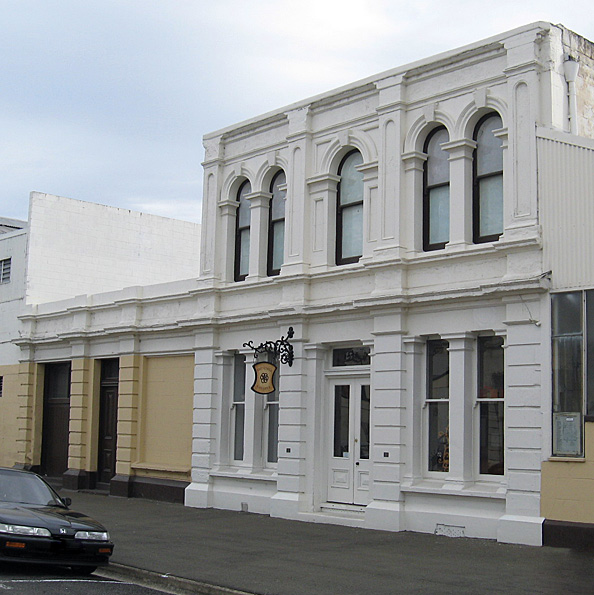
Built in 1884 as home of the Oamaru Mail and of saddlery business Hodge and Jones, this modest stone building is a significant survivor of the Victorian era in what is now a mainly industrial area.
Newspapers were as important in Victorian times as they are today – they provided factual information, acted as watchdogs against abuse of power and were a forum for opinions. Oamaru supported a number of newspapers in its early years: Frank Pinkerton published the Oamaru Times and Waitaki Reporter (after 1872 the North Otago Times) in early 1864. In April 1870 William Roynane and Co published the Oamaru Herald later incorporated into the Oamaru Times. In 1876 William Steward, then mayor of Oamaru, published the short-lived North Otago Standard.
A group of local businessmen decided that an evening newspaper should be published in the town. The paper was registered as the ‘Evening Mail’, and the first issue came out on 22 April 1876. The paper’s first premises were a single storey building on Tyne Street. The paper was not a great success. It was rescued by George Jones (1844-1920), an experienced printer and publisher. He bought the company and issued his first publication on 12 May 1877.
Jones, born in the Hutt Valley and educated in Geelong, was involved in the printing business from the age of fourteen. He returned to New Zealand in 1863 and was employed on a number of papers. He founded the Waikato Times in 1870 and two years later the Echo in Auckland. He founded the Evening News in Dunedin before buying the Evening Mail in 1877. He won the Waitaki seat in Parliament in 1880. He was also called to the Legislative Council, serving two terms until his death in 1920.
Jones changed the Evening Mail’s fortune, although in an unexpected way. He devoted an article to the subject of speculation around native lands in relation to a Bill before parliament, implying that the then Attorney General was an interested party. Jones was summoned to appear in the House, where he was recalcitrant and was made a prisoner under the Sergeant of Arms. The House ordered a criminal prosecution. Jones was tried for libel by a special jury and acquitted. This was the first State trial by order of Parliament. It vindicated the right of the press to comment on matters of public interest. As a result the Evening Mail became notorious and attracted much publicity. Businesses were keen to advertise and the paper grew. In March 1879 Jones decided to identify his paper with the town and changed the title to the Oamaru Mail. Such was the growth of the paper that new premises were needed.
Forrester and Lemon designed a new two storeyed building on the west side of Tyne Street in 1884. Tenders were advertised in the Oamaru Mail on 29 February 1884.
In May 1884 saddlers Hodge and Jones moved into their new premises. Photographs identify their shop as the single storey premises adjacent to the Oamaru Mail’s two storey building. Archibald Hodge and William Jones (no relation to George) took over the business of Thomas Morris in 1877. They carried on the business together until Jones’ death in 1903, after which time Hodge continued to trade as Hodge and Jones.
By 1900 linotypes were installed and a weekly supplement was added. By 1905 the paper was double the size it had been in 1877. The Oamaru Mail played another significant role in Oamaru with the owner and editor’s support for the Prohibition movement in North Otago. No license was secured for Oamaru in 1905, the cause publicised through the columns of the paper.
In 1906 the Oamaru Mail moved to new premises on the east side of Tyne Street in what had been Smith’s Grain Store (Register No. 4380). Hodge and Jones relocated their premises to Thames Street in 1908.
George Jones died in 1920 and was remembered for his notable fifty year career in journalism and his contribution to New Zealand politics.
After the Oamaru Mail and Hodge and Jones moved out Neil Gilchrist bought the property in 1909. He sold to the Waitaki Dairy Company in 1912. They occupied the premises until The Taieri and Peninsula Milk Supply Company Ltd and The Cooperative Dairy Company of Otago Ltd in 1939 bought the property in 1939. From the 1940s the building has been associated with engineering companies – first the North Otago Engineering Company and later Gilllies Engineering Company.
In 2013 the former ‘Oamaru Mail Office and Hodge and Jones’ Saddlery’ remains significant as a surviving Victorian building in the Harbour/Tyne Historic Area and is home to the Crucible Gallery.
Newspapers were as important in Victorian times as they are today – they provided factual information, acted as watchdogs against abuse of power and were a forum for opinions. Oamaru supported a number of newspapers in its early years: Frank Pinkerton published the Oamaru Times and Waitaki Reporter (after 1872 the North Otago Times) in early 1864. In April 1870 William Roynane and Co published the Oamaru Herald later incorporated into the Oamaru Times. In 1876 William Steward, then mayor of Oamaru, published the short-lived North Otago Standard.
A group of local businessmen decided that an evening newspaper should be published in the town. The paper was registered as the ‘Evening Mail’, and the first issue came out on 22 April 1876. The paper’s first premises were a single storey building on Tyne Street. The paper was not a great success. It was rescued by George Jones (1844-1920), an experienced printer and publisher. He bought the company and issued his first publication on 12 May 1877.
Jones, born in the Hutt Valley and educated in Geelong, was involved in the printing business from the age of fourteen. He returned to New Zealand in 1863 and was employed on a number of papers. He founded the Waikato Times in 1870 and two years later the Echo in Auckland. He founded the Evening News in Dunedin before buying the Evening Mail in 1877. He won the Waitaki seat in Parliament in 1880. He was also called to the Legislative Council, serving two terms until his death in 1920.
Jones changed the Evening Mail’s fortune, although in an unexpected way. He devoted an article to the subject of speculation around native lands in relation to a Bill before parliament, implying that the then Attorney General was an interested party. Jones was summoned to appear in the House, where he was recalcitrant and was made a prisoner under the Sergeant of Arms. The House ordered a criminal prosecution. Jones was tried for libel by a special jury and acquitted. This was the first State trial by order of Parliament. It vindicated the right of the press to comment on matters of public interest. As a result the Evening Mail became notorious and attracted much publicity. Businesses were keen to advertise and the paper grew. In March 1879 Jones decided to identify his paper with the town and changed the title to the Oamaru Mail. Such was the growth of the paper that new premises were needed.
Forrester and Lemon designed a new two storeyed building on the west side of Tyne Street in 1884. Tenders were advertised in the Oamaru Mail on 29 February 1884.
In May 1884 saddlers Hodge and Jones moved into their new premises. Photographs identify their shop as the single storey premises adjacent to the Oamaru Mail’s two storey building. Archibald Hodge and William Jones (no relation to George) took over the business of Thomas Morris in 1877. They carried on the business together until Jones’ death in 1903, after which time Hodge continued to trade as Hodge and Jones.
By 1900 linotypes were installed and a weekly supplement was added. By 1905 the paper was double the size it had been in 1877. The Oamaru Mail played another significant role in Oamaru with the owner and editor’s support for the Prohibition movement in North Otago. No license was secured for Oamaru in 1905, the cause publicised through the columns of the paper.
In 1906 the Oamaru Mail moved to new premises on the east side of Tyne Street in what had been Smith’s Grain Store (Register No. 4380). Hodge and Jones relocated their premises to Thames Street in 1908.
George Jones died in 1920 and was remembered for his notable fifty year career in journalism and his contribution to New Zealand politics.
After the Oamaru Mail and Hodge and Jones moved out Neil Gilchrist bought the property in 1909. He sold to the Waitaki Dairy Company in 1912. They occupied the premises until The Taieri and Peninsula Milk Supply Company Ltd and The Cooperative Dairy Company of Otago Ltd in 1939 bought the property in 1939. From the 1940s the building has been associated with engineering companies – first the North Otago Engineering Company and later Gilllies Engineering Company.
In 2013 the former ‘Oamaru Mail Office and Hodge and Jones’ Saddlery’ remains significant as a surviving Victorian building in the Harbour/Tyne Historic Area and is home to the Crucible Gallery.