Built on the western bank of the Turanganui River, The Cenotaph was unveiled on 25 April 1923 in honour of the district’s servicemen who fell during the First World War. A war memorial was first suggested by the local newspaper in 1919. World War One memorials were encouraged by Anzac Day celebrations, which became prominent in the early 1920s and required a permanent focus for the community’s annual tribute to the dead. Its construction was proposed by C.E. Armstrong, the District Engineer, and H.G. Kells, and the monument was designed by Edward Armstrong. The style of the memorial was chosen at the suggestion of the architect’s father, C.E. Armstrong, District Engineer, Public Works Department and H.G. Kells, a prominent citizen and fellow borough councillor. Initially the proposal was to create a memorial through improvements to Waikanae Beach, but by 1920 this idea had been replaced by proposals for a park on Kaiti Hill, and a memorial located in the town centre. In form, the memorial is a cenotaph, a style that had been promoted by the local newspaper after the Whitehall Cenotaph designed by Edwin Lutyens. The lions and soldier were carved overseas and shipped into Gisborne. Messrs Kane and Griffen were contracted to assemble the monument, and it was officially unveiled by Col. C.W. Melville, on Anzac Day in 1923, the eighth anniversary of the historic landing on Gallipoli Peninsula.
Since then it has been the site of Gisborne’s Anzac Day parade and service, and has become a lasting tribute to those who died in the Great War. The monument was much admired in the East Cape region and other local war memorials show its influence. In 1995 four more bronze plaques, bearing the names of those killed during World War Two and later overseas campaigns were designed to match the original plaques. This project was steered by the Gisborne branch of the Returned Services Association, with the advice of the NZ Historic Places Trust. The new plaques were added to the cenotaph and formally unveiled on Anzac Day, 1995. The Cenotaph is now a tribute to all Tairawhiti citizens who have died in war.
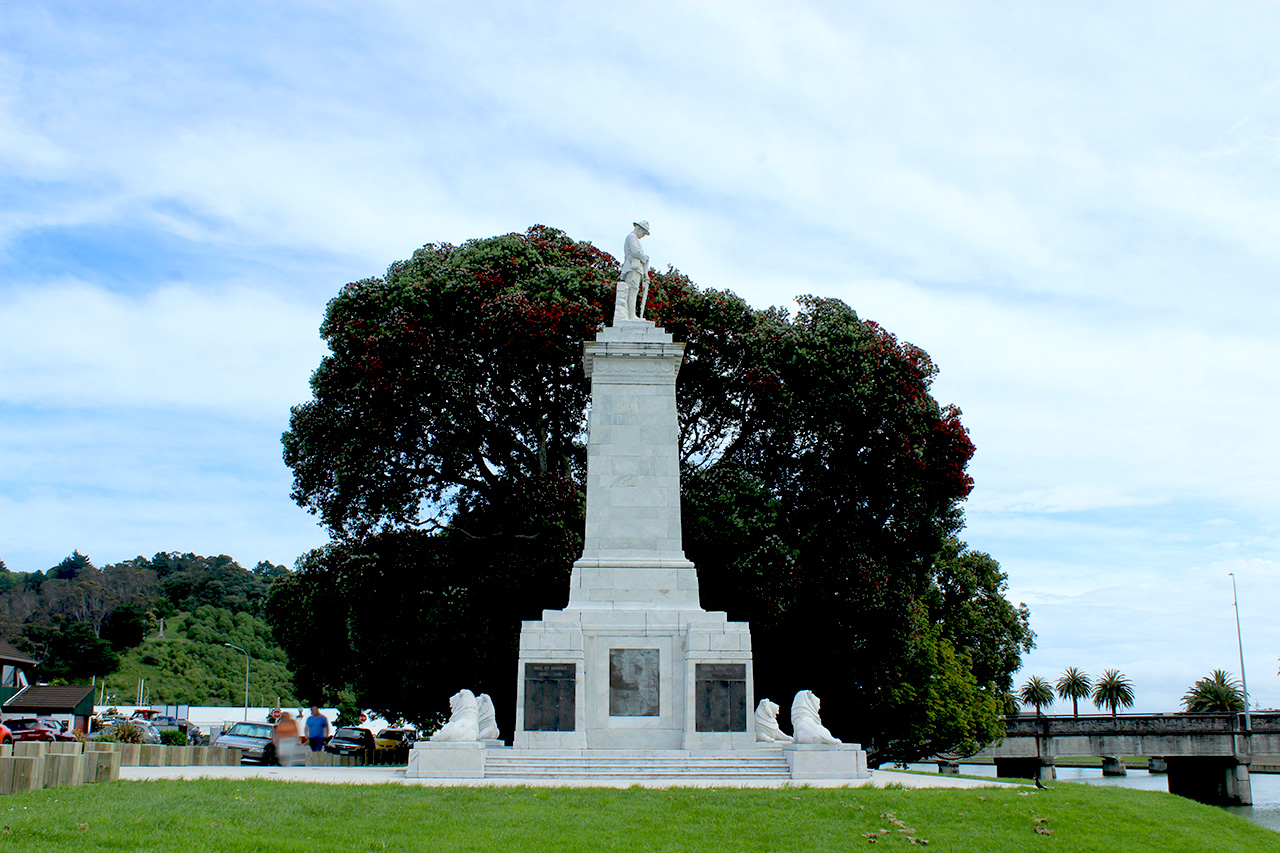
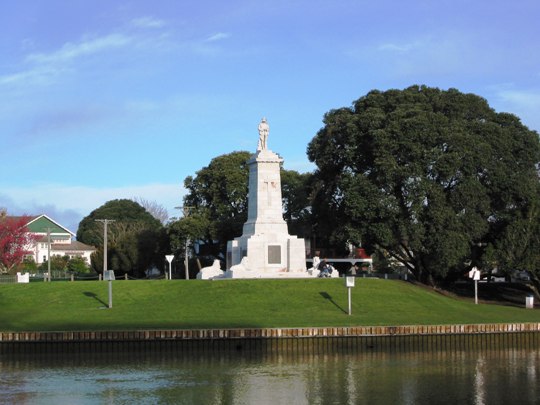
The Cenotaph has jarrah piled foundations, reinforced concrete base and concrete shaft faced with Carrara marble. The marble blocks are butt-joined and backed with concrete. The statue is marble. The monument consists of a base and pillar supporting a statue. Bronze tablets bearing the names of the fallen are recessed in the centre of each side of the base. Four reclining lions flank the corners of the base. The pillar has crosses carved in relief on opposite sides. An entablature caps the pillar. Above this is the statue of a soldier in reversed arms stance. He portrays the reversed arms stance in memory of the 561 fallen men whose names are inscribed on the bronze tablets.
The Cenotaph suffered significant structural damage in the Gisborne earthquake measuring 6.8, at 8.55pm on 20 December 2007. Consideration of methodology for repair and strengthening is currently underway with work expected to be undertaken in 2011/12.
The Cenotaph has historical significance as Gisborne’s war memorial for the First and Second World Wars, and for all other conflicts in which people from Gisborne were killed in active duty. It has architectural and aesthetic significance as a well-designed and well-executed public memorial, and because of its importance to the townscape as a prominent landmark situated in the Esplanade Park, overlooking the rivers confluence and the town centre. The much admired monument has influenced other local war memorials. The architect, Edward Armstrong, was very likely to have drawn on overseas influences for his design and with its graceful form and finely carved status it is a particularly fine example of that distinctive feature of New Zealand towns and cities – the war memorial.
Since then it has been the site of Gisborne’s Anzac Day parade and service, and has become a lasting tribute to those who died in the Great War. The monument was much admired in the East Cape region and other local war memorials show its influence. In 1995 four more bronze plaques, bearing the names of those killed during World War Two and later overseas campaigns were designed to match the original plaques. This project was steered by the Gisborne branch of the Returned Services Association, with the advice of the NZ Historic Places Trust. The new plaques were added to the cenotaph and formally unveiled on Anzac Day, 1995. The Cenotaph is now a tribute to all Tairawhiti citizens who have died in war.
The Cenotaph has jarrah piled foundations, reinforced concrete base and concrete shaft faced with Carrara marble. The marble blocks are butt-joined and backed with concrete. The statue is marble. The monument consists of a base and pillar supporting a statue. Bronze tablets bearing the names of the fallen are recessed in the centre of each side of the base. Four reclining lions flank the corners of the base. The pillar has crosses carved in relief on opposite sides. An entablature caps the pillar. Above this is the statue of a soldier in reversed arms stance. He portrays the reversed arms stance in memory of the 561 fallen men whose names are inscribed on the bronze tablets.
The Cenotaph suffered significant structural damage in the Gisborne earthquake measuring 6.8, at 8.55pm on 20 December 2007. Consideration of methodology for repair and strengthening is currently underway with work expected to be undertaken in 2011/12.
The Cenotaph has historical significance as Gisborne’s war memorial for the First and Second World Wars, and for all other conflicts in which people from Gisborne were killed in active duty. It has architectural and aesthetic significance as a well-designed and well-executed public memorial, and because of its importance to the townscape as a prominent landmark situated in the Esplanade Park, overlooking the rivers confluence and the town centre. The much admired monument has influenced other local war memorials. The architect, Edward Armstrong, was very likely to have drawn on overseas influences for his design and with its graceful form and finely carved status it is a particularly fine example of that distinctive feature of New Zealand towns and cities – the war memorial.