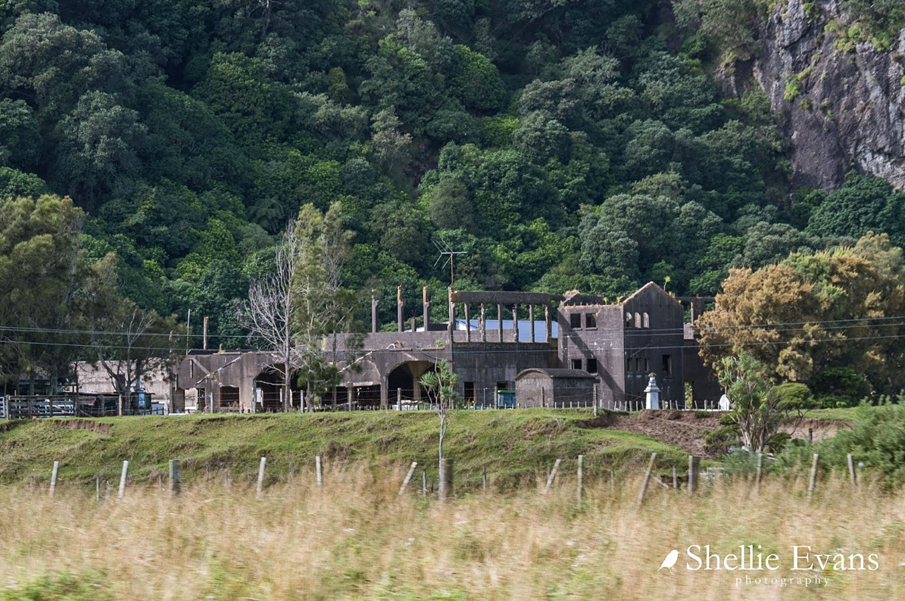
The industrial ruins of the freezing works at Hicks Bay represent the sense of promise, potential (and hubris) that captured the East Coast farming industry in the early twentieth century. In April 1919, ten optimistic coastal farmers formed the Hicks Bay Farmers Meat Company with capital of £75,000 (75,000 shares at £1). Its goal was to maximise the area's agricultural potential by constructing a freezing works and wharf. The nearest freezing works was at Tokomaru Bay, and stock had to be driven over difficult country or sent by boat from the Onepoto landing reserve or the Te Araroa jetty. As the district carried over 400,000 sheep and appeared to have excellent growth prospects, it seemed logical and profitable to build a freezing works at Hicks Bay, particularly given its physical location central to stock movement of the east coast farming area and stock movement by both road and scow feasible.'
The freezing works was to be built of reinforced concrete, with a killing capacity of 1000 sheep and 40 cattle per day, a cold storage facility for 60,000 carcases, a fellmongery and woolstore. There were problems with the original location on the south side of the bay at Onepoto, where one of the company's directors offered 35 acres for the works, so another site on the northern end of Hicks Bay beside the Wharekahika River was chosen, and 10 acres of land purchased from Tipiwai Houkamau. It seems the Hicks Bay farmers overreached themselves while the works were still under construction, and they were bought out by the Gisborne Sheepfarmers Frozen Meat Co in 1920.
Gundry notes that 'As well as the new works, a quarter-mile-long road to a temporary jetty at Maraengaro Cove, the eventual site of a permanent wharf, was built. The combined work cost more than £100,000.' A compact group of buildings, between two and three storeys high, surrounded by sheds, offices and residences, the works were built of concrete and timber, and had multi gabled roofs, many including skylights and belvederes.
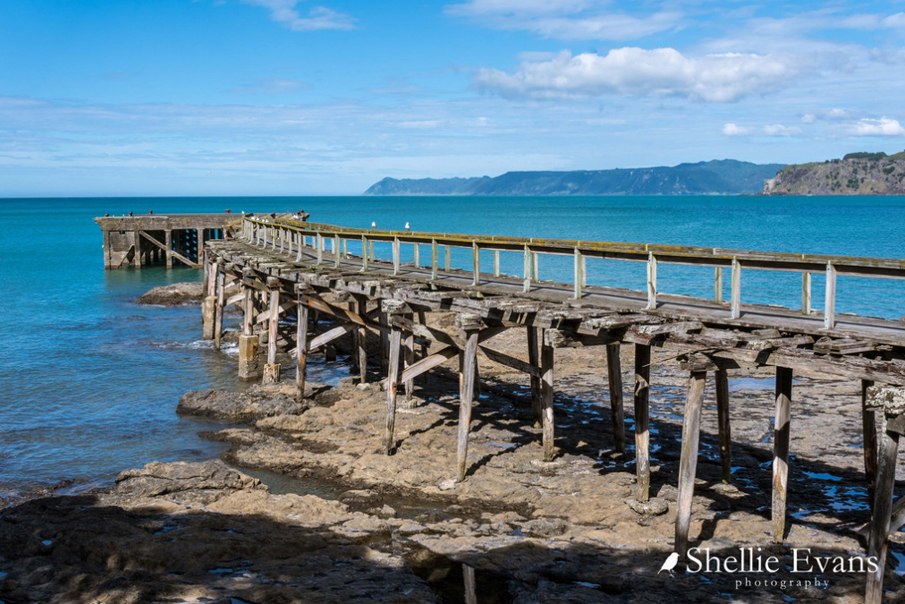
The Hicks Bay freezing works opened for business in March 1921, bringing the number of works in the region to five and demonstrating a confidence, misplaced or otherwise, in the industry's growth in Tairawhiti. A new permanent wharf at Hicks Bay, designed by Blair Mason and constructed by C. McCracken, was completed in 1925 and cost £8334. But it quickly became clear that the region could not supply sufficient stock for the freezing works, and it closed sometime between 1924 and 1926. Everything saleable was stripped from the works following closure and the remains sold in 1928, to a private buyer who later converted a small part of it into a holiday home. In the late 1980s it sold to a former Tokomaru Bay solo slaughterman, Lance Roberts, who lived in the buildings known as the sorting room. Today parts of the concrete shell remain, with what was probably the southernmost building having survived the most.
The Hicks Bay Freezing Works Ruins has significance as an industrial ruin. It is a rich statement about the failures of the promise of capitalism, and an escape from the predictability, sameness and sense of control found in the built environment. The ruin has historical value as remaining evidence of Hicks Bay's freezing works, and the economic ambitions of its citizens. It speaks to the importance of farming in the Tairawhiti region, and as part of a network of freezing works ruins in Gisborne and Tokomaru Bay, indicates how extensive this industry was in the early years of the twentieth century.
The freezing works was to be built of reinforced concrete, with a killing capacity of 1000 sheep and 40 cattle per day, a cold storage facility for 60,000 carcases, a fellmongery and woolstore. There were problems with the original location on the south side of the bay at Onepoto, where one of the company's directors offered 35 acres for the works, so another site on the northern end of Hicks Bay beside the Wharekahika River was chosen, and 10 acres of land purchased from Tipiwai Houkamau. It seems the Hicks Bay farmers overreached themselves while the works were still under construction, and they were bought out by the Gisborne Sheepfarmers Frozen Meat Co in 1920.
Gundry notes that 'As well as the new works, a quarter-mile-long road to a temporary jetty at Maraengaro Cove, the eventual site of a permanent wharf, was built. The combined work cost more than £100,000.' A compact group of buildings, between two and three storeys high, surrounded by sheds, offices and residences, the works were built of concrete and timber, and had multi gabled roofs, many including skylights and belvederes.
The Hicks Bay freezing works opened for business in March 1921, bringing the number of works in the region to five and demonstrating a confidence, misplaced or otherwise, in the industry's growth in Tairawhiti. A new permanent wharf at Hicks Bay, designed by Blair Mason and constructed by C. McCracken, was completed in 1925 and cost £8334. But it quickly became clear that the region could not supply sufficient stock for the freezing works, and it closed sometime between 1924 and 1926. Everything saleable was stripped from the works following closure and the remains sold in 1928, to a private buyer who later converted a small part of it into a holiday home. In the late 1980s it sold to a former Tokomaru Bay solo slaughterman, Lance Roberts, who lived in the buildings known as the sorting room. Today parts of the concrete shell remain, with what was probably the southernmost building having survived the most.
The Hicks Bay Freezing Works Ruins has significance as an industrial ruin. It is a rich statement about the failures of the promise of capitalism, and an escape from the predictability, sameness and sense of control found in the built environment. The ruin has historical value as remaining evidence of Hicks Bay's freezing works, and the economic ambitions of its citizens. It speaks to the importance of farming in the Tairawhiti region, and as part of a network of freezing works ruins in Gisborne and Tokomaru Bay, indicates how extensive this industry was in the early years of the twentieth century.