DonateMembershipVisit Heritage
  • Tūrangawaewae
    Places
  • Tira Māori
    Māori Heritage
  • Poutairangahia
    Archaeology
  • Rauemi
    Resources
  • Mō Tātou
    About Us
  • New Zealand Heritage List
  • Nominate and submit
  • Explore the List
  • National Historic Landmarks
  • Plaques
  • Rainbow List Project
  • Lost heritage
  • Visit Heritage
  • Our properties
  • Turnbull House Project
  • Collections
  • Shop
  • Tohu Whenua
  • Tira Māori
  • Conserving Māori heritage
  • Marae built heritage
  • Māori heritage on the List
  • Hinemihi—Te Hokinga Mai
  • What is archaeology?
  • Is there a site on my property?
  • What are my legal requirements?
  • Affecting an archaeological site
  • Declaring an archaeological site
  • Archaeology FAQs
  • Archaeology Digital Library
  • Archaeology guidelines and templates
  • Resources
  • Funding
  • Publications
  • Sustainable management guides
  • Disaster recovery
  • Podcasts & digital resources
  • Education Hub
  • Conservation plans
  • About
  • Board
  • Māori Heritage Council
  • Senior Staff
  • Offices
  • Contact us
  • Careers
  • Covenants
  • Fast-track
  • Corporate documents
  • Currently consulting on
  • Our submissions
  • News
  • Covid-19 response
Quick links
Rārangi Kōrero | The List
Explore the List
National Historic Landmarks
Ngā Manawhenua o Aotearoa me ōna Kōrero Tūturu
Quick links
Tapuwae
A Vision for Places of Māori Heritage
Funding for Māori Heritage
Resources
Quick links
Archaeological Authority Portal
Applying for an archaeological authority
Archaeology FAQs
Browse the most frequently asked questions about archaeological authorities and the archaeological process.
Quick links
Quick links
News
News Keep up to date with Heritage New Zealand Pouhere Taonga
Membership
Membership Find out more and sign up today
DonateMembershipVisit Heritage
  • Tūrangawaewae
    Places
  • Tira Māori
    Māori Heritage
  • Poutairangahia
    Archaeology
  • Rauemi
    Resources
  • Mō Tātou
    About Us
  • New Zealand Heritage List
  • Nominate and submit
  • Explore the List
  • National Historic Landmarks
  • Plaques
  • Rainbow List Project
  • Lost heritage
  • Visit Heritage
  • Our properties
  • Turnbull House Project
  • Collections
  • Shop
  • Tohu Whenua
  • Tira Māori
  • Conserving Māori heritage
  • Marae built heritage
  • Māori heritage on the List
  • Hinemihi—Te Hokinga Mai
  • What is archaeology?
  • Is there a site on my property?
  • What are my legal requirements?
  • Affecting an archaeological site
  • Declaring an archaeological site
  • Archaeology FAQs
  • Archaeology Digital Library
  • Archaeology guidelines and templates
  • Resources
  • Funding
  • Publications
  • Sustainable management guides
  • Disaster recovery
  • Podcasts & digital resources
  • Education Hub
  • Conservation plans
  • About
  • Board
  • Māori Heritage Council
  • Senior Staff
  • Offices
  • Contact us
  • Careers
  • Covenants
  • Fast-track
  • Corporate documents
  • Currently consulting on
  • Our submissions
  • News
  • Covid-19 response
Quick links
Rārangi Kōrero | The List
Explore the List
National Historic Landmarks
Ngā Manawhenua o Aotearoa me ōna Kōrero Tūturu
Quick links
Tapuwae
A Vision for Places of Māori Heritage
Funding for Māori Heritage
Resources
Quick links
Archaeological Authority Portal
Applying for an archaeological authority
Archaeology FAQs
Browse the most frequently asked questions about archaeological authorities and the archaeological process.
Quick links
Quick links
News
News Keep up to date with Heritage New Zealand Pouhere Taonga
Membership
Membership Find out more and sign up today
  • Nominate and submit
  • National Historic Landmarks
  • Nominate and submit
  • National Historic Landmarks
  • Conserving Māori heritage
  • Marae built heritage
  • Conserving Māori heritage
  • Marae built heritage
  • Archaeological authorities
  • Archaeology Digital Library
  • Archaeological authorities
  • Archaeology Digital Library
  • All resources
  • Publications
  • Funding
  • All resources
  • Publications
  • Funding
  • FAQs
  • FAQs
Follow us on:
Places
  • Nominate and submit
  • National Historic Landmarks
Tira Māori
  • Conserving Māori heritage
  • Marae built heritage
Archaeology
  • Archaeological authorities
  • Archaeology Digital Library
Resources
  • All resources
  • Publications
  • Funding
FAQs
  • FAQs
Follow us on
HomePrivacyTerms and conditionsAbout this site
© Heritage New Zealand Pouhere Taonga 2026.
 
Gambrill House (Former)

72 Russell Street, Whataupoko, GISBORNE

Private

Historic Place Category 2

List No. 3506

Quick links:
List GalleryLocationDetails
Built in the Gisborne suburbs in 1930, Gambrill House (Former) is a remarkably well-preserved neo-Georgian residence designed by nationally renowned architect Cecil Wood. The only identified example of Wood’s work in the North Island, the place has significance for the well-executed design and construction of the two-storey timber building which is set back from the road in gracious surroundings. It has historical significance for its long association with the Gambrill family, particularly Colonel Reginald Frank Gambrill who held high military rank with links to the Returned Services Association (RSA) and the Home Guard. Its importance is enhanced though surviving documentary records.

The fertile lands around Tūranganui-a-kiwa, now known as Gisborne, have enduring associations with several iwi connected to the waka Te Ikaroa-a-Rauru, Horouta and Tākitimu. In 1883 the Whataupoko block was acquired by the New Zealand Native Land Settlement Company which had been set up by William Lee Rees and Wi Pere in an attempt to facilitate the sale of Māori land for settlement without complex litigation. In 1923, after a number of subdivisions, a substantial property fronting Russell Street was purchased by Reginald Frank Gambrill, a Gisborne solicitor working for the firm Nolan and Skeet, and his Canadian wife Grace Thurza Gambrill (née Brenton). The Gambrills had met and married in England while respectively serving as an army officer and a nurse during the First World War (1914-18) before returning to Reginald’s hometown of Gisborne. In 1930 the Gambrills erected a family home on the property.

Built in an American influenced neo-Georgian style that possibly reflected Grace’s North American upbringing, Gambrill House (Former) was designed by leading interwar architect Cecil Wood and constructed by local builder George W. Aitken. Based in Christchurch, Wood was known for his high-quality designs for a range of building types and was elected president of the New Zealand Institute of Architects in 1937. From 1922, Wood created many high-status suburban residences in the neo-Georgian architectural style – mostly for affluent, educated professionals such as the Gambrills – reflecting his keen interest in international Georgian revival movements. The timber residence was centrally located within a landscaped garden with a number of trees including silver birch with a driveway along the side. The broadly symmetrical design featured a roof gabled on the side elevations, double hung multi-pane sash windows, window boxes and louvered shutters, dentil mouldings, boxed eaves, and a recessed central porch and front door. A small single-story sun porch with balcony above was on one side and there was an attached single-story washhouse to the rear. Internally the main living rooms were arranged around a central entrance hall and stairs downstairs with bedrooms including a maid’s room, and a bathroom upstairs. Many rooms had built-in cupboards and benches and the large living room fireplace also featured dentil moulding mirroring the exterior detailing.

The Gambrill family lived in the residence for nearly forty years. Reginald Gambrill remained closely involved in the Army after taking occupation of the house including being given command of the 1st Battalion, Hawke’s Bay Regiment and later the 2nd N.Z Infantry Brigade, and was promoted to Colonel. During the Second World War (1939-45) Gambrill was put in charge of the Gisborne Home Guard which, following the English model, was established nationally to provide local defence. Gambrill was also district president of the Gisborne RSA between 1926 and 1947 and was described as being the ‘mainspring of the organisation’. Since its creation the place remained structurally unchanged. Some modern amenities were added in or by the 1980s. The rearmost portion of the property was subdivided to build a house for a Gambrill family member in 1967 and in 1984 a garage with a matching roof pitch was added in the northwestern corner of the property. In 2021 the place remains a private residence.
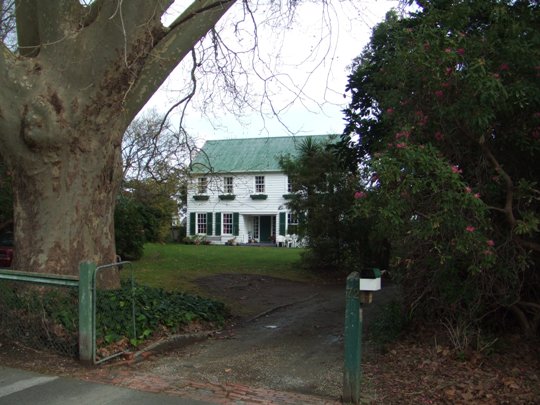
Gambrill House, Gisborne | Damian Skinner | 04/09/2009 | Heritage New Zealand

List Entry Information

Overview

Status
Listed

List Entry Status
Historic Place Category 2

Access
Private/No Public Access

List Number
3506

Date Entered
5th April 1984

Date of Effect
5th April 1984

City/District Council
Gisborne District

Region
Gisborne Region

Extent of List Entry

Extent includes the land described as Lot 1 DP 5194 (RT GS1C/1298), Gisborne Land District, and the buildings and structures known as Gambrill House (Former) thereon.

Legal description

Lot 1 DP 5194 (RT GS1C/1298), Gisborne Land District

Detailed List Entry

Construction Professional

Name

Wood, Cecil Walter

Type

Architect

Biography

Born in Christchurch, Wood (1878-1947) was articled to the local architect Frederick Strouts between 1894 and 1899. He worked for a short time as a draughtsman with the firm Clarkson and Ballantyne before travelling to England in 1901. Here Wood was exposed to a high quality of architectural design in the Edwardian Free Style, and was employed by two leading Edwardian architects Robert Weir Shultz and Leonard Stokes. In 1907 Wood returned to New Zealand to take up partnership with Samuel Hurst Seager. The partnership lasted for only one year for Wood set up his own practice in 1908. The years 1908-1915 were dominated by domestic commissions, but it was also during this time that he began his association with Christ's College, which included such commissions as Hare Memorial Library (1915), the Memorial Dining Hall (1923-5), Jacob's House (1931) and Open Air Classrooms (1932). During the 1920s Wood's practice began to expand and a Georgian influence can be seen in such works as Weston House Park Terrace (1923-4) and Bishopscourt (1926-7). A short lived partnership in 1927 with R S D Harman allowed Wood to travel to the United States while another in 1937 with Paul Pascoe allowed him to travel to England, Europe and the United States without neglecting his practice. During this second trip he made preparations for the design of St Paul's Anglican Cathedral in Wellington, which was erected after his death. During his life Wood had made a substantial contribution to the architecture of Christchurch, having an enthusiasm for both European and American styles.

Construction Details

Start Year

1930

Type

Original Construction

Type

Modification

Description

downstairs shower

Period

Pre-1984

Start Year

1984

Type

Addition

Description

Garage

Start Year

1986

Type

Addition

Description

woodburner installed in downstairs fireplace

Reference

Completion Date

2nd July 2021

Report Written By

Alexandra Foster

Report Written By

This place was identified as significant under previous legislation with different information requirements. It remains significant under the current legislation. There is opportunity under our legislation and policies to add to this information. Further information about this place may be available from the Lower Northern Office of Heritage New Zealand Pouhere Taonga. A fully referenced upgrade report is available on request from the Mid-Northern Area Office of Heritage New Zealand. Please note that entry on the New Zealand Heritage List/Rarangi Korero identifies only the heritage values of the property concerned, and should not be construed as advice on the state of the property, or as a comment of its soundness or safety, including in regard to earthquake risk, safety in the event of fire, or insanitary conditions.

Further Information

Current Usages

Uses: Accommodation

Specific Usage: House

Former Usages

General Usage:: Accommodation

Specific Usage: House

Themes

Web Links

Overview

Status

Listed

List Entry Status

Historic Place Category 2

Access

Private/No Public Access

List Number

3506

Date Entered

5th April 1984

Date of Effect

5th April 1984

City/District Council

Gisborne District

Region

Gisborne Region

Extent of List Entry

Extent includes the land described as Lot 1 DP 5194 (RT GS1C/1298), Gisborne Land District, and the buildings and structures known as Gambrill House (Former) thereon.

Legal description

Lot 1 DP 5194 (RT GS1C/1298), Gisborne Land District

Status

Listed

List Entry Status

Historic Place Category 2

Access

Private/No Public Access

List Number

3506

Date Entered

5th April 1984

Date of Effect

5th April 1984

City/District Council

Gisborne District

Region

Gisborne Region

Extent of List Entry

Extent includes the land described as Lot 1 DP 5194 (RT GS1C/1298), Gisborne Land District, and the buildings and structures known as Gambrill House (Former) thereon.

Legal description

Lot 1 DP 5194 (RT GS1C/1298), Gisborne Land District

Construction Information

Construction Professional

Name

Wood, Cecil Walter

Type

Architect

Biography

Born in Christchurch, Wood (1878-1947) was articled to the local architect Frederick Strouts between 1894 and 1899. He worked for a short time as a draughtsman with the firm Clarkson and Ballantyne before travelling to England in 1901. Here Wood was exposed to a high quality of architectural design in the Edwardian Free Style, and was employed by two leading Edwardian architects Robert Weir Shultz and Leonard Stokes. In 1907 Wood returned to New Zealand to take up partnership with Samuel Hurst Seager. The partnership lasted for only one year for Wood set up his own practice in 1908. The years 1908-1915 were dominated by domestic commissions, but it was also during this time that he began his association with Christ's College, which included such commissions as Hare Memorial Library (1915), the Memorial Dining Hall (1923-5), Jacob's House (1931) and Open Air Classrooms (1932). During the 1920s Wood's practice began to expand and a Georgian influence can be seen in such works as Weston House Park Terrace (1923-4) and Bishopscourt (1926-7). A short lived partnership in 1927 with R S D Harman allowed Wood to travel to the United States while another in 1937 with Paul Pascoe allowed him to travel to England, Europe and the United States without neglecting his practice. During this second trip he made preparations for the design of St Paul's Anglican Cathedral in Wellington, which was erected after his death. During his life Wood had made a substantial contribution to the architecture of Christchurch, having an enthusiasm for both European and American styles.

Construction Details

Start Year

1930

Type

Original Construction

Type

Modification

Description

downstairs shower

Period

Pre-1984

Start Year

1984

Type

Addition

Description

Garage

Start Year

1986

Type

Addition

Description

woodburner installed in downstairs fireplace

Construction Professional

Name

Wood, Cecil Walter

Type

Architect

Biography

Born in Christchurch, Wood (1878-1947) was articled to the local architect Frederick Strouts between 1894 and 1899. He worked for a short time as a draughtsman with the firm Clarkson and Ballantyne before travelling to England in 1901. Here Wood was exposed to a high quality of architectural design in the Edwardian Free Style, and was employed by two leading Edwardian architects Robert Weir Shultz and Leonard Stokes. In 1907 Wood returned to New Zealand to take up partnership with Samuel Hurst Seager. The partnership lasted for only one year for Wood set up his own practice in 1908. The years 1908-1915 were dominated by domestic commissions, but it was also during this time that he began his association with Christ's College, which included such commissions as Hare Memorial Library (1915), the Memorial Dining Hall (1923-5), Jacob's House (1931) and Open Air Classrooms (1932). During the 1920s Wood's practice began to expand and a Georgian influence can be seen in such works as Weston House Park Terrace (1923-4) and Bishopscourt (1926-7). A short lived partnership in 1927 with R S D Harman allowed Wood to travel to the United States while another in 1937 with Paul Pascoe allowed him to travel to England, Europe and the United States without neglecting his practice. During this second trip he made preparations for the design of St Paul's Anglican Cathedral in Wellington, which was erected after his death. During his life Wood had made a substantial contribution to the architecture of Christchurch, having an enthusiasm for both European and American styles.

Construction Details

Start Year

1930

Type

Original Construction

Type

Modification

Description

downstairs shower

Period

Pre-1984

Start Year

1984

Type

Addition

Description

Garage

Start Year

1986

Type

Addition

Description

woodburner installed in downstairs fireplace

Reference

Historical and Associated Iwi / Hapū / Whānau

Completion Date

2nd July 2021

Report Written By

Alexandra Foster

Other Information

This place was identified as significant under previous legislation with different information requirements. It remains significant under the current legislation. There is opportunity under our legislation and policies to add to this information. Further information about this place may be available from the Lower Northern Office of Heritage New Zealand Pouhere Taonga. A fully referenced upgrade report is available on request from the Mid-Northern Area Office of Heritage New Zealand. Please note that entry on the New Zealand Heritage List/Rarangi Korero identifies only the heritage values of the property concerned, and should not be construed as advice on the state of the property, or as a comment of its soundness or safety, including in regard to earthquake risk, safety in the event of fire, or insanitary conditions.

Historical and Associated Iwi / Hapū / Whānau

Completion Date

2nd July 2021

Report Written By

Alexandra Foster

Other Information

This place was identified as significant under previous legislation with different information requirements. It remains significant under the current legislation. There is opportunity under our legislation and policies to add to this information. Further information about this place may be available from the Lower Northern Office of Heritage New Zealand Pouhere Taonga. A fully referenced upgrade report is available on request from the Mid-Northern Area Office of Heritage New Zealand. Please note that entry on the New Zealand Heritage List/Rarangi Korero identifies only the heritage values of the property concerned, and should not be construed as advice on the state of the property, or as a comment of its soundness or safety, including in regard to earthquake risk, safety in the event of fire, or insanitary conditions.

Further Information

Current Usages

Uses: Accommodation

Specific Usage: House

Former Usages

General Usage: Accommodation

Specific Usage: House

Current Usages

Uses: Accommodation

Specific Usage: House

Former Usages

General Usage: Accommodation

Specific Usage: House

Location

Loading
Stay up to date with Heritage this month
