

Tūranganui-a-kiwa has a long history of Māori occupation. The colonial town was laid out by the Crown and named Gisborne in 1870, and expanded north to include the recently subdivided Whataupoko block in 1884. Lot 91 DP 210 was held by a succession of owners before being purchased by A. L. Singer in 1913. Singer had trained at Cambridge and London Universities before moving to Gisborne in 1911. Appointed House Surgeon at Gisborne Hospital, he married Phyllis Lusk the following year. Singer House was built in 1913 both as a marital home and as Arthur Singer’s private surgery.
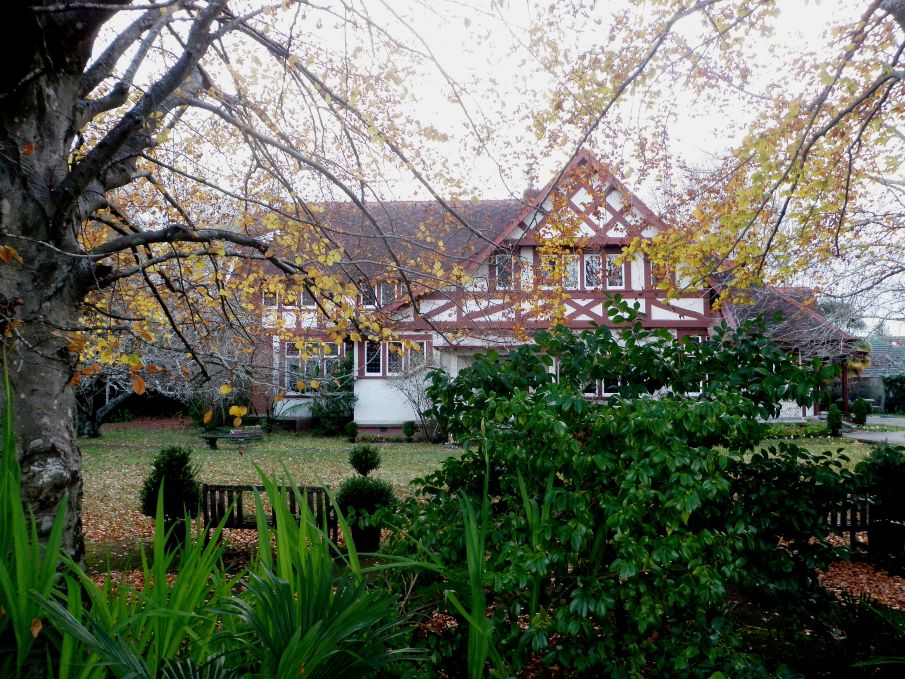
Erected towards the centre of the property and surrounded by a large garden, the substantial Arts and Crafts style building was probably designed by local architect Freddy Forge. Arts and Crafts style originated in England with a focus on craftsmanship, and was commonly used in residential designs. In a New Zealand context, it can also be seen as reflecting close connections with Britain at a time of tightening economic and other imperial ties. Prominent features of this style in the design of Singer House included a steep-pitched roof with decorative half-timbering in the gables, roughcast plaster cladding, Marseilles roof tiles, and leadlight windows - including an example in one of the exterior doors bearing the word ‘surgery’ in patterned glass. As well as incorporating a surgery with a separate entrance, the residence held a number of large family rooms and servants quarters on the ground floor, with bedrooms and a bathroom on the upper level. The asymmetrically-arranged interior was laid out around a central passage and featured wooden panelling in a number of rooms.
The Singers temporarily left Gisborne in 1915, after which Arthur served overseas in the First World War as part of the Royal Army Medical Corps and later the New Zealand Medical Corps. He returned to practice both at the Gisborne Hospital and as a general practitioner from his home in 1920. Arthur Singer was heavily involved in the local community, becoming Director of the Gisborne Art Gallery and Museum, and President of both the Gisborne Art Society and the Gisborne branch of the Red Cross. He was also a Gisborne Borough Council member in 1944-7. Singer was similarly involved in national organisations with elected roles as an officer in both the New Zealand Library Association and the New Zealand Legion National Council.
As well as evidently fencing the property, the Singers built a garage fronting Stout Street, possibly at an early stage after construction of the house and certainly before 1942. In 1950 they subdivided the northwest part of the property and sold Singer House to Hugh Buchanan, a sheepfarmer, the following year. The place has subsequently had a number of owners, and at an unknown date a lean-to addition was added on the east side of the garage. In 2018 Singer House remained a private residence.
List Entry Information
Status
Listed
List Entry Status
Historic Place Category 2
Access
Private/No Public Access
List Number
3520
Date Entered
5th April 1984
Date of Effect
5th April 1984
City/District Council
Gisborne District
Region
Gisborne Region
Extent of List Entry
Extent includes the land described as Pt Lot 91 DP Blk C 210 (RT GS103/6), Gisborne Land District, and the buildings known as Singer House thereon.
Legal description
Pt Lot 91 DP Blk C 210 (RT GS103/6), Gisborne Land District
Status
Listed
List Entry Status
Historic Place Category 2
Access
Private/No Public Access
List Number
3520
Date Entered
5th April 1984
Date of Effect
5th April 1984
City/District Council
Gisborne District
Region
Gisborne Region
Extent of List Entry
Extent includes the land described as Pt Lot 91 DP Blk C 210 (RT GS103/6), Gisborne Land District, and the buildings known as Singer House thereon.
Legal description
Pt Lot 91 DP Blk C 210 (RT GS103/6), Gisborne Land District
Construction Professional
Name
F.H. Forge
Type
Architect
Biography
No biography is currently available for this construction professional
Construction Details
Start Year
1913
startYearCirca
Type
Original Construction
Type
Additional building added to site
Description
Garage built
Period
Pre-1942
Construction Professional
Name
F.H. Forge
Type
Architect
Biography
No biography is currently available for this construction professional
Construction Details
Start Year
1913
startYearCirca
Type
Original Construction
Type
Additional building added to site
Description
Garage built
Period
Pre-1942
Historical and Associated Iwi / Hapū / Whānau
Completion Date
27th June 2018
Report Written By
Alexandra Foster
Information Sources
Tairawhiti Museum
Tairawhiti Museum, 231/6 A-C
Te Ara - The Encyclopedia of New Zealand
www.TeAra.govt.nz
Auckland War Memorial Museum, Online Cenotaph
Hoare, Richard 2014
Hoare, Richard, Singer’s Legacy: His Family and his Home¸ Birmingham, 2014.
Other Information
This place was identified as significant under previous legislation with different information requirements. It remains significant under the current legislation. There is opportunity under our legislation and policies to add to this information. Further information about this place may be available from the Lower Northern Office of Heritage New Zealand Pouhere Taonga. Please note that entry on the New Zealand Heritage List/Rarangi Korero identifies only the heritage values of the property concerned, and should not be construed as advice on the state of the property, or as a comment of its soundness or safety, including in regard to earthquake risk, safety in the event of fire, or insanitary conditions. A fully referenced upgrade report is available on request from the Northern Region Office of Heritage New Zealand.
Historical and Associated Iwi / Hapū / Whānau
Completion Date
27th June 2018
Report Written By
Alexandra Foster
Information Sources
Tairawhiti Museum
Tairawhiti Museum, 231/6 A-C
Te Ara - The Encyclopedia of New Zealand
www.TeAra.govt.nz
Auckland War Memorial Museum, Online Cenotaph
Hoare, Richard 2014
Hoare, Richard, Singer’s Legacy: His Family and his Home¸ Birmingham, 2014.
Other Information
This place was identified as significant under previous legislation with different information requirements. It remains significant under the current legislation. There is opportunity under our legislation and policies to add to this information. Further information about this place may be available from the Lower Northern Office of Heritage New Zealand Pouhere Taonga. Please note that entry on the New Zealand Heritage List/Rarangi Korero identifies only the heritage values of the property concerned, and should not be construed as advice on the state of the property, or as a comment of its soundness or safety, including in regard to earthquake risk, safety in the event of fire, or insanitary conditions. A fully referenced upgrade report is available on request from the Northern Region Office of Heritage New Zealand.
Current Usages
Uses: Accommodation
Specific Usage: House
Former Usages
General Usage: Accommodation
Specific Usage: House
General Usage: Health
Specific Usage: Doctor’s Surgery
Current Usages
Uses: Accommodation
Specific Usage: House
Former Usages
General Usage: Accommodation
Specific Usage: House
General Usage: Health
Specific Usage: Doctor’s Surgery
Location
Sign up to hear more
Get the latest heritage news, features and events delivered
straight to your inbox.
