

The Gisborne Railway Station was built by local Gisborne firm Mathieson and Baldock, and it was designed by George Troup, a draughtsman and engineer with, and later head of the architectural branch of New Zealand Railways. Troup designed a series of standard plans, and the Gisborne Railway Station is from Class B which, as J.B. Mahoney writes,
'offered seven choices ranging from an unattended station 44 ft long and containing lobby and ladies' waiting room, to a station 103 ft long and containing lobby and ladies' waiting room, tickets and parcels office, stationmaster, porters and lamp room.'
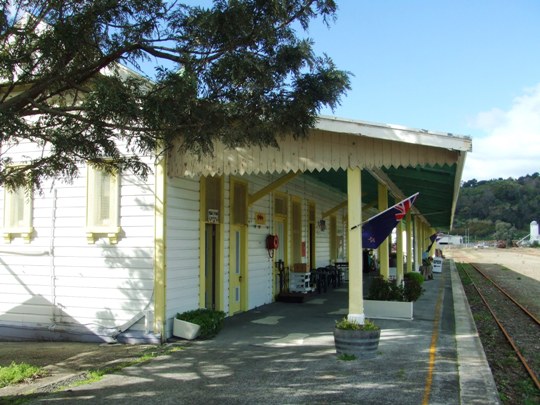
The station is a long timber frame one storey building, with a basically rectangular floor plan. The exterior walls are rusticated timber and the building has a corrugated iron gable roof. A concrete platform runs the length of the station's south side, extending beyond each end. The interior is divided into nine rooms connected by internal doors, including a bathroom at the west end. Many early interior features are intact, including moulded baseboards, dado, cornices and window-frames, with vertical tongue-and-groove lining below the dado and horizontal tongue-and-groove lining above it.
In June 1902 the Poverty Bay Herald featured a long report on the festivities associated with the opening of Gisborne's railway station. It is a touching example of optimism and a demonstration of the excitement that came with the railways. 'Gisborne weather favoured the event and the town, which has been splendidly decorated with festoons of flags along the streets, and with splendid arches, looked gayer than it ever had before.' The first train out of the station was greeted by ‘the cheers from several thousand throats, the waving of flags by happy children aboard the cars, and the loud explosion of detonators placed on the line'.
By 1939, with the rail link to Napier close to completion, it was decided that the old station building, yard and sidings needed to be completely reorganised and expanded. The station building was moved some distance directly back, expanded and internally rearranged. The work took over a year and left Gisborne with an entirely different station layout, although externally the station was only extended a few metres. There were further internal alterations to the station building in 1944 when a new stationmaster's office was installed. Further shelter was provided in 1950 when the verandah at the redundant Te Karaka station (opened 1905) was shifted to Gisborne and added onto the existing verandah. There were further alterations to the booking office in 1964. The main interior changes in recent years are the remodelled fireplace, and the subdivision of the baggage room by the construction of an internal wall in 1992. The station now houses boutique retail outlets.
The Gisborne Railway Station is architecturally significant as an example of the Class B railway station designed by George Troup for New Zealand Railways. While Class B stations do not have the architectural distinction of Troup's individually designed stations, such as those at Dunedin or Blenheim, and were not particularly unique when constructed, they have become important as New Zealand's railway heritage has been gradually demolished. Despite alterations during its lifetime, the Gisborne Railway Station retains a consistent design and has a number of original features. The station is also historically significant as part of the Tairawhiti region's railway network, and a reminder of how important railway connections (between towns in the region, and this region and other places) have been in the economic and social development of Tairawhiti. It also incorporates the verandah of the station at Te Karaka (now demolished). And as a focus of community aspirations, a hub of Gisborne social life in the twentieth century, and a place of thousands of goodbyes and welcomes, Gisborne Railway Station has both social significance and a strong relationship to the community's past.
List Entry Information
Status
Listed
List Entry Status
Historic Place Category 2
Access
Private/No Public Access
List Number
3531
Date Entered
5th April 1984
Date of Effect
5th April 1984
City/District Council
Gisborne District
Region
Gisborne Region
Extent of List Entry
Extent includes the land described as Lot 1 DP 9549 (RT GS6C/1000) (Railway Station NZGZ 1900 p.1692), Gisborne Land District and the buildings and structures known as Gisborne Railway Station thereon, and its fittings and fixtures.
Legal description
Lot 1 DP 9549 (RT GS6C/1000) (Railway Station NZ Gazette 1900 p. 1692), Gisborne Land District
Status
Listed
List Entry Status
Historic Place Category 2
Access
Private/No Public Access
List Number
3531
Date Entered
5th April 1984
Date of Effect
5th April 1984
City/District Council
Gisborne District
Region
Gisborne Region
Extent of List Entry
Extent includes the land described as Lot 1 DP 9549 (RT GS6C/1000) (Railway Station NZGZ 1900 p.1692), Gisborne Land District and the buildings and structures known as Gisborne Railway Station thereon, and its fittings and fixtures.
Legal description
Lot 1 DP 9549 (RT GS6C/1000) (Railway Station NZ Gazette 1900 p. 1692), Gisborne Land District
Construction Professional
Name
Troup, George Alexander
Type
Architect
Biography
G A Troup (1863-1941) was born in London in 1863 and educated in Scotland. He trained as an architect and engineer under C E Calvert of Edinburgh and came to New Zealand in 1884. After a short time with the Survey Department in Otago he became a draughtsman for New Zealand Railways in Dunedin and then, from 1888, in Wellington. Troup became Chief Draughtsman in 1894. He designed many station buildings throughout the county, some of which are still in use today; these buildings form an important part of New Zealand's landscape. His best known building is the Dunedin Railway Station (1904-07). He also designed the head office building in Wellington for Railways (1901, now demolished). Troup became a Fellow of the Royal Institute of British Architects in 1907. After World War I he was promoted to head the newly established Architectural Branch of New Zealand Railways. On retirement from Railways in 1925 he entered local body politics and was Mayor of Wellington from 1927 to 1931. Troup was prominent in the Presbyterian Church and founded the Presbyterian Young Men's Bible Class Union. He was an elder of the church for 47 years and also served on the governing bodies of several Wellington secondary schools. Education was a life-long interest and he was keenly involved in the training of engineering cadets in New Zealand Railways. Troup was knighted in 1937 and died in 1941. Last updated 1 October 2014 See also: James Veitch. 'Troup, George Alexander', Dictionary of New Zealand Biography, first published in 1993. Te Ara - the Encyclopedia of New Zealand, https://teara.govt.nz/en/biographies/2t49/troup-george-alexander
Construction Details
Start Year
1902
Type
Original Construction
Description
Gisborne Railway Station is opened
Start Year
1939
Type
Addition
Description
Station building moved, added to and internally rearranged
Start Year
1944
Type
Modification
Description
New stationmasters office installed
Start Year
1950
Type
Addition
Description
Former Te Karaka Station verandah added on to existing verandah
Start Year
1964
Type
Modification
Description
Alterations to booking office
Start Year
1992
Type
Modification
Description
Fireplace remodelled
Start Year
1992
Type
Modification
Description
Baggage room subdivided with internal wall
Construction Professional
Name
Troup, George Alexander
Type
Architect
Biography
G A Troup (1863-1941) was born in London in 1863 and educated in Scotland. He trained as an architect and engineer under C E Calvert of Edinburgh and came to New Zealand in 1884. After a short time with the Survey Department in Otago he became a draughtsman for New Zealand Railways in Dunedin and then, from 1888, in Wellington. Troup became Chief Draughtsman in 1894. He designed many station buildings throughout the county, some of which are still in use today; these buildings form an important part of New Zealand's landscape. His best known building is the Dunedin Railway Station (1904-07). He also designed the head office building in Wellington for Railways (1901, now demolished). Troup became a Fellow of the Royal Institute of British Architects in 1907. After World War I he was promoted to head the newly established Architectural Branch of New Zealand Railways. On retirement from Railways in 1925 he entered local body politics and was Mayor of Wellington from 1927 to 1931. Troup was prominent in the Presbyterian Church and founded the Presbyterian Young Men's Bible Class Union. He was an elder of the church for 47 years and also served on the governing bodies of several Wellington secondary schools. Education was a life-long interest and he was keenly involved in the training of engineering cadets in New Zealand Railways. Troup was knighted in 1937 and died in 1941. Last updated 1 October 2014 See also: James Veitch. 'Troup, George Alexander', Dictionary of New Zealand Biography, first published in 1993. Te Ara - the Encyclopedia of New Zealand, https://teara.govt.nz/en/biographies/2t49/troup-george-alexander
Construction Details
Start Year
1902
Type
Original Construction
Description
Gisborne Railway Station is opened
Start Year
1939
Type
Addition
Description
Station building moved, added to and internally rearranged
Start Year
1944
Type
Modification
Description
New stationmasters office installed
Start Year
1950
Type
Addition
Description
Former Te Karaka Station verandah added on to existing verandah
Start Year
1964
Type
Modification
Description
Alterations to booking office
Start Year
1992
Type
Modification
Description
Fireplace remodelled
Start Year
1992
Type
Modification
Description
Baggage room subdivided with internal wall
Historical and Associated Iwi / Hapū / Whānau
Completion Date
21st June 2010
Report Written By
Damian Skinner, Gail Henry, Linda Pattison
Information Sources
Mackay, 1949
J A Mackay, Historic Poverty Bay and the East Coast, N.I., N.Z, Gisborne, 1949.
Mahoney, 1987
J. D. Mahoney, Down at the Station: A Study of the New Zealand Railway Station, Palmerston North, 1987
Other Information
This place was identified as significant under previous legislation with different information requirements. It remains significant under the current legislation. There is opportunity under our legislation and policies to add to this information. Further information about this place may be available from the Lower Northern Office of Heritage New Zealand Pouhere Taonga. A fully referenced report is available from the NZHPT Lower Northern Area office Please note that entry on the New Zealand Heritage List/Rarangi Korero identifies only the heritage values of the property concerned, and should not be construed as advice on the state of the property, or as a comment of its soundness or safety, including in regard to earthquake risk, safety in the event of fire, or insanitary conditions.
Historical and Associated Iwi / Hapū / Whānau
Completion Date
21st June 2010
Report Written By
Damian Skinner, Gail Henry, Linda Pattison
Information Sources
Mackay, 1949
J A Mackay, Historic Poverty Bay and the East Coast, N.I., N.Z, Gisborne, 1949.
Mahoney, 1987
J. D. Mahoney, Down at the Station: A Study of the New Zealand Railway Station, Palmerston North, 1987
Other Information
This place was identified as significant under previous legislation with different information requirements. It remains significant under the current legislation. There is opportunity under our legislation and policies to add to this information. Further information about this place may be available from the Lower Northern Office of Heritage New Zealand Pouhere Taonga. A fully referenced report is available from the NZHPT Lower Northern Area office Please note that entry on the New Zealand Heritage List/Rarangi Korero identifies only the heritage values of the property concerned, and should not be construed as advice on the state of the property, or as a comment of its soundness or safety, including in regard to earthquake risk, safety in the event of fire, or insanitary conditions.
Current Usages
Uses: Trade
Specific Usage: Shop
Uses: Transport
Specific Usage: Railway station/ platform/ refreshment room
Former Usages
General Usage: Transport
Specific Usage: Railway station/ platform/ refreshment room
Current Usages
Uses: Trade
Specific Usage: Shop
Uses: Transport
Specific Usage: Railway station/ platform/ refreshment room
Former Usages
General Usage: Transport
Specific Usage: Railway station/ platform/ refreshment room
Location
Sign up to hear more
Get the latest heritage news, features and events delivered
straight to your inbox.
