

A sign of civic pride and optimism in the city's future, the reinforced concrete Peel Street Bridge, which crosses the Taruheru River in the city centre of Gisborne, was opened on the 24 November 1923. It replaced a wooden bridge built in 1882 by the New Zealand Land Settlement Company, largely through the efforts of W. L. Rees, a local businessman and Borough Councillor. According to J.A. Mackay, 'It was called “Rees's Folly” because it was believed that Whataupoko was so far out of town that it would not attract residents.' Rees's Folly was a one way bridge and by the 1920s it was unable to cope with the increased traffic flow.
A proposal was made to replace Rees's Folly with a reinforced concrete bridge 'of plain and substantial character', with the bridge's designer, Borough engineer J.A. McDonald estimating the cost of a suitable ferro-concrete bridge to be £28,000.
This 420 foot long, 40 foot wide bridge was constructed in nine spans using reinforced concrete girders resting on octagonal piles. At the Reads Quay corner of the bridge, a set of concrete steps adjoining the rail end runs down onto the esplanade reserve were designed as part of the bridge structure. The contractor was Mr Fred Goodman, who had been associated with the construction of Grafton Road Bridge in Auckland.
Opened with great fanfare in November 1923 by the Mayor, Mr George Wildish, the Peel Street Bridge was celebrated as the first and only permanent public work in Gisborne, and an investment in the future prosperity and prospects of the town. Flags and streamers decorated the bridge and shops and were festooned with coloured lights in the evening, described as a ‘Fairyland' scene to be remembered.
In 1977 the concrete handrails were removed and replaced with galvanised steel rails to increase the visibility for motorists and to reduce the dead load on the bridge. At the same time repairs were made to spalling (damage from water absorption in the concrete) on the bridge structure.
The Peel Street Bridge is historically significant because of its role in the development of Gisborne's transport and communications systems, and the development of the Whataupoko and Mangapapa areas. It is a good example of reinforced concrete bridges, which began to be built in New Zealand in substantial numbers in the early twentieth century. As one of three bridges designed by J.A. McDonald that cross the Taruheru and Turanganui Rivers in the centre of Gisborne, the Peel Street Bridge makes a substantial contribution to the urban fabric of the city, and to the important role that rivers have played in the region's development.
A proposal was made to replace Rees's Folly with a reinforced concrete bridge 'of plain and substantial character', with the bridge's designer, Borough engineer J.A. McDonald estimating the cost of a suitable ferro-concrete bridge to be £28,000.
This 420 foot long, 40 foot wide bridge was constructed in nine spans using reinforced concrete girders resting on octagonal piles. At the Reads Quay corner of the bridge, a set of concrete steps adjoining the rail end runs down onto the esplanade reserve were designed as part of the bridge structure. The contractor was Mr Fred Goodman, who had been associated with the construction of Grafton Road Bridge in Auckland.
Opened with great fanfare in November 1923 by the Mayor, Mr George Wildish, the Peel Street Bridge was celebrated as the first and only permanent public work in Gisborne, and an investment in the future prosperity and prospects of the town. Flags and streamers decorated the bridge and shops and were festooned with coloured lights in the evening, described as a ‘Fairyland' scene to be remembered.
In 1977 the concrete handrails were removed and replaced with galvanised steel rails to increase the visibility for motorists and to reduce the dead load on the bridge. At the same time repairs were made to spalling (damage from water absorption in the concrete) on the bridge structure.
The Peel Street Bridge is historically significant because of its role in the development of Gisborne's transport and communications systems, and the development of the Whataupoko and Mangapapa areas. It is a good example of reinforced concrete bridges, which began to be built in New Zealand in substantial numbers in the early twentieth century. As one of three bridges designed by J.A. McDonald that cross the Taruheru and Turanganui Rivers in the centre of Gisborne, the Peel Street Bridge makes a substantial contribution to the urban fabric of the city, and to the important role that rivers have played in the region's development.
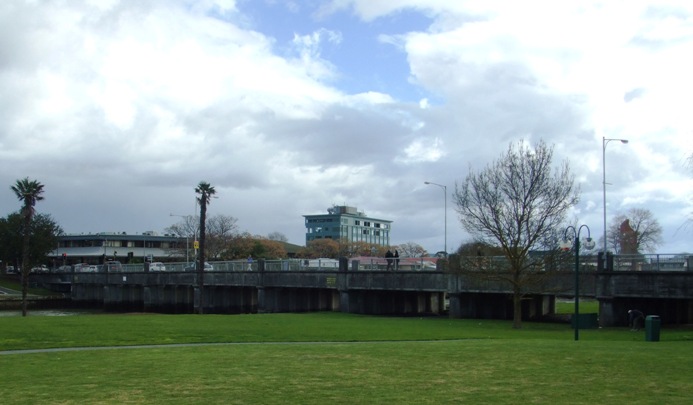
Peel Street, Bridge | Damian Skinner | 24/07/2009 | Heritage New Zealand Pouhere Taonga
Peel Street, Bridge | Damian Skinner | 24/07/2009 | Heritage New Zealand Pouhere Taonga
