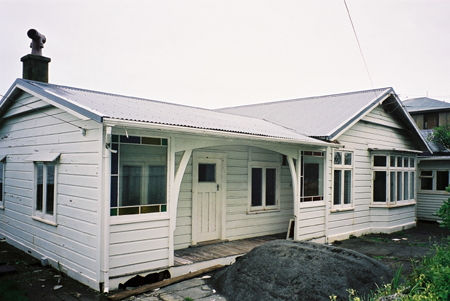
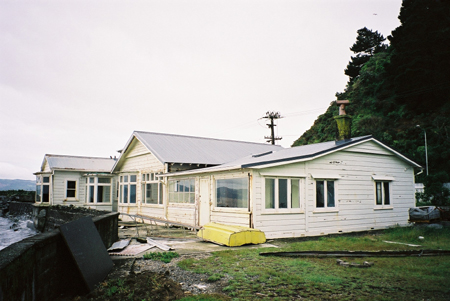
Sited on a rocky outcrop at one end of Days Bay, this house has historical significance as the holiday home for Wellington's Beauchamp family and their daughter Katherine Mansfield (1888-1923), who went on to become New Zealand's most internationally acclaimed writer. Though altered by substantial additions, it is a reminder of the days when the eastern bays of Wellington were sufficiently distant to be a popular holiday destination for those escaping the pressures of the city.
The Māori presence in Wellington began with the explorer Kupe, who travelled to Aotearoa New Zealand from Hawaiki. Following permanent settlement, Whātonga and his sons Tautoki (founder of Rangitāne) and Taraika (the eponymous ancestor of Ngāi Tara) travelled south from Māhia Peninsula and settled at Te Whanganui-a-Tara. Other east coast iwi later migrated and merged with Ngāi Tara to become Ngāti Ira. Days Bay was the location of Ngāti Ira’s Ōruamatoro Pā. In the early nineteenth century, Te Ātiawa, Ngāti Tama and Ngāti Mutunga migrated south from Taranaki and became dominant. When the latter two moved to Wharekauri/Chatham Islands in 1835, their lands were gifted to Te Ātiawa.
Days Bay, named after early Pākehā occupant George Day, was part of the 160,000-acre Port Nicholson Block acquired by the New Zealand Company in 1839. The eastern bays of the harbour became a favoured holiday spot from at least the 1850s. By the 1890s, Days Bay was a major destination and landowner James Williams created an English-style resort over the next two decades. In 1898 Williams sold his caretaker Hugh Downes a small promontory at the north end of the bay. There were four cottages on the land by August 1905, including one that assumed a special place in the early life of Kathleen Beauchamp, better known as writer Katherine Mansfield, as her ‘ideal little “cottage by the sea”’.
The cottage was bought by her father, successful banker and businessman Harold Beauchamp (1853-1939), in March 1906. It became Mansfield’s teenage refuge, a place where she could escape from an increasingly fractious relationship with her father. She wrote: ‘… we bathe and row and walk in the bush or by the sea – and read – and I write …. One could not be lonesome here – I seem to love it more each day – and the sea is a continually new sensation with me’. The cottage is the setting for her 1908 story Rewa and the sea as both an environment and a literary device appears throughout her later work. Its secluded position (‘on the one hand is the sea stretching right up the yard, on the other the bush growing close down almost to my front door’ ) made it the perfect place for assignations with her female lovers Maata Mahupuku and Edie Bendall, which she passionately recorded in her diary. Her experiences in the cottage found their way into her fiction; she explored lesbian attraction in short stories including Leves Amores (1907), The Modern Soul (1911), Bliss (1918), Carnation (1918) and At the Bay (1922).
Harold Beauchamp sold the cottage in 1912 to Wellington grocer David Anderson, whose family owned it for decades. Substantial additions to the cottage were made during their tenure, likely by 1930. In 2013 the house was badly damaged by waves in a storm. Its near liminal location, where the land meets the sea, had always presented vulnerabilities, with Mansfield writing that waves splashed the cottage windows during storms. Major repairs included a second storey on the Anderson-era bungalow extension. Yet, the modest cottage of Mansfield’s lifetime, with its ‘small poverty stricken sitting room [and] cabin like bedroom’, simple stained-glass windows and arched entrance porch, remains the house’s nucleus.
The Māori presence in Wellington began with the explorer Kupe, who travelled to Aotearoa New Zealand from Hawaiki. Following permanent settlement, Whātonga and his sons Tautoki (founder of Rangitāne) and Taraika (the eponymous ancestor of Ngāi Tara) travelled south from Māhia Peninsula and settled at Te Whanganui-a-Tara. Other east coast iwi later migrated and merged with Ngāi Tara to become Ngāti Ira. Days Bay was the location of Ngāti Ira’s Ōruamatoro Pā. In the early nineteenth century, Te Ātiawa, Ngāti Tama and Ngāti Mutunga migrated south from Taranaki and became dominant. When the latter two moved to Wharekauri/Chatham Islands in 1835, their lands were gifted to Te Ātiawa.
Days Bay, named after early Pākehā occupant George Day, was part of the 160,000-acre Port Nicholson Block acquired by the New Zealand Company in 1839. The eastern bays of the harbour became a favoured holiday spot from at least the 1850s. By the 1890s, Days Bay was a major destination and landowner James Williams created an English-style resort over the next two decades. In 1898 Williams sold his caretaker Hugh Downes a small promontory at the north end of the bay. There were four cottages on the land by August 1905, including one that assumed a special place in the early life of Kathleen Beauchamp, better known as writer Katherine Mansfield, as her ‘ideal little “cottage by the sea”’.
The cottage was bought by her father, successful banker and businessman Harold Beauchamp (1853-1939), in March 1906. It became Mansfield’s teenage refuge, a place where she could escape from an increasingly fractious relationship with her father. She wrote: ‘… we bathe and row and walk in the bush or by the sea – and read – and I write …. One could not be lonesome here – I seem to love it more each day – and the sea is a continually new sensation with me’. The cottage is the setting for her 1908 story Rewa and the sea as both an environment and a literary device appears throughout her later work. Its secluded position (‘on the one hand is the sea stretching right up the yard, on the other the bush growing close down almost to my front door’ ) made it the perfect place for assignations with her female lovers Maata Mahupuku and Edie Bendall, which she passionately recorded in her diary. Her experiences in the cottage found their way into her fiction; she explored lesbian attraction in short stories including Leves Amores (1907), The Modern Soul (1911), Bliss (1918), Carnation (1918) and At the Bay (1922).
Harold Beauchamp sold the cottage in 1912 to Wellington grocer David Anderson, whose family owned it for decades. Substantial additions to the cottage were made during their tenure, likely by 1930. In 2013 the house was badly damaged by waves in a storm. Its near liminal location, where the land meets the sea, had always presented vulnerabilities, with Mansfield writing that waves splashed the cottage windows during storms. Major repairs included a second storey on the Anderson-era bungalow extension. Yet, the modest cottage of Mansfield’s lifetime, with its ‘small poverty stricken sitting room [and] cabin like bedroom’, simple stained-glass windows and arched entrance porch, remains the house’s nucleus.