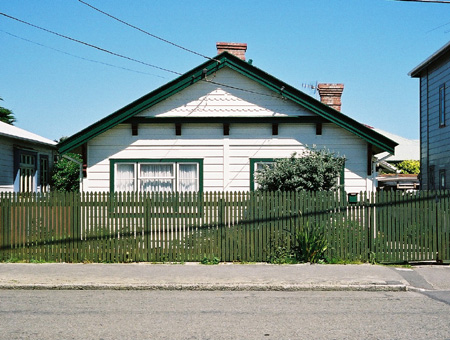
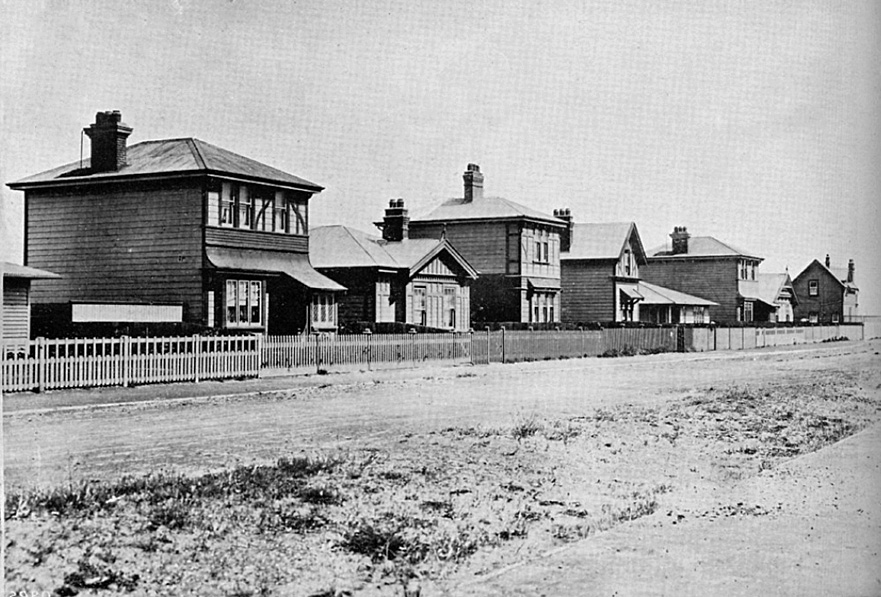
This house is one of the first state houses built in New Zealand. Under the Workers' Dwelling Act 1905 the Liberal Government, led by Premier Richard John Seddon, undertook to provide low cost but quality housing to working families. Land was purchased in the suburbs of the four main centres (Auckland, Wellington, Christchurch, and Dunedin). In order to avoid an image of a 'workers barracks' by erecting all houses to the same design, a competition was held to find a number of designs. From the winning entries two sets of designs were produced, one for the North Island and one for the South Island, to take account of the climatic variation between the two islands. Petone was chosen as the site for the first of these houses primarily because Wellington was considered to have the highest rents in the country. In 1906 the first 25 houses, based on seven designs by prominent New Zealand architects, were built in what was named the Heretaunga Settlement. Initially, interest in applying for the houses was small, primarily due to the cost of rent and the distance of the settlement from the main industrial areas of Petone and Wellington City. Many workers also found it difficult to find the deposit needed to apply for the house. Although changes were made to increase the maximum income limit a worker was allowed to earn, it was not until transport improved that the houses became fully tenanted. Only 9 more houses were built in Petone under the 1905 Act, and by 1919 only 657 had been built throughout the whole country.
In 1984 the registered properties in Patrick Street and adjoining Adelaide Street constructed under the Workers' Dwellings Act 1905 were declared part of an Historic Area by the New Zealand Historic Places Trust.
This house style, known as 'Young New Zealander', was designed by William Gray Young. Gray Young had initially been articled to the Wellington architectural firm of Crichton and McKay, but after winning a competition for the design of Knox College, Dunedin, in 1906, had commenced practice on his own account. He became a prominent New Zealand architect and during a career of 60 years he designed over 500 buildings. This house is one of the architect's first attempts at domestic architecture. It is a single-storeyed house, with a gabled roof, and wide eaves. The windows are double-hung windows, with multi-paned upper sashes. The main entrance is to the side of the house. Only four houses of this design were built.
This house has great historical significance as it was one of the first state houses built under the Workers' Dwelling Act 1905, the first large-scale central government initiative to provide affordable housing to low-income working families. It was part of a wider package of social legislation passed by the Liberal Government (1893-1912). It is also significant as it was designed by notable architect William Gray Young.
In 1984 the registered properties in Patrick Street and adjoining Adelaide Street constructed under the Workers' Dwellings Act 1905 were declared part of an Historic Area by the New Zealand Historic Places Trust.
This house style, known as 'Young New Zealander', was designed by William Gray Young. Gray Young had initially been articled to the Wellington architectural firm of Crichton and McKay, but after winning a competition for the design of Knox College, Dunedin, in 1906, had commenced practice on his own account. He became a prominent New Zealand architect and during a career of 60 years he designed over 500 buildings. This house is one of the architect's first attempts at domestic architecture. It is a single-storeyed house, with a gabled roof, and wide eaves. The windows are double-hung windows, with multi-paned upper sashes. The main entrance is to the side of the house. Only four houses of this design were built.
This house has great historical significance as it was one of the first state houses built under the Workers' Dwelling Act 1905, the first large-scale central government initiative to provide affordable housing to low-income working families. It was part of a wider package of social legislation passed by the Liberal Government (1893-1912). It is also significant as it was designed by notable architect William Gray Young.