

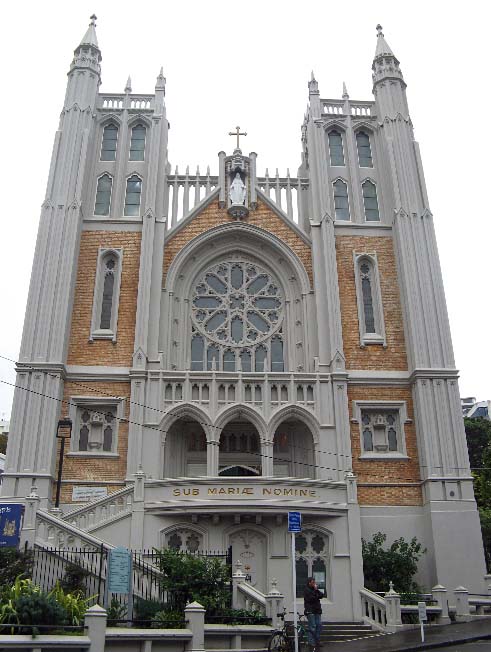
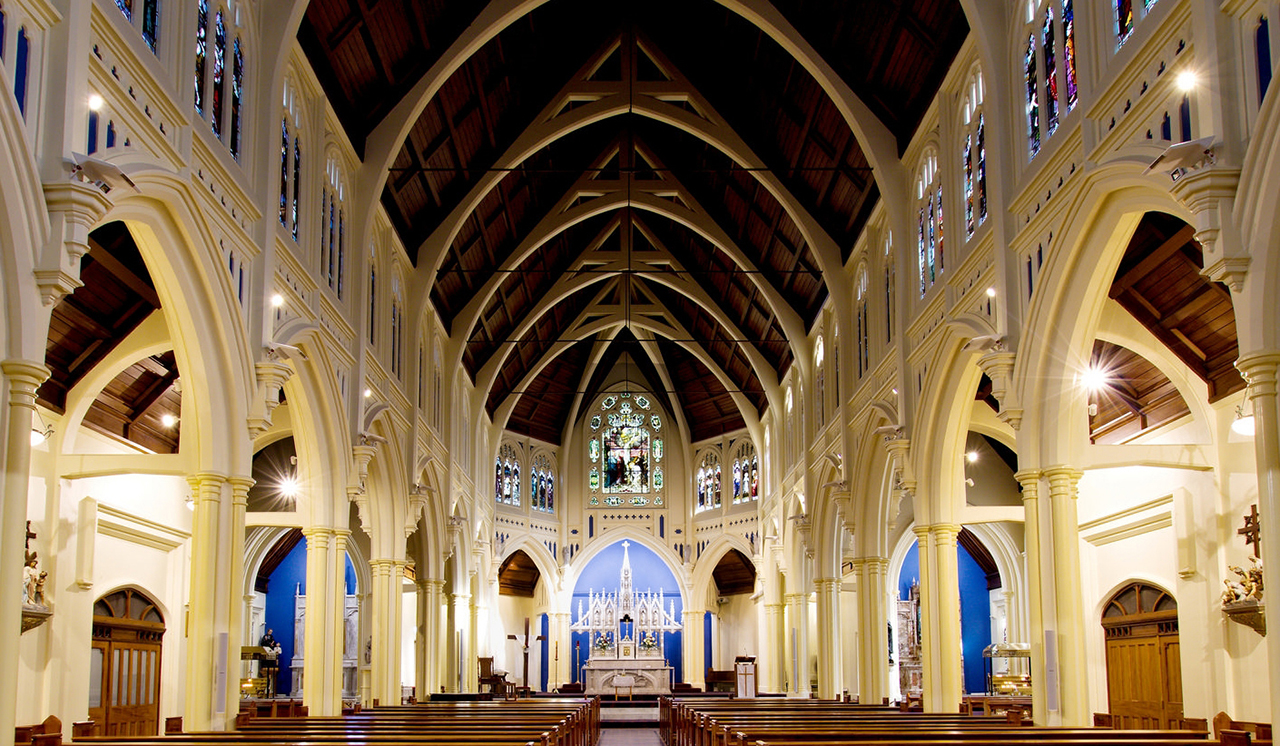
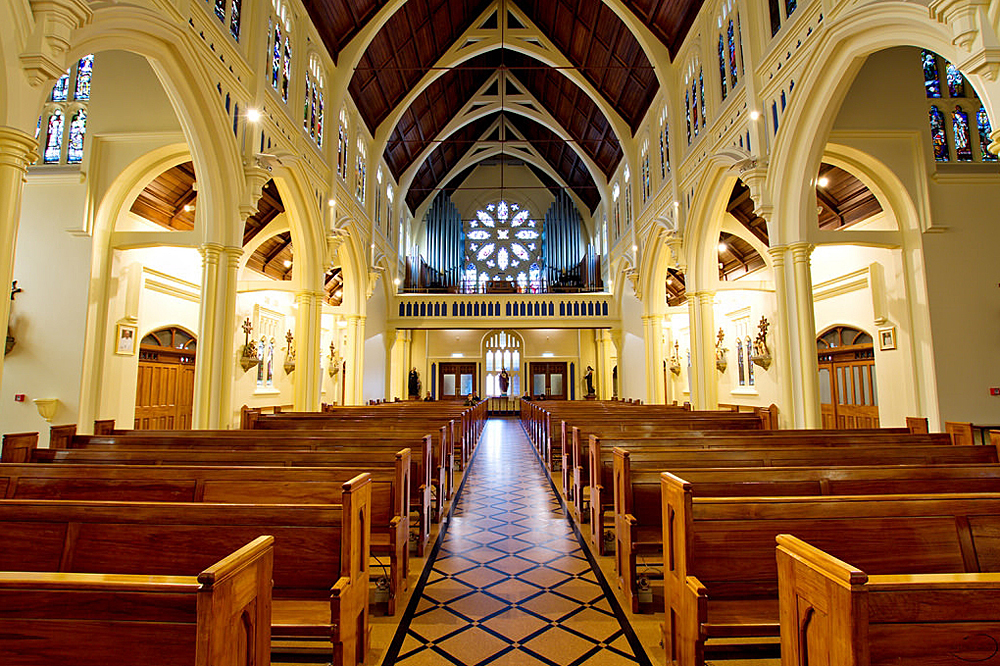
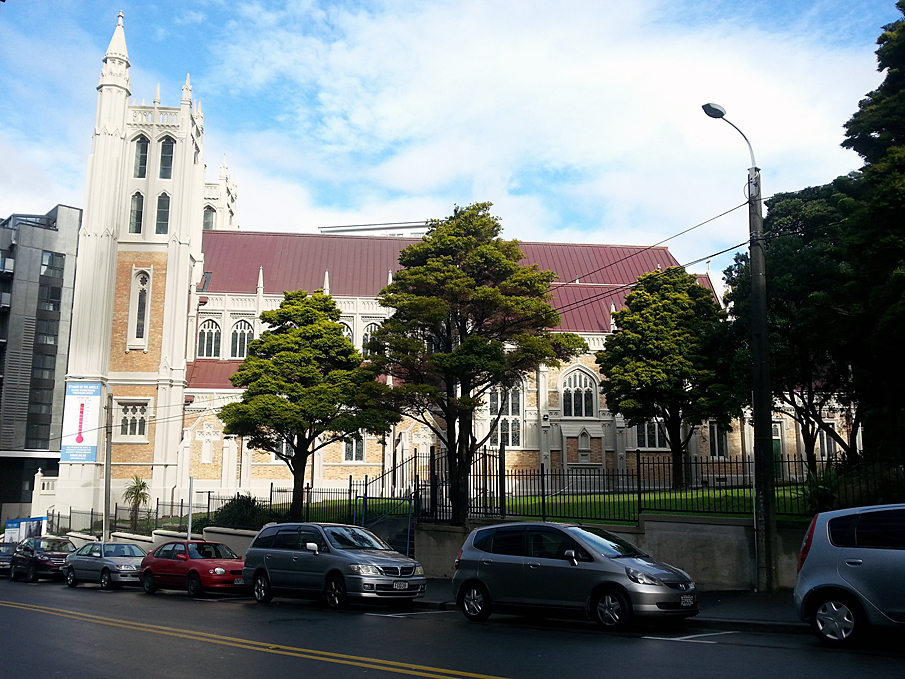
In 1918 the second church was so badly damaged by fire that rebuilding was necessary. In 1919 architect F. de J. Clere prepared plans. The church is of particular interest architecturally. Its design appears traditional Gothic of French influence but it is in reality highly innovative; contemporary opinion states 'the first occasion ferro-concrete was used for a church of Gothic design'. It is built of reinforced concrete and brick with a timber roof supported by concrete arches with steel tie rods. The concrete internal framing is of great slenderness. Running round the nave is a splendid clerestory of stained glass. The west end is characterised by twin towers. Its unique character comes from the elevated entrance and the novel fenestration. A large rose window within a semi-circular arch dominates the clerestory. The screen above the portal repeats the verticality of the towers.
F. de J. Clere, son of a clergyman and trained under two ecclesiastical architects, was one of the most prominent architects of his day and his contribution to New Zealand architecture is significant and extensive. This building enlarges our understanding of the diversity of Clere's work. It maintains its integrity and is in itself a history of the development of the Catholic Church in the area and a lasting monument to the skill and originality of the architect. The church is a prominent landmark and its townscape value is unique as it stands almost on the intersection of major streets of the city.
It must rank as one of the finest churches in New Zealand.
List Entry Information
Status
Listed
List Entry Status
Historic Place Category 1
Access
Private/No Public Access
List Number
36
Date Entered
6th September 1984
Date of Effect
6th September 1984
City/District Council
Wellington City
Region
Wellington Region
Legal description
Lot 1 DP 70132 (RT WN39A/882), Wellington Land District
Status
Listed
List Entry Status
Historic Place Category 1
Access
Private/No Public Access
List Number
36
Date Entered
6th September 1984
Date of Effect
6th September 1984
City/District Council
Wellington City
Region
Wellington Region
Legal description
Lot 1 DP 70132 (RT WN39A/882), Wellington Land District
Construction Professional
Name
Clere, Frederick De Jersey
Type
Architect
Biography
Clere (1856-1952) was born in Lancashire, the son of an Anglican clergyman, and was articled to Edmund Scott, an ecclesiastical architect of Brighton. He then became chief assistant to R J Withers, a London architect. Clere came to New Zealand in 1877, practising first in Feilding and then in Wanganui. He later came to Wellington and practised there for 58 years. He was elected a Fellow of the Royal Institute of British Architects in 1886 and held office for 50 years as one of four honorary secretaries in the Empire. In 1883 he was appointed Diocesan Architect of the Anglican Church; he designed more than 100 churches while he held this position. Clere was a pioneer in reinforced concrete construction; the outstanding example of his work with this material is the Church of St Mary of the Angels (1922), Wellington. As well as being pre-eminent in church design, Clere was responsible for many domestic and commercial buildings including Wellington's Harbour Board Offices and Bond Store (1891) and Overton in Marton. Clere was also involved in the design of large woolsheds in Hawkes Bay and Wairarapa. He was active in the formation of the New Zealand Institute of Architects and served on their council for many years. He was a member of the Wellington City Council until 1895, and from 1900 a member of the Wellington Diocesan Synod and the General Synod. He was also a member of the New Zealand Academy of Fine Arts.
Construction Details
Start Year
1922
Type
Original Construction
Construction Professional
Name
Clere, Frederick De Jersey
Type
Architect
Biography
Clere (1856-1952) was born in Lancashire, the son of an Anglican clergyman, and was articled to Edmund Scott, an ecclesiastical architect of Brighton. He then became chief assistant to R J Withers, a London architect. Clere came to New Zealand in 1877, practising first in Feilding and then in Wanganui. He later came to Wellington and practised there for 58 years. He was elected a Fellow of the Royal Institute of British Architects in 1886 and held office for 50 years as one of four honorary secretaries in the Empire. In 1883 he was appointed Diocesan Architect of the Anglican Church; he designed more than 100 churches while he held this position. Clere was a pioneer in reinforced concrete construction; the outstanding example of his work with this material is the Church of St Mary of the Angels (1922), Wellington. As well as being pre-eminent in church design, Clere was responsible for many domestic and commercial buildings including Wellington's Harbour Board Offices and Bond Store (1891) and Overton in Marton. Clere was also involved in the design of large woolsheds in Hawkes Bay and Wairarapa. He was active in the formation of the New Zealand Institute of Architects and served on their council for many years. He was a member of the Wellington City Council until 1895, and from 1900 a member of the Wellington Diocesan Synod and the General Synod. He was also a member of the New Zealand Academy of Fine Arts.
Construction Details
Start Year
1922
Type
Original Construction
Historical and Associated Iwi / Hapū / Whānau
Other Information
This place was identified as significant under previous legislation with different information requirements. It remains significant under the current legislation. There is opportunity under our legislation and policies to add to this information. Further information about this place may be available from the Central Regional Office of Heritage New Zealand Pouhere Taonga. Awarded the 'Enduring Concrete Award' in 2010 from the NZ Concrete Society Please note that entry on the New Zealand Heritage List/Rarangi Korero identifies only the heritage values of the property concerned, and should not be construed as advice on the state of the property, or as a comment of its soundness or safety, including in regard to earthquake risk, safety in the event of fire, or insanitary conditions. This historic place was registered under the Historic Places Act 1980. The following text is the original citation considered by the NZHPT Board at the time of registration. Information in square brackets indicate modifications made after the paper was considered by the NZHPT Board.
Historical and Associated Iwi / Hapū / Whānau
Other Information
This place was identified as significant under previous legislation with different information requirements. It remains significant under the current legislation. There is opportunity under our legislation and policies to add to this information. Further information about this place may be available from the Central Regional Office of Heritage New Zealand Pouhere Taonga. Awarded the 'Enduring Concrete Award' in 2010 from the NZ Concrete Society Please note that entry on the New Zealand Heritage List/Rarangi Korero identifies only the heritage values of the property concerned, and should not be construed as advice on the state of the property, or as a comment of its soundness or safety, including in regard to earthquake risk, safety in the event of fire, or insanitary conditions. This historic place was registered under the Historic Places Act 1980. The following text is the original citation considered by the NZHPT Board at the time of registration. Information in square brackets indicate modifications made after the paper was considered by the NZHPT Board.
Current Usages
Uses: Religion
Specific Usage: Church
Web Links
description:
Current Usages
Uses: Religion
Specific Usage: Church
Web Links
description:
Location
Stay up to date with Heritage this month
