The Bank of Otago’s first premises were on Thames Street, in 1867, but by June 1868, they had moved to a small building on Tyne Street. The Bank of Otago was founded by a group of Dunedin businessmen in 1863. The bank had its origins in the rich gold discoveries of the Otago Province. A group of financiers registered a company in London, and during the 1863 session of the New Zealand Parliament, authority was obtained for the bank via a private members bill. Branches were established on the goldfields, and outlying areas around Dunedin. Lawson’s design for a new building on Thames Street reflects the aspirations of the new trading bank.
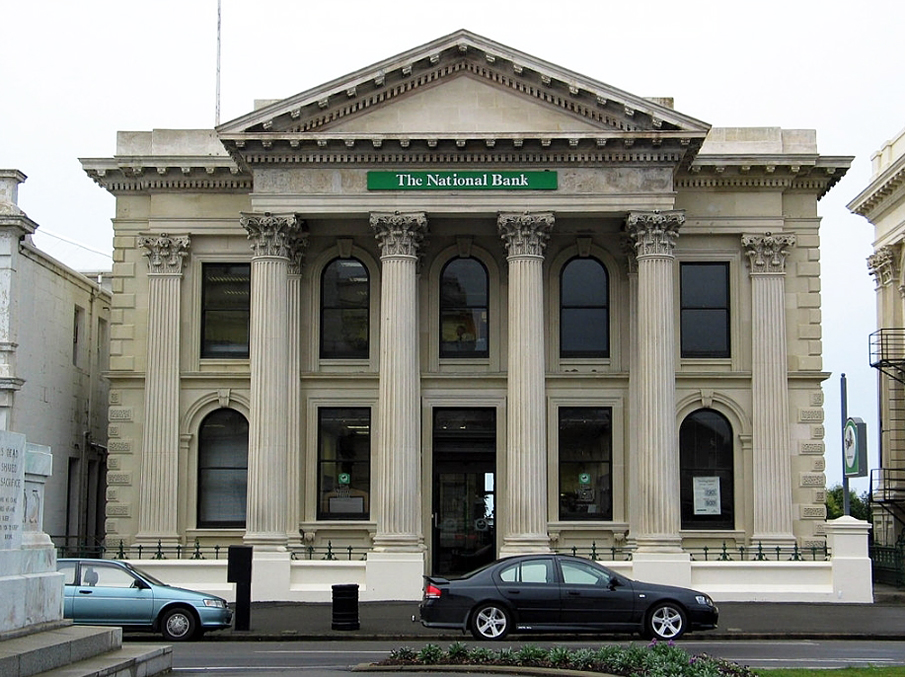
The North Otago Times gave a detailed description of the new bank in May 1870: “The main building covers a ground area of 52ft. by 53ft. [15.8 by 16.1 metres], exclusive of the portico, and there is an annexe 52ft. by 18ft. [15.8 by 5.5 metres], the former having two, and the latter one storey above the basement. The style is Corinthian throughout, and the façade very handsome. The basement is 10ft. [3 metres] in height to the street level, and the front elevation of the main building, above this, 32ft [9.8 metres]. The upper storey of the portion facing the street is pierced with five windows, underneath the centre one of which is the main entrance door, flanked on either side by two window, the window and doors being flanked by Corinthian pilasters (six in all), to be surmounted by handsome floriated capitals. A large porch, supported by four fluted columns, each 19ft. 4in. [5.8 metres] in height, and 3ft. [0.9 metres] in diameter at the base, their capitals ornamented with the acanthus leaf, will project 10ft. [3 metres] from the front of the building and abut upon the street, extending in front of the entrance door and the windows on either side. The entablature will be supported by a rich denticulated cornice and carved medallions, and the corners of the building ornamented by vermiculated quoins. The basement storey of the main building contains two bedrooms, pantry, and children’s day-room, the latter 25ft. by 23ft. [7.6 by 7 metres] in area, the first floor, the Banking Hall, also 25ft. by 23ft., the strong room, manager’s room, and a bedroom’ and the second floor, four bedrooms, a dressing-room, bath-room, etc. The annexe contains, in the basement, a kitchen, laundry, scullery, and offices’ and on the first floor, a drawing-room, 22ft. by 18ft. [6.7 metres by 5.5 metres], and a dining room, 22ft. by 14ft. [6.7 by 4.3 metres]. The contractors were Hunter and Goodfellow, while the stone carving for the capitals was completed by Louis Godfrey.
The Bank of Otago had a short life. In 1873, it was taken over by the National Bank of New Zealand, and was home to the National Bank until it was taken over by the ANZ Bank in 2012. The National Bank made a two storey addition to the rear of the building in the 1980s, and there have been internal alterations. The main façade is much the same as when it was built.
In 2015, the former Bank of Otago, now home to the ANZ Bank, is an essential component in the impressive array of Oamaru stone public and commercial buildings in Thanes Street.


List Entry Information
Status
Listed
List Entry Status
Historic Place Category 1
Access
Private/No Public Access
List Number
363
Date Entered
2nd July 1982
Date of Effect
2nd July 1982
City/District Council
Waitaki District
Region
Otago Region
Extent of List Entry
Extent includes the land described as Sec 2 Blk IV Town of Oamaru (RT OT8B/50), Otago Land District, and the building known as the Bank of Otago (Former), thereon.
Legal description
Sec 2 Blk IV Town of Oamaru (RT OT8B/50), Otago Land District
Status
Listed
List Entry Status
Historic Place Category 1
Access
Private/No Public Access
List Number
363
Date Entered
2nd July 1982
Date of Effect
2nd July 1982
City/District Council
Waitaki District
Region
Otago Region
Extent of List Entry
Extent includes the land described as Sec 2 Blk IV Town of Oamaru (RT OT8B/50), Otago Land District, and the building known as the Bank of Otago (Former), thereon.
Legal description
Sec 2 Blk IV Town of Oamaru (RT OT8B/50), Otago Land District
Why is this place significant?
Historic Significance
Historical Significance or Value This is the only substantial building constructed for the Bank of Otago still in existence. An earlier much more humble structure in Tyne Street was used by the bank between 1867-71. The Bank of Otago was founded in 1863 and was absorbed by the National Bank in 1875. The classical style of the Thanes Street building conveys the security, permanence and sense of tradition appropriate to banking institutes.
Physical Significance
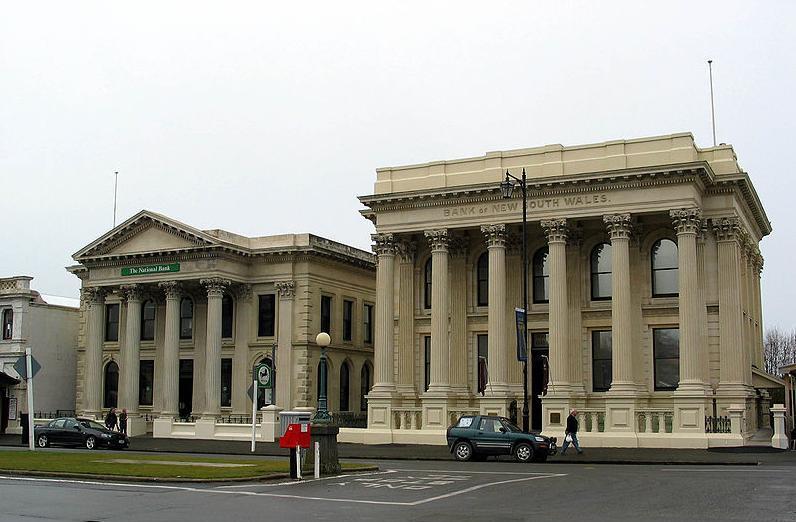
An elegant and dignified building forming a pair with the Forrester Gallery (formerly the Bank of New South Wales) also designed by Lawson, alongside. The style of the building was influenced by Scottish Neo-classical bank architecture of the 1840s, which as a Scot Lawson would have been familiar with. It is one of the finest 19th century bank buildings in New Zealand designed by one of the county's most important architects. TOWNSCAPE/LANDMARK SIGNIFICANCE: The National Bank forms a pair of 19th century neo-classical bank buildings with the Forrester Gallery and is an essential component in the impressive array of Oamaru stone public and commercial buildings in Thanes Street.
Why is this place significant?
Historic Significance
Historical Significance or Value This is the only substantial building constructed for the Bank of Otago still in existence. An earlier much more humble structure in Tyne Street was used by the bank between 1867-71. The Bank of Otago was founded in 1863 and was absorbed by the National Bank in 1875. The classical style of the Thanes Street building conveys the security, permanence and sense of tradition appropriate to banking institutes.
Physical Significance
An elegant and dignified building forming a pair with the Forrester Gallery (formerly the Bank of New South Wales) also designed by Lawson, alongside. The style of the building was influenced by Scottish Neo-classical bank architecture of the 1840s, which as a Scot Lawson would have been familiar with. It is one of the finest 19th century bank buildings in New Zealand designed by one of the county's most important architects. TOWNSCAPE/LANDMARK SIGNIFICANCE: The National Bank forms a pair of 19th century neo-classical bank buildings with the Forrester Gallery and is an essential component in the impressive array of Oamaru stone public and commercial buildings in Thanes Street.
Construction Professional
Name
Lawson, Robert Arthur
Type
Architect
Biography
Born in Scotland, Lawson (1833-1902) began his professional career in Perth. At the age of 25 he moved to Melbourne and was engaged in goldmining and journalism before resuming architectural practice. In 1862 Lawson sailed for Dunedin, where his sketch plans had won the competition for the design of First Church. This was built 1867-73. Lawson went on to become one of the most important architects in New Zealand. First Church is regarded as his masterpiece and one of the finest nineteenth century churches in New Zealand. He was also responsible for the design of the Trinity Church (now Fortune Theatre), Dunedin (1869-70), the East Taieri Presbyterian Church (1870), and Knox Church, Dunedin (1874). He designed Park's School (1864) and the ANZ Bank (originally Union Bank, 1874). In Oamaru he designed the Bank of Otago (later National Bank building, 1870) and the adjoining Bank of New South Wales (now Forrester Gallery, 1881). See also: Ledgerwood, Norman, 2013. 'R.A. Lawson: Victorian Architect of Dunedin'. Historic Cemeteries Conservation NZ.
Name
Hunter & Goodfellow
Type
Builder
Biography
Joshua Goodfellow Scottish-born Joshua Goodfellow came to New Zealand ‘in the very early days’, residing in the country for around fifty years. He worked on the post office in Dunedin and laid part of the Lawrence railway before moving north, where he completed large contracts, including several in Wellington. He died in Scotland in 1907, while visiting family. John Grey Hunter John Grey Hunter was a well-known builder and contractor. He came to New Zealand 1860s, going to the Otago goldfields. He returned to Scotland, married and then returned to Dunedin. He later moving to Christchurch where he entered into partnership with W. Greig, building the first Girls’ and Boys’ High Schools and the Canterbury College of Art (List No. 7301). He later lived in Hokitika where he died in 1924. Hunter and Goodfellow Hunter and Goodfellow were responsible for the construction of the First Church of Otago (Presbyterian) (List No. 60), East Taieri Presbyterian Church (List No. 2260), and the Bank of Otago at Oamaru (List No. 363). Their residential work includes Telford’s 1869 homestead and station buildings at Otanomomo (List No.’s 2127 and 5199). In 1870 they advertised regularly in the Bruce Herald, indicating their range of work. The advertisement indicated that the worked on tombstones, railings, monuments, stone carving, and supplied lime, cement, hearthstones, firebricks, slates, marble and stone mantelpieces. Source: List Entry Review Report for St Andrew's Presbyterian Church and Warden's Cottage (Former), 23 March 2016.
Name
Louis Godfrey
Type
Sculptor
Biography
No biography is currently available for this construction professional
Construction Details
Type
Addition
Description
Two-storey addition to the rear
Period
1980s
Start Year
1870
Type
Original Construction
Construction Materials
Oamaru Stone
Notable Features
The fence across the front of the building is contemporaneous with the building and forms an integral part of the overall design.
Construction Professional
Name
Lawson, Robert Arthur
Type
Architect
Biography
Born in Scotland, Lawson (1833-1902) began his professional career in Perth. At the age of 25 he moved to Melbourne and was engaged in goldmining and journalism before resuming architectural practice. In 1862 Lawson sailed for Dunedin, where his sketch plans had won the competition for the design of First Church. This was built 1867-73. Lawson went on to become one of the most important architects in New Zealand. First Church is regarded as his masterpiece and one of the finest nineteenth century churches in New Zealand. He was also responsible for the design of the Trinity Church (now Fortune Theatre), Dunedin (1869-70), the East Taieri Presbyterian Church (1870), and Knox Church, Dunedin (1874). He designed Park's School (1864) and the ANZ Bank (originally Union Bank, 1874). In Oamaru he designed the Bank of Otago (later National Bank building, 1870) and the adjoining Bank of New South Wales (now Forrester Gallery, 1881). See also: Ledgerwood, Norman, 2013. 'R.A. Lawson: Victorian Architect of Dunedin'. Historic Cemeteries Conservation NZ.
Name
Hunter & Goodfellow
Type
Builder
Biography
Joshua Goodfellow Scottish-born Joshua Goodfellow came to New Zealand ‘in the very early days’, residing in the country for around fifty years. He worked on the post office in Dunedin and laid part of the Lawrence railway before moving north, where he completed large contracts, including several in Wellington. He died in Scotland in 1907, while visiting family. John Grey Hunter John Grey Hunter was a well-known builder and contractor. He came to New Zealand 1860s, going to the Otago goldfields. He returned to Scotland, married and then returned to Dunedin. He later moving to Christchurch where he entered into partnership with W. Greig, building the first Girls’ and Boys’ High Schools and the Canterbury College of Art (List No. 7301). He later lived in Hokitika where he died in 1924. Hunter and Goodfellow Hunter and Goodfellow were responsible for the construction of the First Church of Otago (Presbyterian) (List No. 60), East Taieri Presbyterian Church (List No. 2260), and the Bank of Otago at Oamaru (List No. 363). Their residential work includes Telford’s 1869 homestead and station buildings at Otanomomo (List No.’s 2127 and 5199). In 1870 they advertised regularly in the Bruce Herald, indicating their range of work. The advertisement indicated that the worked on tombstones, railings, monuments, stone carving, and supplied lime, cement, hearthstones, firebricks, slates, marble and stone mantelpieces. Source: List Entry Review Report for St Andrew's Presbyterian Church and Warden's Cottage (Former), 23 March 2016.
Name
Louis Godfrey
Type
Sculptor
Biography
No biography is currently available for this construction professional
Construction Details
Type
Addition
Description
Two-storey addition to the rear
Period
1980s
Start Year
1870
Type
Original Construction
Construction Materials
Oamaru Stone
Notable Features
The fence across the front of the building is contemporaneous with the building and forms an integral part of the overall design.
ARCHITECTURAL DESCRIPTION (Style): A building in the classical style with grand Corinthian portico rising through to storeys. Elegant giant pilasters are arranged across the main body of the building behind the portico. MODIFICATIONS: Substantial modifications to the interior and rear of the building. Exterior, front façade and side walls are largely in original condition.
Historical and Associated Iwi / Hapū / Whānau
Completion Date
6th August 2015
Report Written By
Heather Bauchop
Information Sources
North Otago Times
North Otago Times
Stacpoole, 1976
John Stacpoole, Colonial Architecture in New Zealand, Wellington, 1976
Ledgerwood (2013)
Norman Ledgerwood, R.A. Lawson: Victorian Architect of Dunedin, Historic Cemeteries Conservation Trust of New Zealand, Dunedin, 2013
Other Information
This historic place was registered under the Historic Places Act 1980. This report includes the text from the original Building Classification Committee report considered by the NZHPT Board at the time of registration. Please note that entry on the New Zealand Heritage List/Rarangi Korero identifies only the heritage values of the property concerned, and should not be construed as advice on the state of the property, or as a comment of its soundness or safety, including in regard to earthquake risk, safety in the event of fire, or insanitary conditions. A fully referenced upgrade report is available on request from the Otago/Southland Office of Heritage New Zealand
Historical and Associated Iwi / Hapū / Whānau
Completion Date
6th August 2015
Report Written By
Heather Bauchop
Information Sources
North Otago Times
North Otago Times
Stacpoole, 1976
John Stacpoole, Colonial Architecture in New Zealand, Wellington, 1976
Ledgerwood (2013)
Norman Ledgerwood, R.A. Lawson: Victorian Architect of Dunedin, Historic Cemeteries Conservation Trust of New Zealand, Dunedin, 2013
Other Information
This historic place was registered under the Historic Places Act 1980. This report includes the text from the original Building Classification Committee report considered by the NZHPT Board at the time of registration. Please note that entry on the New Zealand Heritage List/Rarangi Korero identifies only the heritage values of the property concerned, and should not be construed as advice on the state of the property, or as a comment of its soundness or safety, including in regard to earthquake risk, safety in the event of fire, or insanitary conditions. A fully referenced upgrade report is available on request from the Otago/Southland Office of Heritage New Zealand
Current Usages
Uses: Finance
Specific Usage: Bank
Current Usages
Uses: Finance
Specific Usage: Bank
Location
Stay up to date with Heritage this month

