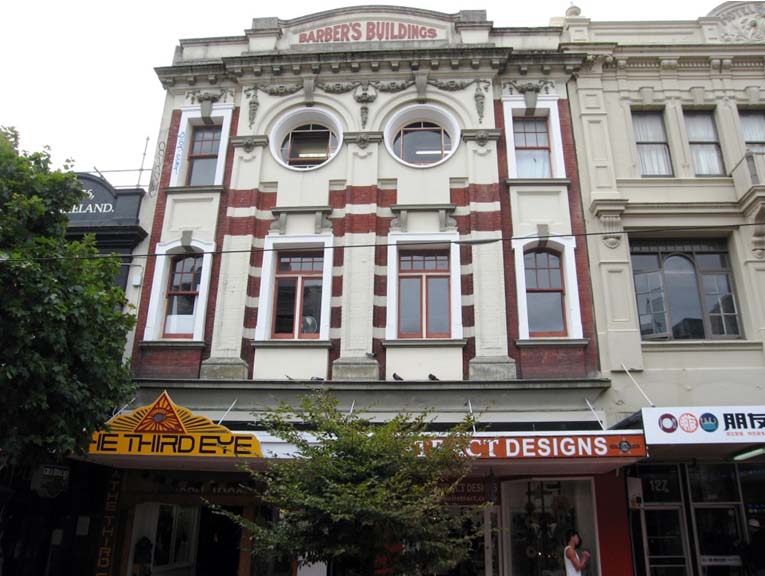
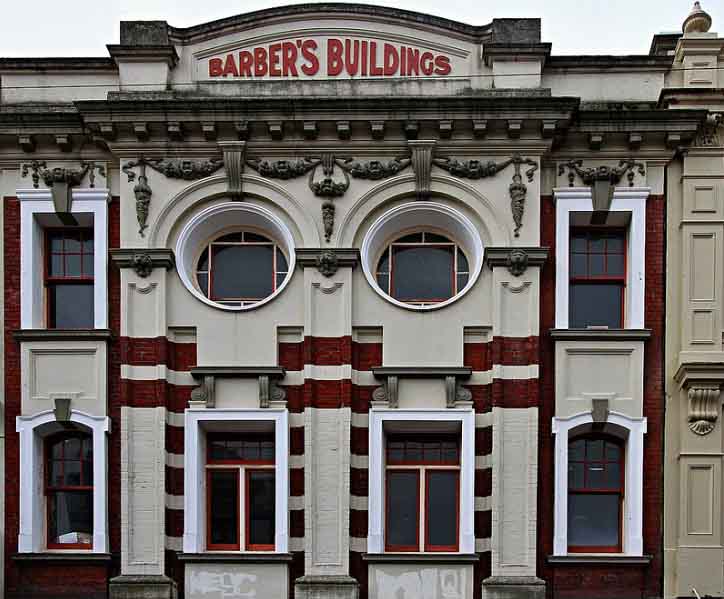
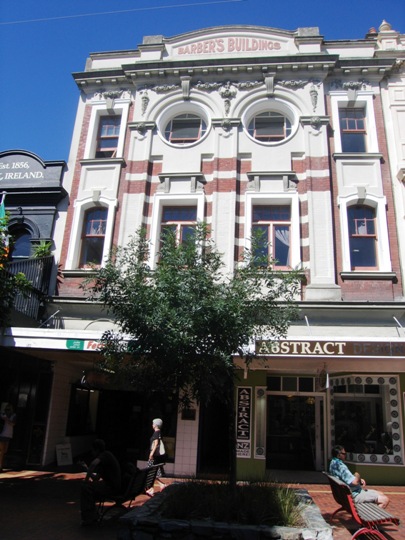
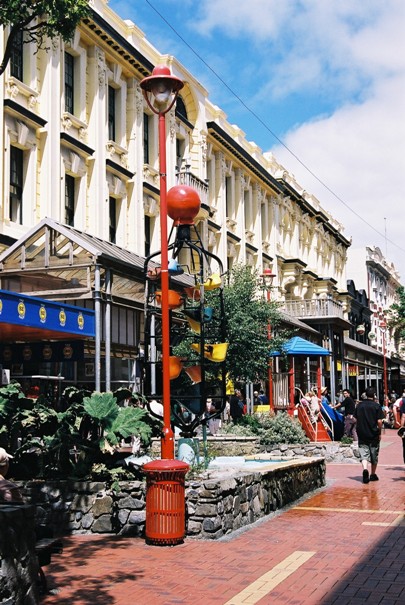
Barber’s Buildings has historic significance because the main building (1910) and store (1902) are associated with a locally important early colonial family business, which was commercially successful by the early twentieth century and exhibited that status through its Cuba Street premises. The three-storey masonry Barber’s Buildings has architectural value as a distinctive central Wellington Edwardian commercial building designed by important local architects, Crichton and McKay. Barber’s Buildings also contributes to the heritage values of the Cuba Street Historic Area (List No.7209) and has social value as a base for cultural and social/political groups throughout the twentieth century.
William P Barber established his original dye-works in 1863 and the 1910 Barber’s Buildings was the third incarnation of the company’s premises fronting its Cuba Street site. The company specialised in steam dying and cleaning. William’s son, William Henry Peter Barber (1857-1943) became prominent in Wellington’s business and political circles, because in addition to heading Barber and Company he served on many Boards, was a City Councillor and in the early twentieth century he was also Newtown’s representative in the House of Representatives.
As with the Barber’s Buildings, Cuba Street’s early timber commercial buildings were gradually replaced in the Edwardian period as owners’ fortunes grew, often with much grander masonry buildings. The 1910 Barber’s Buildings was designed by Crichton and McKay - a notable early twentieth century Wellington architectural practice who designed many central Wellington buildings, including the Missions to Seamen Building (Former), Braemar Flats (Former) and the Barber’s Buildings’ northern neighbour. This main building was constructed by Muir and Rose, a local contracting company which was active from around 1907.
The Barber’s Buildings’ front façade demonstrates the ‘florid Edwardian Baroque’ architectural detailing popular at the time, including Classical elements such as pilasters and heavy cornicing with garlanding beneath. Like these decorative features, the variously shaped windows are placed symmetrically. The Barber’s Buildings’ pair of large and deep-set third-storey circular windows are probably its distinguishing feature. Typical in commercial architecture of the period, this street façade received a higher level of design attention than those not visible from Cuba Street. For example, the earlier two-storey masonry store at the rear of the section is much more utilitarian, with only a shallow cornice decorating its entrance façade, as are the back of the main building and its single storey extension (constructed by the 1930s).
The Barber’s Buildings was the company’s central Wellington base for its dry-cleaning work, as well as a providing space for another ground level shop and upper level storage areas. In the years after the building’s completion, the Scottish Society had rooms in one of the upper levels. A dance studio was later established in the 1930s and consistently used for that purpose throughout the twentieth century. The Barber family owned the premises until 1943, but had closed its shop in the 1930s. Other tenants have included the New Zealand Communist Party and Maritime Social Club. The building continues to accommodate ground-floor retail and dance studios above, including Footnote New Zealand and Tarrant Dance Studio.
William P Barber established his original dye-works in 1863 and the 1910 Barber’s Buildings was the third incarnation of the company’s premises fronting its Cuba Street site. The company specialised in steam dying and cleaning. William’s son, William Henry Peter Barber (1857-1943) became prominent in Wellington’s business and political circles, because in addition to heading Barber and Company he served on many Boards, was a City Councillor and in the early twentieth century he was also Newtown’s representative in the House of Representatives.
As with the Barber’s Buildings, Cuba Street’s early timber commercial buildings were gradually replaced in the Edwardian period as owners’ fortunes grew, often with much grander masonry buildings. The 1910 Barber’s Buildings was designed by Crichton and McKay - a notable early twentieth century Wellington architectural practice who designed many central Wellington buildings, including the Missions to Seamen Building (Former), Braemar Flats (Former) and the Barber’s Buildings’ northern neighbour. This main building was constructed by Muir and Rose, a local contracting company which was active from around 1907.
The Barber’s Buildings’ front façade demonstrates the ‘florid Edwardian Baroque’ architectural detailing popular at the time, including Classical elements such as pilasters and heavy cornicing with garlanding beneath. Like these decorative features, the variously shaped windows are placed symmetrically. The Barber’s Buildings’ pair of large and deep-set third-storey circular windows are probably its distinguishing feature. Typical in commercial architecture of the period, this street façade received a higher level of design attention than those not visible from Cuba Street. For example, the earlier two-storey masonry store at the rear of the section is much more utilitarian, with only a shallow cornice decorating its entrance façade, as are the back of the main building and its single storey extension (constructed by the 1930s).
The Barber’s Buildings was the company’s central Wellington base for its dry-cleaning work, as well as a providing space for another ground level shop and upper level storage areas. In the years after the building’s completion, the Scottish Society had rooms in one of the upper levels. A dance studio was later established in the 1930s and consistently used for that purpose throughout the twentieth century. The Barber family owned the premises until 1943, but had closed its shop in the 1930s. Other tenants have included the New Zealand Communist Party and Maritime Social Club. The building continues to accommodate ground-floor retail and dance studios above, including Footnote New Zealand and Tarrant Dance Studio.