DonateSupporterVisit Heritage
  • Tūrangawaewae
    Places
  • Tira Māori
    Māori Heritage
  • Poutairangahia
    Archaeology
  • Rauemi
    Resources
  • Mō Tātou
    About Us
  • New Zealand Heritage List
  • Nominate and submit
  • Explore the List
  • National Historic Landmarks
  • Plaques
  • Rainbow List Project
  • Lost heritage
  • Visit Heritage
  • Our properties
  • Turnbull House Project
  • Collections
  • Shop
  • Tohu Whenua
  • Tira Māori
  • Conserving Māori heritage
  • Marae built heritage
  • Māori heritage on the List
  • Hinemihi—Te Hokinga Mai
  • What is archaeology?
  • Is there a site on my property?
  • What are my legal requirements?
  • Affecting an archaeological site
  • Declaring an archaeological site
  • Archaeology FAQs
  • Archaeology Digital Library
  • Archaeology guidelines and templates
  • Resources
  • Funding
  • Publications
  • Sustainable management guides
  • Disaster recovery
  • Podcasts & digital resources
  • Education Hub
  • Conservation plans
  • About
  • Board
  • Māori Heritage Council
  • Senior Staff
  • Offices
  • Contact us
  • Careers
  • Covenants
  • Fast-track
  • Corporate documents
  • Currently consulting on
  • Our submissions
  • News
  • Covid-19 response
Quick links
Rārangi Kōrero | The List
Explore the List
National Historic Landmarks
Ngā Manawhenua o Aotearoa me ōna Kōrero Tūturu
Quick links
Tapuwae
A Vision for Places of Māori Heritage
Funding for Māori Heritage
Resources
Quick links
Archaeological Authority Portal
Applying for an archaeological authority
Archaeology FAQs
Browse the most frequently asked questions about archaeological authorities and the archaeological process.
Quick links
Quick links
Contact us
Offices
DonateSupporterVisit Heritage
  • Tūrangawaewae
    Places
  • Tira Māori
    Māori Heritage
  • Poutairangahia
    Archaeology
  • Rauemi
    Resources
  • Mō Tātou
    About Us
  • New Zealand Heritage List
  • Nominate and submit
  • Explore the List
  • National Historic Landmarks
  • Plaques
  • Rainbow List Project
  • Lost heritage
  • Visit Heritage
  • Our properties
  • Turnbull House Project
  • Collections
  • Shop
  • Tohu Whenua
  • Tira Māori
  • Conserving Māori heritage
  • Marae built heritage
  • Māori heritage on the List
  • Hinemihi—Te Hokinga Mai
  • What is archaeology?
  • Is there a site on my property?
  • What are my legal requirements?
  • Affecting an archaeological site
  • Declaring an archaeological site
  • Archaeology FAQs
  • Archaeology Digital Library
  • Archaeology guidelines and templates
  • Resources
  • Funding
  • Publications
  • Sustainable management guides
  • Disaster recovery
  • Podcasts & digital resources
  • Education Hub
  • Conservation plans
  • About
  • Board
  • Māori Heritage Council
  • Senior Staff
  • Offices
  • Contact us
  • Careers
  • Covenants
  • Fast-track
  • Corporate documents
  • Currently consulting on
  • Our submissions
  • News
  • Covid-19 response
Quick links
Rārangi Kōrero | The List
Explore the List
National Historic Landmarks
Ngā Manawhenua o Aotearoa me ōna Kōrero Tūturu
Quick links
Tapuwae
A Vision for Places of Māori Heritage
Funding for Māori Heritage
Resources
Quick links
Archaeological Authority Portal
Applying for an archaeological authority
Archaeology FAQs
Browse the most frequently asked questions about archaeological authorities and the archaeological process.
Quick links
Quick links
Contact us
Offices
  • Places
  • Nominate and submit
  • National Historic Landmarks
  • Places
  • Nominate and submit
  • National Historic Landmarks
  • Tira Māori
  • Conserving Māori heritage
  • Marae built heritage
  • Tira Māori
  • Conserving Māori heritage
  • Marae built heritage
  • Archaeological authorities
  • Archaeology Digital Library
  • Archaeological authorities
  • Archaeology Digital Library
  • All resources
  • Publications
  • Funding
  • All resources
  • Publications
  • Funding
  • FAQs
  • FAQs
Follow us on:
Places
  • Places
  • Nominate and submit
  • National Historic Landmarks
Tira Māori
  • Tira Māori
  • Conserving Māori heritage
  • Marae built heritage
Archaeology
  • Archaeological authorities
  • Archaeology Digital Library
Resources
  • All resources
  • Publications
  • Funding
FAQs
  • FAQs
Follow us on
HomePrivacyTerms and conditionsAbout this site
© Heritage New Zealand Pouhere Taonga 2026.
 
Albemarle Hotel

59 Ghuznee Street, WELLINGTON

Private

Historic Place Category 2

List No. 3633

Quick links:
List GalleryLocationDetails
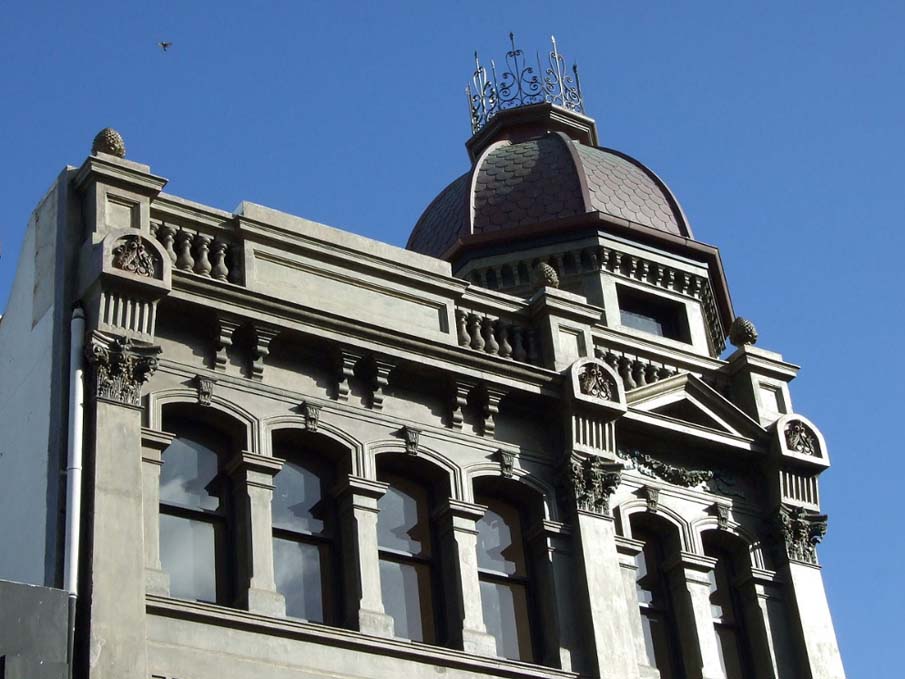
The Albemarle Hotel at 59 Ghuznee Street, Wellington, opened in 1906 as a private hotel with 31 ‘fine lofty rooms’. Its distinctive Italianate style exterior with octagonal tower and cupola was designed by prolific Wellington architect James Bennie (1873-1945) and has been described as ‘eclectic’ and ‘exuberant’. It is an important contributor to the Edwardian streetscape of the Cuba Street area and has particular historical and social significance through its association with the 1913 strike movement, notorious boarding house owner Clara Hallam and Wellington’s ‘red light district’, and retains much of its original fabric.

The early twentieth century was a time of growth and prosperity in Wellington. New buildings were quickly being erected in the central city - James Bennie himself designed over 200 of them. Private hotels offered short- and long-term accommodation and dining but were not licensed to sell alcohol. While the Albemarle does not appear to have advertised itself specifically as a ‘temperance hotel’, it was undoubtedly affected by the temperance movement which saw alcohol as a major contributing factor to poverty, violence, ill health and immorality. Temperance aimed to reduce the impact of alcohol through voluntary abstinence and legal restrictions. Between 1893 and 1911, New Zealanders could vote to reduce the number of liquor licenses granted in their area or remove licenses altogether, making it very difficult to open a new licensed hotel.

The Albemarle was a three-storey building with rendered brick walls, timber exterior joinery, corrugated iron roofing and a striking octagonal rooftop tower capped with a cupola. While the ground-floor street front was relatively plain with Doric columns either side of two arched windows and an arched entryway, the street front exterior of the second and third floors was more richly decorated with foliated Corinthian columns on the first floor, plain columns topped by ornate Corinthian capitals on the second floor and a balustrade and ornate parapet at roof level.

Apart from an additional partial fourth floor added later in 1906, the structure of the building has remained unchanged. A second-floor wrought iron balcony that had served as a street-level verandah was removed and at one point the cupola was also removed, before being replicated and reinstated in 2007. The Albemarle became the unofficial headquarters of the 1913 Wellington waterfront strike movement, hosting most of the out-of-town strike leaders, including future Prime Minister Peter Fraser. The hotel was later run as a boarding house by ‘loveable rogue’ Clara Hallam, who was known for accepting homeless alcoholics at her boarding houses and renting rooms by the hour. It spent some years as massage parlour before being left unoccupied from the 1990s. Various repairs and attempts to revive the fortunes of the building have occurred since the gentrification of the area in the 1990s, but these have not yet (2019) resulted in the building being reopened.
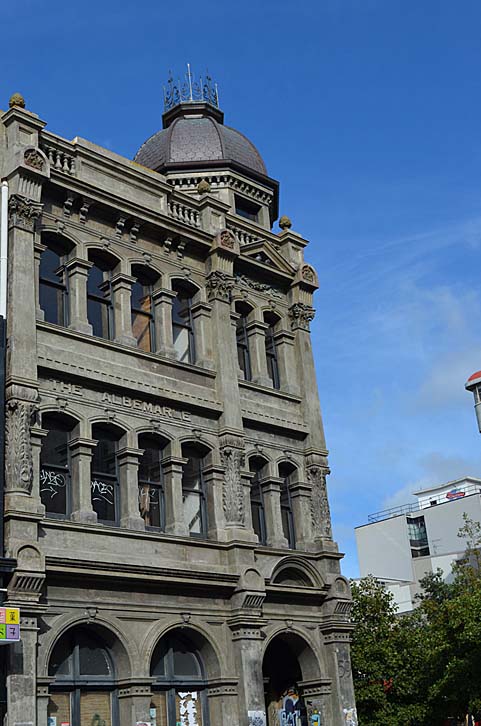
Albemarle Hotel, Wellington | Alison Dangerfield | 20/03/2014 | Heritage New Zealand Pouhere Taonga
Albemarle Hotel, Wellington. Building detail CC BY-SA 2.0 Image courtesy of commons.wikimedia.org | Andre Goble | 22/07/2007 | Andre Goble - Wikimedia Commons
Albemarle Hotel, Wellington | Alison Dangerfield | 20/03/2014 | Heritage New Zealand Pouhere Taonga
Albemarle Hotel, Wellington. Building detail CC BY-SA 2.0 Image courtesy of commons.wikimedia.org | Andre Goble | 22/07/2007 | Andre Goble - Wikimedia Commons

List Entry Information

Overview

Status
Listed

List Entry Status
Historic Place Category 2

Access
Private/No Public Access

List Number
3633

Date Entered
28th June 1984

Date of Effect
28th June 1984

City/District Council
Wellington City

Region
Wellington Region

Extent of List Entry

Extent includes the land described as Pt Sec 152 Town of Wellington (RT WN20C/845), Wellington Land District and the building known as Albemarle Hotel thereon.

Legal description

Pt Sec 152 Town of Wellington (RT WN20C/845), Wellington Land District

Detailed List Entry

Construction Professional

Name

Bennie, James

Type

Architect

Biography

Bennie was born in Ayrshire, Scotland, immigrated to New Zealand in 1880 and settled in Brunnertown near Greymouth. In the early 1890s he attended the Working Men's College in Melbourne, Australia, where he studied under artist and architect Thomas Searell. On completion of his studies he returned to Greymouth and set up in practice as an architect. In 1902 Bennie moved to Wellington and went into practice with E C Farr before establishing his own practice in 1905. Some of Bennie's designs include the Albermarle Hotel, Wellington (1905), the Carnegie Library at Levin (1910), the Karori Methodist Church (1912), and the Oriental Bay Tea Kiosk (1912, demolished 1978). He designed a number of theatres including Kings (1910), Queens (1916), the Crown (1916) and Paramount (1917), all in Wellington and was also responsible for the design of many houses including the Wedge, Glenbervie Terrace (1906) and Bennie house, Salamanca road (1907) both in Wellington. He also had an interest in prefabricated house design. Bennie was an inaugural member of the New Zealand Institute of Architects, founded in 1905, and was later elected a Fellow. He retired in 1935 and his son Malcolm took over the Wellington practice. [Source: an advertisment in the Evening Post, Volume LXIV, Issue 58, 5 September 1902, Page 7 confirms that Bennie entered into partnership with E C Farr on 14 August 1902].

Name

Reynell, A & E

Type

Builder

Biography

No biography is currently available for this construction professional

Name

Foley, Thomas

Type

Plasterer

Biography

No biography is currently available for this construction professional

Construction Details

Finish Year

1906

Type

Addition

Description

Addition of partial fourth floor

Type

Modification

Description

Removal of second-floor balcony; removal of cupola

Period

Unknown

Finish Year

2007

Type

Reconstruction

Description

Reinstatement of cupola

Start Year

1905

Finish Year

1906

Type

Original Construction

Reference

Completion Date

21st May 2019

Report Written By

Cherie Jacobson

Information Sources

Te Ara - The Encyclopedia of New Zealand

www.TeAra.govt.nz

Wellington City Council

Wellington City Heritage website, published and maintained by WCC

Report Written By

This place was identified as significant under previous legislation with different information requirements. It remains significant under the current legislation. There is opportunity under our legislation and policies to add to this information. Further information about this place may be available from the Central Regional Office of Heritage New Zealand Pouhere Taonga. Please note that entry on the New Zealand Heritage List/Rarangi Korero identifies only the heritage values of the property concerned, and should not be construed as advice on the state of the property, or as a comment of its soundness or safety, including in regard to earthquake risk, safety in the event of fire, or insanitary conditions. A fully referenced summary report is available on request from the Central Region Office of Heritage New Zealand.

Further Information

Current Usages

Former Usages

General Usage:: Accommodation

Specific Usage: Boarding/ Guest House

General Usage:: Accommodation

Specific Usage: Hotel

General Usage:: Trade

Specific Usage: Brothel

Themes

Web Links

description: Wellington City Council's Heritage Inventory

url: http://www.wellington.govt.nz/services/heritage/details.php?id=264&m=building

Overview

Status

Listed

List Entry Status

Historic Place Category 2

Access

Private/No Public Access

List Number

3633

Date Entered

28th June 1984

Date of Effect

28th June 1984

City/District Council

Wellington City

Region

Wellington Region

Extent of List Entry

Extent includes the land described as Pt Sec 152 Town of Wellington (RT WN20C/845), Wellington Land District and the building known as Albemarle Hotel thereon.

Legal description

Pt Sec 152 Town of Wellington (RT WN20C/845), Wellington Land District

Status

Listed

List Entry Status

Historic Place Category 2

Access

Private/No Public Access

List Number

3633

Date Entered

28th June 1984

Date of Effect

28th June 1984

City/District Council

Wellington City

Region

Wellington Region

Extent of List Entry

Extent includes the land described as Pt Sec 152 Town of Wellington (RT WN20C/845), Wellington Land District and the building known as Albemarle Hotel thereon.

Legal description

Pt Sec 152 Town of Wellington (RT WN20C/845), Wellington Land District

Construction Information

Construction Professional

Name

Bennie, James

Type

Architect

Biography

Bennie was born in Ayrshire, Scotland, immigrated to New Zealand in 1880 and settled in Brunnertown near Greymouth. In the early 1890s he attended the Working Men's College in Melbourne, Australia, where he studied under artist and architect Thomas Searell. On completion of his studies he returned to Greymouth and set up in practice as an architect. In 1902 Bennie moved to Wellington and went into practice with E C Farr before establishing his own practice in 1905. Some of Bennie's designs include the Albermarle Hotel, Wellington (1905), the Carnegie Library at Levin (1910), the Karori Methodist Church (1912), and the Oriental Bay Tea Kiosk (1912, demolished 1978). He designed a number of theatres including Kings (1910), Queens (1916), the Crown (1916) and Paramount (1917), all in Wellington and was also responsible for the design of many houses including the Wedge, Glenbervie Terrace (1906) and Bennie house, Salamanca road (1907) both in Wellington. He also had an interest in prefabricated house design. Bennie was an inaugural member of the New Zealand Institute of Architects, founded in 1905, and was later elected a Fellow. He retired in 1935 and his son Malcolm took over the Wellington practice. [Source: an advertisment in the Evening Post, Volume LXIV, Issue 58, 5 September 1902, Page 7 confirms that Bennie entered into partnership with E C Farr on 14 August 1902].

Name

Reynell, A & E

Type

Builder

Biography

No biography is currently available for this construction professional

Name

Foley, Thomas

Type

Plasterer

Biography

No biography is currently available for this construction professional

Construction Details

Finish Year

1906

Type

Addition

Description

Addition of partial fourth floor

Type

Modification

Description

Removal of second-floor balcony; removal of cupola

Period

Unknown

Finish Year

2007

Type

Reconstruction

Description

Reinstatement of cupola

Start Year

1905

Finish Year

1906

Type

Original Construction

Construction Professional

Name

Bennie, James

Type

Architect

Biography

Bennie was born in Ayrshire, Scotland, immigrated to New Zealand in 1880 and settled in Brunnertown near Greymouth. In the early 1890s he attended the Working Men's College in Melbourne, Australia, where he studied under artist and architect Thomas Searell. On completion of his studies he returned to Greymouth and set up in practice as an architect. In 1902 Bennie moved to Wellington and went into practice with E C Farr before establishing his own practice in 1905. Some of Bennie's designs include the Albermarle Hotel, Wellington (1905), the Carnegie Library at Levin (1910), the Karori Methodist Church (1912), and the Oriental Bay Tea Kiosk (1912, demolished 1978). He designed a number of theatres including Kings (1910), Queens (1916), the Crown (1916) and Paramount (1917), all in Wellington and was also responsible for the design of many houses including the Wedge, Glenbervie Terrace (1906) and Bennie house, Salamanca road (1907) both in Wellington. He also had an interest in prefabricated house design. Bennie was an inaugural member of the New Zealand Institute of Architects, founded in 1905, and was later elected a Fellow. He retired in 1935 and his son Malcolm took over the Wellington practice. [Source: an advertisment in the Evening Post, Volume LXIV, Issue 58, 5 September 1902, Page 7 confirms that Bennie entered into partnership with E C Farr on 14 August 1902].

Name

Reynell, A & E

Type

Builder

Biography

No biography is currently available for this construction professional

Name

Foley, Thomas

Type

Plasterer

Biography

No biography is currently available for this construction professional

Construction Details

Finish Year

1906

Type

Addition

Description

Addition of partial fourth floor

Type

Modification

Description

Removal of second-floor balcony; removal of cupola

Period

Unknown

Finish Year

2007

Type

Reconstruction

Description

Reinstatement of cupola

Start Year

1905

Finish Year

1906

Type

Original Construction

Reference

Historical and Associated Iwi / Hapū / Whānau

Completion Date

21st May 2019

Report Written By

Cherie Jacobson

Information Sources

Te Ara - The Encyclopedia of New Zealand

www.TeAra.govt.nz

Wellington City Council

Wellington City Heritage website, published and maintained by WCC

Other Information

This place was identified as significant under previous legislation with different information requirements. It remains significant under the current legislation. There is opportunity under our legislation and policies to add to this information. Further information about this place may be available from the Central Regional Office of Heritage New Zealand Pouhere Taonga. Please note that entry on the New Zealand Heritage List/Rarangi Korero identifies only the heritage values of the property concerned, and should not be construed as advice on the state of the property, or as a comment of its soundness or safety, including in regard to earthquake risk, safety in the event of fire, or insanitary conditions. A fully referenced summary report is available on request from the Central Region Office of Heritage New Zealand.

Historical and Associated Iwi / Hapū / Whānau

Completion Date

21st May 2019

Report Written By

Cherie Jacobson

Information Sources

Te Ara - The Encyclopedia of New Zealand

www.TeAra.govt.nz

Wellington City Council

Wellington City Heritage website, published and maintained by WCC

Other Information

This place was identified as significant under previous legislation with different information requirements. It remains significant under the current legislation. There is opportunity under our legislation and policies to add to this information. Further information about this place may be available from the Central Regional Office of Heritage New Zealand Pouhere Taonga. Please note that entry on the New Zealand Heritage List/Rarangi Korero identifies only the heritage values of the property concerned, and should not be construed as advice on the state of the property, or as a comment of its soundness or safety, including in regard to earthquake risk, safety in the event of fire, or insanitary conditions. A fully referenced summary report is available on request from the Central Region Office of Heritage New Zealand.

Further Information

Former Usages

General Usage: Accommodation

Specific Usage: Boarding/ Guest House

General Usage: Accommodation

Specific Usage: Hotel

General Usage: Trade

Specific Usage: Brothel

Web Links

description: Wellington City Council's Heritage Inventory

url: http://www.wellington.govt.nz/services/heritage/details.php?id=264&m=building

Former Usages

General Usage: Accommodation

Specific Usage: Boarding/ Guest House

General Usage: Accommodation

Specific Usage: Hotel

General Usage: Trade

Specific Usage: Brothel

Web Links

description: Wellington City Council's Heritage Inventory

url: http://www.wellington.govt.nz/services/heritage/details.php?id=264&m=building

Location

Loading
Related listings
Cuba Street Historic Area
Sign up to hear more

Get the latest heritage news, features and events delivered
straight to your inbox.

Subscribe