DonateMembershipVisit Heritage
  • Tūrangawaewae
    Places
  • Tira Māori
    Māori Heritage
  • Poutairangahia
    Archaeology
  • Rauemi
    Resources
  • Mō Tātou
    About Us
  • New Zealand Heritage List
  • Nominate and submit
  • Explore the List
  • National Historic Landmarks
  • Plaques
  • Rainbow List Project
  • Lost heritage
  • Visit Heritage
  • Our properties
  • Turnbull House Project
  • Collections
  • Shop
  • Tohu Whenua
  • Tira Māori
  • Conserving Māori heritage
  • Marae built heritage
  • Māori heritage on the List
  • Hinemihi—Te Hokinga Mai
  • What is archaeology?
  • Is there a site on my property?
  • What are my legal requirements?
  • Affecting an archaeological site
  • Declaring an archaeological site
  • Archaeology FAQs
  • Archaeology Digital Library
  • Archaeology guidelines and templates
  • Resources
  • Funding
  • Publications
  • Sustainable management guides
  • Disaster recovery
  • Podcasts & digital resources
  • Education Hub
  • Conservation plans
  • About
  • Board
  • Māori Heritage Council
  • Senior Staff
  • Offices
  • Contact us
  • Careers
  • Covenants
  • Fast-track
  • Corporate documents
  • Currently consulting on
  • Our submissions
  • News
  • Covid-19 response
Quick links
Rārangi Kōrero | The List
Explore the List
National Historic Landmarks
Ngā Manawhenua o Aotearoa me ōna Kōrero Tūturu
Quick links
Tapuwae
A Vision for Places of Māori Heritage
Funding for Māori Heritage
Resources
Quick links
Archaeological Authority Portal
Applying for an archaeological authority
Archaeology FAQs
Browse the most frequently asked questions about archaeological authorities and the archaeological process.
Quick links
Quick links
News
News Keep up to date with Heritage New Zealand Pouhere Taonga
Membership
Membership Find out more and sign up today
DonateMembershipVisit Heritage
  • Tūrangawaewae
    Places
  • Tira Māori
    Māori Heritage
  • Poutairangahia
    Archaeology
  • Rauemi
    Resources
  • Mō Tātou
    About Us
  • New Zealand Heritage List
  • Nominate and submit
  • Explore the List
  • National Historic Landmarks
  • Plaques
  • Rainbow List Project
  • Lost heritage
  • Visit Heritage
  • Our properties
  • Turnbull House Project
  • Collections
  • Shop
  • Tohu Whenua
  • Tira Māori
  • Conserving Māori heritage
  • Marae built heritage
  • Māori heritage on the List
  • Hinemihi—Te Hokinga Mai
  • What is archaeology?
  • Is there a site on my property?
  • What are my legal requirements?
  • Affecting an archaeological site
  • Declaring an archaeological site
  • Archaeology FAQs
  • Archaeology Digital Library
  • Archaeology guidelines and templates
  • Resources
  • Funding
  • Publications
  • Sustainable management guides
  • Disaster recovery
  • Podcasts & digital resources
  • Education Hub
  • Conservation plans
  • About
  • Board
  • Māori Heritage Council
  • Senior Staff
  • Offices
  • Contact us
  • Careers
  • Covenants
  • Fast-track
  • Corporate documents
  • Currently consulting on
  • Our submissions
  • News
  • Covid-19 response
Quick links
Rārangi Kōrero | The List
Explore the List
National Historic Landmarks
Ngā Manawhenua o Aotearoa me ōna Kōrero Tūturu
Quick links
Tapuwae
A Vision for Places of Māori Heritage
Funding for Māori Heritage
Resources
Quick links
Archaeological Authority Portal
Applying for an archaeological authority
Archaeology FAQs
Browse the most frequently asked questions about archaeological authorities and the archaeological process.
Quick links
Quick links
News
News Keep up to date with Heritage New Zealand Pouhere Taonga
Membership
Membership Find out more and sign up today
  • Places
  • Nominate and submit
  • National Historic Landmarks
  • Places
  • Nominate and submit
  • National Historic Landmarks
  • Tira Māori
  • Conserving Māori heritage
  • Marae built heritage
  • Tira Māori
  • Conserving Māori heritage
  • Marae built heritage
  • Archaeological authorities
  • Archaeology Digital Library
  • Archaeological authorities
  • Archaeology Digital Library
  • All resources
  • Publications
  • Funding
  • All resources
  • Publications
  • Funding
  • FAQs
  • FAQs
Follow us on:
Places
  • Places
  • Nominate and submit
  • National Historic Landmarks
Tira Māori
  • Tira Māori
  • Conserving Māori heritage
  • Marae built heritage
Archaeology
  • Archaeological authorities
  • Archaeology Digital Library
Resources
  • All resources
  • Publications
  • Funding
FAQs
  • FAQs
Follow us on
HomePrivacyTerms and conditionsAbout this site
© Heritage New Zealand Pouhere Taonga 2026.
 
Queen Victoria Monument

Kent Terrace; Cambridge Terrace, WELLINGTON

Public

Historic Place Category 2

List No. 3663

Quick links:
List GalleryLocationDetails
The Queen Victoria Monument, now situated between Kent and Cambridge Terraces in Wellington, is a posthumous memorial commemorating the monarch Queen Victoria, who reigned from 1837 to 1901. For Wellington, the Queen has special significance as the much of the planning and building of the city occurred during her reign.

The Queen Victoria Monument was planned in the days following the death of the monarch on the 22 January 1901. The monument was originally intended as a national memorial but this idea was rejected after considerable public outcry (particularly from the South Island) against being forced to contribute to a monument many would never see. As a result, Prime Minister Richard John Seddon (1845-1906) decided to act on behalf of only the citizens of Wellington. He set about informing William Pember Reeves (1857-1932) to begin the search for an artist who could create a ‘creditable statue for the sum of ₤3000’ all of which would be public donation. Reeves contacted several English newspapers to advertise the proposal; he was wary of setting up a competition as first class artists often did not compete. The commission was finally won by Alfred Drury (1856-1944) in late 1902.

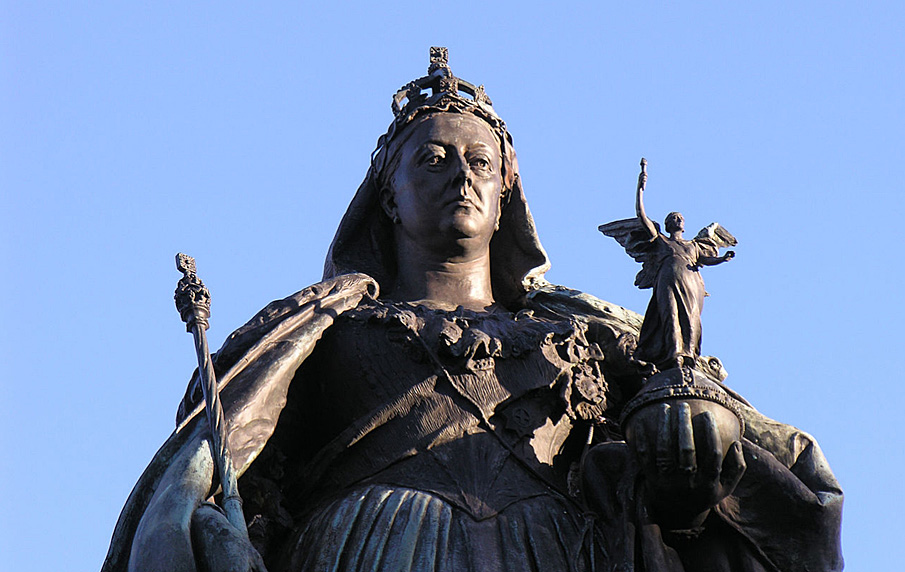
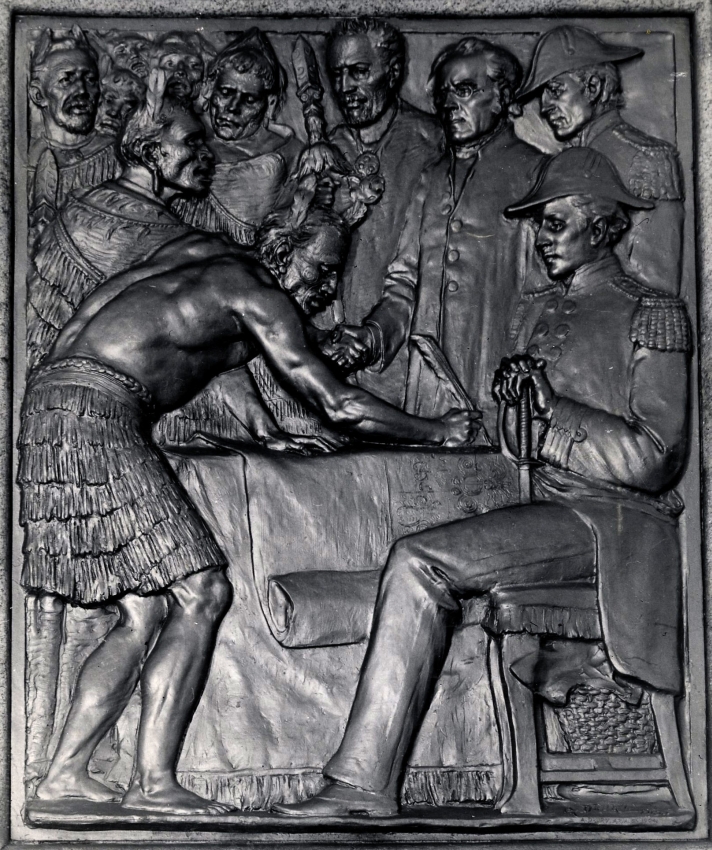
Drury began work on the monument in 1903, creating it in two pieces. The bronze statue of the Queen portrays the monarch wearing the robe of state, with the customary small crown over her widow’s veil. She carries the sceptre and an orb surmounted with a personified winged Victory. Her gown is embroidered with decorative details of national emblems. The pedestal was made from Aberdeen granite. It is decorated with four bronze reliefs showing the artist’s representations of the signing of the Treaty of Waitangi, Fine Arts and Literature and the inventions of Queen Victoria’s reign. The fourth bears an inscription in Latin-VICTORIA REGINA ET IMPERATRIX 1837-1901, Victoria Queen and Empress 1837-1901. The bronze pedestal reliefs have been the subject of heated debate since their creation, mainly due to the representation of the signing of the Treaty of Waitangi. Drury’s attempt to create a dignified but believable scene has been interpreted in a range of ways from a ‘striking artwork’ to a ‘triumphalist gloss over the events of 1840’. The detailing found on these reliefs is remarkable, with Drury including small wheels on the locomotives on the ‘inventions’ relief and individual moko on the chiefs on the relief depicting the Treaty.

Getting the monument finished was easier said than done. Many artists had been commissioned to create statues of Queen Victoria for her Diamond Jubilee and on her death. This meant the casting of the main statue and reliefs for the Wellington monument were delayed due to a large backlog of work at the foundry. The reliefs were not finished in time for the unveiling.

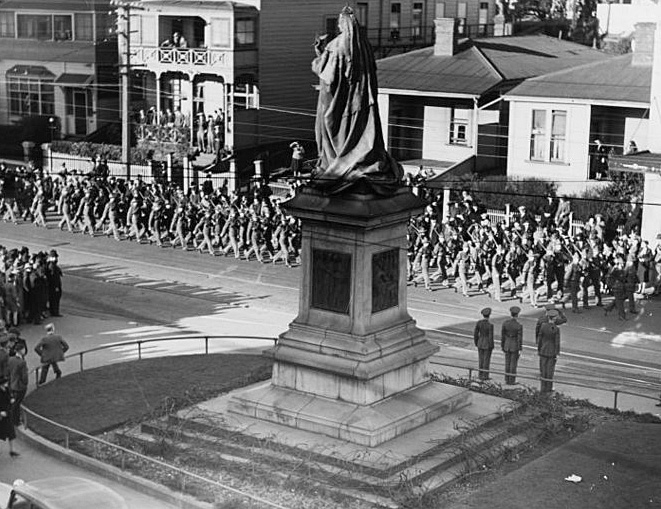
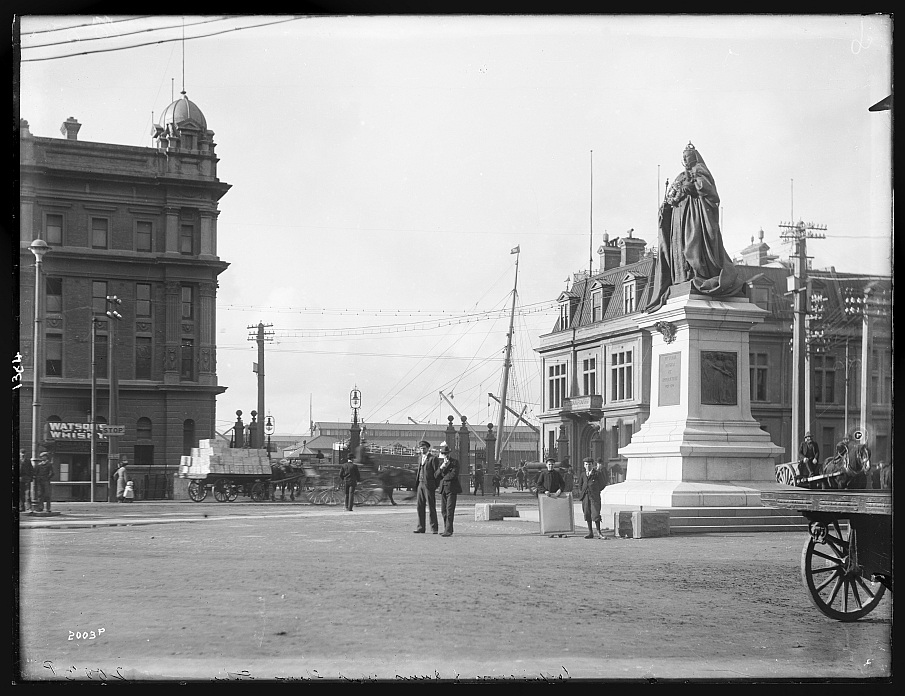
The Queen Victoria Monument was unveiled on the 29 April 1905 by Governor Sir William Plunket (1864-1920) in Post Office Square. Plunket believed that the monument held the significance of a mini Statue of Liberty for immigrants arriving at the harbour. Though Post Office Square seemed well suited for the monument, it was relocated in 1911 to a site between Kent and Cambridge Terraces. The reasons behind this relocation are not well defined, but it seems that the decision to relocate the statue was made due to traffic issues in the Jervois Quay area and the introduction of new electric trams. In its new location, the statue is exposed to heavy traffic and exhausts fumes, and views of the Monument are blemished by the presence of bus and power lines. Attempts have been made to relocate the monument back to its original site in Post Office Square but have failed following protest from local residents and businesses.

The Queen Victoria Monument is a significant piece of Wellington history and an example of artistic and technical skill. The monument is important to many people in Wellington as a fascinating, enduring and beautiful expression of the values that were held in New Zealand’s colonial past. As a potent symbol of colonisation and Victorian morality, it has also been the site of protest. For example, in 1977 it was the site of a demonstration in support of lesbian visibility on International Women's Day.
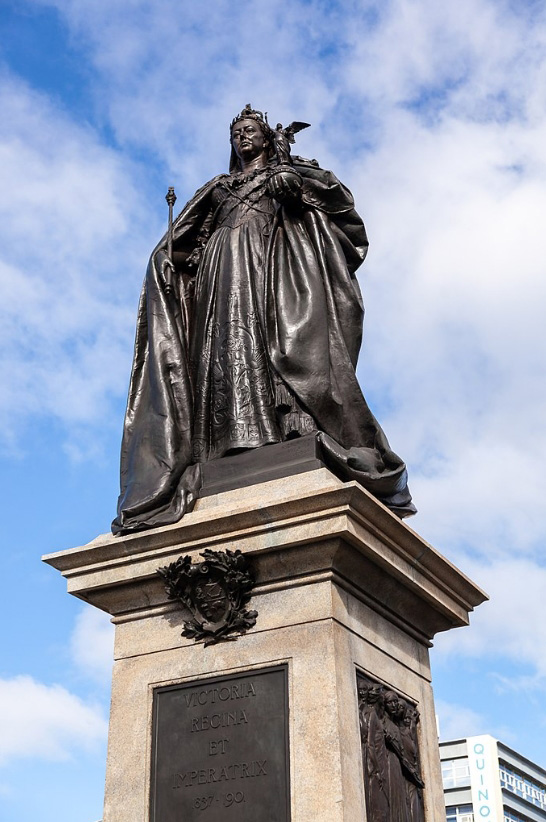
Queen Victoria Monument, Wellington. CC BY 2.0 Image courtesy of www.flickr.com | russellstreet | 10/08/2011 | russellstreet
Queen Victoria Monument, Wellington. CC BY 2.0 Image courtesy of www.flickr.com | Phillip Capper | 09/07/2006 | Phillip Capper
Queen Victoria Monument, Wellington. World War II soldiers marching on Kent Terrace, Wellington, past the statue of Queen Victoria. c.1940s Ref: PAColl-8848 Permission of the Alexander Turnbull Library, Wellington, New Zealand, must be obtained before any re-use of this image | Unknown | Alexander Turnbull Library, Wellington
Queen Victoria Monument, Wellington on original site at Post Office Square, Wellington looking across to Queens Wharf. Reg # C.011364 CC BY 4.0 Museum of NZ Te Papa Collection | Muir & Moodie studio; photography studio; New Zealand | No Known Copyright Restrictions
Queen Victoria Monument, Wellington. CC BY 2.0 This image is a bronze plaque of the signing of te Tiriti o Waitangi on 6 February 1840, from part of the statue of Queen Victoria (Wellington). Henry Williams is standing behind Hobson, shaking the hand of a rangatira. | Unknown | Archives New Zealand
Queen Victoria Monument, Wellington. CC BY 2.0 Image courtesy of www.flickr.com | russellstreet | 10/08/2011 | russellstreet
Queen Victoria Monument, Wellington. CC BY 2.0 Image courtesy of www.flickr.com | Phillip Capper | 09/07/2006 | Phillip Capper
Queen Victoria Monument, Wellington. World War II soldiers marching on Kent Terrace, Wellington, past the statue of Queen Victoria. c.1940s Ref: PAColl-8848 Permission of the Alexander Turnbull Library, Wellington, New Zealand, must be obtained before any re-use of this image | Unknown | Alexander Turnbull Library, Wellington
Queen Victoria Monument, Wellington on original site at Post Office Square, Wellington looking across to Queens Wharf. Reg # C.011364 CC BY 4.0 Museum of NZ Te Papa Collection | Muir & Moodie studio; photography studio; New Zealand | No Known Copyright Restrictions
Queen Victoria Monument, Wellington. CC BY 2.0 This image is a bronze plaque of the signing of te Tiriti o Waitangi on 6 February 1840, from part of the statue of Queen Victoria (Wellington). Henry Williams is standing behind Hobson, shaking the hand of a rangatira. | Unknown | Archives New Zealand

List Entry Information

Overview

Status
Listed

List Entry Status
Historic Place Category 2

Access
Able to Visit

List Number
3663

Date Entered
28th June 1984

Date of Effect
28th June 1984

City/District Council
Wellington City

Region
Wellington Region

Extent of List Entry

Registration includes the part of the land described as Pt Canal Reserve Town of Wellington, Wellington Land District and the structure known as the Queen Victoria Monument and pedestal thereon.

Legal description

Pt Canal Reserve Town of Wellington, Wellington Land District

Location Description

Situated between Kent and Cambridge Terraces, Wellington.

Detailed List Entry

Construction Professional

Name

Drury, Alfred

Type

Architect

Biography

No biography is currently available for this construction professional

Construction Details

Start Year

1911

Type

Relocation

Description

Relocated to Kent Terrace, Wellington

Start Year

1947

Type

Modification

Description

The Wellington City Council gave the statue several layers of lacquer which were subsequently removed due to public protest and disagreement from prominent sculptor Richard Gross (1882-1964).

Start Year

1905

Type

Original Construction

Description

Unveiled in Post Office Square, Wellington

Reference

Completion Date

8th October 2011

Report Written By

Kayla Wilson

Information Sources

Archives New Zealand (Wgtn)

Archives New Zealand (Wellington)

Bulletin of New Zealand Art History

Bulletin of New Zealand Art History

Wellington City Council

Wellington City Council

Report Written By

This place was identified as significant under previous legislation with different information requirements. It remains significant under the current legislation. There is opportunity under our legislation and policies to add to this information. Further information about this place may be available from the Central Regional Office of Heritage New Zealand Pouhere Taonga. A fully referenced Upgrade Report is available from the Central Region office of NZHPT. Please note that entry on the New Zealand Heritage List/Rarangi Korero identifies only the heritage values of the property concerned, and should not be construed as advice on the state of the property, or as a comment of its soundness or safety, including in regard to earthquake risk, safety in the event of fire, or insanitary conditions.

Further Information

Current Usages

Uses: Civic Facilities

Specific Usage: Statue/public art

Uses: Commemoration

Specific Usage: Memorial - Particular person or group

Former Usages

General Usage:: Civic Facilities

Specific Usage: Statue/public art

General Usage:: Commemoration

Specific Usage: Memorial - Particular person or group

Themes

Rainbow List

Web Links

Overview

Status

Listed

List Entry Status

Historic Place Category 2

Access

Able to Visit

List Number

3663

Date Entered

28th June 1984

Date of Effect

28th June 1984

City/District Council

Wellington City

Region

Wellington Region

Extent of List Entry

Registration includes the part of the land described as Pt Canal Reserve Town of Wellington, Wellington Land District and the structure known as the Queen Victoria Monument and pedestal thereon.

Legal description

Pt Canal Reserve Town of Wellington, Wellington Land District

Location Description

Situated between Kent and Cambridge Terraces, Wellington.

Status

Listed

List Entry Status

Historic Place Category 2

Access

Able to Visit

List Number

3663

Date Entered

28th June 1984

Date of Effect

28th June 1984

City/District Council

Wellington City

Region

Wellington Region

Extent of List Entry

Registration includes the part of the land described as Pt Canal Reserve Town of Wellington, Wellington Land District and the structure known as the Queen Victoria Monument and pedestal thereon.

Legal description

Pt Canal Reserve Town of Wellington, Wellington Land District

Location Description

Situated between Kent and Cambridge Terraces, Wellington.

Construction Information

Construction Professional

Name

Drury, Alfred

Type

Architect

Biography

No biography is currently available for this construction professional

Construction Details

Start Year

1911

Type

Relocation

Description

Relocated to Kent Terrace, Wellington

Start Year

1947

Type

Modification

Description

The Wellington City Council gave the statue several layers of lacquer which were subsequently removed due to public protest and disagreement from prominent sculptor Richard Gross (1882-1964).

Start Year

1905

Type

Original Construction

Description

Unveiled in Post Office Square, Wellington

Construction Professional

Name

Drury, Alfred

Type

Architect

Biography

No biography is currently available for this construction professional

Construction Details

Start Year

1911

Type

Relocation

Description

Relocated to Kent Terrace, Wellington

Start Year

1947

Type

Modification

Description

The Wellington City Council gave the statue several layers of lacquer which were subsequently removed due to public protest and disagreement from prominent sculptor Richard Gross (1882-1964).

Start Year

1905

Type

Original Construction

Description

Unveiled in Post Office Square, Wellington

Reference

Historical and Associated Iwi / Hapū / Whānau

Completion Date

8th October 2011

Report Written By

Kayla Wilson

Information Sources

Archives New Zealand (Wgtn)

Archives New Zealand (Wellington)

Bulletin of New Zealand Art History

Bulletin of New Zealand Art History

Wellington City Council

Wellington City Council

Other Information

This place was identified as significant under previous legislation with different information requirements. It remains significant under the current legislation. There is opportunity under our legislation and policies to add to this information. Further information about this place may be available from the Central Regional Office of Heritage New Zealand Pouhere Taonga. A fully referenced Upgrade Report is available from the Central Region office of NZHPT. Please note that entry on the New Zealand Heritage List/Rarangi Korero identifies only the heritage values of the property concerned, and should not be construed as advice on the state of the property, or as a comment of its soundness or safety, including in regard to earthquake risk, safety in the event of fire, or insanitary conditions.

Historical and Associated Iwi / Hapū / Whānau

Completion Date

8th October 2011

Report Written By

Kayla Wilson

Information Sources

Archives New Zealand (Wgtn)

Archives New Zealand (Wellington)

Bulletin of New Zealand Art History

Bulletin of New Zealand Art History

Wellington City Council

Wellington City Council

Other Information

This place was identified as significant under previous legislation with different information requirements. It remains significant under the current legislation. There is opportunity under our legislation and policies to add to this information. Further information about this place may be available from the Central Regional Office of Heritage New Zealand Pouhere Taonga. A fully referenced Upgrade Report is available from the Central Region office of NZHPT. Please note that entry on the New Zealand Heritage List/Rarangi Korero identifies only the heritage values of the property concerned, and should not be construed as advice on the state of the property, or as a comment of its soundness or safety, including in regard to earthquake risk, safety in the event of fire, or insanitary conditions.

Further Information

Current Usages

Uses: Civic Facilities

Specific Usage: Statue/public art

Uses: Commemoration

Specific Usage: Memorial - Particular person or group

Former Usages

General Usage: Civic Facilities

Specific Usage: Statue/public art

General Usage: Commemoration

Specific Usage: Memorial - Particular person or group

Themes

Rainbow List

Current Usages

Uses: Civic Facilities

Specific Usage: Statue/public art

Uses: Commemoration

Specific Usage: Memorial - Particular person or group

Former Usages

General Usage: Civic Facilities

Specific Usage: Statue/public art

General Usage: Commemoration

Specific Usage: Memorial - Particular person or group

Themes

Rainbow List

Location

Loading
Stay up to date with Heritage this month