Godley Statue

Cathedral Square, CHRISTCHURCH

Historic Place Category 1

List No. 3666

Quick links:
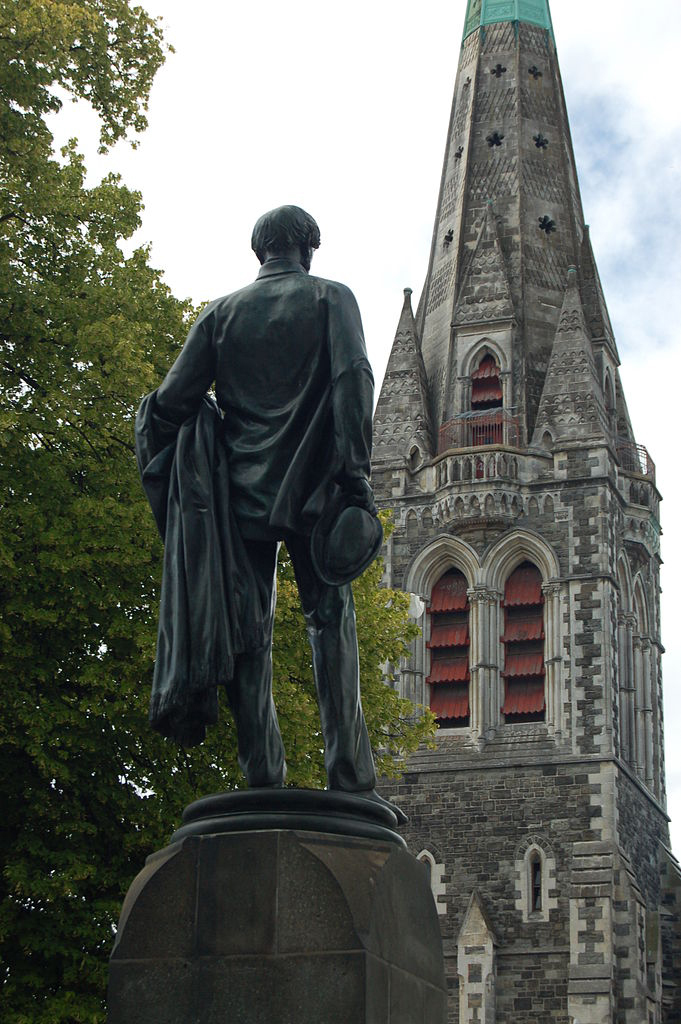
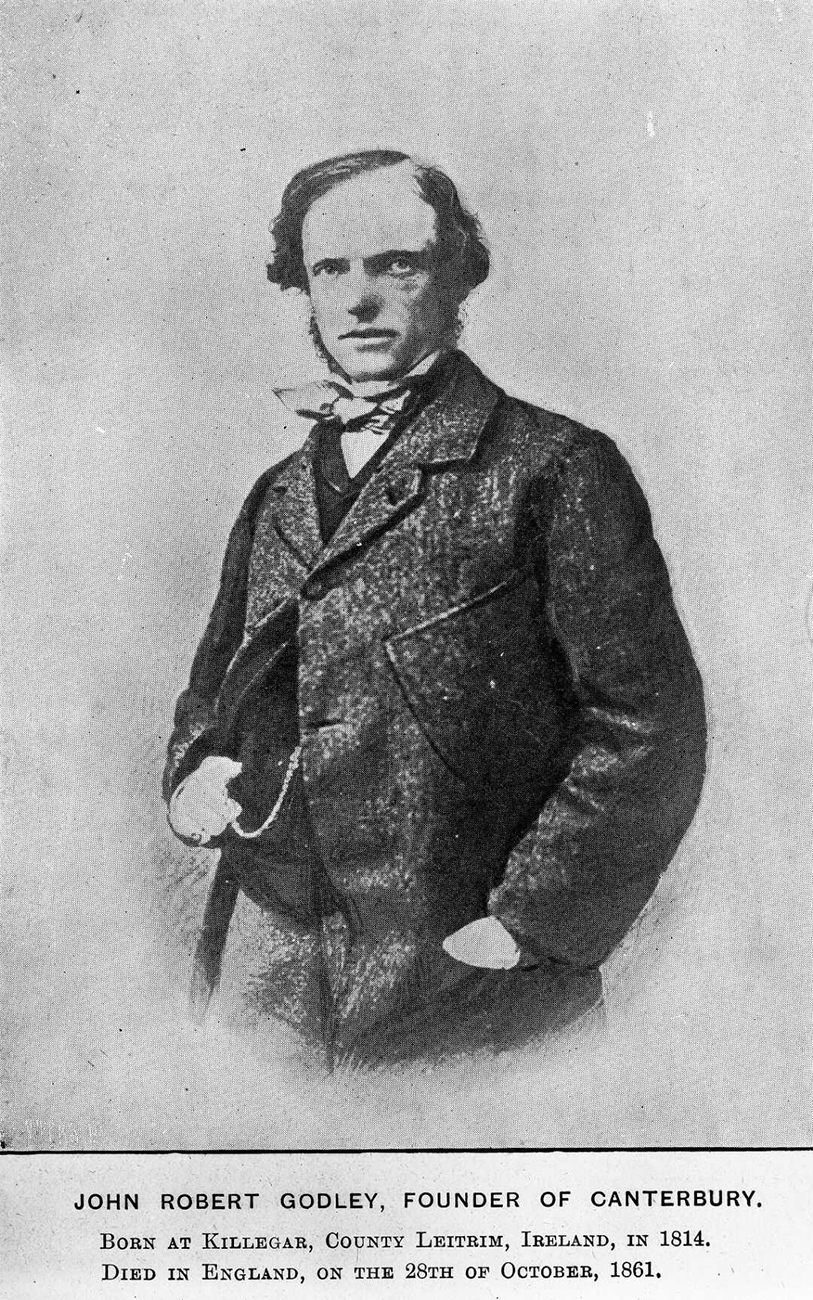
This statue commemorates the founder of the Pakeha settlement of Canterbury, John Robert Godley (1814-1861). Godley, having met Edward Gibbon Wakefield in Britain, had become heavily involved in the establishment of the Canterbury Association, which eventually led to the settlement of Christchurch. Wakefield promoted his ideas of systematic colonisation that would lead to replicas of rural England being established in the colonies while avoiding some of the problems previously associated with colonisation. In practice Wakefield's ideas only worked to a variable degree; the settlement of Canterbury could be regarded as the most successful.

Godley arrived in Canterbury in 1850 and with the arrival of the first four ships in December of that year he became, in effect, governor of the colony. Godley changed the Association's terms for pastoral leases and in doing so opened up the way for the establishment of the large sheep runs of Canterbury. While this was financially shrewd and successful it was a departure from Wakefield's ideals. Godley left New Zealand in 1852 and went on to become assistant under-secretary at the War Office. There he argued strongly for the removal of British troops from the self-governing colonies, a policy that had important ramifications for New Zealand during the 1860s.

The statue of Godley was commissioned by the Memorial Committee of the Provincial Government soon after his death in 1863. The well-known English sculptor Thomas Woolner (1825-1892) cast the statue in England and it arrived in New Zealand in 1867 after first being exhibited at the South Kensington Museum. Woolner had also designed reliefs for the statue's pedestal with a pattern of New Zealand flax bush and English oak branches signifying the Pakeha settlement of New Zealand, which was to be carved in Christchurch. In the event the pedestal made in Christchurch proved too small for the statue and the unveiling had to be delayed until a new (and much plainer) pedestal had been constructed. The statue of Godley was finally unveiled on 6 August 1867; a day that was declared a public holiday.

The statue has since been moved twice. In 1918 it was moved next to the Cathedral as the tram shelter and underground public toilets were encroaching upon it. In 1933 it was moved back to its original site facing the Cathedral, where it remains today.

Godley's Statue is significant as a link to the Pakeha settlement of Canterbury by the Canterbury Association. It is the only known example of Woolner's work in New Zealand and is seen as a particularly fine example of his sculpture. At the time the statue was much praised for its realism and for Woolner's ability to capture the character of his subject. It was the first, and for almost twenty years the only, portrait statue in New Zealand. The creation of this statue (and its exhibition at South Kensington) boosted Woolner's career and he subsequently became ranked as one of the foremost sculptors of his era.
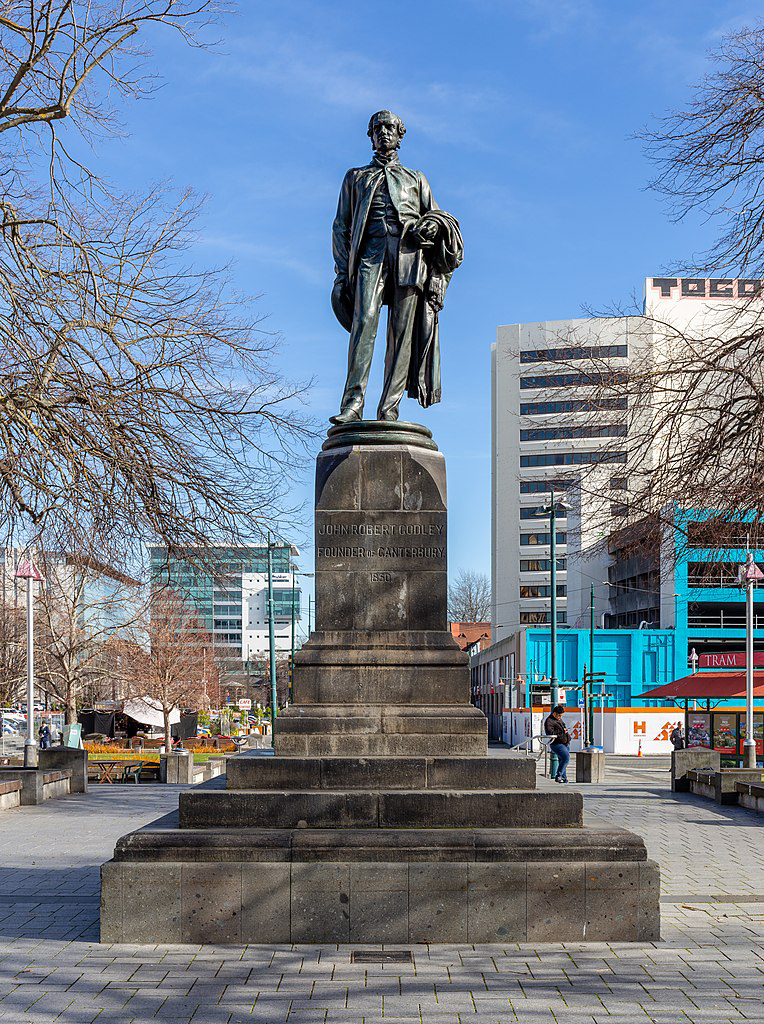
Godley Statue, Christchurch. CC BY-SA 4.0 Image courtesy of commons.wikimedia.org | Michal Klajban | 13/08/2019 | Michal Klajban - Wikimedia Commons
Godley Statue, Christchurch. CC BY-SA 4.0 Image courtesy of commons.wikimedia.org | Allie Hogg | 25/12/2005 | Allie Hogg - Wikimedia Commons
'John Robert Godley'. Permission of the Alexander Turnbull Library, National Library of New Zealand Te Puna Matauranga o Aotearoa, must be obtained before any re-use of this image. Ref no. 1/2-005079-F | Alexander Turnbull Library

List Entry Information

Overview

Status

Listed

List Entry Status

Historic Place Category 1

Access

Able to Visit

List Number

3666

Date Entered

2nd April 1985

Date of Effect

2nd April 1985

City/District Council

Christchurch City

Region

Canterbury Region

Status

Listed

List Entry Status

Historic Place Category 1

Access

Able to Visit

List Number

3666

Date Entered

2nd April 1985

Date of Effect

2nd April 1985

City/District Council

Christchurch City

Region

Canterbury Region

Construction Information

Construction Professional

Name

Woolner, Thomas

Type

Sculptor

Biography

Thomas Woolner (1825-1892) was born in Suffolk, England and studied sculpture in London under William Behnes. He attended the Royal Academy Schools from 1842. In 1848 he became one of the founding members (and the only sculptor) of the Pre-Raphaelite Brotherhood. In 1854 he emmigrated to Australia, where his portrait medallions became popular. Upon his return to England in 1857 with his reputation enhanced by his Australian work, he became well-known for his portrait sculptures, sculpting many well-known personalities of the time. These include Charles Darwin, Captain James Cook, Alfred Tennyson, William Wordsworth, Thomas Carlyle and the Rt Hon. W.E. Gladstone. He came to wide-spread public attention with the exhibition of his sculpture 'Constance and Arthur' at the 1862 International Exhibition. This sculpture was acclaimed for its realism and for its sensitivity, both characteristics of Woolner's work. He was elected to the Royal Academy in 1875, and was appointed Professor of Sculpture at the Royal Academy from 1877-1879. His works became widespread throughout Britian and the Empire. The statue of John Robert Godley in Cathedral Square, Christchurch is the only example of his work in New Zealand and was much admired. Godley's statue was Woolner's first commission for an overlife-sized bronze and was therefore a milestone in Woolner's career. Godley's statue was exhibited at South Kensington before being shipped to New Zealand, and this, according to Mark Stocker, boosted Woolner's career and placed him at the forefront of Victorian sculpture. Woolner died in 1892.

Construction Details

Start Year

1863

Type

Other

Description

Commissioned

Start Year

1864

Finish Year

1865

Type

Original Construction

Description

Plaster model 1864. Cast in bronze 1865

Start Year

1867

Type

Other

Description

Erected in Cathedral Square. Officially unveiled August 1867

Start Year

1918

Type

Relocation

Description

Relocated

Start Year

1933

Type

Relocation

Description

Moved back to original site

Construction Professional

Name

Woolner, Thomas

Type

Sculptor

Biography

Thomas Woolner (1825-1892) was born in Suffolk, England and studied sculpture in London under William Behnes. He attended the Royal Academy Schools from 1842. In 1848 he became one of the founding members (and the only sculptor) of the Pre-Raphaelite Brotherhood. In 1854 he emmigrated to Australia, where his portrait medallions became popular. Upon his return to England in 1857 with his reputation enhanced by his Australian work, he became well-known for his portrait sculptures, sculpting many well-known personalities of the time. These include Charles Darwin, Captain James Cook, Alfred Tennyson, William Wordsworth, Thomas Carlyle and the Rt Hon. W.E. Gladstone. He came to wide-spread public attention with the exhibition of his sculpture 'Constance and Arthur' at the 1862 International Exhibition. This sculpture was acclaimed for its realism and for its sensitivity, both characteristics of Woolner's work. He was elected to the Royal Academy in 1875, and was appointed Professor of Sculpture at the Royal Academy from 1877-1879. His works became widespread throughout Britian and the Empire. The statue of John Robert Godley in Cathedral Square, Christchurch is the only example of his work in New Zealand and was much admired. Godley's statue was Woolner's first commission for an overlife-sized bronze and was therefore a milestone in Woolner's career. Godley's statue was exhibited at South Kensington before being shipped to New Zealand, and this, according to Mark Stocker, boosted Woolner's career and placed him at the forefront of Victorian sculpture. Woolner died in 1892.

Construction Details

Start Year

1863

Type

Other

Description

Commissioned

Start Year

1864

Finish Year

1865

Type

Original Construction

Description

Plaster model 1864. Cast in bronze 1865

Start Year

1867

Type

Other

Description

Erected in Cathedral Square. Officially unveiled August 1867

Start Year

1918

Type

Relocation

Description

Relocated

Start Year

1933

Type

Relocation

Description

Moved back to original site

Reference

Historical and Associated Iwi / Hapū / Whānau

Completion Date

23rd August 2001

Report Written By

Melanie Lovell-Smith

Information Sources

Bulletin of New Zealand Art History

Bulletin of New Zealand Art History

Dictionary of New Zealand Biography

Dictionary of New Zealand Biography

New Zealand Federation of University Women, 1995

New Zealand Federation of University Women, Canterbury Branch, Round the Square. A History of Christchurch's Cathedral Square, Christchurch, 1995

Other Information

This place was identified as significant under previous legislation with different information requirements. It remains significant under the current legislation. There is opportunity under our legislation and policies to add to this information. Further information about this place may be available from the Southern Regional Office of Heritage New Zealand Pouhere Taonga. Please note that entry on the New Zealand Heritage List/Rarangi Korero identifies only the heritage values of the property concerned, and should not be construed as advice on the state of the property, or as a comment of its soundness or safety, including in regard to earthquake risk, safety in the event of fire, or insanitary conditions.

Historical and Associated Iwi / Hapū / Whānau

Completion Date

23rd August 2001

Report Written By

Melanie Lovell-Smith

Information Sources

Bulletin of New Zealand Art History

Bulletin of New Zealand Art History

Dictionary of New Zealand Biography

Dictionary of New Zealand Biography

New Zealand Federation of University Women, 1995

New Zealand Federation of University Women, Canterbury Branch, Round the Square. A History of Christchurch's Cathedral Square, Christchurch, 1995

Other Information

This place was identified as significant under previous legislation with different information requirements. It remains significant under the current legislation. There is opportunity under our legislation and policies to add to this information. Further information about this place may be available from the Southern Regional Office of Heritage New Zealand Pouhere Taonga. Please note that entry on the New Zealand Heritage List/Rarangi Korero identifies only the heritage values of the property concerned, and should not be construed as advice on the state of the property, or as a comment of its soundness or safety, including in regard to earthquake risk, safety in the event of fire, or insanitary conditions.

Further Information

Current Usages

Uses: Commemoration

Specific Usage: Memorial - Early settler

Uses: Commemoration

Specific Usage: Memorial - Particular person or group

Former Usages

General Usage: Commemoration

Specific Usage: Memorial - Early settler

General Usage: Commemoration

Specific Usage: Memorial - Particular person or group

Current Usages

Uses: Commemoration

Specific Usage: Memorial - Early settler

Uses: Commemoration

Specific Usage: Memorial - Particular person or group

Former Usages

General Usage: Commemoration

Specific Usage: Memorial - Early settler

General Usage: Commemoration

Specific Usage: Memorial - Particular person or group

Sign up to hear more

Get the latest heritage news, features and events delivered
straight to your inbox.