

Robert Gillies built up a portfolio of land buying sections on Park Street over a number of years. In 1863 he purchased Sections 63 and 64, Block 19 in Park Street. He then purchased Sections 61 and 62, in February 1879. In 1883 Sections 63 and 64 were worth £100 ($16,810) and were referred to as ‘old house’. Gillies employed his nephew, John Arthur Burnside (1856-1920), New Zealand’s first born and locally trained architect, to design Transit House as the Gillies’ family home. Burnside advertised for tenders for the ‘erection of a residence (stone) in Park Street for Gillies’ in early 1882. The Gillies probably moved into the ‘new house’ in late 1882–1883 as in October 1882 the ‘old house’ was advertised to rent. The family were resident by August 1883 as Mrs Gillies was advertising for a ‘cook and laundress’ for Transit House. By 1884-5, valuation records show the ‘new house’ as complete and worth £300 ($55,657).
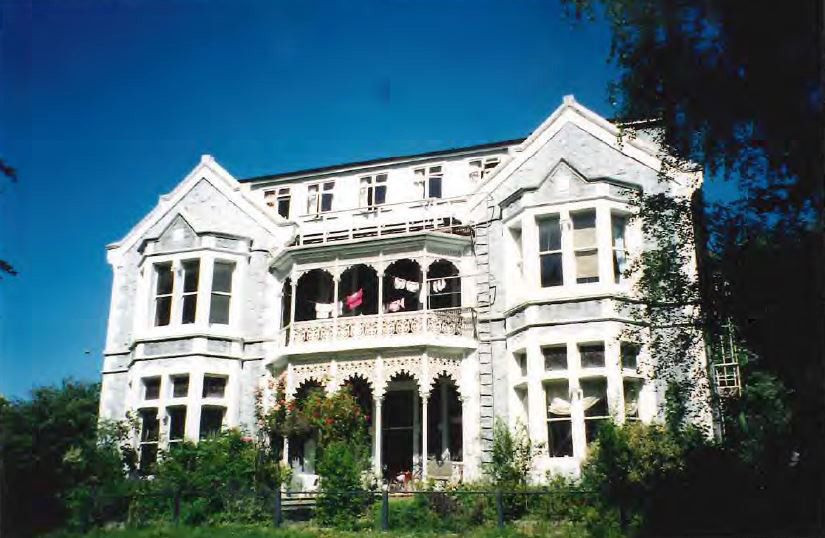
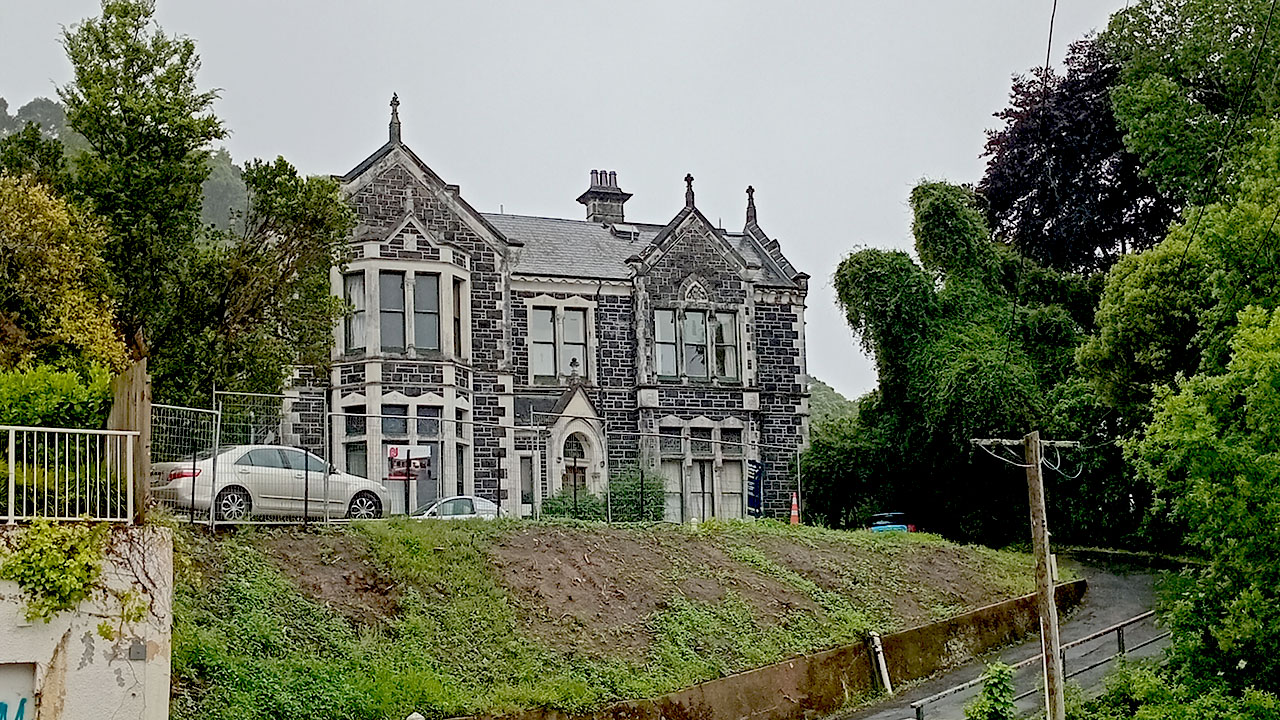
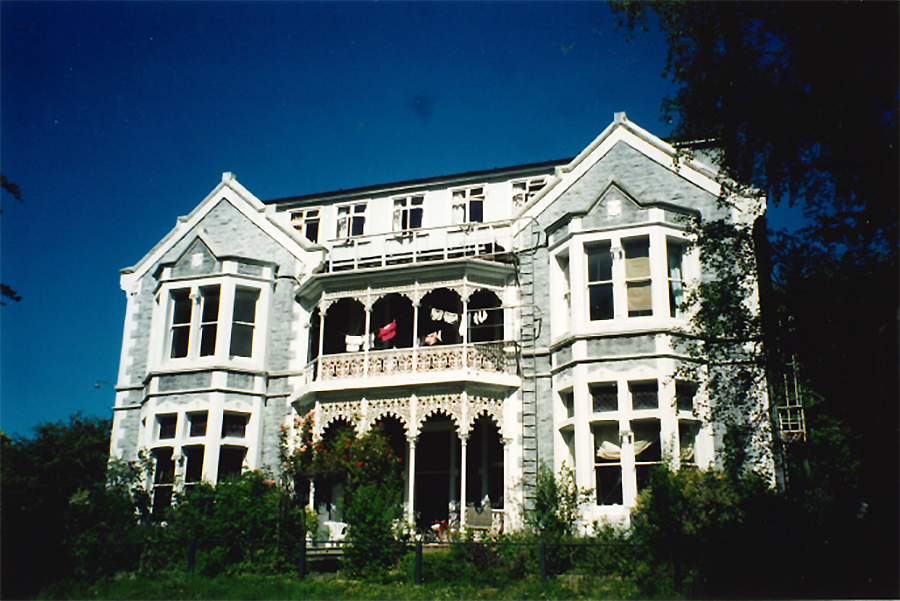
Reflecting Gillies’ wealth and standing in the community, Transit House was grand and imposing in both its interior and exterior, positioned within a beautiful garden setting which includes a significant Wellingtonia (Sequoiadendron giganteum). The exterior of Transit House was constructed of bluestone coursework and dark grey andesite possibly from Leith Valley. This was softened by Ōamaru stone quoining and eight large bay windows to flood the interior with light. Architectural commentator Hardwicke Knight notes ‘its most attractive elevation shows two gables bridged by a verandah and balcony.’ The interior was elegant throughout with white marble fireplaces, an imposing entrance hall and hanging concrete staircase. The rooms were spacious and included embossed plaster ceilings, minton tiles in the hall and ornate door handles. Knight notes Burnside’s use of ‘prefabricated capitals’ on ‘formless columns’ and remarks on the ‘splendid’ arches. A possible Burnside innovation were the heating grilles featured in every main room fed by a furnace in the basement. There is also reported to have been a children’s wing, gardener’s cottage and a coach house. The latter was an attractive brick building at 40 Park Street, with ‘round-topped windows, fretted barge boards, and finials’. Perhaps the most unusual feature of Burnside’s design was an astronomical observatory, installed in the roof which included a revolving glass dome.
Following Gillies’ early death at aged 50, his family moved to Auckland. The longest resident of Transit House was Harman Reeves (1871-1948), son of Dunedin Mayor Charles Reeves. Reeves' company Perpetual Trustees purchased the property from the Gillies' estate in 1914 and then owned it under his own name in 1930, until he sold it in 1945. Transit House was then purchased by the Dominican Order, was renamed Dominican Hall, and underwent significant renovation to become a hall of residence. In the 1960s the garage became the home of the Otago Vintage Car Club. The house was sold by the Order in 1982 and once again became a beloved family home. The current owner has restored much of the house and renamed it Rothesay after Gillies’ birthplace in Scotland.
List Entry Information
Status
Listed
List Entry Status
Historic Place Category 2
Access
Private/No Public Access
List Number
367
Date Entered
13th December 1990
Date of Effect
13th December 1990
City/District Council
Dunedin City
Region
Otago Region
Legal description
Pt Sec 61 and Sec 62 Blk XIX Town of Dunedin (RT OT10B/537), Otago Land District
Status
Listed
List Entry Status
Historic Place Category 2
Access
Private/No Public Access
List Number
367
Date Entered
13th December 1990
Date of Effect
13th December 1990
City/District Council
Dunedin City
Region
Otago Region
Legal description
Pt Sec 61 and Sec 62 Blk XIX Town of Dunedin (RT OT10B/537), Otago Land District
Why is this place significant?
Historic Significance
Historical Significance or Value Transit House has historical significance as the birthplace of Sir Harold Delf Gillies, a worldwide pioneer in the field of plastic surgery, and was in the ownership of the Gillies family from the time of its construction until 1930
Physical Significance
ARCHITECTURAL QUALITY: Transit House was designed by John Burnside who is believed to be one of the first New Zealand born and trained architects. Although compromised by the large penthouse addition it is one of Dunedin's finest Victorian villas and noteworthy for its fine detailing both inside and out. TOWNSCAPE/LANDMARK VALUE: Transit House is largely hidden by mature trees and has minimal townscape impact.
Why is this place significant?
Historic Significance
Historical Significance or Value Transit House has historical significance as the birthplace of Sir Harold Delf Gillies, a worldwide pioneer in the field of plastic surgery, and was in the ownership of the Gillies family from the time of its construction until 1930
Physical Significance
ARCHITECTURAL QUALITY: Transit House was designed by John Burnside who is believed to be one of the first New Zealand born and trained architects. Although compromised by the large penthouse addition it is one of Dunedin's finest Victorian villas and noteworthy for its fine detailing both inside and out. TOWNSCAPE/LANDMARK VALUE: Transit House is largely hidden by mature trees and has minimal townscape impact.
Construction Professional
Name
O'Connell & McKewen
Type
Builder
Biography
No biography is currently available for this construction professional
Name
Burnside, John Arthur
Type
Architect
Biography
Burnside (1856-1920) was born in Dunedin and is believed to be one of the first professional architects who were born and trained in New Zealand. He was articled to the architectural firm of Mason and Wales, remaining with them for two or three years. During this time he won important prizes for designs which he exhibited at international exhibitions. In 1880 he established his own practice at Dunedin. His buildings include Transit House (1880s), Philips Hotel (now Gresham Hotel, 1882) and the Otago Early Settlers' Museum (1908).
Construction Details
Start Year
1882
Type
Original Construction
Description
Construction commenced
Finish Year
1925
Type
Addition
Description
Garage erected (Reeves)
Finish Year
1926
Type
Modification
Description
Alteration to the dwelling (Neill)
Finish Year
1945
Type
Modification
Description
Plumbing and drainage works. Garage converted to a sleep out
Finish Year
1946
Type
Modification
Description
Alterations to the building – no plan
Finish Year
1948
Type
Modification
Description
Revolving dome removed from roof. Area under roof enlarged to incorporate twelve bedrooms and a bathroom at either end of the passage. Fire escapes added.
Finish Year
1952
Type
Physical access improvements
Description
Erection of a covered way
Finish Year
1965
Type
Modification
Description
Alteration to sleeping areas
Finish Year
1967
Type
Addition
Description
11 basins fitted
Finish Year
2013
Type
Modification
Description
5 ensuites with wardrobes into bedrooms
Construction Materials
Bluestone with Oamaru stone quoins and slate roof.
Notable Features
Ornate iron lacework to verandah and balcony. Interior ornamentation including deeply embossed ceilings, pedimented doors and pillared arches.
Construction Professional
Name
O'Connell & McKewen
Type
Builder
Biography
No biography is currently available for this construction professional
Name
Burnside, John Arthur
Type
Architect
Biography
Burnside (1856-1920) was born in Dunedin and is believed to be one of the first professional architects who were born and trained in New Zealand. He was articled to the architectural firm of Mason and Wales, remaining with them for two or three years. During this time he won important prizes for designs which he exhibited at international exhibitions. In 1880 he established his own practice at Dunedin. His buildings include Transit House (1880s), Philips Hotel (now Gresham Hotel, 1882) and the Otago Early Settlers' Museum (1908).
Construction Details
Start Year
1882
Type
Original Construction
Description
Construction commenced
Finish Year
1925
Type
Addition
Description
Garage erected (Reeves)
Finish Year
1926
Type
Modification
Description
Alteration to the dwelling (Neill)
Finish Year
1945
Type
Modification
Description
Plumbing and drainage works. Garage converted to a sleep out
Finish Year
1946
Type
Modification
Description
Alterations to the building – no plan
Finish Year
1948
Type
Modification
Description
Revolving dome removed from roof. Area under roof enlarged to incorporate twelve bedrooms and a bathroom at either end of the passage. Fire escapes added.
Finish Year
1952
Type
Physical access improvements
Description
Erection of a covered way
Finish Year
1965
Type
Modification
Description
Alteration to sleeping areas
Finish Year
1967
Type
Addition
Description
11 basins fitted
Finish Year
2013
Type
Modification
Description
5 ensuites with wardrobes into bedrooms
Construction Materials
Bluestone with Oamaru stone quoins and slate roof.
Notable Features
Ornate iron lacework to verandah and balcony. Interior ornamentation including deeply embossed ceilings, pedimented doors and pillared arches.
Historical Narrative Early history The history of Coastal Otago (Te Tai o Araiteuru) relates to the tradition of the waka Arai Te Uru. These traditions and histories provide the basis for tribal identity. Muaupoko (Otago Peninsula) in particular provided a sheltered place for settlement, and Waitaha, Kāti Māmoe and Kāi Tahu, who remain associated with the area, all visited and lived in the vicinity. At one time up to 12 kāinga existed in the lower Otago harbour. The coastline was a major trade route. Tauranga waka and associated nohoanga occurred up and down the coast, linking sea and land based resources. The mahinga kai and the varieties of plant resources were important to iwi, and with the Pākehā settlement and land sales starting in the late 1840s (particularly the sale of the 400,000 acre Otago Block) there was a significant loss access to land based food sources. The area was traditionally known to Kāi Tahu Māori as Ōtepoti. The Gillies Family Robert Gillies (1836-1886) was born in Rothesay, Scotland and in 1852, aged 17, he and his family immigrated to New Zealand on the Slains Castle. He was a cadet in the Otago Survey Department and became District Surveyor after qualifying. In 1861 he struck out on his own as a land surveyor. Gillies joined Charles Street in partnership to form the Perpetual Trustees Estate and Agency Company, which was very successful. In 1866 Robert married Emily, the daughter of Charles Street, and together they had eight children. As a founder of Knox Church, he played an active role within the church community, and was a founder of the Otago Institute to which he contributed papers on local flora and fauna. He was a member of the House of Representatives in 1884 and 1885. Gillies was also the chairman of the Perpetual Trustees Estate and Agency Company until his death in 1886. Harold Delf Gillies, their youngest child, was reputedly born in Transit House on 17 June 1882 but birth notices do not mention the house by name. A time capsule discovered in the late 1980s under one of the columns supporting the front porch included a letter dated 24 June 1882 which may be indicative of initiation of construction. Harold became a Fellow of the Royal College of Surgeons (FRCS) in 1910 and specialised in ear, nose and throat surgery, serving in the First World War with the Royal Army Medical Corps. He returned to New Zealand and with his cousin, Sir Archibald McIndoe, established the speciality of plastic surgery. In 1946 Harold Gillies was elected foundation president of the British Association of Plastic Surgeons after suggesting the foundation of the Association. He later became honorary president of the International Society of Plastic Surgeons. On visiting Dominican Hall in 1956, he reminisced with the Sisters about sliding down the bannister as a child, falling off and breaking his arm. Construction of Transit House Robert Gillies and John Burnside, the architect of Transit House, had a strong connection through their respective fathers who travelled out to New Zealand together on the Slains Castle in 1852. John Burnside senior farmed at Tokomairiro with T.B. (Judge) Gillies, went gold prospecting with J.L. Gillies, and in 1854 married Ms (Janet) Jessie Gillies. John Arthur Burnside (1856-1920) was born in Tokomariro, south of Dunedin, one of 10 children, and the only son of Mr John Burnside and Mrs Janet (Jessie) Gillies. John was privately tutored then became an indentured assistant to the Dunedin architectural firm Mason and Wales for two to three years during which time he won prizes for designs which he exhibited at international exhibitions. ‘He is believed to be New Zealand’s first-born and trained architect’. Burnside came into his own in 1880, designing many private residences including Transit House. Aside from their familial connections, their business relationship was already established, Burnside having been engaged as architect in the construction of Gillies, Street and Hislop’s offices in 1880. The firm were in occupation of their new offices on the corner of ‘Rattray and Vogel Street, next to the Railway station’ from December 1880. In March 1881 Burnside was advertising for tenders to build a 12 roomed dwelling-house on Park Street and construction likely began soon after. A year later he was again advertising for ‘erection of a residence (stone) in Park Street for Gillies’. By October 1882, Gillies was advertising a property on Park Street to let through his company Gillies, Street and Hislop. ‘Comfortable family home, top of Park Street; contains 8 or 9 rooms, bathroom (with hot and cold water), kitchen (h.p. boiler), scullery, wash-house, etc; beautiful view and nice grounds.’ We know the Gillies were living on Park Street and this timing suggests they were ready to move into Transit House. Transit of Venus On 7 December 1882 the Transit of Venus took place, a rare celestial phenomenon during which Venus can be seen to pass between the sun and earth. The 1882 transit was a highly anticipated event in the New Zealand scientific community resulting in ‘every high-quality telescope in the country’ being pressed into service. This included R. Gillies, A. Beverley and H. Skey in Dunedin. The three Dunedin observations by Beverly, Skey and Gillies were described as being independent. Transit House and its observatory may well have been sufficiently complete for Gillies to observe and report on the transit. Mr Robert Gillies was very successful in his observation, the internal contact at egress being remarkably distinct. It came on very gradually, the line of light getting thinner and thinner. The weather was all that could be desired about the time of contact, though about half an hour before nothing could be seen of the Sun…The external contact was not quite so clear, but Mr Gillies made a very good observation of this also. Sadly, the family did not reside at Transit House for long. Gillies died on 15 June 1886 of a heart aneurism at aged 50 after a period of illness. He was described as, “A staunch friend, a good citizen, an exemplary husband and father, and a man worthy of the highest respect in every relation of life…” After his death, Emily Gillies and their eight children moved to Auckland where her family lived. A woman of influence, she was involved in Church matters and kindergarten work, being one of the originators in Dunedin’s first kindergarten. She had been an invalid for some years before she died in Auckland on 7 September 1913 but was buried with her husband in Dunedin’s Northern Cemetery. From Private Home to Student Residence After Robert’s sudden death, Transit House was retained by the Gillies family but managed by the Perpetual Trustees Estate. Sir Lindo and Lady Ferguson rented Transit House for a period of time and sources show they were living there in 1903 as Lady Ferguson held a luncheon; they moved out of Transit House in 1913. Sir Lindo Ferguson was born in England 1858, attended the Royal College of Science for Ireland, and then went on to study medicine. In 1883 he emigrated to New Zealand where he settled in Dunedin. He became the first trained eye doctor in Australasia, but also carried out ear, nose and throat surgery. Ferguson was president of the New Zealand Medical Association in 1896, was made a Professor at the University of Otago and went on to become the Dean of the Faculty of Medicine in 1914. Ferguson also did extensive work on soldiers after the First World War and was a commander of the Order of St John in 1937. He lived in Dunedin until he died in 1948. The longest resident of Transit House was Harman Reeves (1871-1948), son of Dunedin Mayor Charles Reeves. Reeves' company Perpetual Trustees purchased the property from the Gillies' estate in 1914 and then owned it under his own name in 1930, until he sold it in 1945. Reeves, born in Dunedin, began working as a stockbroking and accounting clerk for his father in 1894. Reeves became involved in the Dunedin Exchange after taking over the broking part of the firm in 1897, and was chairman of the Dunedin Exchange and the Stock Exchange three times. Reeves is the only member known to have written an autobiography detailing his experiences as a stockbroker. In his role as American Consul in Dunedin, Harman Reeves came to know Admiral Byrd who conducted his fourth expedition to Antarctica in 1929-1930. In Reeve’s obituary ‘his assistance to the Byrd Antarctic expedition was fully acknowledged by the admiral.’ The Reeves family owned Transit House until 1945 when it was advertised for sale by auction. It was described as a containing 20 rooms, large ballroom, drawing room, morning room, dining room, nursery, kitchen on ground floor while upstairs, could be found a billiard room and nine bedrooms, four staff bedrooms. Architect’s plans for 8-10 flats had been drawn up. The property sold for £5700 ($494,581) and the successful bidder was Mr J.D. Woods, a local architect, acting on behalf of an undisclosed purchaser. A newspaper report of the time claimed: The University Hostel Committee was interested in purchasing the property for a student hostel, but it is understood that the price realised was higher than the committee was prepared to offer. Transit House was purchased by the Dominican Order in 1945, renamed Dominican Hall, and utilised as a student residence from 1946. Significant alterations were necessarily made to convert the building to fit the purpose of a residential home for young Catholic women. The servants’ rooms in the attic were removed and a mansard roof and casement windows were added to accommodate 11 single bedrooms and two extra bathrooms at either end of a long passageway. Red pine (rimu) was used throughout for desks, wardrobes as well as architectural features like scotia and nosing. In addition to the bedroom renovations, a cubical was erected in the Nun’s refrectory. Reflecting back, Sister Mary Augustine McCarthy described the building as, “Standing amidst trees in beauttiful, secluded grounds, the house proved to be well suited for this purpose.” Dominican Hall was the only Catholic hostel in the city and at peak capacity it could house 50 students. In 1953 there were 47 students in residence and it continued to house students until 1978 when the numbers of residents declined with the availability of more modern residential accommodation on campus. This coincided with the cost of maintenance to meet the Dunedin City Council’s fire safety requirements becoming prohibitive. The hall continued as a private home for student sisters attending Holy Cross College, Dunedin Teachers College, and those working for the Catholic Education Office until 1981. It was then transferred to the New Zealand Dominican Sisters Trust Board in March 1981 and sold to a private owner in April 1982. The advertisement describes the house as having an imported slate roof, kauri floors, mahongany doors and features a mosaic tiled floor in the reception area. Many former residents and members of the Catholic community still refer to the house affectionately as ‘Dom Hall’. A Private Home Once Again Transit House was sold to private owners Geoff and Margaret Williamson and their seven children in April 1982, and remained their home until August 1989 when it was purchased by the current owners, who were senior music students at the time of purchase. Over the following decades much restoration work was undertaken. The sitting room and billiards room were separated by a pair of folding doors which could be opened when required to turn the rooms into a ballroom. The kitchen was reinstated with a coal range, a Shacklock No. 5 twin oven – which had a previous life in an Invercargill hotel. A white marble fireplace was reinstated in the drawing room – the original had been removed when it was converted into a chapel. The library (situated between the drawing room and the ballroom) and the dining room were restored. The unsympathetic third floor was removed and the roof reinstated to nearer its original form. Traces of the dome remain but it is smaller than it would have been as the observatory, and is used as a light source. Galer notes that doors were coded to notify servants which rooms they could enter and which were reserved for family (some have four panels on one side and six on the other). In 2002 the owners were in the midst of a 12-year restoration process and had undertaken extensive renovations including stripping layers of paint and wallpaper from the walls to reveal stencilled panels, and weatherproofing the bluestone and Ōamaru stone exterior. Important restorative work was conducted on the bluestone which had been covered in an asphalt coating. This had broken down, letting in water and resulting in some rot to timbers. Following the removal of this coating, the tuck-pointing was restored which involved the researching, designing and manufacturing of an appropriate tuck-pointing tool. This was achieved in collaboration with stonemason Tom Robinson. The family re-named Transit House ‘Rothesay’ after Robert Gillies birthplace. Despite changing its name to Rothesay, the building is still well known in Dunedin both as Transit House and Dominican Hall, and remains one of Dunedin’s most stately and distinguished buildings.
Historical Narrative Early history The history of Coastal Otago (Te Tai o Araiteuru) relates to the tradition of the waka Arai Te Uru. These traditions and histories provide the basis for tribal identity. Muaupoko (Otago Peninsula) in particular provided a sheltered place for settlement, and Waitaha, Kāti Māmoe and Kāi Tahu, who remain associated with the area, all visited and lived in the vicinity. At one time up to 12 kāinga existed in the lower Otago harbour. The coastline was a major trade route. Tauranga waka and associated nohoanga occurred up and down the coast, linking sea and land based resources. The mahinga kai and the varieties of plant resources were important to iwi, and with the Pākehā settlement and land sales starting in the late 1840s (particularly the sale of the 400,000 acre Otago Block) there was a significant loss access to land based food sources. The area was traditionally known to Kāi Tahu Māori as Ōtepoti. The Gillies Family Robert Gillies (1836-1886) was born in Rothesay, Scotland and in 1852, aged 17, he and his family immigrated to New Zealand on the Slains Castle. He was a cadet in the Otago Survey Department and became District Surveyor after qualifying. In 1861 he struck out on his own as a land surveyor. Gillies joined Charles Street in partnership to form the Perpetual Trustees Estate and Agency Company, which was very successful. In 1866 Robert married Emily, the daughter of Charles Street, and together they had eight children. As a founder of Knox Church, he played an active role within the church community, and was a founder of the Otago Institute to which he contributed papers on local flora and fauna. He was a member of the House of Representatives in 1884 and 1885. Gillies was also the chairman of the Perpetual Trustees Estate and Agency Company until his death in 1886. Harold Delf Gillies, their youngest child, was reputedly born in Transit House on 17 June 1882 but birth notices do not mention the house by name. A time capsule discovered in the late 1980s under one of the columns supporting the front porch included a letter dated 24 June 1882 which may be indicative of initiation of construction. Harold became a Fellow of the Royal College of Surgeons (FRCS) in 1910 and specialised in ear, nose and throat surgery, serving in the First World War with the Royal Army Medical Corps. He returned to New Zealand and with his cousin, Sir Archibald McIndoe, established the speciality of plastic surgery. In 1946 Harold Gillies was elected foundation president of the British Association of Plastic Surgeons after suggesting the foundation of the Association. He later became honorary president of the International Society of Plastic Surgeons. On visiting Dominican Hall in 1956, he reminisced with the Sisters about sliding down the bannister as a child, falling off and breaking his arm. Construction of Transit House Robert Gillies and John Burnside, the architect of Transit House, had a strong connection through their respective fathers who travelled out to New Zealand together on the Slains Castle in 1852. John Burnside senior farmed at Tokomairiro with T.B. (Judge) Gillies, went gold prospecting with J.L. Gillies, and in 1854 married Ms (Janet) Jessie Gillies. John Arthur Burnside (1856-1920) was born in Tokomariro, south of Dunedin, one of 10 children, and the only son of Mr John Burnside and Mrs Janet (Jessie) Gillies. John was privately tutored then became an indentured assistant to the Dunedin architectural firm Mason and Wales for two to three years during which time he won prizes for designs which he exhibited at international exhibitions. ‘He is believed to be New Zealand’s first-born and trained architect’. Burnside came into his own in 1880, designing many private residences including Transit House. Aside from their familial connections, their business relationship was already established, Burnside having been engaged as architect in the construction of Gillies, Street and Hislop’s offices in 1880. The firm were in occupation of their new offices on the corner of ‘Rattray and Vogel Street, next to the Railway station’ from December 1880. In March 1881 Burnside was advertising for tenders to build a 12 roomed dwelling-house on Park Street and construction likely began soon after. A year later he was again advertising for ‘erection of a residence (stone) in Park Street for Gillies’. By October 1882, Gillies was advertising a property on Park Street to let through his company Gillies, Street and Hislop. ‘Comfortable family home, top of Park Street; contains 8 or 9 rooms, bathroom (with hot and cold water), kitchen (h.p. boiler), scullery, wash-house, etc; beautiful view and nice grounds.’ We know the Gillies were living on Park Street and this timing suggests they were ready to move into Transit House. Transit of Venus On 7 December 1882 the Transit of Venus took place, a rare celestial phenomenon during which Venus can be seen to pass between the sun and earth. The 1882 transit was a highly anticipated event in the New Zealand scientific community resulting in ‘every high-quality telescope in the country’ being pressed into service. This included R. Gillies, A. Beverley and H. Skey in Dunedin. The three Dunedin observations by Beverly, Skey and Gillies were described as being independent. Transit House and its observatory may well have been sufficiently complete for Gillies to observe and report on the transit. Mr Robert Gillies was very successful in his observation, the internal contact at egress being remarkably distinct. It came on very gradually, the line of light getting thinner and thinner. The weather was all that could be desired about the time of contact, though about half an hour before nothing could be seen of the Sun…The external contact was not quite so clear, but Mr Gillies made a very good observation of this also. Sadly, the family did not reside at Transit House for long. Gillies died on 15 June 1886 of a heart aneurism at aged 50 after a period of illness. He was described as, “A staunch friend, a good citizen, an exemplary husband and father, and a man worthy of the highest respect in every relation of life…” After his death, Emily Gillies and their eight children moved to Auckland where her family lived. A woman of influence, she was involved in Church matters and kindergarten work, being one of the originators in Dunedin’s first kindergarten. She had been an invalid for some years before she died in Auckland on 7 September 1913 but was buried with her husband in Dunedin’s Northern Cemetery. From Private Home to Student Residence After Robert’s sudden death, Transit House was retained by the Gillies family but managed by the Perpetual Trustees Estate. Sir Lindo and Lady Ferguson rented Transit House for a period of time and sources show they were living there in 1903 as Lady Ferguson held a luncheon; they moved out of Transit House in 1913. Sir Lindo Ferguson was born in England 1858, attended the Royal College of Science for Ireland, and then went on to study medicine. In 1883 he emigrated to New Zealand where he settled in Dunedin. He became the first trained eye doctor in Australasia, but also carried out ear, nose and throat surgery. Ferguson was president of the New Zealand Medical Association in 1896, was made a Professor at the University of Otago and went on to become the Dean of the Faculty of Medicine in 1914. Ferguson also did extensive work on soldiers after the First World War and was a commander of the Order of St John in 1937. He lived in Dunedin until he died in 1948. The longest resident of Transit House was Harman Reeves (1871-1948), son of Dunedin Mayor Charles Reeves. Reeves' company Perpetual Trustees purchased the property from the Gillies' estate in 1914 and then owned it under his own name in 1930, until he sold it in 1945. Reeves, born in Dunedin, began working as a stockbroking and accounting clerk for his father in 1894. Reeves became involved in the Dunedin Exchange after taking over the broking part of the firm in 1897, and was chairman of the Dunedin Exchange and the Stock Exchange three times. Reeves is the only member known to have written an autobiography detailing his experiences as a stockbroker. In his role as American Consul in Dunedin, Harman Reeves came to know Admiral Byrd who conducted his fourth expedition to Antarctica in 1929-1930. In Reeve’s obituary ‘his assistance to the Byrd Antarctic expedition was fully acknowledged by the admiral.’ The Reeves family owned Transit House until 1945 when it was advertised for sale by auction. It was described as a containing 20 rooms, large ballroom, drawing room, morning room, dining room, nursery, kitchen on ground floor while upstairs, could be found a billiard room and nine bedrooms, four staff bedrooms. Architect’s plans for 8-10 flats had been drawn up. The property sold for £5700 ($494,581) and the successful bidder was Mr J.D. Woods, a local architect, acting on behalf of an undisclosed purchaser. A newspaper report of the time claimed: The University Hostel Committee was interested in purchasing the property for a student hostel, but it is understood that the price realised was higher than the committee was prepared to offer. Transit House was purchased by the Dominican Order in 1945, renamed Dominican Hall, and utilised as a student residence from 1946. Significant alterations were necessarily made to convert the building to fit the purpose of a residential home for young Catholic women. The servants’ rooms in the attic were removed and a mansard roof and casement windows were added to accommodate 11 single bedrooms and two extra bathrooms at either end of a long passageway. Red pine (rimu) was used throughout for desks, wardrobes as well as architectural features like scotia and nosing. In addition to the bedroom renovations, a cubical was erected in the Nun’s refrectory. Reflecting back, Sister Mary Augustine McCarthy described the building as, “Standing amidst trees in beauttiful, secluded grounds, the house proved to be well suited for this purpose.” Dominican Hall was the only Catholic hostel in the city and at peak capacity it could house 50 students. In 1953 there were 47 students in residence and it continued to house students until 1978 when the numbers of residents declined with the availability of more modern residential accommodation on campus. This coincided with the cost of maintenance to meet the Dunedin City Council’s fire safety requirements becoming prohibitive. The hall continued as a private home for student sisters attending Holy Cross College, Dunedin Teachers College, and those working for the Catholic Education Office until 1981. It was then transferred to the New Zealand Dominican Sisters Trust Board in March 1981 and sold to a private owner in April 1982. The advertisement describes the house as having an imported slate roof, kauri floors, mahongany doors and features a mosaic tiled floor in the reception area. Many former residents and members of the Catholic community still refer to the house affectionately as ‘Dom Hall’. A Private Home Once Again Transit House was sold to private owners Geoff and Margaret Williamson and their seven children in April 1982, and remained their home until August 1989 when it was purchased by the current owners, who were senior music students at the time of purchase. Over the following decades much restoration work was undertaken. The sitting room and billiards room were separated by a pair of folding doors which could be opened when required to turn the rooms into a ballroom. The kitchen was reinstated with a coal range, a Shacklock No. 5 twin oven – which had a previous life in an Invercargill hotel. A white marble fireplace was reinstated in the drawing room – the original had been removed when it was converted into a chapel. The library (situated between the drawing room and the ballroom) and the dining room were restored. The unsympathetic third floor was removed and the roof reinstated to nearer its original form. Traces of the dome remain but it is smaller than it would have been as the observatory, and is used as a light source. Galer notes that doors were coded to notify servants which rooms they could enter and which were reserved for family (some have four panels on one side and six on the other). In 2002 the owners were in the midst of a 12-year restoration process and had undertaken extensive renovations including stripping layers of paint and wallpaper from the walls to reveal stencilled panels, and weatherproofing the bluestone and Ōamaru stone exterior. Important restorative work was conducted on the bluestone which had been covered in an asphalt coating. This had broken down, letting in water and resulting in some rot to timbers. Following the removal of this coating, the tuck-pointing was restored which involved the researching, designing and manufacturing of an appropriate tuck-pointing tool. This was achieved in collaboration with stonemason Tom Robinson. The family re-named Transit House ‘Rothesay’ after Robert Gillies birthplace. Despite changing its name to Rothesay, the building is still well known in Dunedin both as Transit House and Dominican Hall, and remains one of Dunedin’s most stately and distinguished buildings.
ARCHITECTURAL DESCRIPTION: This Victorian villa is three-storeyed, large and stately. The north facade is symmetrical with a gable at either end bridged by a verandah and balcony. Beneath each gable is a two-storeyed angled bay with double hung sash windows at both levels. At ground floor level there are leaded fanlights and at first floor each bay has a small parapet echoing the form of the gable above. The verandah and balcony have fluted iron posts and ornate iron lacework between. Originally there was a revolving dome on the roof but the third storey has been enlarged and the dome is used only as a light source. The substantial third storey penthouse is not in sympathy with the remainder of the house. Gables, bay windows, double-hung sashes and quoins are also used on the other facades. The east facade has one gable similar to those described above and has a smaller square bay which is also gabled. The entrance is located between. The interior is elaborately detailed with deeply embossed ceilings and heavily pedimented doors leading to the main rooms on either side of the hall. The hall itself has a Minton-tiled floor and Ionic columns supported an arch at the bottom of the balustraded staircase. Similarly, Corinthian columns support an arch which frames a bay window in the drawing room. MODIFICATIONS: Transit House was used as a Catholic boarding house from 1945-82, and several alterations were made to make the house suitable, including: c.1948 - Revolving dome removed from roof. Area under roof enlarged to incorporate twelve bedrooms and a bathroom at either end of the passage. Dates not known -The Dominican Sister's crest and the name 'Dominican Hall' were inscribed over the front door. - Fireplace removed from drawing room. During this time the drawing room was used as a chapel. Since 1982 the house has been converted back to a family home.
ARCHITECTURAL DESCRIPTION: This Victorian villa is three-storeyed, large and stately. The north facade is symmetrical with a gable at either end bridged by a verandah and balcony. Beneath each gable is a two-storeyed angled bay with double hung sash windows at both levels. At ground floor level there are leaded fanlights and at first floor each bay has a small parapet echoing the form of the gable above. The verandah and balcony have fluted iron posts and ornate iron lacework between. Originally there was a revolving dome on the roof but the third storey has been enlarged and the dome is used only as a light source. The substantial third storey penthouse is not in sympathy with the remainder of the house. Gables, bay windows, double-hung sashes and quoins are also used on the other facades. The east facade has one gable similar to those described above and has a smaller square bay which is also gabled. The entrance is located between. The interior is elaborately detailed with deeply embossed ceilings and heavily pedimented doors leading to the main rooms on either side of the hall. The hall itself has a Minton-tiled floor and Ionic columns supported an arch at the bottom of the balustraded staircase. Similarly, Corinthian columns support an arch which frames a bay window in the drawing room. MODIFICATIONS: Transit House was used as a Catholic boarding house from 1945-82, and several alterations were made to make the house suitable, including: c.1948 - Revolving dome removed from roof. Area under roof enlarged to incorporate twelve bedrooms and a bathroom at either end of the passage. Dates not known -The Dominican Sister's crest and the name 'Dominican Hall' were inscribed over the front door. - Fireplace removed from drawing room. During this time the drawing room was used as a chapel. Since 1982 the house has been converted back to a family home.
Historical and Associated Iwi / Hapū / Whānau
Completion Date
17th June 2019
Report Written By
Sarah Gallagher
Information Sources
Galer, L., 1995
Lois Galer, Houses of Dunedin: An illustrated collection of the city's historic homes, Hyndman Publishing, Dunedin, 1995
Knight, H. & N. Wales, 1988
Hardwicke Knight and Niel Wales, Buildings of Dunedin: An Illustrated Architectural Guide to New Zealand's Victorian City, John McIndoe, Dunedin, 1988
Galer, 1984
L Galer, Further Houses and Homes, Dunedin, 1984
McCarthy, 1970
McCarthy, Sister Mary Augustine, Star in the South, St Dominic’s Priory, Dunedin, 1970.
Other Information
A fully referenced upgrade report is available on request from the Otago/Southland Office of Heritage New Zealand. This historic place was registered under the Historic Places Act 1980. This report includes the text from the original Building Classification Committee report considered by the NZHPT Board at the time of registration. Please note that entry on the New Zealand Heritage List/Rarangi Korero identifies only the heritage values of the property concerned, and should not be construed as advice on the state of the property, or as a comment of its soundness or safety, including in regard to earthquake risk, safety in the event of fire, or insanitary conditions.
Historical and Associated Iwi / Hapū / Whānau
Completion Date
17th June 2019
Report Written By
Sarah Gallagher
Information Sources
Galer, L., 1995
Lois Galer, Houses of Dunedin: An illustrated collection of the city's historic homes, Hyndman Publishing, Dunedin, 1995
Knight, H. & N. Wales, 1988
Hardwicke Knight and Niel Wales, Buildings of Dunedin: An Illustrated Architectural Guide to New Zealand's Victorian City, John McIndoe, Dunedin, 1988
Galer, 1984
L Galer, Further Houses and Homes, Dunedin, 1984
McCarthy, 1970
McCarthy, Sister Mary Augustine, Star in the South, St Dominic’s Priory, Dunedin, 1970.
Other Information
A fully referenced upgrade report is available on request from the Otago/Southland Office of Heritage New Zealand. This historic place was registered under the Historic Places Act 1980. This report includes the text from the original Building Classification Committee report considered by the NZHPT Board at the time of registration. Please note that entry on the New Zealand Heritage List/Rarangi Korero identifies only the heritage values of the property concerned, and should not be construed as advice on the state of the property, or as a comment of its soundness or safety, including in regard to earthquake risk, safety in the event of fire, or insanitary conditions.
Current Usages
Uses: Accommodation
Specific Usage: House
Former Usages
General Usage: Accommodation
Specific Usage: Boarding/ Guest House
General Usage: Education
Specific Usage: University Halls of Residence
Themes
Rainbow List
Current Usages
Uses: Accommodation
Specific Usage: House
Former Usages
General Usage: Accommodation
Specific Usage: Boarding/ Guest House
General Usage: Education
Specific Usage: University Halls of Residence
Themes
Rainbow List
Location
Stay up to date with Heritage this month
