List Entry Information
Status
Listed
List Entry Status
Historic Place Category 1
Access
Private/No Public Access
List Number
372
Date Entered
15th February 1990
Date of Effect
15th February 1990
City/District Council
Dunedin City
Region
Otago Region
Extent of List Entry
Extent includes the land described as Lot 1 DP 25330 (RT17B/764), Otago Land District, and the building known as the St Dominic's Priory (Former) thereon, and its fittings and fixtures.
Legal description
Lot 1 DP 25330 (OT17B/764), Otago Land District
Status
Listed
List Entry Status
Historic Place Category 1
Access
Private/No Public Access
List Number
372
Date Entered
15th February 1990
Date of Effect
15th February 1990
City/District Council
Dunedin City
Region
Otago Region
Extent of List Entry
Extent includes the land described as Lot 1 DP 25330 (RT17B/764), Otago Land District, and the building known as the St Dominic's Priory (Former) thereon, and its fittings and fixtures.
Legal description
Lot 1 DP 25330 (OT17B/764), Otago Land District
Why is this place significant?
Historic Significance
Historical Significance or Value This historic place was registered under the Historic Places Act 1980. This report includes the text from the original Building Classification Committee report considered by the NZHPT Board at the time of registration. The Sisters of the Dominican Order arrived in New Zealand in 1871. They were based in Dunedin under Bishop Moran, in the newly created South Island See. The nuns had accommodation problems until the Priory was built. The establishment included a school for young Catholic girls. In 1889 a bluestone extension was built to accommodate older students in the newly established St Dominic's College. The Priory was built in the heyday of closed religious orders. The general decline in vocations for closed religious orders in recent decades resulted in the eventual closure of the school and priory. It remains however, a visible reminder of the traditional approach to religious life and a symbol of the values of its period.
Physical Significance
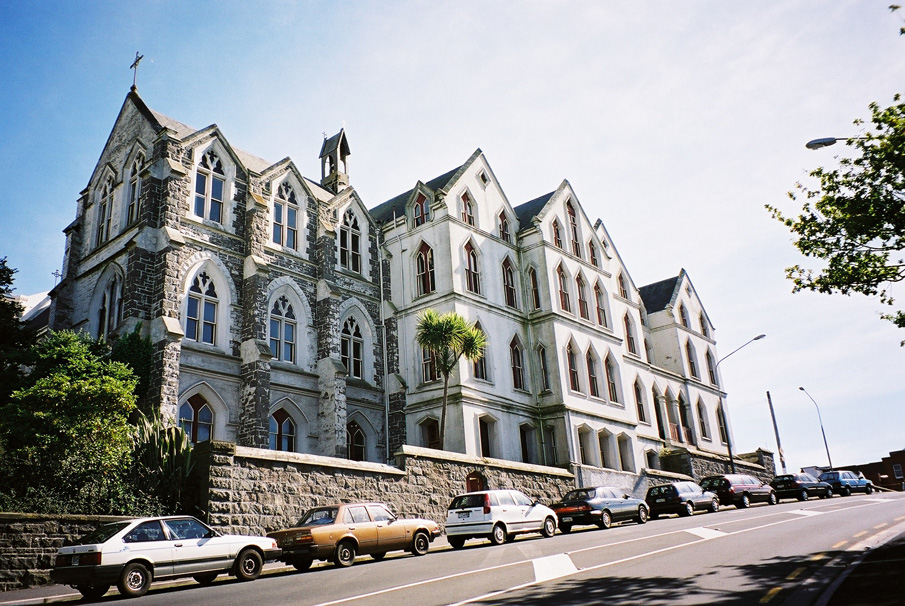
This historic place was registered under the Historic Places Act 1980. This report includes the text from the original Building Classification Committee report considered by the NZHPT Board at the time of registration. ARCHITECTURAL SIGNIFICANCE: The Dominican Priory is rightly considered one of New Zealand's most important Victorian buildings. The innovative style and method of construction have few parallels in the early history of New Zealand architecture. The relative stylisation of the design is many years ahead of its time. When built it was the largest mass concrete building in the southern hemisphere. The large structure was built without reinforcing and the engineering skill demonstrated is as considerable as the architectural. TOWNSCAPE/LANDMARK SIGNIFICANCE: The building forms an important part of the ecclesiastical precinct of St Joseph's in a commanding position above Dunedin's commercial centre.
Why is this place significant?
Historic Significance
Historical Significance or Value This historic place was registered under the Historic Places Act 1980. This report includes the text from the original Building Classification Committee report considered by the NZHPT Board at the time of registration. The Sisters of the Dominican Order arrived in New Zealand in 1871. They were based in Dunedin under Bishop Moran, in the newly created South Island See. The nuns had accommodation problems until the Priory was built. The establishment included a school for young Catholic girls. In 1889 a bluestone extension was built to accommodate older students in the newly established St Dominic's College. The Priory was built in the heyday of closed religious orders. The general decline in vocations for closed religious orders in recent decades resulted in the eventual closure of the school and priory. It remains however, a visible reminder of the traditional approach to religious life and a symbol of the values of its period.
Physical Significance
This historic place was registered under the Historic Places Act 1980. This report includes the text from the original Building Classification Committee report considered by the NZHPT Board at the time of registration. ARCHITECTURAL SIGNIFICANCE: The Dominican Priory is rightly considered one of New Zealand's most important Victorian buildings. The innovative style and method of construction have few parallels in the early history of New Zealand architecture. The relative stylisation of the design is many years ahead of its time. When built it was the largest mass concrete building in the southern hemisphere. The large structure was built without reinforcing and the engineering skill demonstrated is as considerable as the architectural. TOWNSCAPE/LANDMARK SIGNIFICANCE: The building forms an important part of the ecclesiastical precinct of St Joseph's in a commanding position above Dunedin's commercial centre.
Construction Professional
Name
Petre, Francis William
Type
Architect
Biography
Petre (1847-1918) was born in Lower Hutt. He was the son of the Hon. Henry William Petre and grandson of the eleventh Baron Petre, Chairman of the second New Zealand Company. Petre trained in London as a naval architect, engineer, and architect, returning to New Zealand in 1872. During the next three years he was employed by Brogden and Sons, English railway contractors, superintending the construction of the Dunedin-Clutha and the Blenheim-Picton railways. He set up office in Dunedin in 1875 as an architect and civil engineer. He designed a house for Judge Chapman (1875), followed by 'Cargill's Castle' (1876) for E B Cargill and then St Dominic's Priory (1877), all in mass concrete. It is for his church designs and for his pioneering use of concrete that Petre is most recognised. His church buildings include St Joseph's Cathedral, Dunedin (1878-86), Sacred Heart Basilica (now Cathedral of the Sacred Heart), Wellington (1901), St Patrick's Basilica, Oamaru, (1894 and 1903) and the Cathedral of the Blessed Sacrament, Christchurch, (1904-05), which is the outstanding achievement of his career. Petre's commercial buildings include the Guardian Royal Exchange Assurance Building (1881-82) and Pheonix House (now Airport House, c.1885), both in Dunedin.
Construction Details
Start Year
1877
Type
Original Construction
Start Year
1889
Type
Addition
Description
Bluestone Addition
Construction Materials
The materials are poured mass concrete for the walls and a slate roof for the main part, and bluestone and slate for the south wing.
Notable Features
The music practice rooms are double glazed for sound proofing without cutting the students off from supervision by the teachers in the neighbouring classroom. The concrete hanging staircase.
Construction Professional
Name
Petre, Francis William
Type
Architect
Biography
Petre (1847-1918) was born in Lower Hutt. He was the son of the Hon. Henry William Petre and grandson of the eleventh Baron Petre, Chairman of the second New Zealand Company. Petre trained in London as a naval architect, engineer, and architect, returning to New Zealand in 1872. During the next three years he was employed by Brogden and Sons, English railway contractors, superintending the construction of the Dunedin-Clutha and the Blenheim-Picton railways. He set up office in Dunedin in 1875 as an architect and civil engineer. He designed a house for Judge Chapman (1875), followed by 'Cargill's Castle' (1876) for E B Cargill and then St Dominic's Priory (1877), all in mass concrete. It is for his church designs and for his pioneering use of concrete that Petre is most recognised. His church buildings include St Joseph's Cathedral, Dunedin (1878-86), Sacred Heart Basilica (now Cathedral of the Sacred Heart), Wellington (1901), St Patrick's Basilica, Oamaru, (1894 and 1903) and the Cathedral of the Blessed Sacrament, Christchurch, (1904-05), which is the outstanding achievement of his career. Petre's commercial buildings include the Guardian Royal Exchange Assurance Building (1881-82) and Pheonix House (now Airport House, c.1885), both in Dunedin.
Construction Details
Start Year
1877
Type
Original Construction
Start Year
1889
Type
Addition
Description
Bluestone Addition
Construction Materials
The materials are poured mass concrete for the walls and a slate roof for the main part, and bluestone and slate for the south wing.
Notable Features
The music practice rooms are double glazed for sound proofing without cutting the students off from supervision by the teachers in the neighbouring classroom. The concrete hanging staircase.
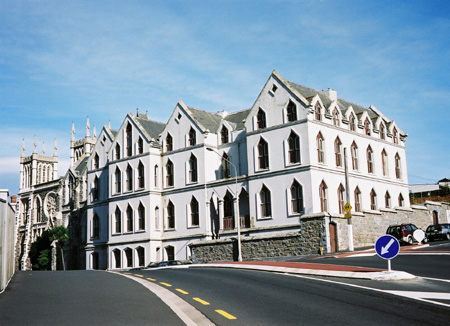
This historic place was registered under the Historic Places Act 1980. This report includes the text from the original Building Classification Committee report considered by the NZHPT Board at the time of registration. ARCHITECTURAL DESCRIPTION (STYLE): The large, stylised neo-Gothic building is a chaste and controlled design well suited to its urban site. It reaches four storeys at gable level and there are over 70 rooms, both large and small. Although relatively simple in design the subtle variations in the fenestration and the arrangement of the gables and dormers give the building its vibrancy. The geometric, stylised lancet windows vary in pitch and size from the squat ground floor openings to the irregularly shaped gable windows. The employment of projecting and recessing bays gives the facade added visual interest as do the numerous dormer windows. Petre made little effort to accommodate traditional Gothic features although the interior decoration is less stylised. The interior is, considering the time of its design and purpose as a closed convent, remarkably well-lit by the natural light provided by the large number of windows and internal glass partitions. A concrete hanging staircase, its construction a considerable technical feat at the time, is also a feature of the interior. The bluestone addition on the St Joseph's Cathedral side is a more traditionally Gothic structure which complements both the nearby Cathedral and the Priory. The buttressed stone walls are an obvious contrast with the smooth finish of the main block. MODIFICATIONS: The building is mostly unmodified, though the interior furnishings have been dispersed with the departure of the Dominican Order.
This historic place was registered under the Historic Places Act 1980. This report includes the text from the original Building Classification Committee report considered by the NZHPT Board at the time of registration. ARCHITECTURAL DESCRIPTION (STYLE): The large, stylised neo-Gothic building is a chaste and controlled design well suited to its urban site. It reaches four storeys at gable level and there are over 70 rooms, both large and small. Although relatively simple in design the subtle variations in the fenestration and the arrangement of the gables and dormers give the building its vibrancy. The geometric, stylised lancet windows vary in pitch and size from the squat ground floor openings to the irregularly shaped gable windows. The employment of projecting and recessing bays gives the facade added visual interest as do the numerous dormer windows. Petre made little effort to accommodate traditional Gothic features although the interior decoration is less stylised. The interior is, considering the time of its design and purpose as a closed convent, remarkably well-lit by the natural light provided by the large number of windows and internal glass partitions. A concrete hanging staircase, its construction a considerable technical feat at the time, is also a feature of the interior. The bluestone addition on the St Joseph's Cathedral side is a more traditionally Gothic structure which complements both the nearby Cathedral and the Priory. The buttressed stone walls are an obvious contrast with the smooth finish of the main block. MODIFICATIONS: The building is mostly unmodified, though the interior furnishings have been dispersed with the departure of the Dominican Order.
Historical and Associated Iwi / Hapū / Whānau
Public NZAA Number
I44/1060
Completion Date
18th April 1989
Information Sources
Porter, 1983
Frances Porter (ed), Historic Buildings of Dunedin, South Island, Methuen, Auckland, 1983.
Other Information
A copy of this report is available from the NZHPT Southern Region office Please note that entry on the New Zealand Heritage List/Rarangi Korero identifies only the heritage values of the property concerned, and should not be construed as advice on the state of the property, or as a comment of its soundness or safety, including in regard to earthquake risk, safety in the event of fire, or insanitary conditions.
Historical and Associated Iwi / Hapū / Whānau
Public NZAA Number
I44/1060
Completion Date
18th April 1989
Information Sources
Porter, 1983
Frances Porter (ed), Historic Buildings of Dunedin, South Island, Methuen, Auckland, 1983.
Other Information
A copy of this report is available from the NZHPT Southern Region office Please note that entry on the New Zealand Heritage List/Rarangi Korero identifies only the heritage values of the property concerned, and should not be construed as advice on the state of the property, or as a comment of its soundness or safety, including in regard to earthquake risk, safety in the event of fire, or insanitary conditions.
Current Usages
Uses: Vacant
Specific Usage: Vacant
Current Usages
Uses: Vacant
Specific Usage: Vacant