The Kaiapoi community began discussions of a memorial in 1919, and intended to build a memorial hall. However, like many small towns, Kaiapoi quietly dropped the idea after a strong nationwide lobby began against ‘useful’ memorials. Unlike many small towns, which imported statues from a catalogue or copied memorials from overseas, Kaiapoi decided instead to commission ‘a statue of a New Zealand private in field dress’. The statue was set on a section previously owned by the Waimakariri Harbour Board. The result, unveiled on Anzac Day 1922, is a moving expression of the experience of war for a young New Zealand ‘digger’.
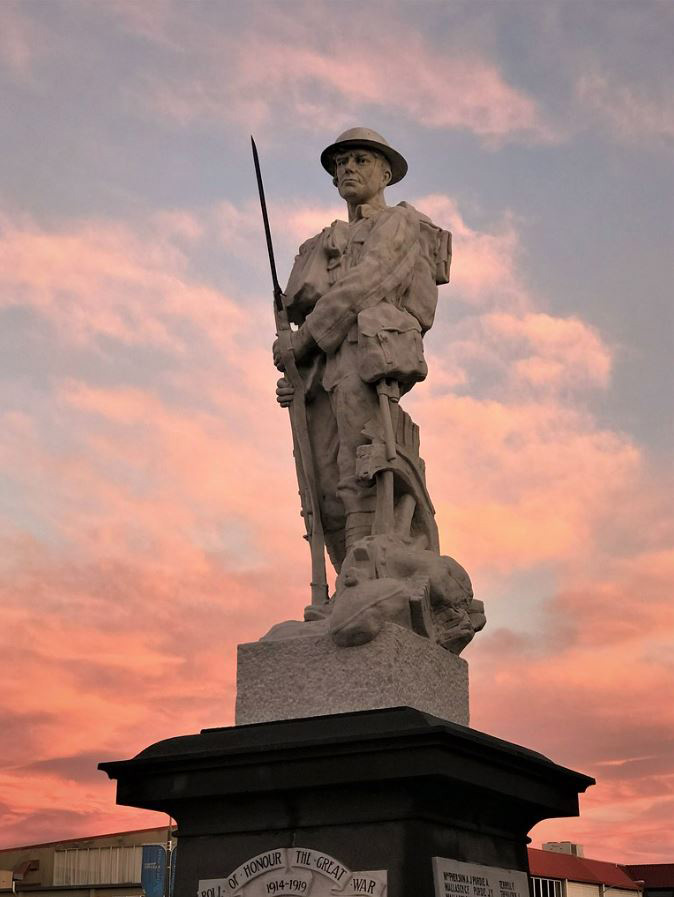
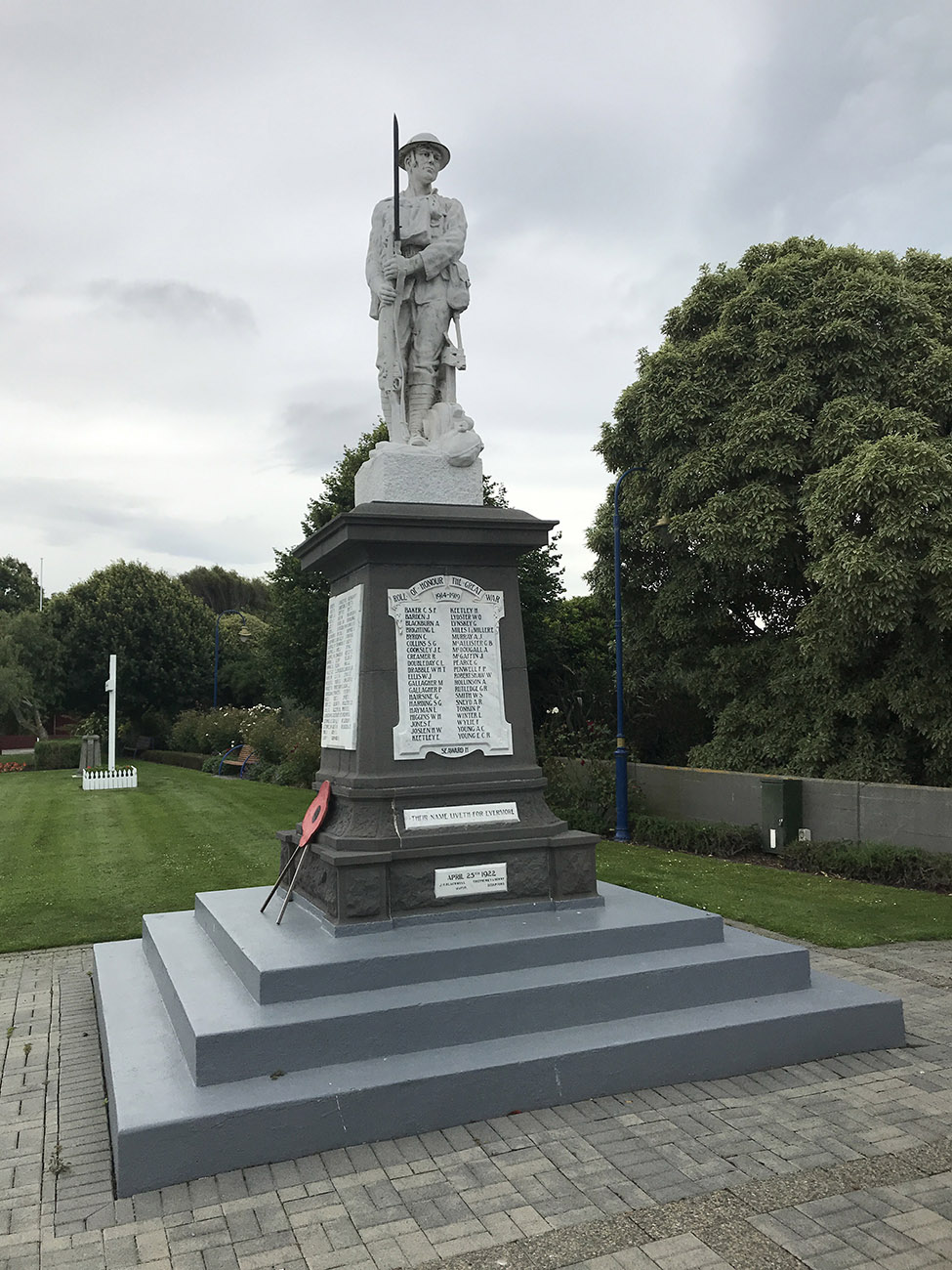
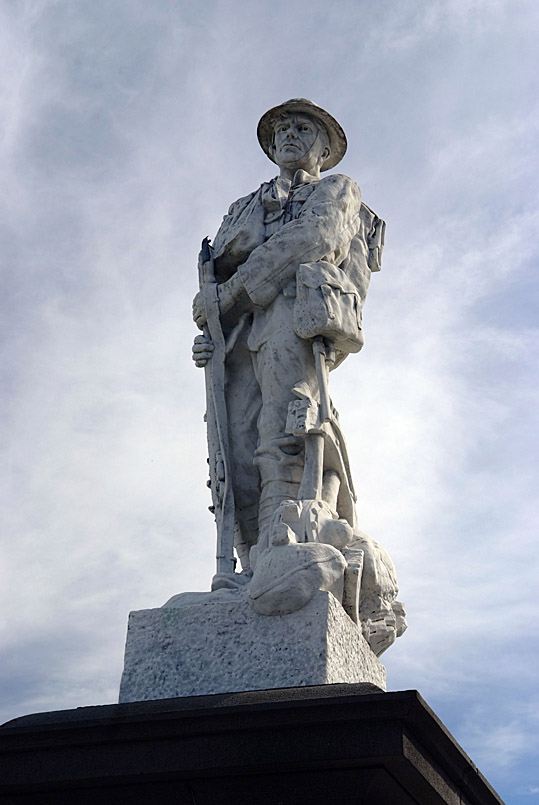
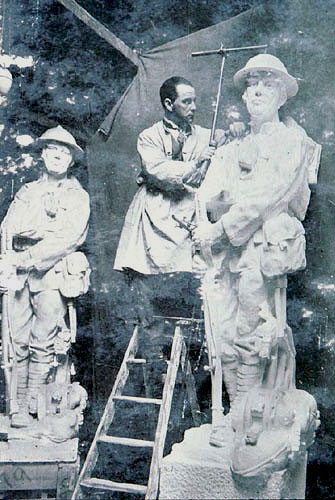
The memorial sits in a prominent position in the town within a memorial garden, between the Kaiapoi River and Raven Quay, next to the Williams Street Bridge. It is a full-length representation of a New Zealand soldier, carved from one block of Italian Carrara marble, standing on a stone plinth. The carving depicts the exhausted soldier standing but leaning on a broken gun carriage wheel. His tired face is looking slightly to the left, his sleeve is torn, revealing a wounded arm, and his bootlace is broken. In his hands he loosely holds a rifle. At the south-east base of the marble, below the soldier’s boots, is the inscription ‘W. TREWETHEY FECIT’ and at the base of the south front of the stone plinth is a marble plaque stating ‘APRIL 25th 1922 J.H. BLACKWELL MAYOR, TRETHEWEY & BERRY SCULPTORS’. The stone plinth carries plaques on each side. Three large marble plaques, at the south front and west and east sides, name all the men from the district who died or served in World War One. Another small marble plaque on the south front states ‘THEIR NAME LIVETH FOR EVERMORE’. At the north rear is a further marble plaque for ‘The Great War’, below which are metal plaques in memory of those who died in World War Two, Korea, Malaya, Borneo and Vietnam and the combined services involved.
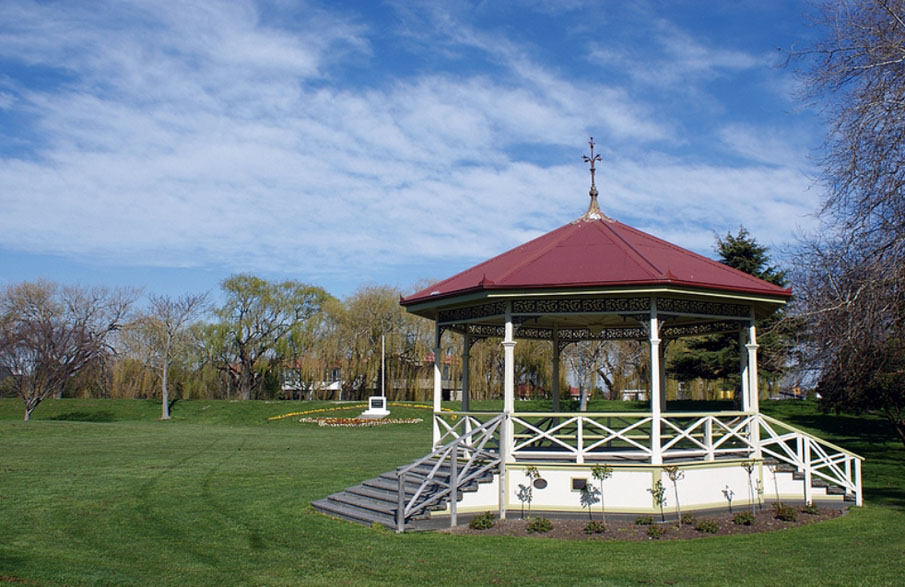
Originally the sculpture included a bayonet with the rifle but this was removed at some time. In 2004, the reserve on which the War Memorial stands was upgraded and memorial plaques naming those who served in the South African and Second World War, built on freestanding walls, were added nearby. Kaiapoi’s Band Rotunda (Register No. 3748) stood to the north-west of the War Memorial until it was relocated to Trousselot Park in 2003. The War Memorial in Kaiapoi continues to be a focus during Anzac Day services.
List Entry Information
Status
Listed
List Entry Status
Historic Place Category 2
Access
Able to Visit
List Number
3763
Date Entered
6th September 1984
Date of Effect
6th September 1984
City/District Council
Waimakariri District
Region
Canterbury Region
Extent of List Entry
Extent includes part of the land described as Lot 12 DP 1280 (RT CB524/82), Canterbury Land District and the structure known as the War Memorial thereon.
Legal description
Lot 12 DP1280 (RT CB524/82), Canterbury Land District
Status
Listed
List Entry Status
Historic Place Category 2
Access
Able to Visit
List Number
3763
Date Entered
6th September 1984
Date of Effect
6th September 1984
City/District Council
Waimakariri District
Region
Canterbury Region
Extent of List Entry
Extent includes part of the land described as Lot 12 DP 1280 (RT CB524/82), Canterbury Land District and the structure known as the War Memorial thereon.
Legal description
Lot 12 DP1280 (RT CB524/82), Canterbury Land District
Construction Professional
Name
Berry, Daniel
Type
Stonemason
Biography
No biography is currently available for this construction professional
Name
Trethewey, William
Type
Sculptor
Biography
William Trethewey (1892-1956) was born in Christchurch. He left school at the age of 13 and began work as a wood carver, studying at night at the Canterbury College School of Art, where he came into contact with Frederick Gurnsey. In 1914 he moved to Wellington and studied life modelling under J. Ellis. Trethewey returned to Christchurch and decided to shift from wood carving to stone, and for the remainder of his life worked as a monumental mason, 'supplying angels and carving headstones for the people of Canterbury'. He became aware of the potential for memorial sculptures at the end of the First World War and his first commission in this line was a St Andrews cross as a memorial for Elmwood School. In 1920 he submitted a piece, 'The Bomb-thrower', to the annual Christchurch Art Society exhibition. This piece aroused a great deal of public interest, and the Society purchased it for their collection. It was considered unsuitable for a war memorial, because it was a realistic portrait of a New Zealand soldier about to hurl a grenade, rather than the idealised image of heroic youth that was preferred for war memorials. Despite this, in 1920, Trethewey was awarded the commission for the Kaiapoi war memorial, which, when unveiled in 1922, was described by the mayor as being a 'typical Anzac' down to the 'broken boot-lace'. Other sculptures of Trethewey's between 1920 and the early 1930s include a bust of Hyman Marks, the statue of Captain James Cook, in Victoria Square, Christchurch and a statue of Maui Pomare for Manukorihi Pa in Waitara. He began his most famous work, the Citizens War Memorial in Christchurch, in 1933 and it was unveiled in 1937. This memorial is, arguably, the finest public monument in New Zealand. Subsequently he was commissioned to sculpt most of the statuary for the centennial exhibition in Wellington. The only piece of this to survive is the statue of Kupe. The interest in monumental sculpture waned over the course of the twentieth century, and Trethewey spent the last years of his life making clocks. He died in 1956. (Chris Maclean and Jock Phillips, 'The Sorrow and the Pride : New Zealand War Memorials', Wellington, 1990.)
Name
Trethewey, William
Type
Designer
Biography
William Trethewey (1892-1956) was born in Christchurch. He left school at the age of 13 and began work as a wood carver, studying at night at the Canterbury College School of Art, where he came into contact with Frederick Gurnsey. In 1914 he moved to Wellington and studied life modelling under J. Ellis. Trethewey returned to Christchurch and decided to shift from wood carving to stone, and for the remainder of his life worked as a monumental mason, 'supplying angels and carving headstones for the people of Canterbury'. He became aware of the potential for memorial sculptures at the end of the First World War and his first commission in this line was a St Andrews cross as a memorial for Elmwood School. In 1920 he submitted a piece, 'The Bomb-thrower', to the annual Christchurch Art Society exhibition. This piece aroused a great deal of public interest, and the Society purchased it for their collection. It was considered unsuitable for a war memorial, because it was a realistic portrait of a New Zealand soldier about to hurl a grenade, rather than the idealised image of heroic youth that was preferred for war memorials. Despite this, in 1920, Trethewey was awarded the commission for the Kaiapoi war memorial, which, when unveiled in 1922, was described by the mayor as being a 'typical Anzac' down to the 'broken boot-lace'. Other sculptures of Trethewey's between 1920 and the early 1930s include a bust of Hyman Marks, the statue of Captain James Cook, in Victoria Square, Christchurch and a statue of Maui Pomare for Manukorihi Pa in Waitara. He began his most famous work, the Citizens War Memorial in Christchurch, in 1933 and it was unveiled in 1937. This memorial is, arguably, the finest public monument in New Zealand. Subsequently he was commissioned to sculpt most of the statuary for the centennial exhibition in Wellington. The only piece of this to survive is the statue of Kupe. The interest in monumental sculpture waned over the course of the twentieth century, and Trethewey spent the last years of his life making clocks. He died in 1956. (Chris Maclean and Jock Phillips, 'The Sorrow and the Pride : New Zealand War Memorials', Wellington, 1990.)
Construction Details
Start Year
2004
Type
Addition
Description
Park upgraded and new memorial walls added
Start Year
1921
Finish Year
1922
Type
Original Construction
Construction Professional
Name
Berry, Daniel
Type
Stonemason
Biography
No biography is currently available for this construction professional
Name
Trethewey, William
Type
Sculptor
Biography
William Trethewey (1892-1956) was born in Christchurch. He left school at the age of 13 and began work as a wood carver, studying at night at the Canterbury College School of Art, where he came into contact with Frederick Gurnsey. In 1914 he moved to Wellington and studied life modelling under J. Ellis. Trethewey returned to Christchurch and decided to shift from wood carving to stone, and for the remainder of his life worked as a monumental mason, 'supplying angels and carving headstones for the people of Canterbury'. He became aware of the potential for memorial sculptures at the end of the First World War and his first commission in this line was a St Andrews cross as a memorial for Elmwood School. In 1920 he submitted a piece, 'The Bomb-thrower', to the annual Christchurch Art Society exhibition. This piece aroused a great deal of public interest, and the Society purchased it for their collection. It was considered unsuitable for a war memorial, because it was a realistic portrait of a New Zealand soldier about to hurl a grenade, rather than the idealised image of heroic youth that was preferred for war memorials. Despite this, in 1920, Trethewey was awarded the commission for the Kaiapoi war memorial, which, when unveiled in 1922, was described by the mayor as being a 'typical Anzac' down to the 'broken boot-lace'. Other sculptures of Trethewey's between 1920 and the early 1930s include a bust of Hyman Marks, the statue of Captain James Cook, in Victoria Square, Christchurch and a statue of Maui Pomare for Manukorihi Pa in Waitara. He began his most famous work, the Citizens War Memorial in Christchurch, in 1933 and it was unveiled in 1937. This memorial is, arguably, the finest public monument in New Zealand. Subsequently he was commissioned to sculpt most of the statuary for the centennial exhibition in Wellington. The only piece of this to survive is the statue of Kupe. The interest in monumental sculpture waned over the course of the twentieth century, and Trethewey spent the last years of his life making clocks. He died in 1956. (Chris Maclean and Jock Phillips, 'The Sorrow and the Pride : New Zealand War Memorials', Wellington, 1990.)
Name
Trethewey, William
Type
Designer
Biography
William Trethewey (1892-1956) was born in Christchurch. He left school at the age of 13 and began work as a wood carver, studying at night at the Canterbury College School of Art, where he came into contact with Frederick Gurnsey. In 1914 he moved to Wellington and studied life modelling under J. Ellis. Trethewey returned to Christchurch and decided to shift from wood carving to stone, and for the remainder of his life worked as a monumental mason, 'supplying angels and carving headstones for the people of Canterbury'. He became aware of the potential for memorial sculptures at the end of the First World War and his first commission in this line was a St Andrews cross as a memorial for Elmwood School. In 1920 he submitted a piece, 'The Bomb-thrower', to the annual Christchurch Art Society exhibition. This piece aroused a great deal of public interest, and the Society purchased it for their collection. It was considered unsuitable for a war memorial, because it was a realistic portrait of a New Zealand soldier about to hurl a grenade, rather than the idealised image of heroic youth that was preferred for war memorials. Despite this, in 1920, Trethewey was awarded the commission for the Kaiapoi war memorial, which, when unveiled in 1922, was described by the mayor as being a 'typical Anzac' down to the 'broken boot-lace'. Other sculptures of Trethewey's between 1920 and the early 1930s include a bust of Hyman Marks, the statue of Captain James Cook, in Victoria Square, Christchurch and a statue of Maui Pomare for Manukorihi Pa in Waitara. He began his most famous work, the Citizens War Memorial in Christchurch, in 1933 and it was unveiled in 1937. This memorial is, arguably, the finest public monument in New Zealand. Subsequently he was commissioned to sculpt most of the statuary for the centennial exhibition in Wellington. The only piece of this to survive is the statue of Kupe. The interest in monumental sculpture waned over the course of the twentieth century, and Trethewey spent the last years of his life making clocks. He died in 1956. (Chris Maclean and Jock Phillips, 'The Sorrow and the Pride : New Zealand War Memorials', Wellington, 1990.)
Construction Details
Start Year
2004
Type
Addition
Description
Park upgraded and new memorial walls added
Start Year
1921
Finish Year
1922
Type
Original Construction
Historical and Associated Iwi / Hapū / Whānau
Completion Date
28th March 2014
Report Written By
Robyn Burgess
Information Sources
Wood, 1993
Pauline Wood, Kaiapoi: A Search for Identity, Rangiora, 1993
Dunn, 2002
Dunn, Michael, New Zealand Sculpture: A History, Auckland University Press, Auckland, 2002.
Phillips & Maclean, 1990.
Phillips, Jock and Chris Maclean, The Sorrow and the Pride: New Zealand War Memorials, Department of Internal Affairs, Historical Branch, Wellington, 1990.
Other Information
This place was identified as significant under previous legislation with different information requirements. It remains significant under the current legislation. There is opportunity under our legislation and policies to add to this information. Further information about this place may be available from the Southern Regional Office of Heritage New Zealand Pouhere Taonga. A fully referenced upgrade report is available on request from the Southern Regional Office of the NZHPT. Please note that entry on the New Zealand Heritage List/Rarangi Korero identifies only the heritage values of the property concerned, and should not be construed as advice on the state of the property, or as a comment of its soundness or safety, including in regard to earthquake risk, safety in the event of fire, or insanitary conditions.
Historical and Associated Iwi / Hapū / Whānau
Completion Date
28th March 2014
Report Written By
Robyn Burgess
Information Sources
Wood, 1993
Pauline Wood, Kaiapoi: A Search for Identity, Rangiora, 1993
Dunn, 2002
Dunn, Michael, New Zealand Sculpture: A History, Auckland University Press, Auckland, 2002.
Phillips & Maclean, 1990.
Phillips, Jock and Chris Maclean, The Sorrow and the Pride: New Zealand War Memorials, Department of Internal Affairs, Historical Branch, Wellington, 1990.
Other Information
This place was identified as significant under previous legislation with different information requirements. It remains significant under the current legislation. There is opportunity under our legislation and policies to add to this information. Further information about this place may be available from the Southern Regional Office of Heritage New Zealand Pouhere Taonga. A fully referenced upgrade report is available on request from the Southern Regional Office of the NZHPT. Please note that entry on the New Zealand Heritage List/Rarangi Korero identifies only the heritage values of the property concerned, and should not be construed as advice on the state of the property, or as a comment of its soundness or safety, including in regard to earthquake risk, safety in the event of fire, or insanitary conditions.
Current Usages
Uses: Commemoration
Specific Usage: Memorial - Post World War Two
Uses: Commemoration
Specific Usage: Memorial - South African War
Uses: Commemoration
Specific Usage: Memorial - World War One
Uses: Commemoration
Specific Usage: Memorial - World War Two
Former Usages
General Usage: Commemoration
Specific Usage: Memorial - Post World War Two
General Usage: Commemoration
Specific Usage: Memorial - South African War
General Usage: Commemoration
Specific Usage: Memorial - World War One
General Usage: Commemoration
Specific Usage: Memorial - World War Two
Themes
War Memorial
Web Links
description: The Memorials Register, New Zealand History Online, Ministry for Culture and Heritage.
Current Usages
Uses: Commemoration
Specific Usage: Memorial - Post World War Two
Uses: Commemoration
Specific Usage: Memorial - South African War
Uses: Commemoration
Specific Usage: Memorial - World War One
Uses: Commemoration
Specific Usage: Memorial - World War Two
Former Usages
General Usage: Commemoration
Specific Usage: Memorial - Post World War Two
General Usage: Commemoration
Specific Usage: Memorial - South African War
General Usage: Commemoration
Specific Usage: Memorial - World War One
General Usage: Commemoration
Specific Usage: Memorial - World War Two
Themes
War Memorial
Web Links
description: The Memorials Register, New Zealand History Online, Ministry for Culture and Heritage.
Location
Sign up to hear more
Get the latest heritage news, features and events delivered
straight to your inbox.


