Current Description
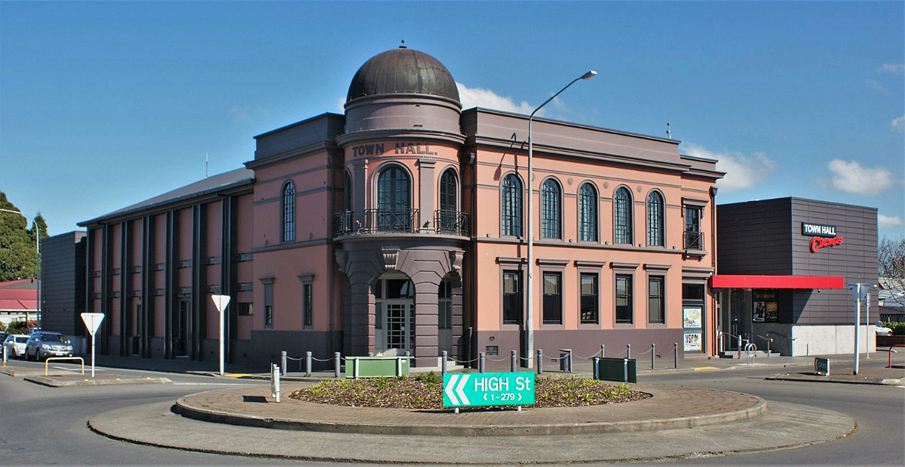
The Town Hall is located on a prominent corner site at 303 High Street, Rangiora. It is located adjacent to the Town Hall Reserve and the intersection of High Street and King Street.
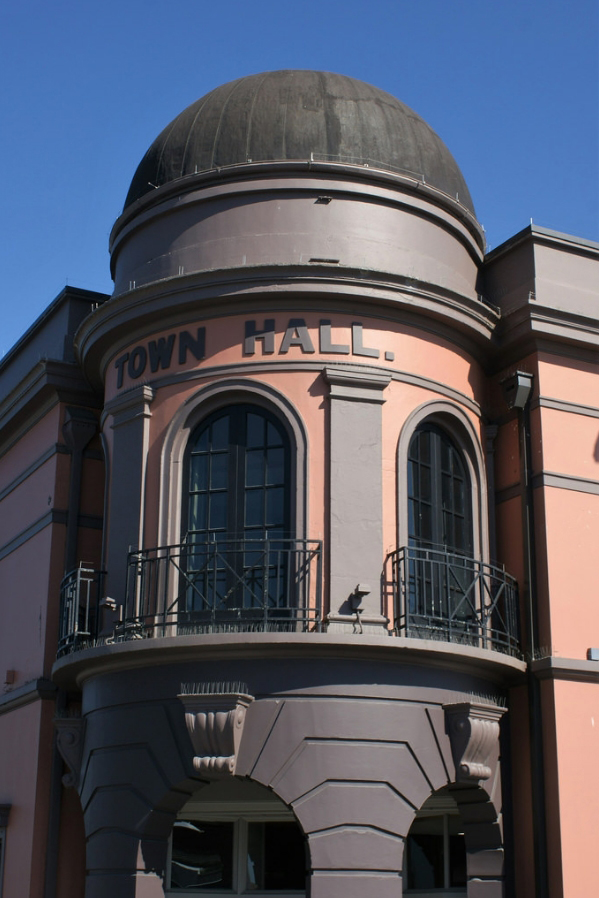
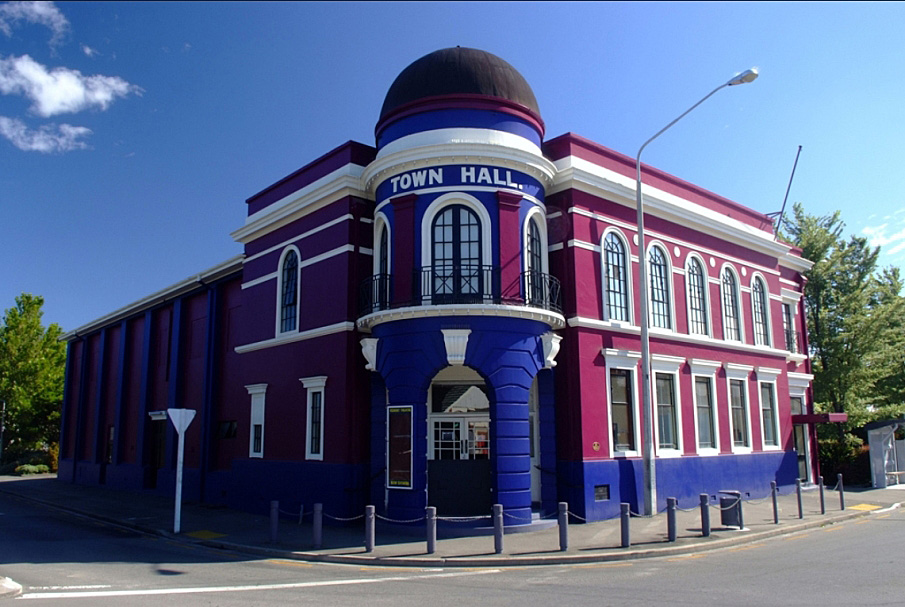
The two-storeyed building is constructed of reinforced concrete. It is neo-classical in style, with an inset rounded corner piece surmounted by a round dome. The corner has plasterwork scored to give a rusticated appearance and contains three round-arched entrances with decorative keystones on the ground floor and three round arched double doors with decorative iron balconies on the first floor. The words ‘Town Hall’ in painted plaster appear below the dome. Along the north and east elevations both the ground and first floor exteriors are not rusticated. On the north elevation ground floor are five rectangular windows with square hood moulds and above on the first floor are five round headed windows. Plain circular motifs are in place between each of the window arches. A single bay set back at the western end of the north elevation contains a door at ground floor and a square headed rectangular window with balcony on the first floor above. Along the east elevation, the bay beside the rounded corner contains two square headed windows on the ground floor and a single round headed window on the first floor. Set back slightly, the remainder of the east elevation contains seven bays, marked by plain pilasters. Square markings are evidence that at least five of these bays each earlier contained a window.
Major extensions are currently being built adjoining the south and west elevations of the Town Hall. The current works on the site are also resulting in a number of changes to the interior. Prior to closure for repair and refurbishment, the building contained a movie theatre, offices and foyer in the front and an auditorium to the rear, featuring a full dress circle and a band pit. On the first floor, the dress circle remains, but many other internal structures, including the projection box, have been removed.
The architect Henry St Aubyn Murray (1886-1943) was an inter-war architect in Christchurch. He carried out his apprenticeship under local architect Frederick John Barlow. As a young man he was also an athlete in the first Olympic Games that New Zealanders participated in, in London in 1908. Murray took an active interest in the New Zealand Institute of Architects and was elected to the Canterbury Branch in 1914, serving as secretary/treasurer of the Canterbury Branch in 1919-20 and again in 1923-24. He served with the Australian engineers during the First World War and was awarded a Military Cross for gallantry in 1917. Murray’s designs included war memorials at Akaroa and Leeston and many works for the Roman Catholic Church in Canterbury, including the Church of the Holy Name on Sealy Street, Ashburton. Not long before he was given the contract to design the Rangiora Town Hall, in 1923 Murray had designed the Caledonian Hall at 135 Kilmore Street West in Christchurch (demolished following the Canterbury earthquakes). At the time there was a dearth of public halls in Christchurch and the Caledonian Society was asked by a number of organisations to include space for dances and concerts in their new building. As a result the main hall was built to seat 800 people, with a further 100 upstairs.
Comparative Analysis
Architectural Style
In terms of architectural style, the Register contains a number of buildings that have similar features to the Rangiora Town Hall, such as the neo-classical or stripped classical style windows or various buildings with a domed or turreted corner.
The windows, for example, bear similarity to the Canterbury Technical College Assembly Hall (Register No. 1847, Category 2 historic place), the Grey Lynn Public Library (Register No. 584, Category 2 historic place) and the Temuka Library (Register No. 2035, Category 2 historic place). Gisborne’s AMP Building (Register No. 3538) has a domed corner entry point as did the now-demolished 1920s Ozone Stores in Christchurch (not registered) and ANZ Bank building on High Street (Register No. 3091, Category 2 historic place) in Christchurch, also now demolished. These corner features are not entirely dissimilar to the corner of the Town Hall in Rangiora.
Town Halls
Monumental town halls as an emblem of local government were common in nineteenth-century Europe, and were adopted in colonial New Zealand. As a building type, town halls reached their zenith in the Victorian and Edwardian period. A common important feature was their tower which was usually capped with a dome or cupola. Designs of town halls often combined a variety of classical motifs with symmetrical facades while the internal arrangement was not based on axiality and symmetry.
The Rangiora Town Hall is likely to have been modelled on national examples, at least in part. The Lambeth Town Hall in London (1906-8), with its corner tower and classical features, is said to have influenced the landmark Auckland Town Hall (c1909-11, Register No. 549, Category 1 historic place), and the architect of the Rangiora Town Hall is likely to have known of this and other examples. The Dunedin Town Hall and Concert Chamber (Register No. 2150, Category 2 historic place) was built in the 1920s, the Town Hall and Civic Theatre in Invercargill (1906, Register No. 2521, Category 1 historic place) combined Council administration and public entertainment including film screenings and the Wellington Town Hall (1902-1904, Register No. 3275, Category 1 historic place) combined Council administration and public entertainment. The Avondale Town Hall (1915-24, not registered) was used as a town hall only until 1927 but was a cinema from its inception and remains extant as ‘The Hollywood’. The Eltham Town Hall, built in 1911 (Register No. 7127, Category 2 historic place) was used as a cinema for over 70 years and remains relatively intact. It retains not only its projection box and old machinery but its hall also has a dress circle of seating to the rear. The Geraldine Town Hall, built in 1925 (not registered) survives as a cinema. The Oxford Town Hall (not registered), c1931, is also used as a cinema. The Rangiora Town Hall, therefore, is not unique as a town hall with a cinema and there are others that remain relatively intact on the interior. Nevertheless, it does appear to be notable as a survivor of this type of building still functioning as a cinema and with a dress circle.
Cinemas
Cinemas were very common in twentieth century New Zealand. For the first two-thirds of the twentieth century, a trip to the cinema was the major form of indoor entertainment. Cinema attendance per head of population reached a peak during the Second World War. In 1940 the average attendance at a cinema per year per head of population was 19.1, rising to 19.3 in 1950. In March 1953 New Zealand had a total of 589 picture theatres, with a seating capacity of 266,213. This is a high number given the population of the country was fewer than two million. During this time a total of 3260 people were employed in theatres, and the average New Zealander went to the movies more than 18 times a year. Attendance fell sharply in the 1960s after the advent of television. By 1960 the average attendance at cinemas had dropped to 17 and by 1970 the average attendance at movies was only 4.6 times a year.
There are many cinemas/theatres on the NZHPT Register, some of which are noted as being relatively unmodified or relatively intact. For example: the Civic Theatre in Auckland (Register No. 100, Category 1 historic place) is described as having one of the most intact 'atmospheric interiors in the Southern Hemisphere'; the Hokitika Regent Theatre (Register No.5053, Category 2 historic place) registration states that it is one of the few remaining theatres in New Zealand dating from the 1930s that has not been remodelled into a multi-plex cinema; the 19th century Theatre Royal in Nelson (Register no. 3341, Category 1 historic place) is said to have an auditorium which has retained much of its original character and some of its historic fabric; the De Luxe Theatre in Opotiki (Register No. 3498, Category 2 historic place) was built at the same time that the Rangiora Town Hall complex was built; the grand St James Theatre in Auckland (Register No. 4404, Category 1 historic place) was built 1929 and said to be largely unaltered; the Regent Theatre in Palmerston North (Register No. 5104, Category 1 historic place), built in 1930, it is outstanding especially for its architecture. The 1935 Regent Theatre in Greymouth (Register No. 7552, Category 2 historic place) still has many of its original fittings and designs and is still used today as a multi-purpose venue for theatre, live shows and films. The 1912 Victoria Theatre in Devonport (Register No. 7712, Category 1 historic place) is historically significant as a surviving purpose built picture theatre. The Capitol Theatre (Register No. 508, Category 2 historic place) in Auckland dates from 1923. The Mangere East Hall (Register No 530, Category 2 historic place) was constructed in 1925 and converted to a cinema in the 1930s. The Crystal Palace Theatre (Register No. 512, Category 2 historic place) opened in Mt Eden Road in 1928 and continues to operate as a cinema.
Canterbury had a number of cinemas. Christchurch’s Cathedral Square, in particular, was notable in the 1940s and 1950s for having the most concentrated cluster of picture theatres in the Southern Hemisphere. The Canterbury earthquakes of 2010-2011 and subsequent demolitions have radically changed the central city of Christchurch and numerous movie theatres (or former movie theatres) have been lost. The former Rialto Theatre in Kaiapoi (formerly Category 2 historic place 2750) was also demolished following the quakes. However, there are some cinemas in historic buildings that do survive in Canterbury. Examples include the cinema (formerly the Town Hall) in Geraldine, 1925 (not registered), the Mayfair Cinema in Kaikoura (not registered), the Hollywood Theatre in Sumner, Christchurch, 1938 (not registered, much altered) and the Oxford Town Hall (not registered), c1931. As a cinema, therefore, the Town Hall in Rangiora is a representative type of building, notwithstanding it being one that is increasingly rare in Canterbury following the recent earthquakes.
Rangiora’s High Street
Prior to the Canterbury earthquakes of 2010-11, the High Street of Rangiora, stretching from the Rangiora Town Hall at King Street up to Ashley Street, was noted for its buildings from a range of periods. Since the earthquakes, there have been noticeable changes. Some High Street historic buildings have been demolished, notably the 1923 Pulley Building at 106-8 High Street and the 1914 Lamberts building at 174 High Street. Both the 1919 Farmers Buildings on the corner of High Street and Percival Street and the 1920s John Knox Presbyterian Church at the corner of High and King Streets are still standing but are earmarked for demolition. The fate of some buildings is still not known, such as the 1873 Red Lion Hotel at 31 High Street. Some buildings will be partially retained, notably the Junction Hotel (Former) at 112 High Street (1880 Category 2 historic place, Register No. 3783), which is expected to keep its façade. In addition, the site of the War Memorial (Category 2 historic place, Register No. 3789) on the corner of 55 High Street and Ivory Street is expected to be altered by road-widening in the near future.
However, Rangiora’s High Street retains a number of historic buildings. In addition to the Town Hall, these include the late nineteenth century E J Parrot former grocery store at 42 High Street, the 1924 War Memorial at 55 High Street (Category 2 historic place, Register No. 3789), the 1936 Post Office building on the corner of High Street and Percival Street, the 1896 Johnston building at 113 High Street (Category 2 historic place, Register No. 3784) and Hunnibell’s Shop at 257-259 High Street (circa 1878, Category 2 historic place, Register No. 3274).. Further west, a 1920s house (Category 2 historic place, Register No. 3775) still stands at 367 High Street and the Church of St John the Baptist stands at 351 High Street (Category 2 historic place, Register No. 1823).
There are other historic buildings just off High Street in the central part of town. Of note on Percival Street are the 1893 Courthouse (Category 2 historic place, Register No. 3770) at 143-145 Percival Street, the 1907 Rangiora Borough Council Chambers (Former) (Category 2 historic place, Register No. 3786) at 133 Percival Street, and the 1902-7 Band Rotunda and Domain Gates (Category 2 historic place, Register No. 3765). The 1882 Masonic Lodge at 132 Percival Street (original registered as a Category 2 historic place, Register No. 3785) was demolished in 2013 following earthquake damage. At 93 Ivory Street, adjacent to the registered war memorial on High Street, is the 1925 Northern A & P Association Building (Category 2 historic place, Register No. 3772).