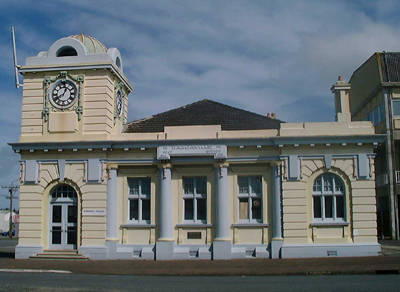
The former Post Office at Dargaville is an interesting example of early twentieth-century government architecture, which reflects the importance of communications in provincial towns. Erected in 1914 under the direction of the Public Works Department (PWD), the brick post office was one of the most substantial structures in Dargaville township when it was built. Located on a busy intersection, it replaced a timber post office closer to the wharf that had been constructed in 1902. Postal and other communication services in Dargaville had risen rapidly in the intervening years, as the town's role in the exploitation of kauri timber and gum resources in the Northern Wairoa reached its peak. A particularly high number of savings bank and money order transactions were carried out in the settlement, attributed to the activities of Dalmatian gum-diggers.
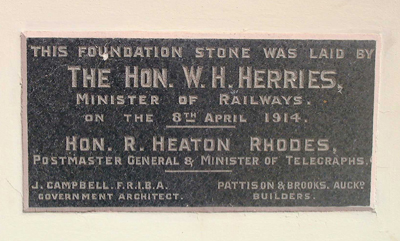
Constructed towards the end of a nationwide building boom for government structures, the post office was the source of considerable civic pride. Its foundation stone was laid on 8 April 1914 by the Minister of Railways, W. H. Herries (1859-1923), who was a strong supporter of rural development. Herries also inspected the crossing of the North Auckland Main Trunk Railway over the Wairoa River during his visit, which was located 43 kilometres from the town. Formal opening ceremonies for the post office, planned for September 1914, were curtailed due to the outbreak of the First World War (1914-1918).
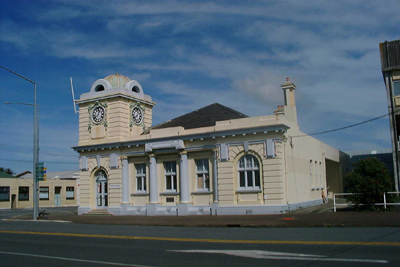
The building was designed in an Imperial Baroque style, possibly by Claude Paton under the supervision of the Government Architect, John Campbell. Initially conceived as a smaller building, a short corner tower was incorporated after protests by the Dargaville public, rendering it similar to post offices in larger provincial centres. Erected by Pattison and Brooks of Auckland, its Baroque appearance emphasised notions of grandeur, civilisation and progress. The building was broadly rectangular in plan, with a telephone exchange and women's retiring room at the rear, reflecting the expanding role of women in the post office workforce. In 1919, the building received the first internal airmail shipment in New Zealand, after letters were sent from Auckland aboard a twin-float aeroplane that landed on the Wairoa River.
Subsequent alterations included the installation of a clock in the corner tower in 1925, donated by G. N. Hayes, a local solicitor. Dedicated to Hayes' partner Lieutenant Charles Darling and other servicemen from the Northern Wairoa who had died in the First World War, this was unveiled in the presence of the local M.P. Gordon Coates (1878-1943), shortly before he became Prime Minister. More substantial changes in the 1920s included an increase in the size of the telephone exchange, while a larger extension was added in about 1953. Following the division of the New Zealand Post Office into state-owned enterprises in 1987, the building was sold into private hands, when partial demolition at the rear enabled it to be used as a drive-through liquor store, in spite of local opposition. It has since been employed as a community centre, a bank and commercial offices.
The former Dargaville Post Office has considerable significance for its association with the growth of the postal network, including the earliest trials in airmail delivery. It reflects important aspects of early twentieth-century life, including the role of the post office in providing fundamental state services to the general public. The building also demonstrates gender and other social issues, such as the different working tasks provided to men and women, and the comparative status of manager and employees. It is associated with several prominent events and individuals, including the First World War and Gordon Coates. The structure is an important symbol of local pride and commemoration, and an impressive example of government architecture. It is associated with the 'golden age' of Public Works Department construction in the early 1900s, overseen by John Campbell. The former post office is one of the few remaining buildings in central Dargaville that reflects the town's initial transition from a pioneer environment to established provincial centre. It has considerable landmark value for its appearance and prominent location.
Constructed towards the end of a nationwide building boom for government structures, the post office was the source of considerable civic pride. Its foundation stone was laid on 8 April 1914 by the Minister of Railways, W. H. Herries (1859-1923), who was a strong supporter of rural development. Herries also inspected the crossing of the North Auckland Main Trunk Railway over the Wairoa River during his visit, which was located 43 kilometres from the town. Formal opening ceremonies for the post office, planned for September 1914, were curtailed due to the outbreak of the First World War (1914-1918).
The building was designed in an Imperial Baroque style, possibly by Claude Paton under the supervision of the Government Architect, John Campbell. Initially conceived as a smaller building, a short corner tower was incorporated after protests by the Dargaville public, rendering it similar to post offices in larger provincial centres. Erected by Pattison and Brooks of Auckland, its Baroque appearance emphasised notions of grandeur, civilisation and progress. The building was broadly rectangular in plan, with a telephone exchange and women's retiring room at the rear, reflecting the expanding role of women in the post office workforce. In 1919, the building received the first internal airmail shipment in New Zealand, after letters were sent from Auckland aboard a twin-float aeroplane that landed on the Wairoa River.
Subsequent alterations included the installation of a clock in the corner tower in 1925, donated by G. N. Hayes, a local solicitor. Dedicated to Hayes' partner Lieutenant Charles Darling and other servicemen from the Northern Wairoa who had died in the First World War, this was unveiled in the presence of the local M.P. Gordon Coates (1878-1943), shortly before he became Prime Minister. More substantial changes in the 1920s included an increase in the size of the telephone exchange, while a larger extension was added in about 1953. Following the division of the New Zealand Post Office into state-owned enterprises in 1987, the building was sold into private hands, when partial demolition at the rear enabled it to be used as a drive-through liquor store, in spite of local opposition. It has since been employed as a community centre, a bank and commercial offices.
The former Dargaville Post Office has considerable significance for its association with the growth of the postal network, including the earliest trials in airmail delivery. It reflects important aspects of early twentieth-century life, including the role of the post office in providing fundamental state services to the general public. The building also demonstrates gender and other social issues, such as the different working tasks provided to men and women, and the comparative status of manager and employees. It is associated with several prominent events and individuals, including the First World War and Gordon Coates. The structure is an important symbol of local pride and commemoration, and an impressive example of government architecture. It is associated with the 'golden age' of Public Works Department construction in the early 1900s, overseen by John Campbell. The former post office is one of the few remaining buildings in central Dargaville that reflects the town's initial transition from a pioneer environment to established provincial centre. It has considerable landmark value for its appearance and prominent location.