

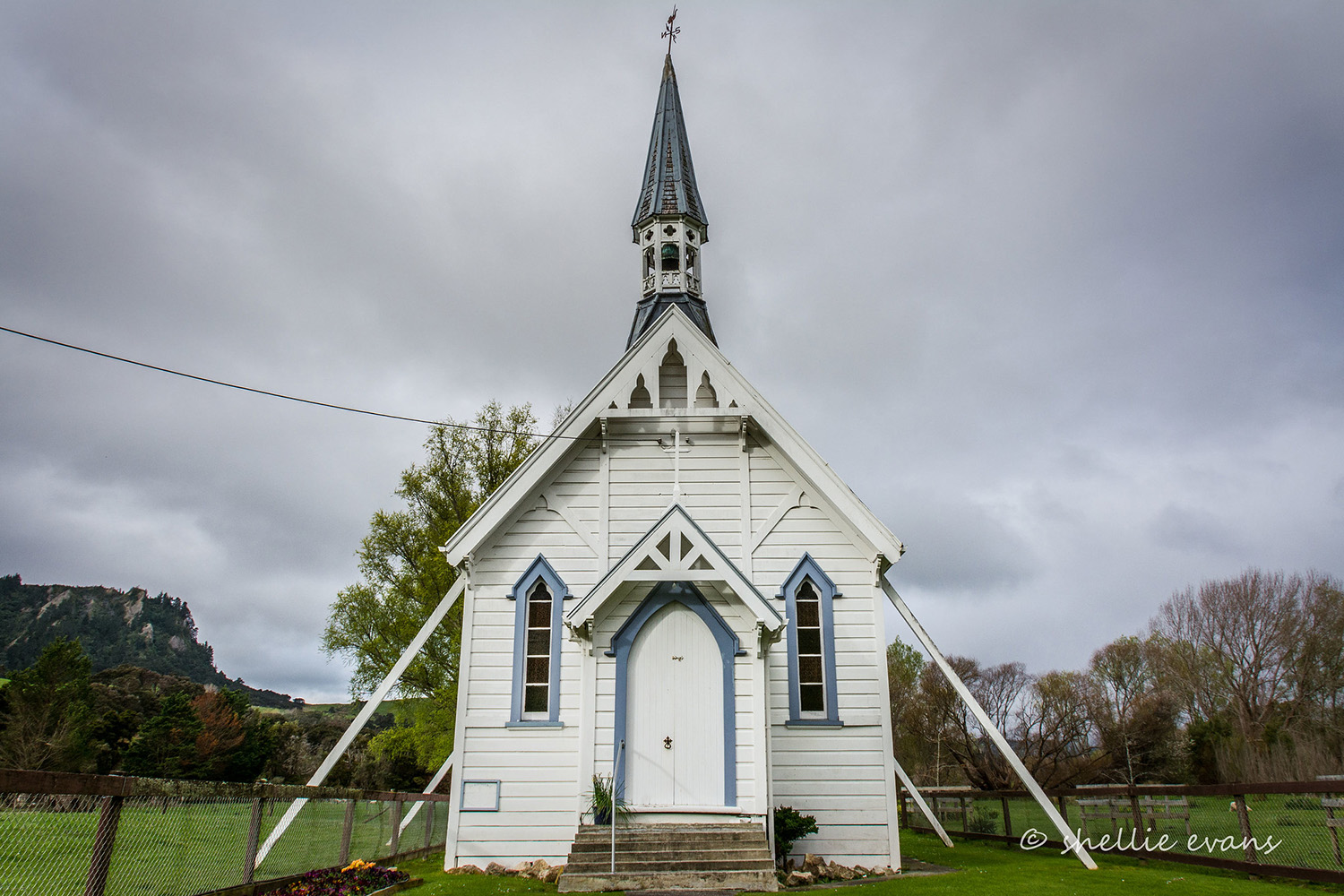
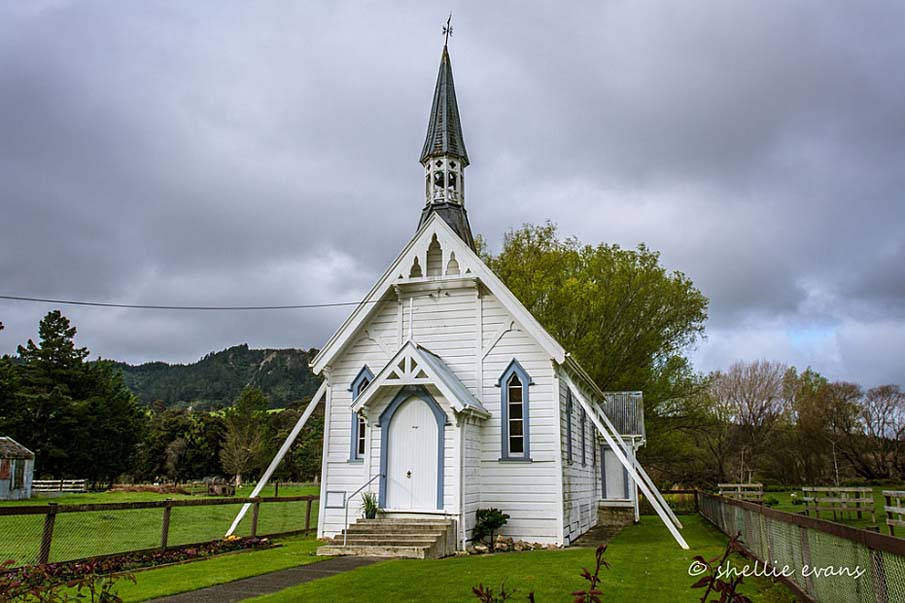
After being incorporated into a large parochial district centred around Greytown and Masterton, thanks to the work of Rev. John Chapman Andrews Tinui was established as an Anglican parochial district in 1899. Appropriately, three years later construction of a suitable new church was begun in town at the centre of the parish, with the name Church of the Good Shepherd. A building committee had been formed in 1901 and the prominent Wellington architectural practice of Clere and Swan were approached to design a building that could seat up to one hundred people. Because Frederick de Jersey Clere was in England at the time, the design of the church was the work of John Sydney Swan. This is thought to have been the first church that Swan was solely responsible for, but draws on the established style of Clere’s numerous country churches, including a characteristic bell-tower. Tinui’s Church of the Good Shepherd was built by Charles E. Daniell, who a few years later was also responsible for Langdale’s St Andrew’s Church, which was a Clere building. The Church of the Good Shepherd was completed in July 1902.
The Maunsell family, who owned Tinui Station and were a prominent local family, would have been key parishioners and supporters of the church given Robert and John Maunsell, who owned the station from the late 1850s, were the sons of an Anglican missionary who later went on to become Archdeacon of Auckland. When the Archdeacon travelled to visit his sons in the 1860s he is known to have conducted some of the first services in Tinui. Robert Maunsell was also on the building committee for the Church of the Good Shepherd and the Maunsells have continued to support the church with donations over the years, including the creation of a lychgate for the church in 1983.
Just over a decade after the Church of the Good Shepherd was constructed the Tinui community was, like most others in New Zealand and Australia, deeply affected by the result of the disastrous ANZAC campaign at Gallipoli that lasted nine months. Therefore, the Maunsells and the wider community were keen to commemorate this through a series of events on the first ANZAC Day. The day’s events on 25 April 1916 started with a morning religious service at the Church of the Good Shepherd. This service was one of hundreds of religious memorial services throughout New Zealand, Australia, and England that took place on the first official ANZAC Day, setting a precedent for future commemorations. However, because of the recorded 7.30am start for the ANZAC and St Mark’s Day morning service, the ceremony at the Church of the Good Shepherd is believed to be the world’s first ANZAC Day religious memorial service.
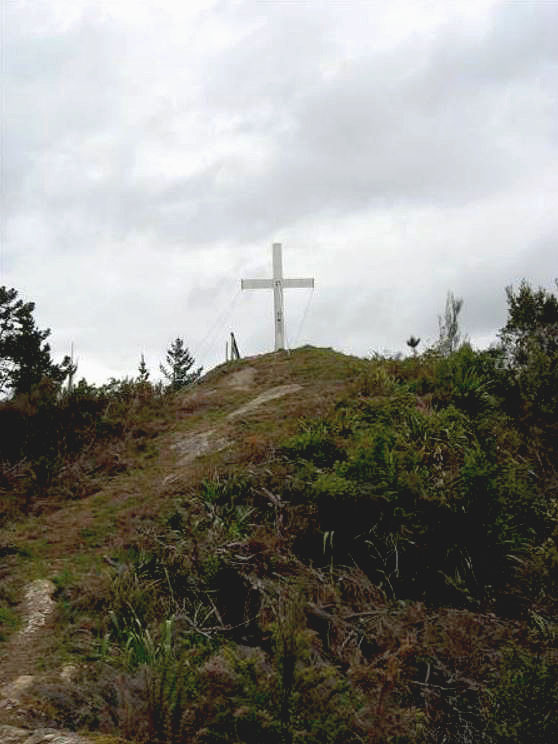
After the church service the ceremonies then continued with Bugler Hancock of the 13th Regiment, who was at home at Tinui on final leave from the Featherston camp, playing a salute while a Union Jack was ceremonially delivered to and unfurled at Tinui Hall. Other events of the day included refreshments at Tinui Station before a long trek to the top of Mount Maunsell/Tinui-Taipo to erect a memorial cross in honour of the ANZACs, one of the first ANZAC memorials established in New Zealand.
Since its construction in the early twentieth century the Church of the Good Shepherd, designed by prominent architect John Sydney Swan, has had social and spiritual significance as the heart of the local Anglican congregation, a community led by the Maunsell family who were the settlement’s important landowners. Not only did this prominent family have a strong connection with the church, but as a result of the inaugural ANZAC commemorations in 1916 the Church of the Good Shepherd and the Tinui ANZAC Memorial Cross Site, on the former Maunsell land, form an important historical and cultural complex. The Church of the Good Shepherd has further commemorative and historical significance as the site of the world’s first known religious observance commemorating the ANZACs.
List Entry Information
Status
Listed
List Entry Status
Historic Place Category 2
Access
Private/No Public Access
List Number
3957
Date Entered
21st September 1989
Date of Effect
21st September 1989
City/District Council
Masterton District
Region
Wellington Region
Extent of List Entry
Extent includes the land described as Lot 22 DP 224 (RT WN117/96), Wellington Land District and the building known as Church of the Good Shepherd (Anglican) thereon, and its fittings and fixtures.
Legal description
Lot 22 DP 224 (RT WN117/96), Wellington Land District
Location Description
Tinui township is situated east towards the coast from Masterton, along Masterton-Castlepoint Road. Upon entering Tinui this road becomes Blackhill Road, and Manawa Road travels north at the intersection of these two roads and Charles Street. Church of the Good Shepherd is approximately 250 metres from this intersection, on the east side of Manawa Road. In 2019 the church was relocated to 7 Blackhill Road.
Status
Listed
List Entry Status
Historic Place Category 2
Access
Private/No Public Access
List Number
3957
Date Entered
21st September 1989
Date of Effect
21st September 1989
City/District Council
Masterton District
Region
Wellington Region
Extent of List Entry
Extent includes the land described as Lot 22 DP 224 (RT WN117/96), Wellington Land District and the building known as Church of the Good Shepherd (Anglican) thereon, and its fittings and fixtures.
Legal description
Lot 22 DP 224 (RT WN117/96), Wellington Land District
Location Description
Tinui township is situated east towards the coast from Masterton, along Masterton-Castlepoint Road. Upon entering Tinui this road becomes Blackhill Road, and Manawa Road travels north at the intersection of these two roads and Charles Street. Church of the Good Shepherd is approximately 250 metres from this intersection, on the east side of Manawa Road. In 2019 the church was relocated to 7 Blackhill Road.
Construction Professional
Name
Daniell, Charles Edward
Type
Builder
Biography
Daniell emigrated to New Zealand and settled in the Wairarapa in 1880 at the age of 24. He had learned building skills in England and began constructing bridges in the Wairarapa. Throughout the following years he designed and built many of the Wairarapa's large homesteads and farm buildings. He set up a timber mill for a ready supply of timber and then a hardware store. This store survived as "C.E. Daniell's" until the mid 1980s. Such ventures meant that Daniell was the largest employer in the Wairarapa for many years. In addition to this he worked extensively in the community, chairing several school Boards, an orphanage and the Wellington Harbour Board among other organizations. He was responsible for Awatoitoi Homestead, Blairlogie (1907-12) and Annandale Station woolshed.
Name
Swan, John Sydney
Type
Architect
Biography
Swan (1874-1936) practised architecture during the late nineteenth and early twentieth centuries. He formed part of the last group of architects to follow the traditional Gothic and Classical styles. He was articled to Frederick de Jersey Clere, working with Clere on many major designs such as the Wellington Rowing Club building (then known as the Naval Artillery Boat Shed, 1894) as well as smaller provincial buildings such as the Church of the Good Shepherd, Tinui. The firm was known as Clere, Fitzgerald and Richmond and was one of the most prominent architectural practices in Wellington. From 1901 to 1906 Swan was in partnership with Clere, practising on his own account from 1907. The first major design produced by Swan in this new practice was the Karori Crematorium (1907) which served to establish his architectural identity separate from Clere. During his long and varied career Swan produced a large and wide range of work, including a number of banks for the National Bank such as the head office building in Wellington (1907), educational buildings for the Wellington Technical College with William Gray Young (1922), and a number of major buildings for the Catholic Church including St Gerard's Church, Mt Victoria (1910), Sacred Heart Convent (later Erskine College), Island Bay (1909), and Wanganui Convent (1912). He was an architect of imagination as evidenced by the design of his own house 'The Moorings', Glenbervie Terrace (1905).
Construction Details
Start Year
1902
Finish Year
1904
Type
Original Construction
Description
Church constructed
Start Year
2019
Finish Year
2019
Type
Relocation
Description
Church building but not Litch gate
Period
2019
Start Year
2020
Finish Year
2020
Type
Modification
Description
Steeple & belfry reconstructed by Henleys Men's Shed. No contact with HNZ on this.
Period
2020
Start Year
1983
Type
Additional building added to site
Description
Lychgate constructed
Construction Materials
Concrete piles, timber frame and weatherboard, corrugated iron roof.
Construction Professional
Name
Daniell, Charles Edward
Type
Builder
Biography
Daniell emigrated to New Zealand and settled in the Wairarapa in 1880 at the age of 24. He had learned building skills in England and began constructing bridges in the Wairarapa. Throughout the following years he designed and built many of the Wairarapa's large homesteads and farm buildings. He set up a timber mill for a ready supply of timber and then a hardware store. This store survived as "C.E. Daniell's" until the mid 1980s. Such ventures meant that Daniell was the largest employer in the Wairarapa for many years. In addition to this he worked extensively in the community, chairing several school Boards, an orphanage and the Wellington Harbour Board among other organizations. He was responsible for Awatoitoi Homestead, Blairlogie (1907-12) and Annandale Station woolshed.
Name
Swan, John Sydney
Type
Architect
Biography
Swan (1874-1936) practised architecture during the late nineteenth and early twentieth centuries. He formed part of the last group of architects to follow the traditional Gothic and Classical styles. He was articled to Frederick de Jersey Clere, working with Clere on many major designs such as the Wellington Rowing Club building (then known as the Naval Artillery Boat Shed, 1894) as well as smaller provincial buildings such as the Church of the Good Shepherd, Tinui. The firm was known as Clere, Fitzgerald and Richmond and was one of the most prominent architectural practices in Wellington. From 1901 to 1906 Swan was in partnership with Clere, practising on his own account from 1907. The first major design produced by Swan in this new practice was the Karori Crematorium (1907) which served to establish his architectural identity separate from Clere. During his long and varied career Swan produced a large and wide range of work, including a number of banks for the National Bank such as the head office building in Wellington (1907), educational buildings for the Wellington Technical College with William Gray Young (1922), and a number of major buildings for the Catholic Church including St Gerard's Church, Mt Victoria (1910), Sacred Heart Convent (later Erskine College), Island Bay (1909), and Wanganui Convent (1912). He was an architect of imagination as evidenced by the design of his own house 'The Moorings', Glenbervie Terrace (1905).
Construction Details
Start Year
1902
Finish Year
1904
Type
Original Construction
Description
Church constructed
Start Year
2019
Finish Year
2019
Type
Relocation
Description
Church building but not Litch gate
Period
2019
Start Year
2020
Finish Year
2020
Type
Modification
Description
Steeple & belfry reconstructed by Henleys Men's Shed. No contact with HNZ on this.
Period
2020
Start Year
1983
Type
Additional building added to site
Description
Lychgate constructed
Construction Materials
Concrete piles, timber frame and weatherboard, corrugated iron roof.
Historical and Associated Iwi / Hapū / Whānau
Completion Date
22nd March 2011
Report Written By
Karen Astwood
Information Sources
Bagnall, 1976
A. G. Bagnall, Wairarapa; An Historical Excursion, Trentham, 1976
Maclean, 2003
S. Mclean, Architect of the Angels; the churches of Frederick de Jersey Clere, Wellington, 2003
McLintock, 1966
An Encyclopedia of New Zealand, Government Printer, Wellington, 1966
Reed, 2002
A W Reed, Reed Dictionary of New Zealand Place Names, Auckland, 2002
Andrew, J. and P. and B. Maunsell 2000
J. Andrew and P. and B. Maunsell, ‘Some history of Tinui Village on the banks of the Whareama River’, Tinui Historical Society, 2000
Other Information
This place was identified as significant under previous legislation with different information requirements. It remains significant under the current legislation. There is opportunity under our legislation and policies to add to this information. Further information about this place may be available from the Central Regional Office of Heritage New Zealand Pouhere Taonga. A copy of this report is available from the NZHPT Central Region Office Please note that entry on the New Zealand Heritage List/Rarangi Korero identifies only the heritage values of the property concerned, and should not be construed as advice on the state of the property, or as a comment of its soundness or safety, including in regard to earthquake risk, safety in the event of fire, or insanitary conditions.
Historical and Associated Iwi / Hapū / Whānau
Completion Date
22nd March 2011
Report Written By
Karen Astwood
Information Sources
Bagnall, 1976
A. G. Bagnall, Wairarapa; An Historical Excursion, Trentham, 1976
Maclean, 2003
S. Mclean, Architect of the Angels; the churches of Frederick de Jersey Clere, Wellington, 2003
McLintock, 1966
An Encyclopedia of New Zealand, Government Printer, Wellington, 1966
Reed, 2002
A W Reed, Reed Dictionary of New Zealand Place Names, Auckland, 2002
Andrew, J. and P. and B. Maunsell 2000
J. Andrew and P. and B. Maunsell, ‘Some history of Tinui Village on the banks of the Whareama River’, Tinui Historical Society, 2000
Other Information
This place was identified as significant under previous legislation with different information requirements. It remains significant under the current legislation. There is opportunity under our legislation and policies to add to this information. Further information about this place may be available from the Central Regional Office of Heritage New Zealand Pouhere Taonga. A copy of this report is available from the NZHPT Central Region Office Please note that entry on the New Zealand Heritage List/Rarangi Korero identifies only the heritage values of the property concerned, and should not be construed as advice on the state of the property, or as a comment of its soundness or safety, including in regard to earthquake risk, safety in the event of fire, or insanitary conditions.
Current Usages
Uses: Religion
Specific Usage: Church
Former Usages
General Usage: Religion
Specific Usage: Church
Current Usages
Uses: Religion
Specific Usage: Church
Former Usages
General Usage: Religion
Specific Usage: Church
Location
Sign up to hear more
Get the latest heritage news, features and events delivered
straight to your inbox.
