Around the 1600s Rangitāne, Ngāti Ira and Ngāti Kahungunu tribes settled in the Wairarapa, all migrating from further north. Rangitāne and Ngāti Kahungunu intermarried extensively. In 1821 a northern war party entered the Wairarapa, and further invasions from Taranaki tribes followed with Ngāti Tama settling on the western shore of Lake Wairarapa. In the early 1840s a peace treaty between the Wairarapa iwi and the occupying Te Ātiawa chief Te Wharepouri saw the return of the local iwi to the Wairarapa.
European settlement of the Wairarapa began in 1844 when a small number of Wellington settlers arranged pastoral leases with local Māori. In 1853 Charles Rooking Carter (1822-1896), one of Wellington’s leading lights in the building trade, worked with Joseph Masters to persuade the Crown to buy land in the Wairarapa for settlement purposes. Greytown (named for Governor George Grey) and Masterton were the resulting settlements. Carter, however, acquired a large block of land south of Masterton. In 1857 he was selected to represent the Wairarapa District in Wellington’s Provincial Council. That same year, a small settlement named Three Mile Bush was founded to provide a base for men working on the road between Greytown and Masterton – ‘men whose capital chiefly, if not solely, consisted of stout hearts and strong arms’. Carter took such a ‘lively interest’ in the district and ‘its purchase from the natives - its settlement by small farmers – and its general prosperity’ that in July 1859 Three Mile Bush was renamed Carterton.
A sawmilling industry grew up in the bush surrounding Carterton, proving not only additional employment but more ground for settlement and farming. The development of the dairying industry in particular, combined with sawmilling, helped give Carterton a strong economic base. By 1897 the township had ‘rapidly grown into a place of considerable importance’.
Carrington Park
By the mid-1890s Carterton was ‘only just beginning to feel leisure for such luxuries as balls, “evenings”, concerts and so on’. Into this atmosphere stepped William Booth, Chairman of the Wellington Meat Export Company, and Walter Buchanan, Member of the House of Representatives for the Wairarapa. In February 1896 it was announced that Booth and Buchanan had purchased eight and a half acres of land in the centre of town from W.G. Beard for £500. The section was gifted in trust to the town of Carterton as ‘a public reserve and recreation ground’. The clearing of the site to create an open ground cost 11s 1d. Booth donated the sum.
The new public reserve first appeared as ‘Carrington Park’ in May 1897. It is thought to have been named after Booth’s own estate, also named Carrington. Plans to celebrate Queen Victoria’s Diamond Jubilee included planting trees at the gifted land. Indeed a Mr Blomquist offered to gift 100 trees for the park. In June, however, the Council decided instead to lease the land for cropping for a period of twelve months. Not only would this help solve the Council’s ever-increasing overdraft, but would also leave the ground in ‘good order for tree planting’. By 1899 the lease was over and the land was planted out in shrubs - although an unauthorised grazing of sheep in the Park in December saw all the new plantings eaten and in need of replacement.
Over the next few years the park was used for events such as hockey and cricket matches, Arbour Day tree planting and public gatherings. Importantly, it also provided a space for the local band to play. The Carterton Brass Band was formed in 1878. In 1879 six bandsmen were charged and fined five shillings each for obstructing the public highway by playing music on the road. Perhaps in response, the Band then used a ‘portable rotunda built on wheels and horse drawn or pushed by the bandsmen to whatever venue’. Yet there were mixed feelings. While a ‘lover of harmony’ wrote to the Wairarapa Daily Times in 1883 strongly criticising the music played by the Band, they were often hired for events throughout the district, where they ‘tended to enliven the proceedings considerably’.
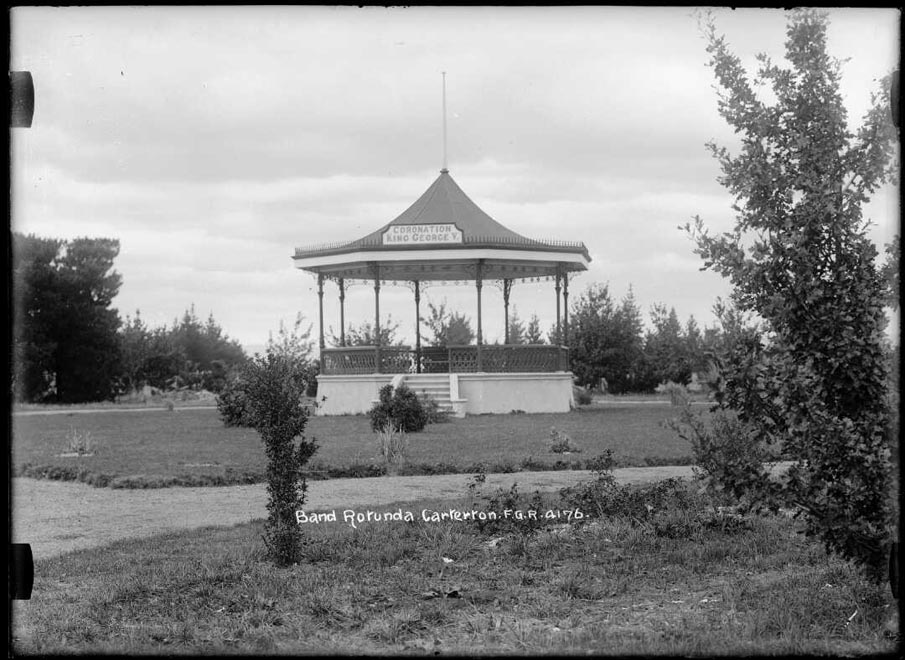
Carrington Park increasingly became a focus for the Carterton community and at a public meeting in May 1911, the community decided to raise funds for a band rotunda in the park as a Coronation monument to King George V.
Band rotundas
Well into the twentieth century, England was still seen as ‘Home’. New Zealand was still officially a British colony as late as 1907 when it was granted Dominion status. Yet little changed – it was not until the First World War that a separate sense of New Zealand identity began developing in earnest. At the time of King George V’s coronation, then, the general public were enthusiastic to welcome and celebrate the new monarch.
New Zealand used a number of structures to commemorate coronations in the early twentieth century – a hall in Auckland, a fountain in Palmerston North, a hospital in Christchurch and a street lamp in Arrowtown. Yet band rotundas emerged as a popular celebratory structure. Masterton and New Plymouth, for example, constructed rotundas to commemorate King Edward VII’s 1902 coronation. Like Carterton, a number of towns also chose to commemorate the 1911 coronation of King George V with band rotundas, including Tīmaru, Hāwera, Eltham and Inglewood. For small towns, offered a pound by pound subsidy, a commemorative rotunda was within their financial scope.
Yet the origin of band rotundas pre-dates their popularity as coronation memorials. Bandstands, as they are known internationally, owed their existence to two developments in England’s history. Firstly, as a response to the Industrial Revolution, green open spaces were created for the public to relax, restore and reconnect to the natural world. Secondly, brass bands began to emerge during the 1840s, and quickly grew in popularity. In 1861 England’s first bandstand was built in the Royal Horticultural Society Gardens. These outdoor stages, connected with light-hearted entertainment, quickly became considered a necessity in public parks as the 'good music would free the mind of urban griminess and humanise the industrial landscape'. Traditionally Victorian bandstands were octagonal in shape; ornate and embellished with fine iron work; they were ‘light and airy, painted in bold colours and set against a background of green’.
Probably New Zealand’s first bandstand structure was in Dunedin’s Vauxhall Gardens, which opened in December 1862. Simply called ‘the Rotunda’, it was a ‘round building, of considerable size. The sides are open, but the top is roofed in. It is to serve the purposes of dancing and promenading. In the centre a place is enclosed for the band…’. The use of the term ‘rotunda’ when describing a bandstand appears to be limited to New Zealand and Australia, as research by George Griffiths and Dianne Bardsley indicates.
Carterton’s Band Rotunda
At Carterton’s coronation celebration day, in June 1911, £80 was raised towards the erection of a band rotunda. The community now had sufficient funds to embark on the project.
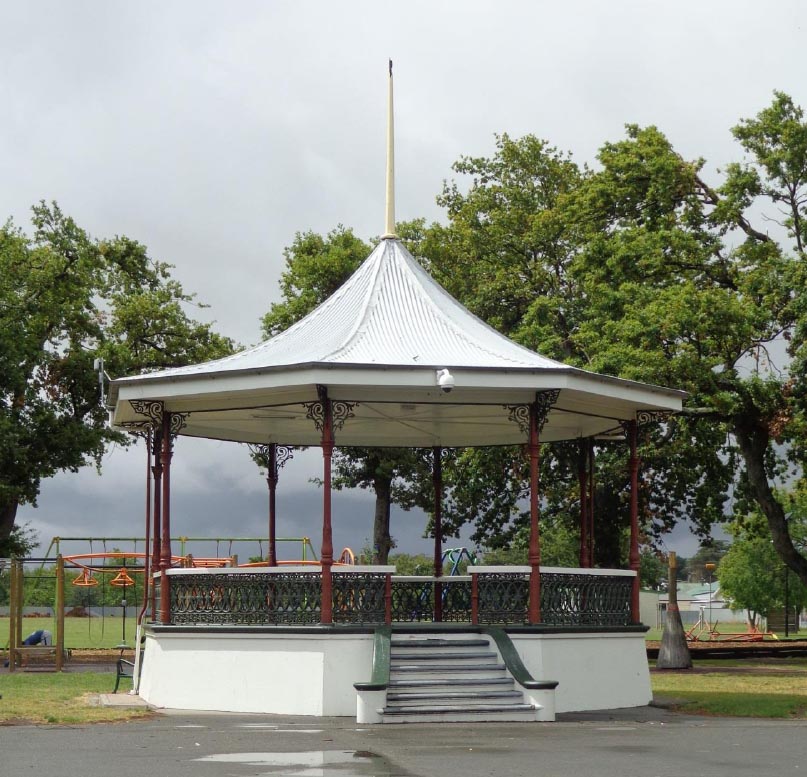
On 28 June 1911 Milton Rhodes Varnham (1860-1938), of Varnham and Rose, an architectural firm in Masterton, accepted the offer from the Parks Improvement Committee to design a rotunda. Varnham wrote he would be ‘pleased to prepare plans and supervise the construction of same at half the usual fees, viz. two and a half percent’. As a musician of ‘considerable ability’, who was also a conductor for various bands, Varnham was an obvious choice as architect. According to architectural historian David Kernohan the firm was ‘arguably the leading architecture practice of the era in the Wairarapa’. Varnham had designed Masterton’s band rotunda in 1902 and the two rotundas were similar, although Carterton’s was a little less ornamental. Yet newspapers of the day reported that Carterton’s rotunda was to be similar in design to Gisborne’s 1902 rotunda by architect W.J. Quigley. Carterton District Council correspondence, however, records that the style took after the rotunda at Wellington Hospital, but smaller. Indeed the elements of commonality between the Carterton and Wellington Hospital Rotundas are marked.
By the end of September 1911 the design was complete and by mid-October four tenders had been received. The estimated cost was £200. The lowest tender, belonging to Messrs Rose and Mason, was accepted by the Borough Council Committee. Rose and Mason, however, turned down the offered contract. The Council then asked all other tenderers to resubmit. While newspaper reports on the rotunda’s progress fall quiet over the succeeding weeks it seems likely that T.S. Arcus and Sons, Carterton’s own builders and joiners, were contracted for the work. Their tender of £310 had been the second lowest quote during the first round of tenders.
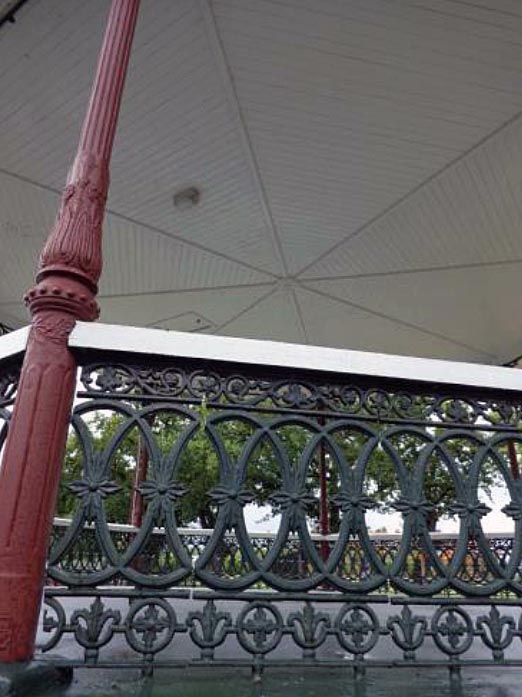
Carterton District Council also corresponded with the firm ‘for the supply of goods and services’ for the rotunda. Other goods and materials were sourced from New Zealand Railways, T.J. Rathbone (a Carterton sawmiller), and Wairarapa Steam Saw and Planing Mills. The extensive cast ironwork on the Rotunda was sourced from the foundry of S. Luke and Company of Wellington. The company was founded in 1876 and grew to be one of the country’s large engineering firms, specialising in ship building, boilermaking and cooking ranges, as well as brass and iron work. Notes written on the specifications indicate that the cast iron work was chosen from a Luke and Sons catalogue to echo the Wellington Hospital rotunda and not specifically designed for the Carterton Band Rotunda.
By 30 January 1912 the ‘Coronation Band Rotunda’ had been completed. On 8 February the rotunda was officially ‘opened’. Carterton was ‘en-fete…reflecting the progress of the town …to the accompaniment of much enthusiasm’. The New Zealand Times detailed the proceedings:
'A large assemblage gathered at Carrington Park, in ideal recreation ground…Here a handsome band rotunda with a concrete foundation, surmounted by iron pillars and a railing, has just been erected to commemorate the coronation of King George V. The rotunda supplies a long-felt want and cost £265, supplemented by a Government grant on a £1 for £1 basis. The Mayor (Mr Frank Feist) declared the rotunda open…[then] the Carterton Brass Band, of twenty-seven members, under Bandmaster R. Crawley, rendered selections.'
In describing the form and construction of the Rotunda, local architect David Kernohan wrote that it speaks ‘of the era and tradition in which it was built…[it] is constructed in a manner that reflects and demonstrates the technical expertise of the time. The use of cast iron for both structural members and for decoration evoke[s] the architecture of the period’.
…and the band played on
The following Sunday afternoon the Carterton Brass Band made use of the new rotunda to play a programme of music. The band’s performances drew large numbers and by December the band was said to be ‘improving in every way’. The conductor also decided to take up residence in Carterton to devote as much time as possible to the band. Visiting bands, such as the Salvation Army Brass Band and Masterton’s Municipal Silver Band, also made use of the rotunda.
Not long after its opening, however, mention of the rotunda faded from newspaper reports. Sadly the Carterton Brass Band also faded from view. It was soon left depleted when the majority of its members left for active war service. In 1916 the band was disbanded and the instruments ‘called in’ so they could be sold to the military authorities at Tauherenikau.
Despite the demise of the band, Carterton’s rotunda was still used for public events. In 1922, for example, when Governor General Lord Jellicoe visited Carterton, the community gathered around the rotunda to hear him speak. That same year a ‘war trophy’, a German howitzer, was presented to the Carterton Borough Council. It was placed on a concrete stand in front of the rotunda. The Council had it removed, however, during the Second World War in case it was mistaken as a gun emplacement.
In May 1937 the rotunda briefly regained its commemorative function when the coronation of King George VI was celebrated there with addresses and hymns. In 1957 a roller skating rink was built in front of the rotunda by the Carterton Jaycees. Carterton’s mayoress cut the ribbon near the bottom of the rotunda’s steps. It is clear from the photograph of the proceedings that in the intervening years the ornamental railheads on the edge of the rotunda’s roof had been removed, as had the cast iron lacework between the brackets of the columns. The commemoration sign ‘Coronation King George V’ had also been removed.
By the end of the twentieth century the rotunda was only used infrequently by community groups or by visiting bands during fairs or festivals. In 2004 Carterton District Council applied for Lottery funding to undertake repairs to the deteriorating structure. The Council and local Rotary Club also contributed toward the cost of the renovation, which was carried out by local builder Steve Ticehurst. Rotten timbers, such as match lining and fascia, were replaced. The low concrete rail that framed the steps was also repaired. After the rotunda was restored it hosted a series of summer concerts in 2006 and 2007.
Although brass band outdoor concerts are no longer fashionable, and band rotundas no longer patronised for their original purpose, over one hundred years since Carterton’s Band Rotunda was built it remains ‘an elegant, although under-utilized addition to Carrington Park’.