Around the 1600s Rangitāne, Ngāti Ira and Ngāti Kahungunu tribes settled in the Wairarapa, all migrating from further north. Rangitāne and Ngāti Kahungunu intermarried extensively. In 1821 a northern war party entered the Wairarapa, and further invasions from Taranaki tribes followed with Ngāti Tama settling on the western shore of Lake Wairarapa. In the early 1840s a peace treaty between the Wairarapa iwi and the occupying Te Ātiawa chief Te Wharepouri saw the return of the local iwi to the Wairarapa.
European settlement of the Wairarapa began in 1844 when a small number of Wellington settlers arranged pastoral leases with local Māori. In 1853 Charles Rooking Carter (1822-1896), one of Wellington’s leading lights in the building trade, worked with Joseph Masters to persuade the Crown to buy land in the Wairarapa for settlement purposes. Greytown (named for Governor George Grey) and Masterton were the resulting settlements. Carter, however, acquired a large block of land south of Masterton. In 1857 he was selected to represent the Wairarapa District in Wellington’s Provincial Council. That same year, a small settlement named Three Mile Bush was founded to provide a base for men working on the road between Greytown and Masterton – ‘men whose capital chiefly, if not solely, consisted of stout hearts and strong arms’. Carter took such a ‘lively interest’ in the district and ‘its purchase from the natives - its settlement by small farmers – and its general prosperity’ that in July 1859 Three Mile Bush was renamed Carterton.
A sawmilling industry grew up in the bush surrounding Carterton, proving not only additional employment but more ground for settlement and farming. The development of the dairying industry in particular, combined with sawmilling, helped give Carterton a strong economic base. By 1897 the township had ‘rapidly grown into a place of considerable importance’.
A world away from Carterton, on 28 July 1914 Austria-Hungary declared war on Serbia, effectively beginning World War One. On 4 August 1914 the United Kingdom joined the war and ‘[t]here was a rush when the [New Zealand] Government asked men to volunteer for an expeditionary force’. The first New Zealand troops left to support the Mother Country on 16 October 1914. Over the next four years, nearly 17,000 New Zealanders died as a result of the fighting and about 543 were the Wairarapa’s own. This was a considerable proportion of the area’s population and of the estimated 2000 Wairarapa people who served in the war.
‘I hope the townships will not fritter away this Memorial matter into banality…’
In New Zealand, memorials began being created during the First World War and they appear to have been on everyone’s mind after the war ended, especially throughout the Wairarapa. By early 1919, neighbouring Masterton had a sportsground ‘as a lasting Memorial to Fallen Wairarapa Solders’ created by notable landscape designer, Alfred William Buxton (1872-1950). Martinborough proposed an improved town square as a memorial. Greytown’s Chamber of Commerce intended to secure O’Connor’s Bush as a memorial. Featherston was thinking of bathing sheds.
Carterton locals were also intensely interested in commemorating the service of their soldiers. The Wairarapa Agricultural and Pastoral Society proposed a memorial cattle pen for their show. Yet many felt this was not the ultimate solution. As Borough Councillor Callister argued:
‘Let us be done with stupid schemes of trees, cowsheds and pig-sties as memorials for fallen soldiers. Get something good, solid, substantial and beautiful in marble and erect it right in the heart of the town, so that it shall be a reminder to all of what our gallant soldiers have sacrifices and a constant reproach to the shirker, who gave nothing.’
And so they did.
Memorial Square
In September 1919 a public meeting agreed ‘[t]hat a memorial square be established in Carterton on the site of the old garden on the Parkes estate, situated on the corner of High Street and Park Road, and for this purpose the whole frontage of the property facing High Street be acquired, to a depth of 365 feet facing Park Road…at an estimated cost of £3650’. The financial goal was set at £5000, a considerable sum at the time, and £665 was promised at the meeting. A Memorial Square Committee was also created. A monument was not specifically mentioned as part of this early thinking.
The proposed memorial square was to be ‘an attractive pleasure park, containing side-walks, garden plots, etc’. For such an enterprise a ‘landscape artist’ was required and foremost in the field was Alfred Buxton. Buxton was born in England and around 1886 the family arrived in Christchurch. Buxton was apprenticed to Canterbury’s leading nurseryman. Acquiring three nurseries over the course of his career, he also formed A. W. Buxton Limited, landscape gardeners. Buxton became ‘the most significant landscape gardener in New Zealand in the first half of the twentieth century’. He worked throughout the South Island and the lower half of the North Island, where his clients ‘were predominantly members of the rural élite… The First World War period was one of pastoral affluence and a Buxton landscape became a symbol of that affluence’. Buxton also designed a number of urban parks, including Tīmaru’s Caroline Bay and Temuka Domain, as well as memorial parks for Masterton and Gisborne and ‘landscaped memorials’ in Cheviot and Leeston. Therefore, Buxton was the obvious choice for Carterton’s memorial park.
By November subscriptions for Memorial Square were still well short of the target. The ‘Memorial plot’ had been established and working bees were held to clear it, but the site still remained in ‘primitive condition’. In mid-January the Secretary of the Soldiers’ Memorial Committee reported that a deposit of £400 had been paid on the land and donations stood at just over £2961. A canvas of outer districts was planned and there was also prospective income from the sale of building sites around the Square. Perhaps to widen the appeal of donating even further, spin-offs from the scheme to memorialise fallen soldiers were emphasised:
‘The Soldiers Memorial proposal will make a decided improvement to Carterton. Two unsightly buildings on High Street will be demolished in the reconstructive scheme; Park Road is to be widened and the approach to High Street rounded off; a new street is to be created…and sections along this have been disposed of, on which it is proposed to erect business premises, residences, and a club.’
In February 1920 the Committee rejected a modified scheme Buxton submitted as too expensive and they asked him to submit a third scheme. However, they accept tenders for the removal of ‘old landmark’ buildings on site.
By the beginning of March £3000 had been promised and £1200 was in hand. The Committee, however, were of the opinion ‘that the response has not been what it should be in view of the object – It was thought sufficient funds would be forthcoming to complete the scheme without resorting to socials, entertainments, etc….the committee is consequently disappointed’. A newspaper, which gave weekly updates on the fundraising, termed it ‘a poor compliment to those who sacrificed their all to save this country from Hun domination’. The Committee’s disappointment had the desired effect and donations increased. Canvassers to the country district also found encouraging support. At the same time the Fund ceased to be called the ‘Fallen Soldiers Memorial Fund’ and was renamed the ‘District Soldiers Memorial’.
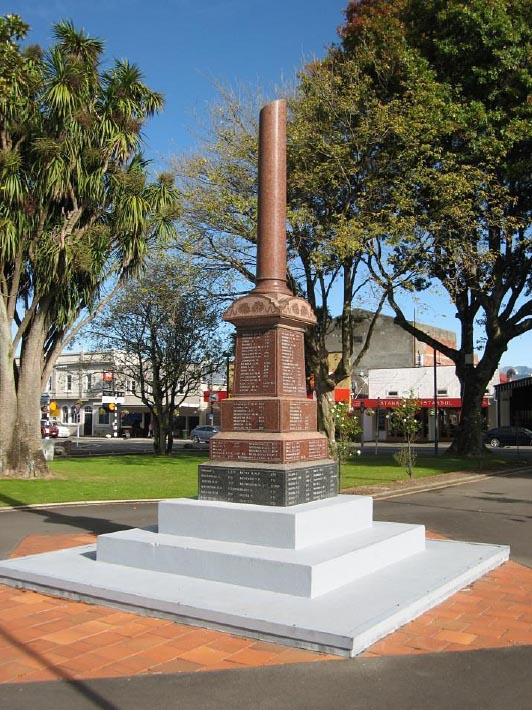
In April the Committee decided to establish a £2000 fund for the Memorial’s upkeep. The purchase of the land for Memorial Square was also completed. The total cost of the land was £3775. Buxton’s estimate for laying out the grounds was £2500, but the Committee decided that they could only afford £1800 and would ask if he still would undertake the work. In mid-April Buxton arrived in Carterton. During May the Committee and Buxton reached an agreement – the project would amount to around £1800 and, most significantly, included the erection of a war memorial. An eight-foot pathway from each corner of the Square would lead to a centre piece 36 feet wide. In the centre of this would rise a ‘grey Nelson stone set up on a concrete base 15ft across’. A tablet on the monument would contain the names of the fallen from the Carterton Borough and the Wairarapa South County. The memorial was perhaps designed by Buxton or the local monumental mason. Financial restraints often saw small towns like Carterton turn to monumental masons rather than architects. Again the commemorative intent was somewhat tempered by the description of the town improvements that would be gained on the completion of the Square.
Workmen were soon on the site and by mid-June all was looking ‘spruce and bright’. In August the Committee asked the public to supply the names of soldiers who fell, together with their rank, so their names could be inscribed on the memorial. Within a month almost 100 names had been gathered by the Committee. The Square was almost ready for planting too. Funding shortfalls saw the Committee consider holding a fete – but ‘some parents of the fallen feel that festivities and merriment are inconsistent with the purport and sacredness of the monument’. In desperation the Committee enlisted ‘the support of ladies’. The first ‘enthusiastic meeting of the ladies’ was held in October – by November they had held a social and handed over £12 for the Upkeep Fund. Next on the list was a ‘Baby Carnival’ involving various functions throughout the district. The contest raised £754.
In September the Carterton District Fallen Soldiers’ Memorial Committee approached the Wairarapa South County Council and asked for a donation of £500, or a grant of £50 per year towards upkeep and maintenance. The Council noted that it not been consulted about the memorial and was now asked to contribute, on top of the £500 spent on providing gas and water services to the Square. The decision was delayed for the incoming Council. In the meantime pupils of the Carterton District High School guaranteed they would each contribute one penny per quarter towards the upkeep of the Square.
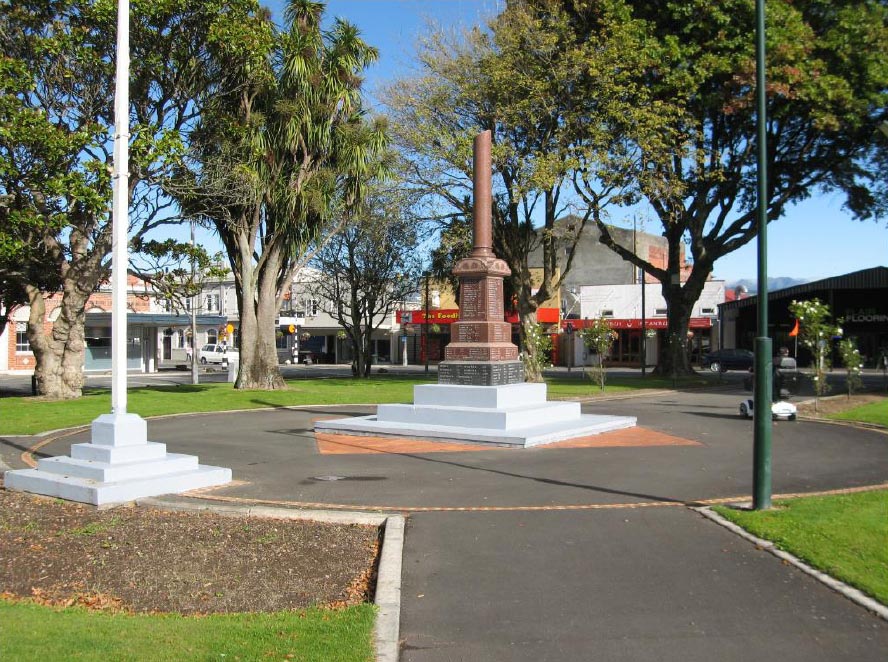
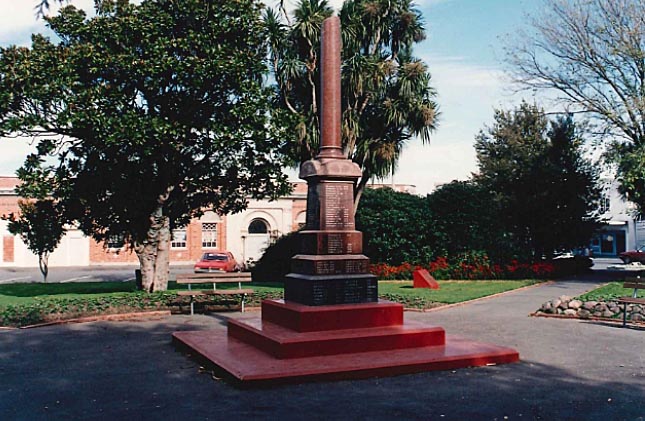
On 19 November Masterton’s monumental mason began to erect the stone containing the names of the fallen soldiers in the Square. By the end of December Memorial Square was ‘a perfect picture’ and it appears to be the first of the Wairarapa’s permanent civic memorials to be completed. The unveiling of the War Memorial was scheduled for 13 February 1921. The Committee had retained the services of the Prime Minister to unveil the memorial but in early February he indicated his unavailability. The ceremony was instead performed by the Hon G. J. Anderson, Minister of Internal Affairs. The Mayor of Carterton, W. Howard Booth, also spoke as did Member of Parliament A. D. McLeod and Brigadier General Hart. A large number attended from Masterton and the Wairarapa district at large. The monument, at the centre of the Square’s ‘neatly laid out in Garden, [and]…asphalt paths’, was wrapped in flags for the ceremony and when unveiled was seen to be polished red granite rather than Nelson grey stone.
The memorial
In honour of the war dead, approximately 500 First World War memorials were erected throughout New Zealand. These memorials symbolised two contradictory messages: pride and sorrow at the death of young men cut off in their prime. Over 16,600 men were buried in foreign lands. War memorials functioned as surrogate graves where relatives could visit and grieve. Yet there was also ‘pride [in] the way “our boys” had given identity to a nation’. A new ‘Kiwi’ sense of identity was honoured and commemorated.
New Zealand’s First World War memorials did not usually serve a useful purpose. A memorial with a functional use, albeit a community one, was generally held to be disrespectful to the sacrifice of those who had died. However, Carterton was not alone in having an additional motive of beautifying the streetscape of the town by placing a memorial in an improved space. Memorials were often located in an open space to provide easy access and the position was usually central and prominent. Open grounds also enabled the monument to be used in public ceremonies, especially Anzac Day.
Into the future
With an eye to the future the Committee appointed R. Priest caretaker and gardener for Memorial Square and fundraising continued. In November 1921, the Committee still had a debt of £2462 on the general account. In 1922 the Committee again decided ‘to convene a meeting of ladies’ to take charge of fundraising efforts. By July 1924 the memorial account was only £1337 in debt, while the upkeep account was £2009 in credit. Memorial Square, the Committee’s upkeep fund and unsold sections were eventually transferred to the local council. Under the Carterton and District Memorial Square Act 1932, the council was entrusted with the space, for ‘use of the public for the purpose of a public park and recreation ground for all time as a memorial to the soldiers from the district who lost their lives in the late European War’.
Upon completion Memorial Square became the focal point for many civic events and activities, including Anzac Day services. In the succeeding years returned soldiers, veterans and the public gathered round the monument while the band played the ‘Garland of Flowers’ in the Square. The memorial was surrounded by wreathes laid by friends and family in remembrance. There is a tradition in Carterton of residents marching to Memorial Square to participate in a wreath-laying ceremony at the War Memorial. The Square was also used for public occasions. For example, Governor-General and Lady Bledisloe were officially welcomed in Memorial Square in 1933.
Unfortunately, additions to the War Memorial were still to come. After the Second World War, the memorial was raised and a black granite base inserted below the original red granite sections. The addition carried the names of the soldiers from the area who lost their lives in that conflict. Again the names were ordered alphabetically and their ranks were included. This approach to commemorating the Second World War dead was decided upon at a public meeting in 1947 and the addition was unveiled on Anzac Day 1949. Despite rainy weather some of the ceremony took place in the Square and the mayor, other local politicians, dignitaries and citizens were in attendance.
Memorial Square has been described by the Carterton District Council as ‘an integral part of the town’. The Council undertook a rejuvenation project in 2006. As well as continuing to play a significant part in annual Anzac Day commemorations, the Square hosts other community and public events, including farmers’ markets. As a central open space, the park is also used as a leisure spot which was reflected in the addition of a more seating in 2018. The ‘love seat’ was a community project using timber from a large oak, donated by its private owner after the tree was brought down in a 2013 storm. Local tradespeople and the Lions Club members donated their time to craft and install the seat, which was unveiled by Mayor John Booth. This is not a new concept in regards to the Square, for example the local Farmers’ Union donated a seat and funds to the park in 1925. concept in regards to the Square, for example the local Farmers’ Union donated a seat and funds to the park in 1925.