

The Horowhenua settlement of Ohau developed after the Wellington ̶ Manawatū railway line, which opened the district to Pākehā settlement, was completed in 1886. The land was heavily forested and sawmilling became a major local industry, as did flax-milling and dairy and sheep farming. By 1896 Ohau’s population was 256, sufficient to support a small Anglican church. Wellington architect Frederick de Jersey Clere designed what has been described by his biographer as one of his ‘most charming country churches’ for Ohau in 1898. Construction of the church, which commenced in 1901, was a community affair. Funds were raised locally, the land on which it stood was donated by farming couple Mary and John Kebbell, who also supplied the piles, and timber was carted to the site for free. The church was constructed by Ohau builder Laurence Arcus and local people donated furnishings, altar vessels and cloths.
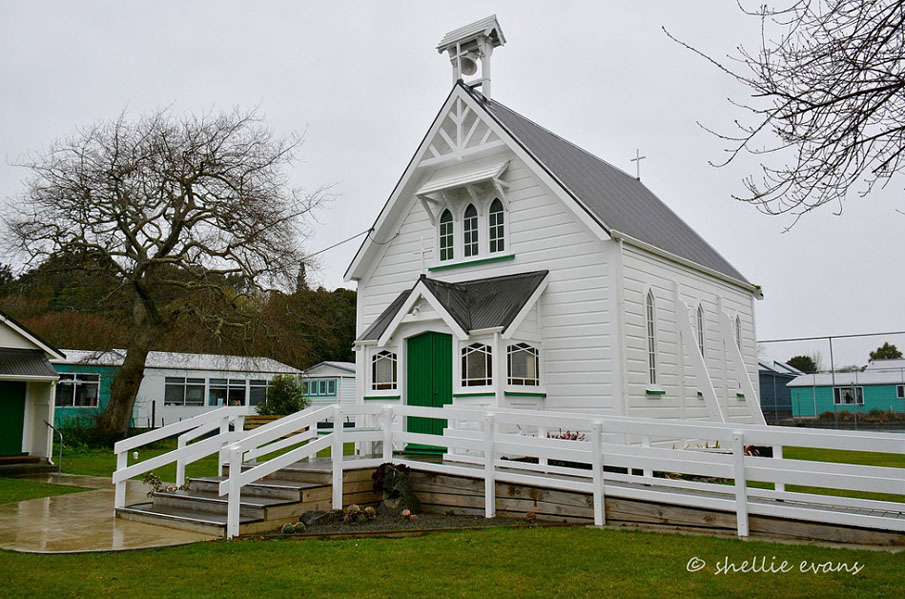
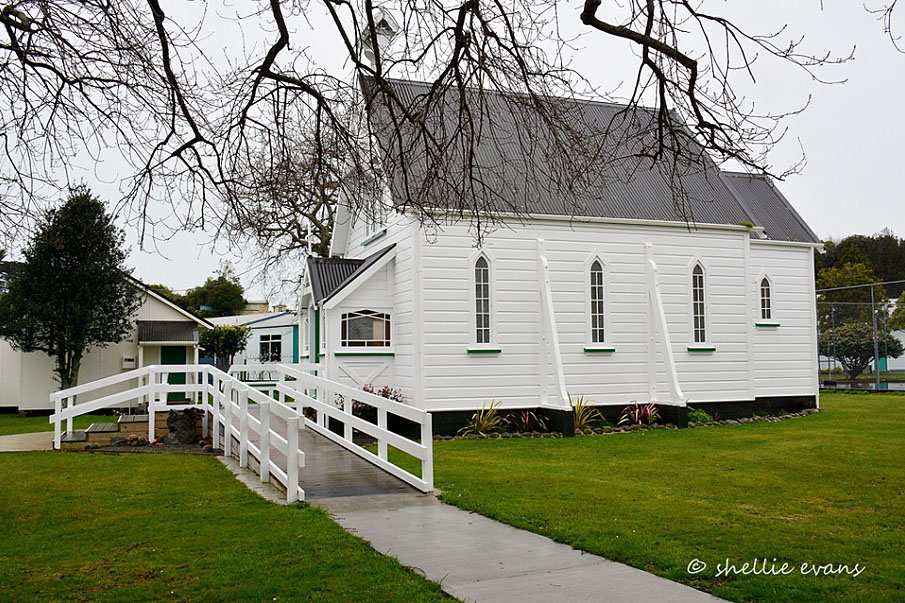
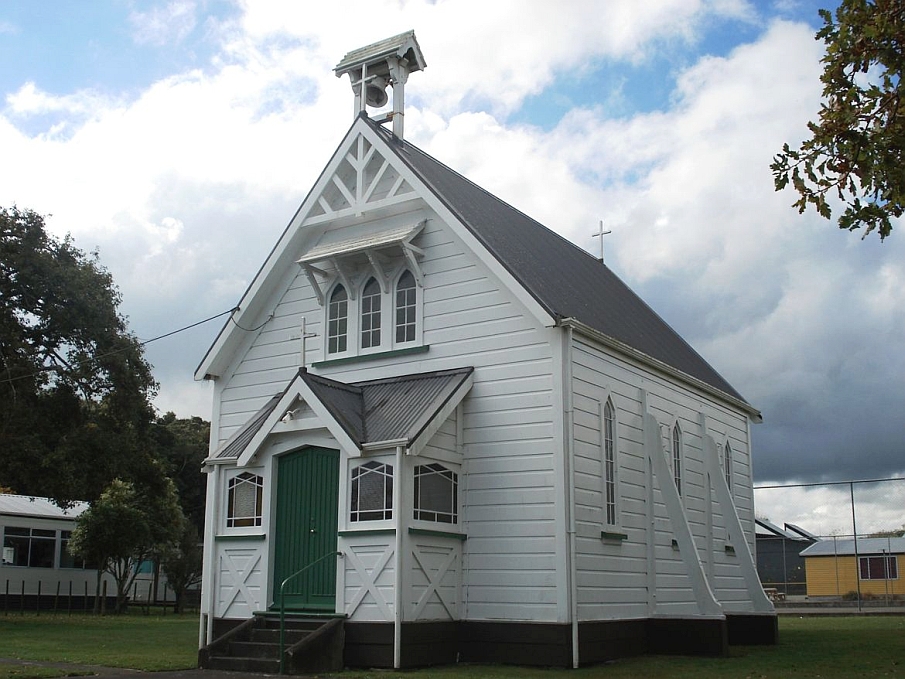
One of over 100 churches designed by Clere, who was architect to the Wellington Anglican diocese, the rusticated weatherboard Church of St John the Baptist is amongst the smallest, with the nave measuring approximately 7.5 by 6 metres. The small belfry on the gable roof houses a bell donated in memory of the lawyer and ornithologist Walter Buller in 1907. The lancet windows on the main west elevation are repeated on the north and south elevations, both of which are supported by two slim buttresses. A chancel with three lancet windows and a lean-to vestry form the east elevation. The dressed-timber interior is enhanced by stained glass windows installed in the chancel in 1921. Made by James Powell & Sons of London, the windows commemorate three children of Mary and John Kebbell, a son killed in the battle of Gallipoli (1915) and two daughters drowned in 1890. A roll of honour commemorates locals who served overseas during the First and Second World Wars.
Restoration work carried out between 1973 and 1974 involved re-piling, replacement of the timber bargeboards at the base, new spouting, re-varnishing of the interior and carpeting of the floor. In 2013 new timber steps and a ramp were built onto the west elevation to improve access. The church remains a site of worship.
List Entry Information
Status
Listed
List Entry Status
Historic Place Category 2
Access
Private/No Public Access
List Number
4049
Date Entered
5th September 1985
Date of Effect
5th September 1985
City/District Council
Horowhenua District
Region
Horizons (Manawatū-Whanganui) Region
Extent of List Entry
Extent includes part of the land described as Pt Sec 6 TN OF Ohau (RT WN83/239), Wellington Land District and the building known as Church of St John the Baptist (Anglican) thereon. Refer to the extent map tabled at the Rārangi Kōrero Committee meeting on 30 April 2019.
Legal description
Pt Sec 6 TN OF Ohau (RT WN83/239), Wellington Land District
Status
Listed
List Entry Status
Historic Place Category 2
Access
Private/No Public Access
List Number
4049
Date Entered
5th September 1985
Date of Effect
5th September 1985
City/District Council
Horowhenua District
Region
Horizons (Manawatū-Whanganui) Region
Extent of List Entry
Extent includes part of the land described as Pt Sec 6 TN OF Ohau (RT WN83/239), Wellington Land District and the building known as Church of St John the Baptist (Anglican) thereon. Refer to the extent map tabled at the Rārangi Kōrero Committee meeting on 30 April 2019.
Legal description
Pt Sec 6 TN OF Ohau (RT WN83/239), Wellington Land District
Construction Professional
Name
Clere, Frederick De Jersey
Type
Architect
Biography
Clere (1856-1952) was born in Lancashire, the son of an Anglican clergyman, and was articled to Edmund Scott, an ecclesiastical architect of Brighton. He then became chief assistant to R J Withers, a London architect. Clere came to New Zealand in 1877, practising first in Feilding and then in Wanganui. He later came to Wellington and practised there for 58 years. He was elected a Fellow of the Royal Institute of British Architects in 1886 and held office for 50 years as one of four honorary secretaries in the Empire. In 1883 he was appointed Diocesan Architect of the Anglican Church; he designed more than 100 churches while he held this position. Clere was a pioneer in reinforced concrete construction; the outstanding example of his work with this material is the Church of St Mary of the Angels (1922), Wellington. As well as being pre-eminent in church design, Clere was responsible for many domestic and commercial buildings including Wellington's Harbour Board Offices and Bond Store (1891) and Overton in Marton. Clere was also involved in the design of large woolsheds in Hawkes Bay and Wairarapa. He was active in the formation of the New Zealand Institute of Architects and served on their council for many years. He was a member of the Wellington City Council until 1895, and from 1900 a member of the Wellington Diocesan Synod and the General Synod. He was also a member of the New Zealand Academy of Fine Arts.
Name
Laurence Arcus
Type
Builder
Biography
No biography is currently available for this construction professional
Construction Details
Start Year
1973
Finish Year
1974
Type
Refurbishment/renovation
Description
Re-piled, timber bargeboards replaced, new spouting, re-varnishing of interior timber, carpet laid
Finish Year
2013
Type
Physical access improvements
Description
Construction of an entrance ramp and steps
Construction Professional
Name
Clere, Frederick De Jersey
Type
Architect
Biography
Clere (1856-1952) was born in Lancashire, the son of an Anglican clergyman, and was articled to Edmund Scott, an ecclesiastical architect of Brighton. He then became chief assistant to R J Withers, a London architect. Clere came to New Zealand in 1877, practising first in Feilding and then in Wanganui. He later came to Wellington and practised there for 58 years. He was elected a Fellow of the Royal Institute of British Architects in 1886 and held office for 50 years as one of four honorary secretaries in the Empire. In 1883 he was appointed Diocesan Architect of the Anglican Church; he designed more than 100 churches while he held this position. Clere was a pioneer in reinforced concrete construction; the outstanding example of his work with this material is the Church of St Mary of the Angels (1922), Wellington. As well as being pre-eminent in church design, Clere was responsible for many domestic and commercial buildings including Wellington's Harbour Board Offices and Bond Store (1891) and Overton in Marton. Clere was also involved in the design of large woolsheds in Hawkes Bay and Wairarapa. He was active in the formation of the New Zealand Institute of Architects and served on their council for many years. He was a member of the Wellington City Council until 1895, and from 1900 a member of the Wellington Diocesan Synod and the General Synod. He was also a member of the New Zealand Academy of Fine Arts.
Name
Laurence Arcus
Type
Builder
Biography
No biography is currently available for this construction professional
Construction Details
Start Year
1973
Finish Year
1974
Type
Refurbishment/renovation
Description
Re-piled, timber bargeboards replaced, new spouting, re-varnishing of interior timber, carpet laid
Finish Year
2013
Type
Physical access improvements
Description
Construction of an entrance ramp and steps
Historical and Associated Iwi / Hapū / Whānau
Completion Date
20th March 2019
Report Written By
Kerryn Pollock and Phillis Chih-Hsuan Chen
Information Sources
Maclean, 2003
S. Mclean, Architect of the Angels; the churches of Frederick de Jersey Clere, Wellington, 2003
Te Ara - The Encyclopedia of New Zealand
www.TeAra.govt.nz
Kete Horowhenua
Kete Horowhenua
Centennial Committee, 1992
Souvenir of Ohau School and district: from then to now, Ohau: Centennial Committee, 1992
St. Mary’s Anglican Church, 1997
The Anglican parish of Levin: celebrating 100 years of worship and fellowship at St. Mary’s Church, Levin: St. Mary’s Anglican Church, 1997.
Other Information
This place was identified as significant under previous legislation with different information requirements. It remains significant under the current legislation. There is opportunity under our legislation and policies to add to this information. Further information about this place may be available from the Central Regional Office of Heritage New Zealand Pouhere Taonga. A fully referenced upgrade report is available on request from the Central Region Office of Heritage New Zealand. Please note that entry on the New Zealand Heritage List/Rarangi Korero identifies only the heritage values of the property concerned, and should not be construed as advice on the state of the property, or as a comment of its soundness or safety, including in regard to earthquake risk, safety in the event of fire, or insanitary conditions.
Historical and Associated Iwi / Hapū / Whānau
Completion Date
20th March 2019
Report Written By
Kerryn Pollock and Phillis Chih-Hsuan Chen
Information Sources
Maclean, 2003
S. Mclean, Architect of the Angels; the churches of Frederick de Jersey Clere, Wellington, 2003
Te Ara - The Encyclopedia of New Zealand
www.TeAra.govt.nz
Kete Horowhenua
Kete Horowhenua
Centennial Committee, 1992
Souvenir of Ohau School and district: from then to now, Ohau: Centennial Committee, 1992
St. Mary’s Anglican Church, 1997
The Anglican parish of Levin: celebrating 100 years of worship and fellowship at St. Mary’s Church, Levin: St. Mary’s Anglican Church, 1997.
Other Information
This place was identified as significant under previous legislation with different information requirements. It remains significant under the current legislation. There is opportunity under our legislation and policies to add to this information. Further information about this place may be available from the Central Regional Office of Heritage New Zealand Pouhere Taonga. A fully referenced upgrade report is available on request from the Central Region Office of Heritage New Zealand. Please note that entry on the New Zealand Heritage List/Rarangi Korero identifies only the heritage values of the property concerned, and should not be construed as advice on the state of the property, or as a comment of its soundness or safety, including in regard to earthquake risk, safety in the event of fire, or insanitary conditions.
Current Usages
Uses: Commemoration
Specific Usage: Memorial building (hall, museum, church, school, library etc)
Uses: Religion
Specific Usage: Church
Current Usages
Uses: Commemoration
Specific Usage: Memorial building (hall, museum, church, school, library etc)
Uses: Religion
Specific Usage: Church
Location
Sign up to hear more
Get the latest heritage news, features and events delivered
straight to your inbox.
