Balgownie House, in Naenae a suburb of Lower Hutt, was constructed for notable businessman and politician, John Duthie (1841-1915) in 1900. Duthie emigrated from Scotland to New Zealand in 1863, and after establishing a successful business, was appointed to a number of prominent boards including the Wellington Harbour Board and the Gear Meat Company. Duthie became Mayor of Wellington in 1888 and eventually a member of both the House of Representatives and the Legislative Council. He is also credited for being one of the founding directors of the Dominion newspaper, and later Chairman of its Board of Directors (1912-1915). He married a Miss Mercer and the couple were to have eight children. Initially the family lived in Wellington but moved out to their new house in Naenae in 1903.
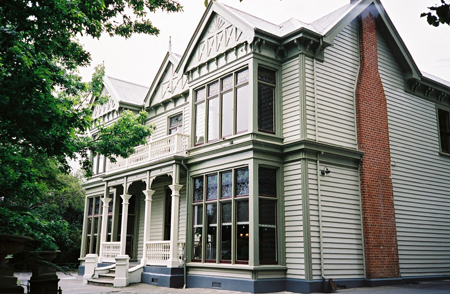
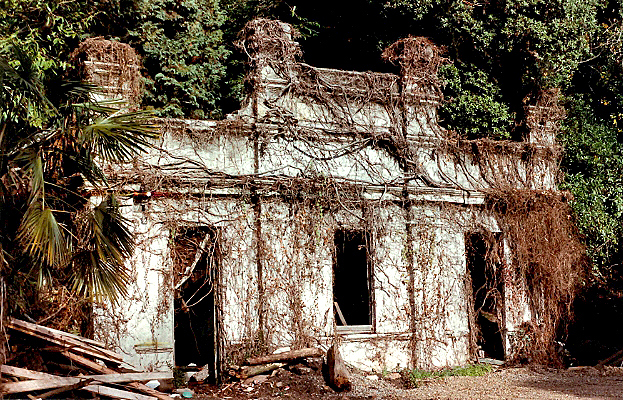
Balgownie House, named after a suburb of Duthie's home city, Aberdeen, was built entirely of native timbers. At the time it was built, the house was regarded as one of the finest in Wellington, but it is not known who designed the building. It is also believed to be the first house in the area to be run on electricity. Electricity was generated in a concrete building, in front of the house at the bottom of the hill. (This generator building is registered Category II by the New Zealand Historic Places Trust.) The house features several gables with half-timbering under the eaves. The front facade has a verandah supporting a balcony between the two window bays, and there is an an elaborate porch. Situated on a hill it once overlooked formal gardens in which every year Duthie would hold a picnic for his employees.
Following Duthie's death in 1915, the house was sold to another successful businessman, William Henry Harrison George. In 1917 the Sisters of Mercy (Wellington) Trust Board acquired the house for a boys' orphanage and hostel called St Thomas'. The Sisters later acquired land adjacent to the house for a farm which allowed them to become self- sufficient. In 1958 the house became a Parish Convent. The Sisters built an addition at the back of the house, and converted the billiard room, located in a building behind the house, to a chapel. In 1970 the house was sold to the Marist Brothers Trust Board, who used it as a training centre until 1982. The house was sold by the Marist Brothers in 1984. It has since been used as a private residence, and is being restored.
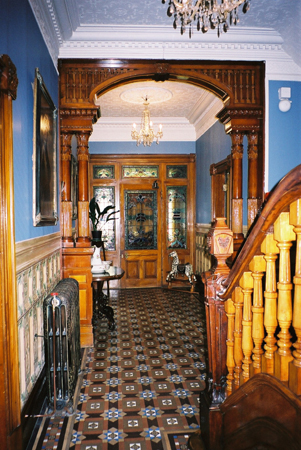
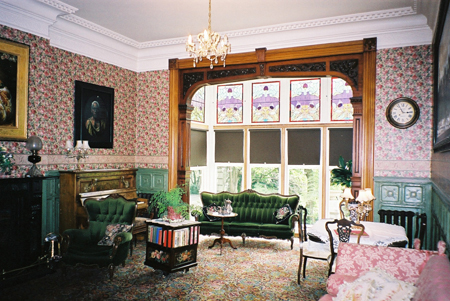
Balgownie House is historically significant for its association with prominent Wellington businessman and politician, John Duthie, and for the early use of electricity in the house. It is also significant for its association with the Catholic Church, particularly for the Sisters of Mercy, who occupied the building for over half a century. The house is architecturally significant as an elegant late Victorian house.
Balgownie House, named after a suburb of Duthie's home city, Aberdeen, was built entirely of native timbers. At the time it was built, the house was regarded as one of the finest in Wellington, but it is not known who designed the building. It is also believed to be the first house in the area to be run on electricity. Electricity was generated in a concrete building, in front of the house at the bottom of the hill. (This generator building is registered Category II by the New Zealand Historic Places Trust.) The house features several gables with half-timbering under the eaves. The front facade has a verandah supporting a balcony between the two window bays, and there is an an elaborate porch. Situated on a hill it once overlooked formal gardens in which every year Duthie would hold a picnic for his employees.
Following Duthie's death in 1915, the house was sold to another successful businessman, William Henry Harrison George. In 1917 the Sisters of Mercy (Wellington) Trust Board acquired the house for a boys' orphanage and hostel called St Thomas'. The Sisters later acquired land adjacent to the house for a farm which allowed them to become self- sufficient. In 1958 the house became a Parish Convent. The Sisters built an addition at the back of the house, and converted the billiard room, located in a building behind the house, to a chapel. In 1970 the house was sold to the Marist Brothers Trust Board, who used it as a training centre until 1982. The house was sold by the Marist Brothers in 1984. It has since been used as a private residence, and is being restored.
Balgownie House is historically significant for its association with prominent Wellington businessman and politician, John Duthie, and for the early use of electricity in the house. It is also significant for its association with the Catholic Church, particularly for the Sisters of Mercy, who occupied the building for over half a century. The house is architecturally significant as an elegant late Victorian house.