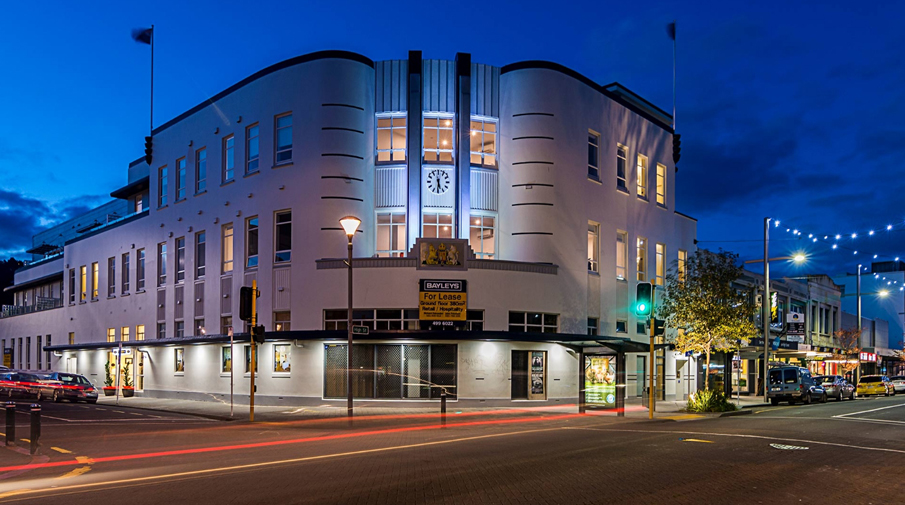
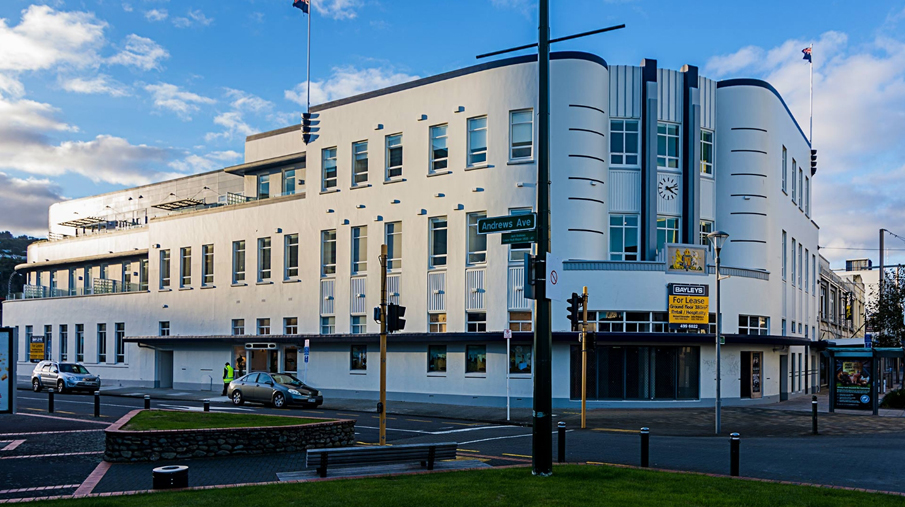
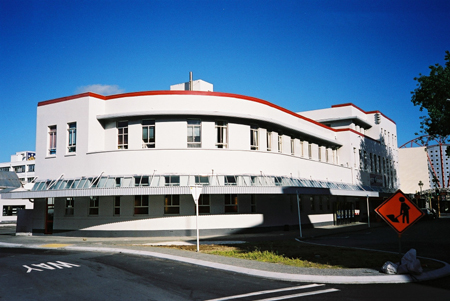
This large Moderne building was the third Post Office built in Lower Hutt, and was designed by the Government Architect, John Thomas Mair (1876-1959). The first post office in Lower Hutt was a small wooden building built on the corner of High Street and Laings Road in 1891. During the 1890s the role of the Postal and Telegraph Department expanded. Not only did the volume of mail it carried increase, but it also offered a far greater range of government services, such as a savings bank and the acceptance of licence fees, taxes, and local body rates. At the same the population of Lower Hutt grew. To cope with the increased demand on postal services, a two-storey masonry post office was built in 1906 to replace the wooden structure.
The 1920s and 1930s saw the rapid expansion of suburban development in the Hutt Valley, aided by the establishment of the Housing Construction Department in 1936. In that same year a town-planning scheme was adopted to control development. As part of planning for anticipated growth in the town of Lower Hutt, and to relieve future traffic congestion, land owned by the Catholic Church - then occupied by the Church of Sts Peter and Paul - was acquired by the Lower Hutt Borough Council in 1937 for a 'cross-street' between High Street and Dudley Street. It was called Andrews Avenue, and the north side of the street was set aside for the new and larger post office which is the subject of this registration.
The contract for the construction of the building was let to Messrs. W. M. Angus Ltd of Napier in July 1940, but it was not until a year later that the foundation stone was laid. In the meantime Lower Hutt became a city. On the day Lower Hutt's new status as a municipality was announced a picture of the proposed new post office was published in the Dominion newspaper. Further delays caused by shortages associated with the Second World War meant that the post office did not open until February 1943, and, even then, work still had to be completed on the upper storeys of the building.
Mair's Moderne design, incorporating elements of Art Deco, was purpose-designed for its site. The building was never intended to be solely occupied by a post office. The ground floor was also planned to be used by the railways bus office, with other government offices occupying the top floors. However, this never eventuated. For around fifty years or so the principal occupant has been the Post Office (including the Post Savings Bank, and later Postbank). Other occupants have included solicitors, dentists, and photographers. Today New Zealand Post utilises the building for a sorting office and private boxes. The ground floor space facing the High Street has been let for commercial purposes.
The Post Office Building, Lower Hutt, is historically significant as a reminder of the phenomenal growth of Lower Hutt in the first decades of the twentieth century. It is also important for its association with the Government Architect, John Mair. Occupying a corner site, it is a well-known landmark on Lower Hutt's main street.
The 1920s and 1930s saw the rapid expansion of suburban development in the Hutt Valley, aided by the establishment of the Housing Construction Department in 1936. In that same year a town-planning scheme was adopted to control development. As part of planning for anticipated growth in the town of Lower Hutt, and to relieve future traffic congestion, land owned by the Catholic Church - then occupied by the Church of Sts Peter and Paul - was acquired by the Lower Hutt Borough Council in 1937 for a 'cross-street' between High Street and Dudley Street. It was called Andrews Avenue, and the north side of the street was set aside for the new and larger post office which is the subject of this registration.
The contract for the construction of the building was let to Messrs. W. M. Angus Ltd of Napier in July 1940, but it was not until a year later that the foundation stone was laid. In the meantime Lower Hutt became a city. On the day Lower Hutt's new status as a municipality was announced a picture of the proposed new post office was published in the Dominion newspaper. Further delays caused by shortages associated with the Second World War meant that the post office did not open until February 1943, and, even then, work still had to be completed on the upper storeys of the building.
Mair's Moderne design, incorporating elements of Art Deco, was purpose-designed for its site. The building was never intended to be solely occupied by a post office. The ground floor was also planned to be used by the railways bus office, with other government offices occupying the top floors. However, this never eventuated. For around fifty years or so the principal occupant has been the Post Office (including the Post Savings Bank, and later Postbank). Other occupants have included solicitors, dentists, and photographers. Today New Zealand Post utilises the building for a sorting office and private boxes. The ground floor space facing the High Street has been let for commercial purposes.
The Post Office Building, Lower Hutt, is historically significant as a reminder of the phenomenal growth of Lower Hutt in the first decades of the twentieth century. It is also important for its association with the Government Architect, John Mair. Occupying a corner site, it is a well-known landmark on Lower Hutt's main street.