

The Arts and Crafts advocated a return to the handmade crafts of England before the industrial revolution. Chapman Taylor had acquainted himself with buildings erected according to Arts and Crafts principles on a trip to England in 1909, where he met Charles Voysey, Baillie Scott, Richard Parker and Sir Raymond Unwin, prominent figures in the movement. On returning to New Zealand, Chapman-Taylor adapted the Arts and Crafts 'style' to local conditions. Over the 50 years of his career he retained the principles of the movement, not only designing and building houses, but also making the furniture and fittings to go in them.
In 1953 the Barr's sold the property to Judy and John Wilson, who added a flat-roofed sunroom on the north end of the house in 1964.
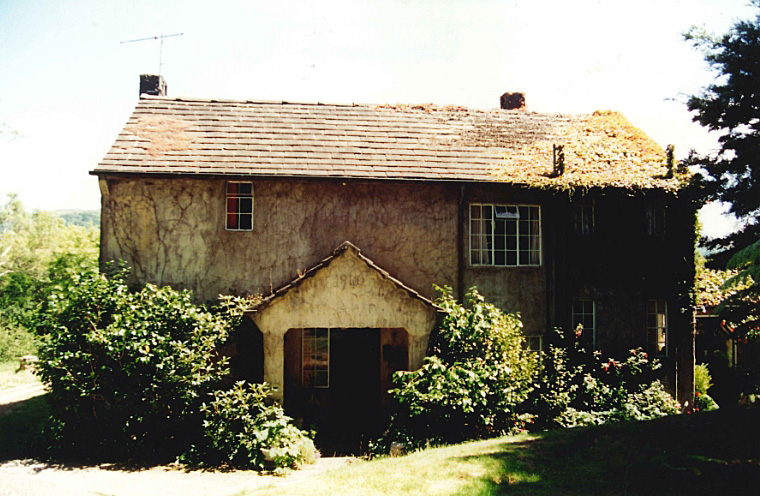
This house is a fine example of James Chapman-Taylor's designs and the skills of his son Rex Chapman-Taylor in the Heretaunga-Silverstream area.
List Entry Information
Status
Listed
List Entry Status
Historic Place Category 2
Access
Private/No Public Access
List Number
4146
Date Entered
5th September 1985
Date of Effect
5th September 1985
City/District Council
Upper Hutt City
Region
Wellington Region
Legal description
Pt Lots 5 & 7 DP 1452
Status
Listed
List Entry Status
Historic Place Category 2
Access
Private/No Public Access
List Number
4146
Date Entered
5th September 1985
Date of Effect
5th September 1985
City/District Council
Upper Hutt City
Region
Wellington Region
Legal description
Pt Lots 5 & 7 DP 1452
Construction Professional
Name
Chapman-Taylor, James Walter
Type
Architect
Biography
Chapman-Taylor (1878-1958) was born in London and his family came to New Zealand in 1880. He was apprenticed to a builder in Stratford, and there he studied architecture by correspondence. In 1909 Chapman-Taylor went on a voyage to England where he acquainted himself with the English vernacular and the Arts and Crafts movement. This trip had a profound effect on Chapman-Taylor's future work as he followed the principles of the Arts and Crafts movement, a movement with origins in the English Gothic Revival. Chapman-Taylor adhered to the Arts and Crafts principles of permanence, honesty, simplicity and beauty as espoused by architects C.F.A. Voysey (1857-1941), Baillie Scott, Parker and Unwin whom he met on this trip to England. He adapted the English movement to local conditions. His is an honest architecture which remained popular despite changing fashions. Chapman-Taylor adhered to Arts and Crafts principles over the 50 years of his career and showed a keen awareness of local forms and materials. He designed the furniture and fittings for many of his houses, including details such as wrought iron door and window fittings. As an architect and a craftsman, Chapman-Taylor designed and then built his houses himself - approximately 80 of them dated between 1904 and 1953. While most of these houses are situated in Wellington and Heretaunga, there are others throughout the North Island and one in the South Island.
Construction Details
Start Year
1939
Finish Year
1940
Type
Original Construction
Start Year
1964
Type
Addition
Description
Addition of North-end sunroom
Construction Professional
Name
Chapman-Taylor, James Walter
Type
Architect
Biography
Chapman-Taylor (1878-1958) was born in London and his family came to New Zealand in 1880. He was apprenticed to a builder in Stratford, and there he studied architecture by correspondence. In 1909 Chapman-Taylor went on a voyage to England where he acquainted himself with the English vernacular and the Arts and Crafts movement. This trip had a profound effect on Chapman-Taylor's future work as he followed the principles of the Arts and Crafts movement, a movement with origins in the English Gothic Revival. Chapman-Taylor adhered to the Arts and Crafts principles of permanence, honesty, simplicity and beauty as espoused by architects C.F.A. Voysey (1857-1941), Baillie Scott, Parker and Unwin whom he met on this trip to England. He adapted the English movement to local conditions. His is an honest architecture which remained popular despite changing fashions. Chapman-Taylor adhered to Arts and Crafts principles over the 50 years of his career and showed a keen awareness of local forms and materials. He designed the furniture and fittings for many of his houses, including details such as wrought iron door and window fittings. As an architect and a craftsman, Chapman-Taylor designed and then built his houses himself - approximately 80 of them dated between 1904 and 1953. While most of these houses are situated in Wellington and Heretaunga, there are others throughout the North Island and one in the South Island.
Construction Details
Start Year
1939
Finish Year
1940
Type
Original Construction
Start Year
1964
Type
Addition
Description
Addition of North-end sunroom
Historical and Associated Iwi / Hapū / Whānau
Completion Date
24th August 2001
Report Written By
Helen McCracken
Information Sources
Dictionary of New Zealand Biography
Dictionary of New Zealand Biography
Niven, 1975
Stuart Niven, 'J. W. Chapman-Taylor; Architect and Craftsman', Bachelor of Architecture, University of Auckland, 1975
Other Information
This place was identified as significant under previous legislation with different information requirements. It remains significant under the current legislation. There is opportunity under our legislation and policies to add to this information. Further information about this place may be available from the Central Regional Office of Heritage New Zealand Pouhere Taonga. Please note that entry on the New Zealand Heritage List/Rarangi Korero identifies only the heritage values of the property concerned, and should not be construed as advice on the state of the property, or as a comment of its soundness or safety, including in regard to earthquake risk, safety in the event of fire, or insanitary conditions.
Historical and Associated Iwi / Hapū / Whānau
Completion Date
24th August 2001
Report Written By
Helen McCracken
Information Sources
Dictionary of New Zealand Biography
Dictionary of New Zealand Biography
Niven, 1975
Stuart Niven, 'J. W. Chapman-Taylor; Architect and Craftsman', Bachelor of Architecture, University of Auckland, 1975
Other Information
This place was identified as significant under previous legislation with different information requirements. It remains significant under the current legislation. There is opportunity under our legislation and policies to add to this information. Further information about this place may be available from the Central Regional Office of Heritage New Zealand Pouhere Taonga. Please note that entry on the New Zealand Heritage List/Rarangi Korero identifies only the heritage values of the property concerned, and should not be construed as advice on the state of the property, or as a comment of its soundness or safety, including in regard to earthquake risk, safety in the event of fire, or insanitary conditions.
Current Usages
Uses: Accommodation
Specific Usage: House
Current Usages
Uses: Accommodation
Specific Usage: House
