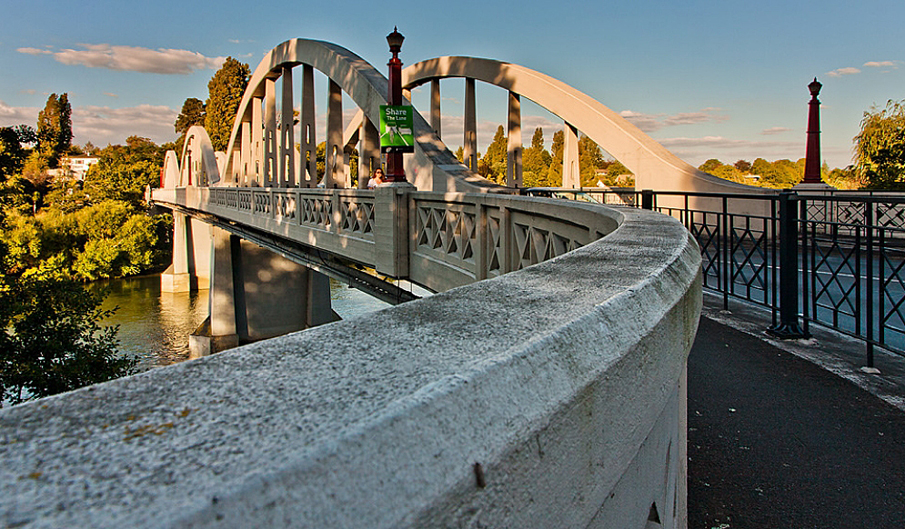
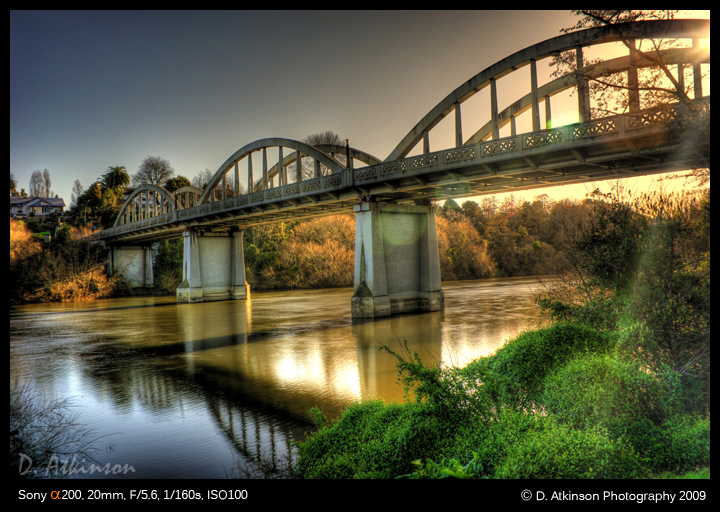
The bridge was built with three bowstring arches and a pierced balustrade of geometric style. Its main technological achievement lay in the central span of 39.6 m (130 feet), which was considered the largest in New Zealand for this form of concrete structure when the bridge was opened. Elegant piers enhanced its modern appearance, as did Art Deco lamp standards between each arch. The structure was designed by the Auckland-based firm of Jones and Adams, pioneer exponents of concrete bridges in the region. Bowstring structures using concrete had been introduced to New Zealand in 1917, but were not popularly adopted until the mid 1930s. Still in regular use, the bridge was registered as a Historic Place in 1990, after which an extensive conservation programme was carried out.
Fairfield Bridge is nationally significant for being at the forefront of using concrete technology to construct bowstring bridges. It is one of the best preserved of these structures from their 'golden age' in the 1930s. Visually, it has been considered the epitome of concrete bowstring bridge design in New Zealand, and is important for its incorporation of Art Deco style. The structure is historically valuable for its links with suburban growth and road transport in the years before the Second World War, having played a considerable role in the expansion of Hamilton. Its national and regional importance are attested to by its association with New Zealand's first Labour government and the engineering firm of Jones and Adams. It is a prominent local landmark enhanced by its river setting and the presence of Art Deco housing at both ends of the bridge. It has additional value for its association with other historic structures along the Waikato River, including Victoria Bridge in central Hamilton.


List Entry Information
Status
Listed
List Entry Status
Historic Place Category 1
Access
Able to Visit
List Number
4161
Date Entered
30th August 1990
Date of Effect
30th August 1990
City/District Council
Hamilton City
Region
Waikato Region
Status
Listed
List Entry Status
Historic Place Category 1
Access
Able to Visit
List Number
4161
Date Entered
30th August 1990
Date of Effect
30th August 1990
City/District Council
Hamilton City
Region
Waikato Region
Why is this place significant?
Historic Significance
Historical Significance or Value The Fairfield Bridge provided more direct access to the commercial centre of Hamilton and to the Frankton area for the residents of the developing northern section of the borough, and for the people of the adjacent farming areas of Waipa and Waikato Counties. In doing so it stimulated further development of the town north-easterly into the country areas.
Physical Significance
ARCHITECTURAL QUALITY: Sited well away from commercial development, the Fairfield Bridge can be readily appreciated in its uncluttered environment. It is noteworthy for the refinement seen in the gentle transition of the bowstring curve at the bases of adjoining trusses. This aesthetic appreciation is also seen in the walkways on the west side where they have attractively curved balustrades. As with earlier bridges by Adams and Jones in the 1920s the balustrades are pierced, in this instance in a geometric pattern whereas the others have a floriated form. The Fairfield Bridge illustrates design confidence with refinement. TOWNSCAPE/LANDMARK VALUE: The Fairfield Bridge has considerable landscape value, especially when viewed from the riverside walkways.
Why is this place significant?
Historic Significance
Historical Significance or Value The Fairfield Bridge provided more direct access to the commercial centre of Hamilton and to the Frankton area for the residents of the developing northern section of the borough, and for the people of the adjacent farming areas of Waipa and Waikato Counties. In doing so it stimulated further development of the town north-easterly into the country areas.
Physical Significance
ARCHITECTURAL QUALITY: Sited well away from commercial development, the Fairfield Bridge can be readily appreciated in its uncluttered environment. It is noteworthy for the refinement seen in the gentle transition of the bowstring curve at the bases of adjoining trusses. This aesthetic appreciation is also seen in the walkways on the west side where they have attractively curved balustrades. As with earlier bridges by Adams and Jones in the 1920s the balustrades are pierced, in this instance in a geometric pattern whereas the others have a floriated form. The Fairfield Bridge illustrates design confidence with refinement. TOWNSCAPE/LANDMARK VALUE: The Fairfield Bridge has considerable landscape value, especially when viewed from the riverside walkways.
Construction Professional
Name
Jones, Stanley W.
Type
Engineer
Biography
Stanley Jones of Jones and Adams, Auckland based consulting engineers, was a notable exponent of early reinforced concrete design and construction in the Auckland Province. The firm was responsible for some well known structures including the Horotinu bridge over the Waikato (1921), Te Aroha bridge (1926), Ngamuawahine River bridge (1930) and in 1933 the Tuakau bridge over the Waikato River prior to the Fairfield bridge. Jones may well have been the first to use the pierced concrete balustrade instead of the heavy solid forms prevalent in early construction. His firm was the predecessor of KRTA, one of New Zealand's largest consultants.
Construction Details
Start Year
1934
Finish Year
1937
Type
Original Construction
Start Year
1992
Finish Year
1993
Type
Modification
Description
Modifications to light standards, replacement of some balustrades and concrete re-coating
Construction Materials
Reinforced concrete abutments, piers, deck, bowstring arch trusses and girder spans.
Notable Features
Registration covers the structure, its fixtures and finishes. It also includes recent modifications. The three large bowstring arches and the pierced balustrade.
Construction Professional
Name
Jones, Stanley W.
Type
Engineer
Biography
Stanley Jones of Jones and Adams, Auckland based consulting engineers, was a notable exponent of early reinforced concrete design and construction in the Auckland Province. The firm was responsible for some well known structures including the Horotinu bridge over the Waikato (1921), Te Aroha bridge (1926), Ngamuawahine River bridge (1930) and in 1933 the Tuakau bridge over the Waikato River prior to the Fairfield bridge. Jones may well have been the first to use the pierced concrete balustrade instead of the heavy solid forms prevalent in early construction. His firm was the predecessor of KRTA, one of New Zealand's largest consultants.
Construction Details
Start Year
1934
Finish Year
1937
Type
Original Construction
Start Year
1992
Finish Year
1993
Type
Modification
Description
Modifications to light standards, replacement of some balustrades and concrete re-coating
Construction Materials
Reinforced concrete abutments, piers, deck, bowstring arch trusses and girder spans.
Notable Features
Registration covers the structure, its fixtures and finishes. It also includes recent modifications. The three large bowstring arches and the pierced balustrade.
DESCRIPTION: The first bowstring arch bridge of reinforced concrete in New Zealand was opened in Blenheim in 1917. This form of bridge was popular with French and American engineers, in USA it was known as the rainbow arch. The single bowstring arch Westshore bridge at Napier was built in 1918 and then a spate of designs appeared in the 1930s. Jones and Adams designed the Tuskan Bridge (1933). In the following year the Balclutha Bridge was opened and in 1935 the Fitzherbert Bridge at Palmerston North. Two small single span bridges were built in 1935 over the Makarau River, north of Helensville and in 1937 in the Tangahoe Valley, Taranaki. Some of these had lateral ties between the bowstring arches but the Fairfield Bridge does not. With the expansion northwards of Hamilton city during the first three decades of the century, and with increasing traffic levels, replacement of the 1910 traffic bridge over the Waikato became necessary. As the chosen site lay outside of the then borough boundary, the work was carried out under the supervision of the Waikato County Council, with costs being contributed by the Hamilton Borough Council, Waipa County Council and the Public Works Department. The bridge was opened in March 1937 by the Hon. R. Semple, Minister of Public Works.
ARCHITECTURAL DESCRIPTION: The Fairfield Bridge over the Waikato River is a reinforced concrete arch structure having bowstring trusses. It is 139 metres overall with three 39 metres bowstring arches and a short land span at both ends. Piers, abutments, deck and balustrades are also of reinforced concrete. Pedestrian access is provided on both sides of the carriageway on the outside of the trusses. MODIFICATIONS: None, although there is some cracking and deterioration of the concrete.
Historical and Associated Iwi / Hapū / Whānau
Completion Date
21st November 2001
Report Written By
Martin Jones
Information Sources
Gibbons, 1977
P.J. Gibbons, Astride the River: A History of Hamilton, Christchurch, 1977
New Zealand Historic Places Trust (NZHPT)
New Zealand Historic Places Trust
Journal of the New Zealand Institute of Architects
The Journal of The New Zealand Institute of Architects
Thornton, 2001
Geoffrey Thornton, Bridging the Gap, Early Bridges in New Zealand 1830-1939, Auckland, 2001
Thornton, 1996
Geoffrey Thornton, Cast in Concrete: Concrete Construction in New Zealand 1850-1939, Auckland, 1996
Waikato Museum of Art & History
Waikato Times
Murray, 1918
G T Murray. 1918 - 'The Waikato River' in Proceedings of the New Zealand Society of Engineers,
Other Information
This historic place was registered under the Historic Places Act 1980. This report includes the text from the original Building Classification Committee report considered by the NZHPT Board at the time of registration. The Fairfield Bridge was the winner of the Enduring Concrete Award for 2012. Please note that entry on the New Zealand Heritage List/Rarangi Korero identifies only the heritage values of the property concerned, and should not be construed as advice on the state of the property, or as a comment of its soundness or safety, including in regard to earthquake risk, safety in the event of fire, or insanitary conditions.
Historical and Associated Iwi / Hapū / Whānau
Completion Date
21st November 2001
Report Written By
Martin Jones
Information Sources
Gibbons, 1977
P.J. Gibbons, Astride the River: A History of Hamilton, Christchurch, 1977
New Zealand Historic Places Trust (NZHPT)
New Zealand Historic Places Trust
Journal of the New Zealand Institute of Architects
The Journal of The New Zealand Institute of Architects
Thornton, 2001
Geoffrey Thornton, Bridging the Gap, Early Bridges in New Zealand 1830-1939, Auckland, 2001
Thornton, 1996
Geoffrey Thornton, Cast in Concrete: Concrete Construction in New Zealand 1850-1939, Auckland, 1996
Waikato Museum of Art & History
Waikato Times
Murray, 1918
G T Murray. 1918 - 'The Waikato River' in Proceedings of the New Zealand Society of Engineers,
Other Information
This historic place was registered under the Historic Places Act 1980. This report includes the text from the original Building Classification Committee report considered by the NZHPT Board at the time of registration. The Fairfield Bridge was the winner of the Enduring Concrete Award for 2012. Please note that entry on the New Zealand Heritage List/Rarangi Korero identifies only the heritage values of the property concerned, and should not be construed as advice on the state of the property, or as a comment of its soundness or safety, including in regard to earthquake risk, safety in the event of fire, or insanitary conditions.
Current Usages
Uses: Transport
Specific Usage: Bridge/ Viaduct
Current Usages
Uses: Transport
Specific Usage: Bridge/ Viaduct
Location
Related listings
Stay up to date with Heritage this month