

Huntly was established as a militia settlement after the conclusion of the Waikato War (1863-64), during which it had been used as a military outpost. Previously the area was known as Rahui Pokeka by local Maori and used for convenient river access. The colonial settlement expanded as an industrial centre with the discovery of coal in 1875, which led to the creation of Taupiri Coal Mines Limited in 1899. Amalgamating earlier mining businesses in the Huntly coalfield, the company was a major local enterprise employing some 170 individuals. Smith House was built on land subdivided by the company, forming one of multiple lots which they sold to address demand for housing in the growing settlement between 1901 and 1921. These lots were purchased by mine workers and other local citizens.
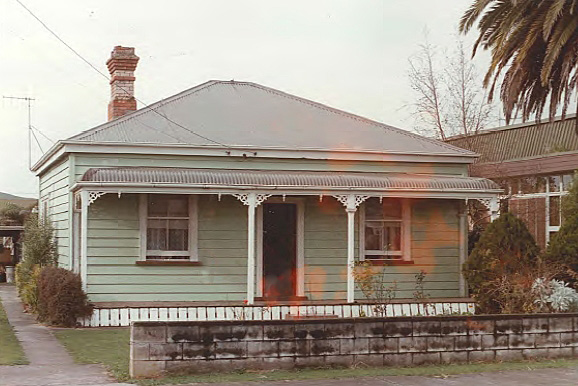
The first owner of the William Street property, James Smith, was a miner and likely built Smith House shortly after purchase in 1905. Consisting of a detached timber dwelling with a hipped roof and symmetrical frontage, the house incorporated ornate features that included a brick chimney of Huntly brick – another of the settlement’s main industrial products. Perhaps reflecting the property’s relatively desirable nature, successive owners in 1907 and 1910 were both from engineering families. Like many emigrant miners the latter owner, Thomas Cummack, had worked in the mines in Scotland before coming to New Zealand with his wife, Jane. In 1915, their son, John Cummack, was exempted from service in the First World War (1914-18) due to his position in the coal mines, although he did serve overseas from 1917. After returning to mining, John was accidentally killed in 1922. In 1930, the property was inherited by Thomas and Jane Cummack’s son-in-law, Hector Dick, who in 1917 had been tried and acquitted of industrial action in the mines. Dick worked in the local mines until retirement.
Following Dick’s death in 1961 the house passed to his wife, Margaret, who evidently made some internal alterations. The Huntly Workingmen’s Club, which occupied adjoining premises, bought the property in 1982. The house was rented as a private residence until 2009 when it was sold to a private owner. An extension was added to the back and further interior alterations were planned. In 2016, the house remained a private residence.
List Entry Information
Status
Listed
List Entry Status
Historic Place Category 2
Access
Private/No Public Access
List Number
4217
Date Entered
5th September 1985
Date of Effect
5th September 1985
City/District Council
Waikato District
Region
Waikato Region
Extent of List Entry
Extent includes the land described as Lot 13 DP 1188 (RT SA127/127), South Auckland Land District, and the building known as Smith House thereon.
Legal description
Lot 13 DP 1188 (RT SA127/127), South Auckland Land District
Status
Listed
List Entry Status
Historic Place Category 2
Access
Private/No Public Access
List Number
4217
Date Entered
5th September 1985
Date of Effect
5th September 1985
City/District Council
Waikato District
Region
Waikato Region
Extent of List Entry
Extent includes the land described as Lot 13 DP 1188 (RT SA127/127), South Auckland Land District, and the building known as Smith House thereon.
Legal description
Lot 13 DP 1188 (RT SA127/127), South Auckland Land District
Construction Details
Type
Modification
Description
Interior alterations
Period
1960s
Start Year
2009
startYearCirca
Type
Addition
Description
Rear extension added
Start Year
1905
startYearCirca
Type
Original Construction
Construction Details
Type
Modification
Description
Interior alterations
Period
1960s
Start Year
2009
startYearCirca
Type
Addition
Description
Rear extension added
Start Year
1905
startYearCirca
Type
Original Construction
Historical and Associated Iwi / Hapū / Whānau
Completion Date
9th March 2017
Report Written By
Alexandra Foster
Information Sources
Richardson, 1995
Len Richardson, Coal, Class and Community: The United Mineworkers of New Zealand, 1880-1960, Auckland, 1995
Te Ara - The Encyclopedia of New Zealand
www.TeAra.govt.nz
Other Information
This place was identified as significant under previous legislation with different information requirements. It remains significant under the current legislation. There is opportunity under our legislation and policies to add to this information. Further information about this place may be available from the Lower Northern Office of Heritage New Zealand Pouhere Taonga. Please note that entry on the New Zealand Heritage List/Rarangi Korero identifies only the heritage values of the property concerned, and should not be construed as advice on the state of the property, or as a comment of its soundness or safety, including in regard to earthquake risk, safety in the event of fire, or insanitary conditions. A fully referenced upgrade report is available on request from the Northern Region Office of Heritage New Zealand.
Historical and Associated Iwi / Hapū / Whānau
Completion Date
9th March 2017
Report Written By
Alexandra Foster
Information Sources
Richardson, 1995
Len Richardson, Coal, Class and Community: The United Mineworkers of New Zealand, 1880-1960, Auckland, 1995
Te Ara - The Encyclopedia of New Zealand
www.TeAra.govt.nz
Other Information
This place was identified as significant under previous legislation with different information requirements. It remains significant under the current legislation. There is opportunity under our legislation and policies to add to this information. Further information about this place may be available from the Lower Northern Office of Heritage New Zealand Pouhere Taonga. Please note that entry on the New Zealand Heritage List/Rarangi Korero identifies only the heritage values of the property concerned, and should not be construed as advice on the state of the property, or as a comment of its soundness or safety, including in regard to earthquake risk, safety in the event of fire, or insanitary conditions. A fully referenced upgrade report is available on request from the Northern Region Office of Heritage New Zealand.
Current Usages
Uses: Accommodation
Specific Usage: House
Former Usages
General Usage: Accommodation
Specific Usage: House
Current Usages
Uses: Accommodation
Specific Usage: House
Former Usages
General Usage: Accommodation
Specific Usage: House
Location
Sign up to hear more
Get the latest heritage news, features and events delivered
straight to your inbox.
