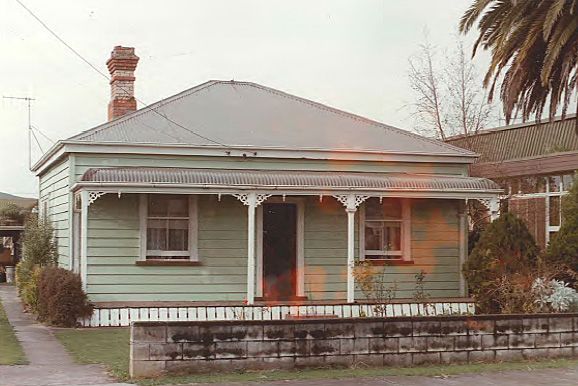
Smith House, constructed c.1905, is a visually well preserved, square-fronted villa which was evidently built by Huntly miner James Smith. The single-storey timber dwelling reflects close connections between the local coal mining industry and Huntly’s residential expansion in the early twentieth century. Smith House particularly demonstrates changing housing options for some mine workers at this time. The house was built on land which Taupiri Coal Mines Limited sold at auction for private housing, allowing workers some opportunity to own their own houses as opposed to being restricted to renting from the mine company. Smith House subsequently retained strong links to the Huntly mining industry, being occupied continuously by mine workers and their families for over 75 years. Smith House has historical significance in this long association with mining families since its construction as well as reflecting the development of Huntly as a township around the growing mining industry in the area and the needs of the local community.
Huntly was established as a militia settlement after the conclusion of the Waikato War (1863-64), during which it had been used as a military outpost. Previously the area was known as Rahui Pokeka by local Maori and used for convenient river access. The colonial settlement expanded as an industrial centre with the discovery of coal in 1875, which led to the creation of Taupiri Coal Mines Limited in 1899. Amalgamating earlier mining businesses in the Huntly coalfield, the company was a major local enterprise employing some 170 individuals. Smith House was built on land subdivided by the company, forming one of multiple lots which they sold to address demand for housing in the growing settlement between 1901 and 1921. These lots were purchased by mine workers and other local citizens.
The first owner of the William Street property, James Smith, was a miner and likely built Smith House shortly after purchase in 1905. Consisting of a detached timber dwelling with a hipped roof and symmetrical frontage, the house incorporated ornate features that included a brick chimney of Huntly brick – another of the settlement’s main industrial products. Perhaps reflecting the property’s relatively desirable nature, successive owners in 1907 and 1910 were both from engineering families. Like many emigrant miners the latter owner, Thomas Cummack, had worked in the mines in Scotland before coming to New Zealand with his wife, Jane. In 1915, their son, John Cummack, was exempted from service in the First World War (1914-18) due to his position in the coal mines, although he did serve overseas from 1917. After returning to mining, John was accidentally killed in 1922. In 1930, the property was inherited by Thomas and Jane Cummack’s son-in-law, Hector Dick, who in 1917 had been tried and acquitted of industrial action in the mines. Dick worked in the local mines until retirement.
Following Dick’s death in 1961 the house passed to his wife, Margaret, who evidently made some internal alterations. The Huntly Workingmen’s Club, which occupied adjoining premises, bought the property in 1982. The house was rented as a private residence until 2009 when it was sold to a private owner. An extension was added to the back and further interior alterations were planned. In 2016, the house remained a private residence.