Kohukohu
The Polynesian explorer Kupe returned to Hawaiki on his canoe Matawhaorua from Hokianga, providing one possible explanation for the name of the harbour, from the full name Te Hokianga-nui--a-Kupe, the great returning place of Kupe. In preparation for the return voyage his people made a hangi on the harbour shore, but they opened the oven before the food was cooked, and the food was cold. Kupe cursed them, and this place was named Kohukohu ('curse'). 'Place of mist' is another explanation of the name.
Nukutawhiti re-adzed Kupe's canoe, which accordingly was renamed Ngatokimatawhaorua, and in company with Ruanui in the canoe Mamari sailed to New Zealand. The descendants of Nukutawhiti are Ngapuhi, while Ruanui's descendants are Te Rarawa and Te Aupouri. Te Rarawa occupied the northern side of the lower Hokianga, and land further north, while Ngapuhi occupied the southern side of the harbour, and expanded to the east. Whiria pa near Omapere was the birthplace of Rahiri, from whom Ngapuhi trace their descent.
The first Pakeha to visit Hokianga were the missionaries Thomas Kendall and John King, who came overland from the Bay of Islands in June and July 1819. Lee comments that the only identifiable places they described are on the southern side of the harbour, which were more accessible than the settlements on the Kohukohu side of the harbour, and thus attracted more attention. 'Kohukohu gained prominence only after its occupation by Europeans'.
The first Pakeha settler at Kohukohu was Captain David Clark, who bought a small parcel of land from Wharepapa of Te Ihutai hapu in 1830, after the shipyard at Horeke which he managed was sold to Thomas McDonnell by its owners Raine and Ramsay. Clark drowned in 1831.
Frederick Edward Maning, an Irishman who had arrived in the Hokianga via Tasmania in 1833, bought Clark's land from Wharepapa in 1834. In quick succession Maning sold the land in 1837 to Dr Ross, who sold it to the Wesleyan missionary Nathaniel Turner, who sold it in 1839 to George Frederick Russell.
George Frederick Russell came from Sydney in 1830 to manage the shipyard at Horeke, a successor to Captain Clark. Russell bought Turner's land in June 1839, established trading station in opposition to McDonnell who owned Horeke. Russell's business at Kohukohu soon eclipsed the Horeke business, and Kohukohu went on to achieve considerable prominence as the principal town of the Hokianga.
Russell built the house in Kohukohu shown in Heaphy's painting of December 1839, and later Jolliffe's drawing of 1851. After his death in 1855 the house passed to his son-in law John Webster, then was sold in 1874 to Andrew C Yarborough. George Russell was a Pakeha witness to the Treaty signing at Mangungu on 12 February 1840.
Andrew Cooke Yarborough came to Hokianga in 1871, and in 1873 set up a partnership in trading stores with Alfred Spry Andrewes. Yarborough's son and his daughter (who was later to become Andrewes' daughter-in-law) were later pupils at the Kohukohu School in the first decade of its operation. In 1874 Yarborough moved to Kohukohu and bought out Webster. Yarborough and Andrewes came to have substantial stores in several Hokianga towns.
From the 1870s onward, Rawene on the southern side of the harbour gradually developed as the administrative and juridical centre for the Hokianga, becoming the county town after the passing of the Counties Act 1876. However, Kohukohu continued to make substantial progress economically, and the two towns were to be rivals on either side of the harbour for some time to come.
The first hotel in Kohukohu opened in 1882, as the facilities of the town expanded. In 1881 Yarborough and Andrewes took over the timber mill that had been established at Kohukohu in 1879 by Greenfield and Stewart of Sydney, operated as the Hokianga Sawmill Ltd. The depression of the 1880s created hard times - the mill closed in 1886, but only briefly. In 1888 a group of Melbourne financiers bought out most of the surviving kauri mills in New Zealand, including Kohukohu, and formed the Kauri Timber Company, which became the dominant player in the industry from that time on. With the mill back in full production, Kohukohu experienced a growth in population, employment and town facilities. 1907 was the peak year for production and export of kauri timber, after which a steady decline set in.
The Kauri Timber Company's Kohukohu Mill closed down in 1909, and was demolished in 1912. Many of the surviving kauri buildings in Kohukohu were built at that boom time from 1890 onwards. But prosperity continued. Kohukohu historian Eric Harrison has written:
Kohukohu had grown from a village of perhaps fifty people in 1870, into the major commercial centre of the harbour, with over six hundred people in 1910. Kohukohu was built on the timber trade, but when the mill pulled out, it grew fat on butter. A new and more reliable industry was replacing the timber. The Hokianga Co-operative Dairy Factory opened its factory at Motukaraka in 1908. Hokianga now had two legs to stand on.
The mills processed not just kauri but also kahikatea, puriri and tōtara. In a succession that was followed in many parts of the North, the land that had been cleared of its timber was converted to growing cows. The Hokianga Cooperative Dairy Company was established at Motukaraka in 1908. To export butter, it had to be packed in containers that would not taint it on its long sea voyage to London. Kahikatea was found to be an ideal timber for butter boxes. So King's mill opened in 1924 on the former Kauri Timber Company mill site making kahikatea butter boxes for Northland dairy companies, and others elsewhere.
Kohukohu suffered significant losses of its young men in World War One. It suffered significant losses of its commercial buildings in major fires in 1922, 1937, 1954 and 1967. Eric Harrison wrote:
Kohukohu was in decline, a trend that was not reversed until the early 1970s. Several businesses had closed down even before the dairy factory closed in 1957. Most of the younger people were leaving town. Kohukohu was becoming a place for middle aged and elderly folk.
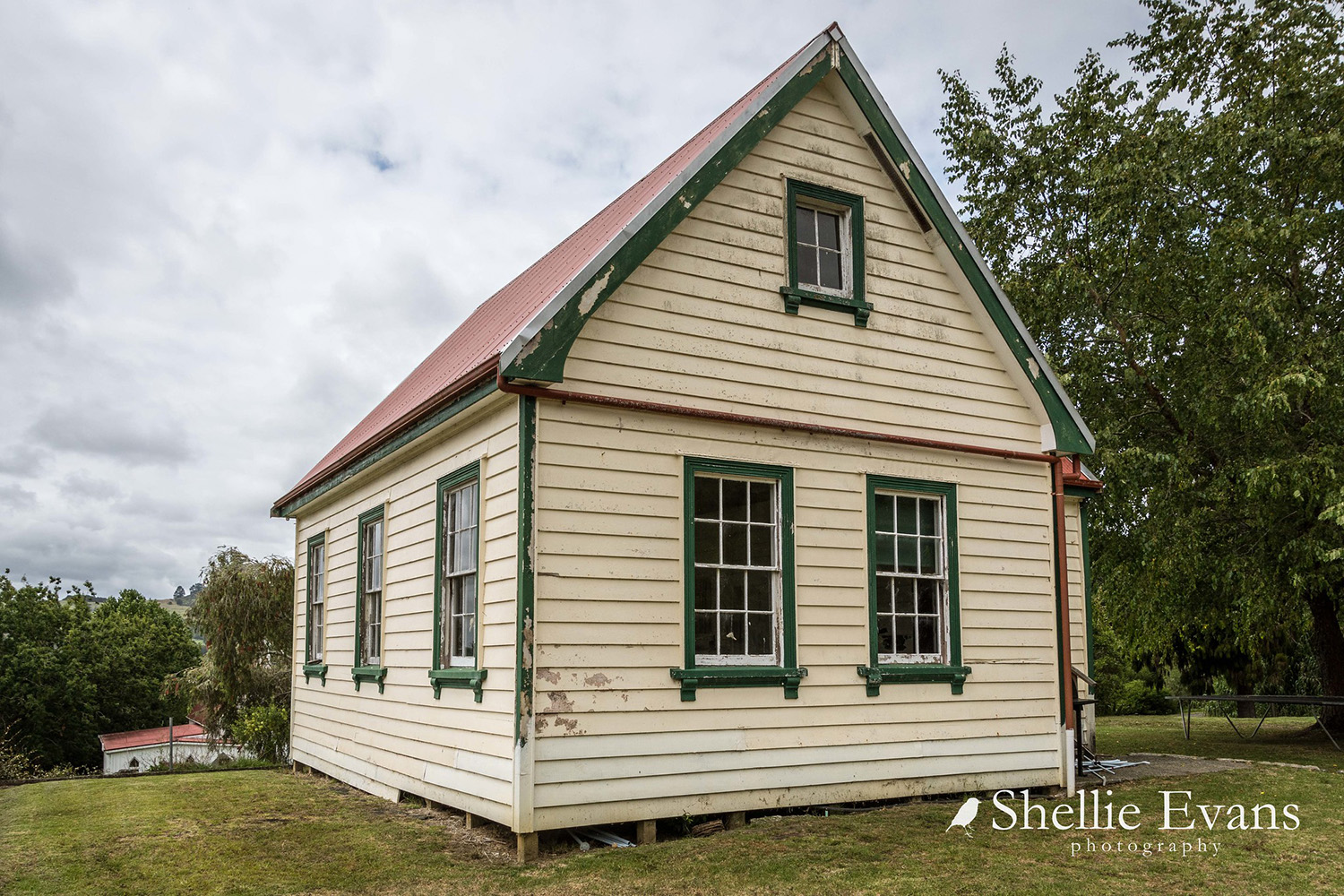
Kohukohu School
From about 1874, a Maori ('Native') school was the only school in Kohukohu. It was situated at Rakaupara, at the southern end of Yarborough Street. The Education Act 1877 provided for free, secular, and compulsory education for all children aged between seven and 13, with Maori children given the option of attending either state or native schools. Pakeha children usually attended Native schools until their numbers justified the building of a state school. When Kohukohu School opened, three quarters of the pupils had previously been attending the Rakaupara Native School. Presumably for this reason, Rakaupara School closed in the 1880s.
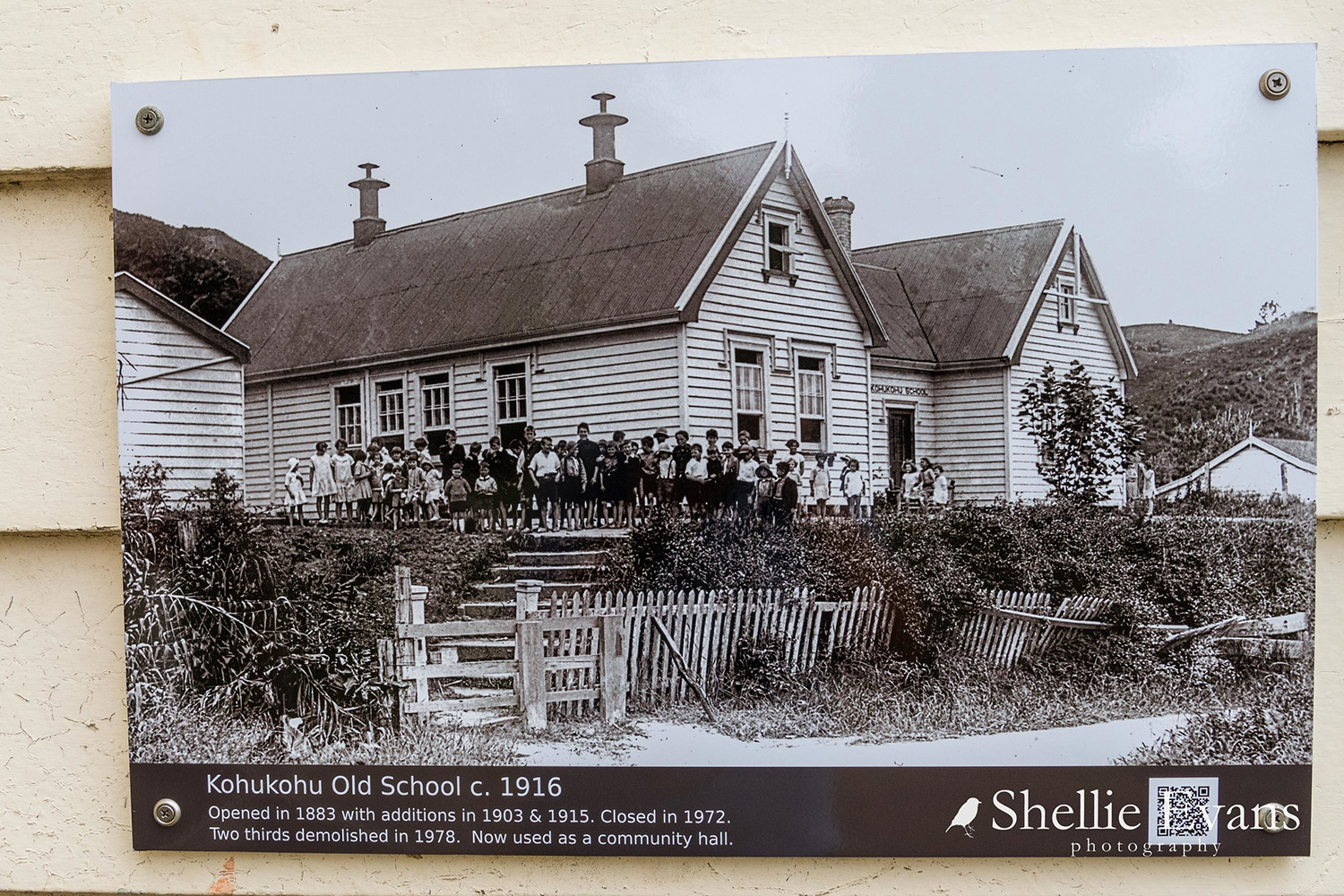
Kohukohu School opened on 20 April 1881 with sixteen pupils, and two more who enrolled the following day. Until the building was erected, the school met in temporary premises. The first school building was opened in 1883, on a site purchased three years earlier. The school had a shingle roof over its one large room with an entrance porch. The area was 928 square feet (86 square metres), which was said to be sufficient for up to 60 pupils. As the roll grew, the porch was extended, perhaps twice, in the 1890s. By 1902, the average attendance at the school was 86 pupils, but it was estimated that there were 112 school age children within three miles of the school. Accordingly, the Auckland Education Board applied to the Government for a grant to build another classroom at the school. The request sought £278, which as well as the classroom itself included provision for 30 desks, 10 forms, a bookpress, blackboards, easels, tables and chairs.
The Government's first response was to ask if the school could avoid the expense. It was suggested a partition might enable the space, designed for 60 pupils, to accommodate its 90 pupils. The Education Board's response to this suggestion was to build the new classroom anyway, so that when the Government indicated it was prepared to make the allocation, the additional classroom had already been built.
By 1914, the school roll had again increased substantially, reaching 139. 48 pupils from Standards 3 to 7 were taught in one classroom, while 63 primers were taught in the other. 28 pupils from Standards 1 and 2 were taught permanently in the porch. By August 1915, an extra room of 500 square feet (46 square metres) had been built, together with an extension to the porch of 150 square feet (14 square metres), a small store room, a shelter shed and additional outbuildings. As school historian Eric Harrison has commented 'Kohukohu was never cramped for room space again'.
However, while classroom space was not a problem again, space on the site certainly was. The location for the school had been selected and the school built on a small site on a steep hillside, before playgrounds were considered a relevant aspect of a school. The total cost of building the school had been about £800, but many thousands were subsequently to be spent trying to stabilise the site.
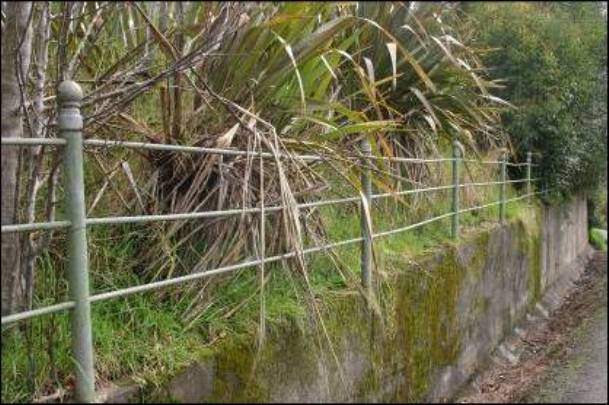
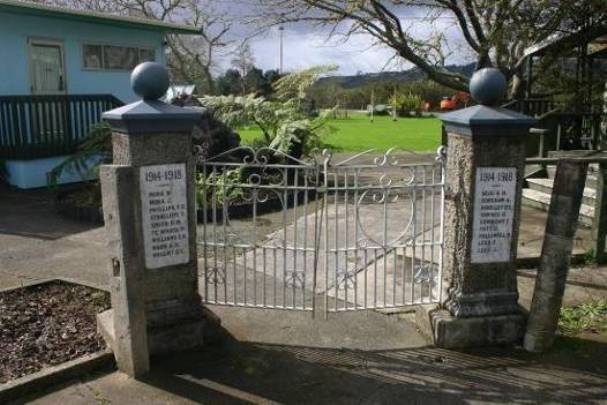
Parents began urging the necessity for improvements to the grounds. In August 1919 the school made application to the Education Board for a 1:1 subsidy on voluntary contributions raised at a concert, a dance and through sports subscriptions, to the value of £10. Sketch plans dated 12 December 1919 of 'Proposed Improvements at Kohukohu School' outline proposals to excavate the bank at the rear of the school, provide drainage, relocate a toilet, and provide a concrete wall along the Yarborough St frontage, surmounted by a fence. Contrasting sketches of the situation 'as it is now' and 'as it is proposed to be when built up' show a concrete retaining wall replacing an earth bank and wooden shuttering, with a fence with four rails on top of the concrete wall. What is probably a representation of the wooden gate shown in a 1920 photo ('as it is now') is replaced by a more elaborate single gate, with round balls on top of the gate posts. This has a resemblance to the War Memorial gate, but does not seem to show the War Memorial gate, which must have been a later idea. Records do not indicate whether this work was approved, or when it was implemented, but a distant photo of about 1928 indicates that the work had probably been carried out by that time.
Movement of the hillside site caused problems both for the grounds and for the building. The first retaining wall, built in the 1920s, was already too late. By 1936, the asphalt was broken and had sunk in parts, with other parts pushed upwards by pressure from the hillside behind. By 1937 the school was unsuitable in several respects. Only two rooms were being used of what was described as a 'rambling old structure of three large rooms and two large porches'. Since the school was seen as certain to remain a two teacher school for the foreseeable future, it was suggested that it should be remodelled as a compact two-roomed school. Plans were drawn up to demolish the original 1883 building and half the porch, to build a staffroom and do essential maintenance.
However, in summer 1938, the school at Rawhia further inland on the Waihou River closed. Because it was much closer by water than by road, the remaining pupils from Rawhia were ferried to Kohukohu to attend school. This meant the third classroom was needed again, and it was decided not to proceed with the demolition. Instead, money was spent enlarging the playing grounds. The school was seen to be in urgent need of repair, with sinking foundations and undulating floors. The school committee proposed that the building should be restored, or a new school built in a more suitable location. Nothing was done.
A school dental clinic was erected in 1946, and in 1950 a 10,000 gallon (45,000 litre) septic tank was installed, with the effluent piped 300 yards (275 metres) out into the harbour. The quick action of a newspaper delivery boy prevented the school from burning down early one morning in October 1958. His swift action with a bucket extinguished the fire before it could do too much damage. It is suggested many in the community would have preferred that it had been left to burn down.
In 1959, in spite of strong local advice, the Education Board bulldozed a new playing ground at the rear of the school. An enormous landslide resulted, filling the grounds with soil, trees and mud, and causing a substantial clean-up bill. In May 1962 serious flooding eroded the playing fields and damaged the drains. The floor level subsided some three inches (7.5 centimetres), so that various doors would not open (or close). In 1964, further ground stabilisation work was required.
In 1966 it was decided to celebrate the 85th Jubilee of the school. It was completely painted, ceilings were installed to improve the heating, and the school was given a general 'spruce-up'. Over Labour Weekend 1966, some 600 people came from all over New Zealand to celebrate the event. Among those attending were 85 year old former Hokianga County and Hokianga Harbour Board Chairman Mr A G C Yarborough, who entered the school in 1884, almost at its inception, and his sister Mrs Mabel Andrewes, who enrolled in 1890. A total of nine pupils from the school's first decade attended.
Between 1940 and 1969, there was protracted and continual lobbying to get agreement on a new school in Kohukohu. In 1969, as the Board appeared ready to renege on an agreed new school, a successful media campaign was mounted to embarrass the Education Board into action. Attention was drawn to the subsiding ground which constantly broke the drains from the toilets. There were large holes in wall and floors. A marble placed on the teacher's desk would drop to the floor, roll to the other end of the room and disappear from sight down a hole in the floor. The site was tiny, with less than half an acre (0.2 hectare) of playing grounds for up to 80 children. The headmaster described the school as 'a typical 19th century school erected when children were talked at and sport played no part in education'.
Within a month of the campaign, repairs were undertaken, and negotiations started on a site for the new school. The site proposed was the 'Kohukohu Memorial Park', whose World War Two Commemorative wrought iron gates remain in place at the corner of Beach Road and Kohukohu Road. This site had originally been part of the harbour, the location of two timber mills, and consisted mostly of decomposing sawdust. It had to be raised seven feet with earth fill to allow the new school to be built. The new school in Beach Road was officially opened on 16 December 1972.
The future of the old school was the subject of much community discussion, with several worthy uses being suggested for the buildings. However, the instability of the land and the drainage problems meant that offers for the site were not forthcoming. The Department of Lands and Survey offered the school to any group prepared to maintain and use it. When there was no response, the Department let a tender for the demolition of the school in 1977.
At this point, the Kohukohu community decided that it should fight to save at least part of the old school. The Kohukohu Historic Society was formed and it was agreed that the original 1883 building should be retained, with the remaining later buildings being demolished. The kauri from the demolished buildings was incorporated into five new houses in Kohukohu.
The original thought of creating a museum failed to eventuate. By 1981, a different group was formed to use the school as a community facility for a range of purposes: clubrooms, drop-in centre, music practice room, dance venue, yoga and exercise classes and training courses. In 1985, the Minister for Conservation classified the land as an historic reserve, set it aside as an historic reserve and formally appointed the Kohukohu Historic and Arts Society Incorporated to control and manage the reserve under the Reserves Act 1977. This wide range of community uses has continued, with several community groups involved, sometimes informally, in managing the building. Most recently, the Minister revoked the management by the Kohukohu Historic and Arts Society Incorporated and appointed the Kohukohu Conservation and Re-creation Society Incorporated to control and manage the historic reserve.
Iron Railing Fence
Photographic evidence suggests that the original fence around the school was a wooden picket fence. The circa 1920 photograph in the Kohukohu Library shows this particularly well in its dilapidated state at that time, while both the Vic Gurney photograph of about 1890 also in the Kohukohu Library and the Henry Wright photograph of 1894 in the Turnbull Library show it in good condition at those dates, albeit from a distance. There are a number of references in the Education Board files in National Archives to fund-raising for improvements to the school grounds between 1919 and 1924, and these include a 1919 drawing of a pipe fence. This sketch shows four rails in the fence, whereas the fence as built has only three.
In February 1972, the Auckland Education Board's Building Supervisor wrote to the Board listing items at the old Kohukohu School that might be recoverable for reuse. He includes 'Item 9: Ornamental pipe front fence on top of roadside retaining fence (hacksaw off as complete unit and relocate at new school if desired).' Clearly this action did not occur, since the fence remains in place, but the Memorial Gate does appear to have been removed with a hacksaw. However, until very recently no reference had been found in any source, published, photographic or archival, to the World War One Memorial Gate that clearly formed part of this fence, before it was relocated to the present school, presumably in the 1970s. In response to newspaper publicity about this review, Joe Wilson of Taipa, who was a pupil at the school between 1936 and 1940, has produced a photograph his mother Francie Wilson took in 1940 showing the Memorial Gate in its original position.