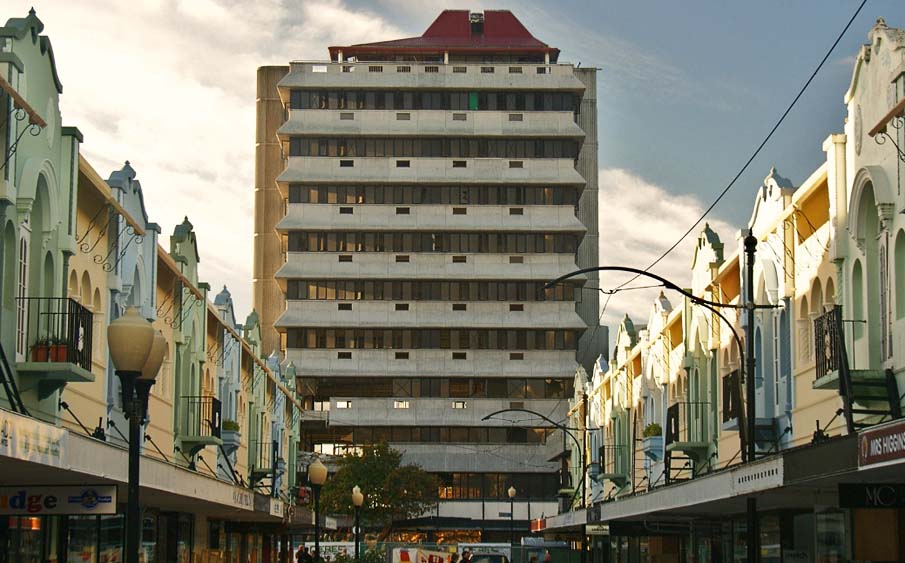
New Regent Street runs between Gloucester and Armagh Streets in central Christchurch and is lined with two terraces of Spanish Mission style shops. The site now covered by New Regent Street and its terraced shops was once the location of the Colosseum, a building designed by Thomas Cane and erected in 1888. This building was first a skating rink, then a boot factory, taxi rank and finally, in 1908, Christchurch's first picture theatre. In 1929 a company, New Regent Street Limited, was formed to develop the site of the Colesseum. The company's architect, Francis Willis, who specialised in the design of movie theatres, decided that the street should be built in the Spanish Mission style. The Spanish Mission style developed in late nineteenth-century California and originally combined indigenous Indian mud brick construction with Spanish motifs. This combination translated successfully into concrete and stucco, and became popular in many countries after World War I. The buildings in New Regent Street feature some of the classic traits of the style, such as the shaped gables, medallions, tiled window hoods, and barley-twist columns.
The street was opened by the mayor of Christchurch on 1 April 1932. Only three of the forty shops were let at that time due to the Depression. The Depression also affected the construction of the street. It was one of the few large scale building projects in the South Island during this period, and many of the construction workers were experienced foremen who could not find other work. Eventually all the shops were let, and then later sold on individual titles. After World War II the street was declared a public road. Now the street is closed to all motor traffic except for trams and the buildings still house a variety of shops and restaurants. While the interiors and the ground floors have been much remodelled, the upper stories remain relatively intact.
New Regent Street is significant as the only commercial street in New Zealand to have been designed as a coherent whole. It is one of the best examples of Spanish Mission style architecture in New Zealand, and as a street made up of small speciality shops it can be read as a forerunner to today's shopping malls. Its distinctive style and colouring makes this street a notable part of central Christchurch's townscape.
The street was opened by the mayor of Christchurch on 1 April 1932. Only three of the forty shops were let at that time due to the Depression. The Depression also affected the construction of the street. It was one of the few large scale building projects in the South Island during this period, and many of the construction workers were experienced foremen who could not find other work. Eventually all the shops were let, and then later sold on individual titles. After World War II the street was declared a public road. Now the street is closed to all motor traffic except for trams and the buildings still house a variety of shops and restaurants. While the interiors and the ground floors have been much remodelled, the upper stories remain relatively intact.
New Regent Street is significant as the only commercial street in New Zealand to have been designed as a coherent whole. It is one of the best examples of Spanish Mission style architecture in New Zealand, and as a street made up of small speciality shops it can be read as a forerunner to today's shopping malls. Its distinctive style and colouring makes this street a notable part of central Christchurch's townscape.
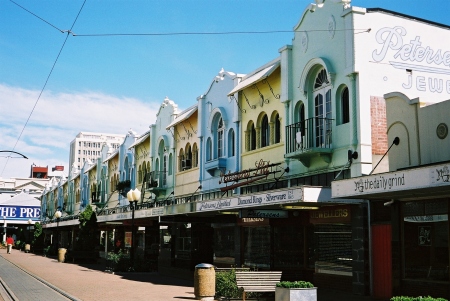
New Regent Street Terrace Shops | Melanie Lovell-Smith | 01/09/2001 | Heritage New Zealand Pouhere Taonga
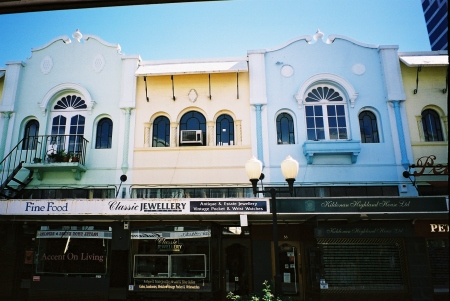
New Regent Street Terrace Shops | Melanie Lovell-Smith | 01/09/2001 | Heritage New Zealand Pouhere Taonga
New Regent Street Terrace Shops. Image courtesy of www.flickr.com | PhilBee NZ - Phil Braithwaite | 25/04/2013 | PhilBee NZ - Phil Braithwaite
New Regent Street Terrace Shops | Melanie Lovell-Smith | 01/09/2001 | Heritage New Zealand Pouhere Taonga
New Regent Street Terrace Shops | Melanie Lovell-Smith | 01/09/2001 | Heritage New Zealand Pouhere Taonga
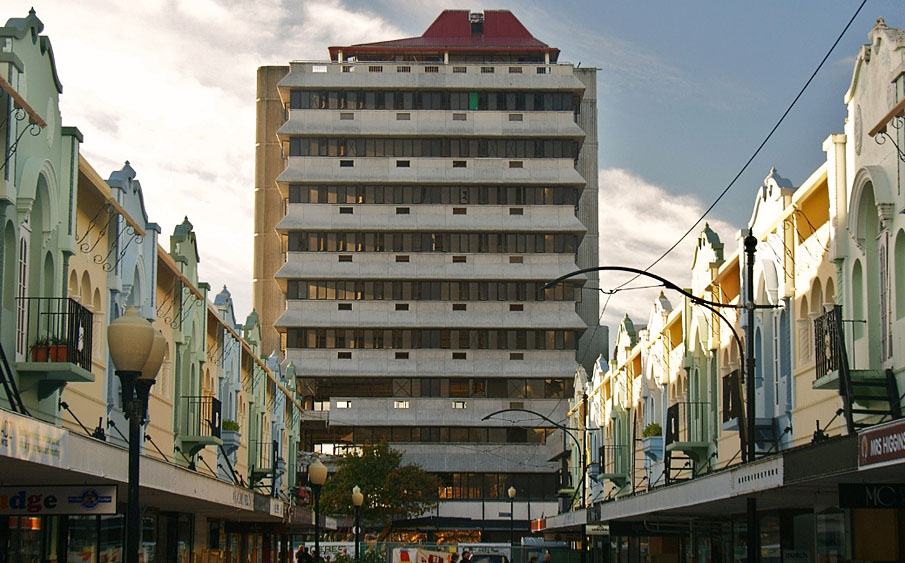
New Regent Street Terrace Shops. Image courtesy of www.flickr.com | PhilBee NZ - Phil Braithwaite | 25/04/2013 | PhilBee NZ - Phil Braithwaite