Early History of Christchurch
Christchurch and the wider area have a long history of Māori occupation. The vast network of wetlands and plains of Kā Pakihi Whakatekateka o Waitaha (Canterbury Plains) is inherently important to the history of its early occupation. The area was rich in food from the forest and waterways. Major awa (river) such as the Rakahuri (Ashley), Waimakariri, Pūharakekenui (Styx) and Rakaia were supplied from the mountain fed aquifers of Kā Tiritiri o te Moana (Southern Alps). Other spring-fed waterways such as the Ōtakaro (Avon) meandered throughout the landscape. The rivers teamed with tuna, kōkopu, kanakana and inaka; the wetlands were a good supply of wading birds and fibres for weaving, food and medicine; with the forest supplying kererū, kokopa, tui and other fauna as well as building materials. Ara tawhito (travelling routes) crossed over the landscape providing annual and seasonal pathways up and down and across the plains and in some cases skirting or traversing the swamps. Permanent pā sites and temporary kāinga were located within and around the Plains as Ngāi Tahu established and used the mahinga kai sites where they gathered and utilised natural resources from the network of springs, waterways, wetlands, grasslands and lowland podocarp forests that abounded along the rivers and estuaries.
Most of the Canterbury region was purchased from Ngāi Tahu by the Crown in 1848. The Canterbury Association oversaw the systematic European settlement of Canterbury and surveyed the town of Christchurch and rural sections outside of the town boundary.
Canterbury Earthquakes 2010-11
The situation with the Canterbury Earthquakes of 2010-11 was summarised by the Canterbury Earthquakes Royal Commission Te Komihana Rūwhenua o Waitaha as follows: ‘On 4 September 2010, at 4:35am, an earthquake of magnitude 7.1 struck Christchurch and the surrounding Canterbury region. The earthquake had an epicentre near Darfield, a small town about 40km west of the Christchurch Central Business District. An aftershock sequence began, which at the time of writing is ongoing. All of the earthquakes were the result of ruptures on faults not known to be active prior to the September event. ….However, many unreinforced masonry buildings were damaged and there was extensive damage to infrastructure. The eastern suburbs of Christchurch and Kaiapoi were seriously affected by liquefaction and lateral spreading of the ground. The September earthquake was followed by four other major earthquakes occurring on Boxing Day 2010, and 22 February, 13 June and 23 December 2011. Of these, the event on 22 February was by far the most serious, resulting in 185 deaths. …’
Severe damage to heritage places caused by the Canterbury earthquakes of 2010 and 2011 has meant unprecedented, rapid loss of items from the New Zealand Heritage List, particularly in Christchurch. Significant historic places have been lost, and many places have been removed from the List.
The Heritage New Zealand response to addressing the high number of formal reviews required in post-quake Canterbury, under Section 78 of the Heritage New Zealand Pouhere Taonga Act 2014, has been to explore efficiencies either by adopting a shortened review format report or to reuse existing authoritative histories where already in existence and permission is given by the author. The latter approach has been adopted for this review report for the Community of the Sacred Name (Former).
Historical Narrative
The following information is taken, with permission, as extracts from the historical background in Calum Maclean’s Conservation Plan for the Community of the Sacred Name Convent, Christchurch, March 2015:
The Canterbury Association, founded 1848, aimed to recreate English rural society in New Zealand. The first [Canterbury Association] immigrants to Canterbury arrived in 1850 … with the Anglican Church at its centre. While these pioneers had earnestly hoped to leave behind the social ills and hardships of Victorian England, the very same concerns developed as the colony grew and there was very little social support to addresses these issues. There was a need to support families and in particular women and children as people found it difficult to cope with no social services. The need for institutions such as hospitals, orphanages and prisons was recognised but the early colony lacked those with the requisite training and experience in these areas. The appointment by the Provincial Government of Rev. Henry Torlesse as chaplain to these institutions in 1864 eventually led to the training of deaconesses for this service. The matter was raised with the Diocesan Synod in 1879 and 1880 when a resolution was passed recognising the importance of service by women. In 1882 the idea found some support from Bishop Harper but at this time the diocese lacked funding and an English trained Deaconess was not available.
Frances Torlesse, Henry’s younger sister, emigrated to New Zealand in 1883 and began working with the Girls’ Friendly Society which offered support for immigrant girls. With support from Bishop Harper, Frances became responsible for the running of St Catherine’s Lodge (established by the Girls’ Friendly Society), the Women’s Refuge (established in 1864) and St Mary’s Home for ‘fallen women’ in Addington. At this time fund raising for an organised deaconess styled response to these social issues began.
Frances wrote to St Andrew’s House, Portsmouth (established 1879) to enquire of the workings of a Sisterhood and the possibility of sending a deaconess to Christchurch. Frances was invited to Portsmouth to experience the working of the Sisterhood and it was here that she met Edith Mellish (later Sister Edith). At Marylebone Infirmary she met Sister Mary Anne Vousden (later Sister Marian) who, with support from Florence Nightingale, returned with Frances to Christchurch along with Rose Godfrey (later Sister Rose). In Christchurch they were joined by Mary Pursey (later Sister Mary) and together carried out the institutional work of the Diocese. In 1892 these women were admitted as probationer Deaconesses.
Churchill Julius was installed as Bishop of Canterbury in 1890 and further promoted the establishment and training of women within the church as an organised group. Julius wrote to St Andrew’s Community requesting if a Deaconess might come to New Zealand. Sister Edith Mellish responded and when Julius visited England in 1893 she returned with him to establish a New Zealand Order of Deaconesses which was instituted by Bishop Julius in 1894. The community of St Andrew’s was a formative influence on the development of the Community of the Sacred Name as it would later become known.
The ordination of Deaconesses by a Bishop was thought to give them legitimacy within the Church of England and was associated with the early Christian Church and the formation of conventual houses of the Middle Ages. As foundress, Sister Edith was instrumental in developing the ethos of the Sisterhood. The Community provided the opportunity for theological study and for training to assist parishes in pastoral and social work and importantly a Sisterhood for those ready to take vows and enter a Religious Order. The Community later changed its constitution to become a Community of Sisters guided by a Superior rather than as Deaconesses under a Bishop.
The founding of an Anglican religious community of women in Christchurch in 1893 came about from three main influences; that greater opportunities for women were sought; the influence of the Oxford Movement within Anglicanism; and the growth of Christian social action. Also, the Community was established in response to the social conditions in a newly established colonial town and key members of that community … who provided impetus and inspiration.
The community was originally known as the Christchurch Deaconesses' Institute and was initially located in Gloucester Street and later in two rented cottages in George Street. One early priority was to establish a suitable building to house the community. Just two months after her arrival in Canterbury, Sister Edith was part of a committee that proposed that architect Benjamin Woolfield Mountfort draw up plans for a Deaconess House for a site which was part of the Bishopric Estate on the corner of Barbadoes and St Asaph Streets.
Mountfort had established himself as one of the foremost architects in Victorian New Zealand, and had designed many fine Gothic Revival buildings, including churches for the Anglican Church. While the initial plans for this building were approved, funding would take time, so Mountfort was asked to provide plans for a temporary cottage on the site for which £400 was raised through private donations, the Eton Harper Memorial Fund and a loan from a Building Society. The Deaconesses moved into the new building on … 18 January 1895 and on 28 February 1895 the house was dedicated. It was at this time that Bishop Julius introduced a bill to the Anglican General Synod to establish an Order of Deaconesses.
Early maps show the site of the new Community was located on the edge of the ‘Original Town Reserve’. Built from timber and clad in corrugated iron, it was planned that this plain one-storey house would later form the laundry and back offices of the future Deaconess' house. The building was described in the Star, 18 April 1895, as a ‘marine residence’ and ‘very unpretentious’. The Star continues: ‘It is a one-storeyed structure of corrugated iron, match-lined, and contains a large living room, a dormitory divided into seven cubicles, a bathroom, a kitchen, an office, and a private Chapel. The walls of the rooms are of plain unvarnished wood, the ceilings of brown paper, and the floors are stained a dark brown, with here and there a strip of matting. The furniture is in keeping with the rooms which contain it, cheap, plain and serviceable. The decorations which redeem the place from utter bareness and ascetic coldness are due to the taste of the occupants rather than to money, which has certainly not been lavished upon them.’
For the dedication, a large tent was erected in the garden and 150 guests attended. The building became known as Deaconess House and the sisters the Sisters of Bethany. At this time there were six women attached to the community.
Community of the Sacred Name 1896, Allan K. Davidson, 'Anglican Church - Social services', Te Ara - the Encyclopedia of New Zealand, http://www.TeAra.govt.nz/en/photograph/27684/community-of-the-sacred-name-christchurch (accessed 16 May 2018)
In 1896 Sybilla E. Maude came to live in the community and it was from the kitchen room (later the Mission Room) that she established her dispensary and initially ran the district nursing scheme that became associated with her. Nurse Maude trained in England and for a time was Matron of Christchurch Hospital. Nurse Maude ‘kept a small dispensary on a few shelves behind the door of the basin room’. Nurse Maude wrote, ‘I first began district nursing from the Deaconess House, where I had the use of a telephone, and the space of a cupboard to keep the necessities of my work.’ Nurse Maude ran the dispensary until her Madras Street building opened. During the influenza epidemic of 1918 Nurse Maude slept at the Community.
Sister Rose was sent to Christchurch Hospital to train as a nurse and it was here that she met Nurse Maude. In 1898, when Sister Rose became Matron of St Mary’s Home, Nurse Maude moved into the Home with her. Nurse Maude remained close to the Community and often visited and attended the Chapel. Sister Rose and Nurse Maude remained lifelong friends, lived together and spent time at the Moncks Spur and Scarborough Hill cottages.
The Community soon required more space and in 1898 the addition which includes what is now the wafer room, study and wood shed was added. This addition originally included a bed-sitting room for Sister Edith who had been using what became the visitor’s bedroom. The wood shed was originally the laundry.
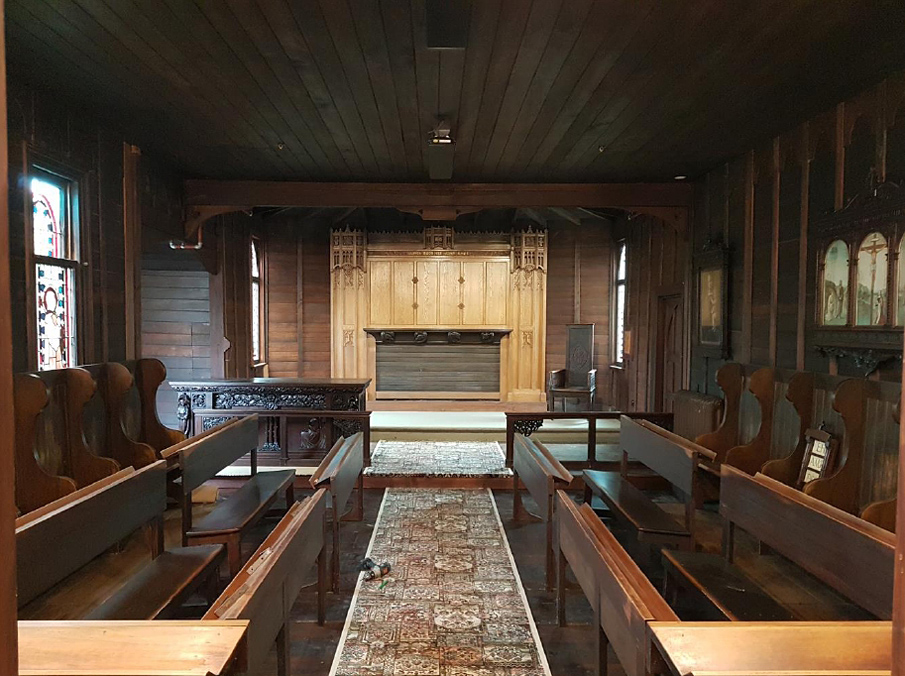
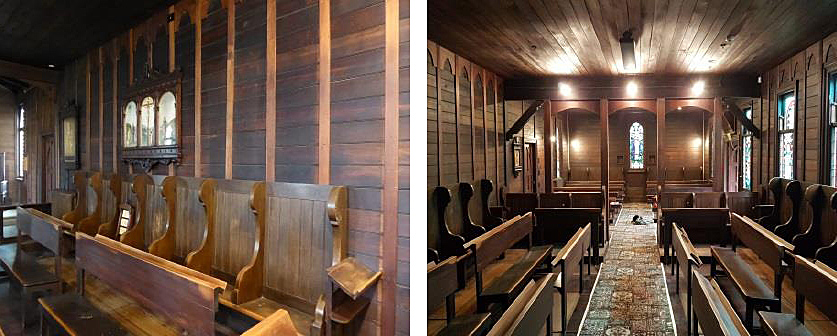
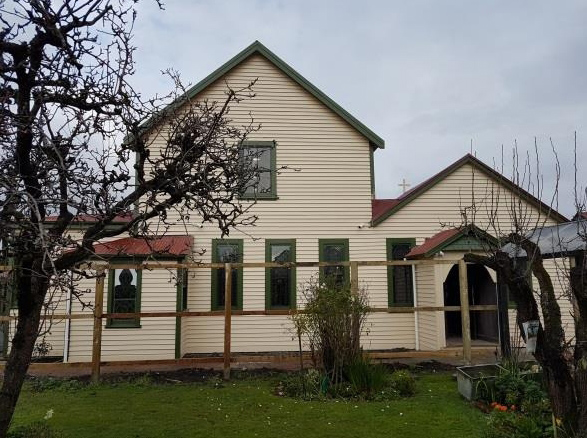
A second larger extension was started 25 January 1900 as more Probationers were admitted to the Community. Designed by C. J. Mountfort, Benjamin's son, it was constructed of rimu weatherboard with an iron roof. It ran perpendicular to the original building and is two storeys high. It included a Chapel, sitting room, eight bedrooms (the landing was later converted to a ninth bedroom) and a bathroom. The extension was dedicated on 27 April 1900. …
In 1905 the Chapel was enlarged to the east. In 1916 the Chapel was further extended (and possibly the vestry added). The brick extension to the Mission Room was also constructed at this time. In 1921 the Chapel was further enlarged by the extension to the west (and possibly to the sanctuary).
Further growth of the Community saw the construction in 1911-12 of a 2 ½ storey brick building on the Barbadoes Street street frontage. This imposing brick Gothic styled building was designed by J.G. Collins from the architectural firm Armson, Collins and Harman and contained bedrooms on the upper floor, sitting rooms, service rooms, offices and a dining room. While ornamentation [was kept] to a minimum, the brickwork had a decorative quality and this was particularly so in the refectory. The building was officially opened on 9 October 1912 as the ‘House of the Sacred Name’. At the time the final building was erected the sisters became known as the Community of the Sacred Name, having been briefly known as the Sisters of Bethany. The brick building was extensively damaged in the Canterbury earthquakes of 2010 and 2011 and later demolished. …
Left: Community of the Sacred Name brick convent building, A McEwan, Dec 1988, Heritage New Zealand
Right: Community of the Sacred Name brick convent building with quake damage, D Margetts, Mar 2011, Heritage New Zealand
As well as providing pastoral care and community initiatives the Community also undertook other work. The making of Holy Communion wafers by the Sisters for the supply to the parishes began in 1911. This enterprise, in time, supplied wafers right across the country and later into the Pacific Islands and provided a modest income to the Community. The sewing of Church embroidery was also important. This highly skilled traditional craft was introduced by Sister Edith and the Community continued to produce finely crafted frontals, priestly vestments, altar linen and banners up until present times. The Sisters have also passed these skills on to members of the general community. This work was undertaken in the Sewing Room (which was once the Dining Room).
The garden setting of the Convent was important for the Community. Importantly it provided a place of solace but also for social gatherings and garden parties and for the supply of produce. Retreats were held for the Community and other groups, ‘those attending always responding to the calm and quiet of the Community and the spiritual atmosphere of the Chapel’. A strong group of supporters, the Companions, have until around 1990 held monthly meetings and attended retreats and prayer sessions at the Community.
A Guild of Help was formed in 1925 with the aim of providing practical support for the Sisters. The Guild organised an annual garden party. Jam was made from the mulberry tree in the Convent garden (which still fruits from an offshoot from the original stump) for the garden parties which served as an annual fund raising event with money raised spent for the benefit of the Sisters. The installation of central heating was one of first projects supported and also an upgraded stove for the kitchen, a new sewing machine and comfortable chairs. ….
Nurse Maude was a key figure in the establishment of tuberculosis camps at New Brighton in 1905. Originally comprising of tents at the men’s camp, Nurse Maude had timber and corrugated iron shelters erected as the tents were frequently damaged by storms. Later a women’s camp was established two miles north of men’s camp. In 1910 a sanatorium was established in the Port Hills and photos of this show lines of huts following the contours of the hillside.
The two huts at the [wider Convent site] are from these camps. The hut [to the west of] the Chapel was relocated from the New Brighton sand hills camps and was given by Nurse Maude for Sister Eleanor who suffered from tuberculosis. This hut was originally located where the walnut tree was. The hut adjacent to the garage [on a separate land parcel to the north] was originally located where the Retreat House dining room now is and was used as a room for novices. There may be a number of other huts that have survived in gardens in the Canterbury region. Tuberculosis was reasonably common during this time and Sister Zoe contracted the disease in the 1940s and was treated into the 1960s.
Sister Zoe was elected Superior in 1961 and was concerned for the future of the Community and the need for a Retreat House for visiting retreatants was raised. Sister Zoe arranged the purchase of the middle of three sections adjoining the Community fronting on to Tuam Street. The Community later bought a second adjacent section. The villa house 52 originally on the site of the Retreat House was used as a hostel for girls with its own entrance off Barbadoes Street. The villa was later moved to Linwood Ave where it still survives. The Community bought further land fronting Tuam Street for the retreat house in 1986 and the Retreat House was finally opened in 1992.
As the only Anglican Convent in New Zealand, the Community of the Sacred Name has been associated with the Christchurch diocese for over 100 years. The Community has also played an important role in Canterbury women's history and in the history of non-governmental welfare assistance. The Sisters cared for unmarried mothers and orphans and generally assisted families in need. This aspect of their work declined after the state began to provide welfare assistance in the early twentieth century. The Sisters continue to make a significant contribution to the Anglican Church through their mission work both in New Zealand and the Pacific.
______________________________________________________________________
Canterbury Earthquakes 2010-11 and Home and Family
Following the Canterbury earthquakes of 2010-11, the Community of the Sacred Name sisters largely relocated to Ashburton, whilst retaining a 1992 retreat building that fronts 298-300 Tuam Street. The large brick convent building, constructed in 1911-12 as an addition to the complex on the corner of Barbadoes Street and St Asaph Street, was demolished in 2011 and the land was subsequently subdivided. The Community of the Sacred Name identified Home and Family Society/Te Whare Manaaki Tangata as the organisation that they wanted to take over the guardianship of the remaining historic complex. Originally called the Society for the Protection of Women and Children, Home and Family Society has served the people of Christchurch since the late nineteenth century and works closely with children and families affected by family violence and poverty. Home and Family lost the building that housed its head office and counselling services in the Canterbury earthquakes of 2010-11. In 2014 it secured the purchase of the former Community of the Sacred Name convent. In 2017-18 the remaining historic buildings in the complex were strengthened and repaired as a result of a high level of community support and financial contributions. The main building was lifted to allow for new foundations and a sprinkler system was installed. External cladding, linings, and some of the old wiring, light fittings and radiators have been retained. Where some walls were removed to combine some of the small first floor rooms into slightly larger spaces for offices, nibs have been retained so that the place of the former wall is readable. The complex remains consecrated and the chapel will continue to be a place of reflection and worship. Renamed ‘Our House’, the former convent complex reopened in July 2018 to function as offices and continue the community work that has always been part of its history. ‘The Good Habit’, a commercial café open to the public, operates in the south-west portion of the ground floor.