Lowe had trained at the Royal Botanic Gardens at Kew before immigrating to New Zealand and specialised in the cultivation and hybridisation of narcissi. Rhodes supported him in this interest. Rhodes and his wife, Jessie, helped Lowe with hand-pollination during the 1890s and by the 1920s they had established New Zealand's pre-eminent daffodil collection. During the early 1920s Lowe and Rhodes decided to put aside the money raised from the sale of narcissi bulbs and prize money won at flower shows to fund the construction of a new library for Taitapu. By the time Lowe died in 1924 the fund stood at just over £1,000. At the opening of the library in 1932, the Governor-General Lord Bledisloe commented: 'I have never before heard of flowers being converted by realisation, into a home for the flowers of literature - it is a most ingenious and delightful idea'. Bledisloe's visit to Tai Tapu to open the library was the first visit by a governor-general to the town and he and his wife donated two parcels of books to the library.
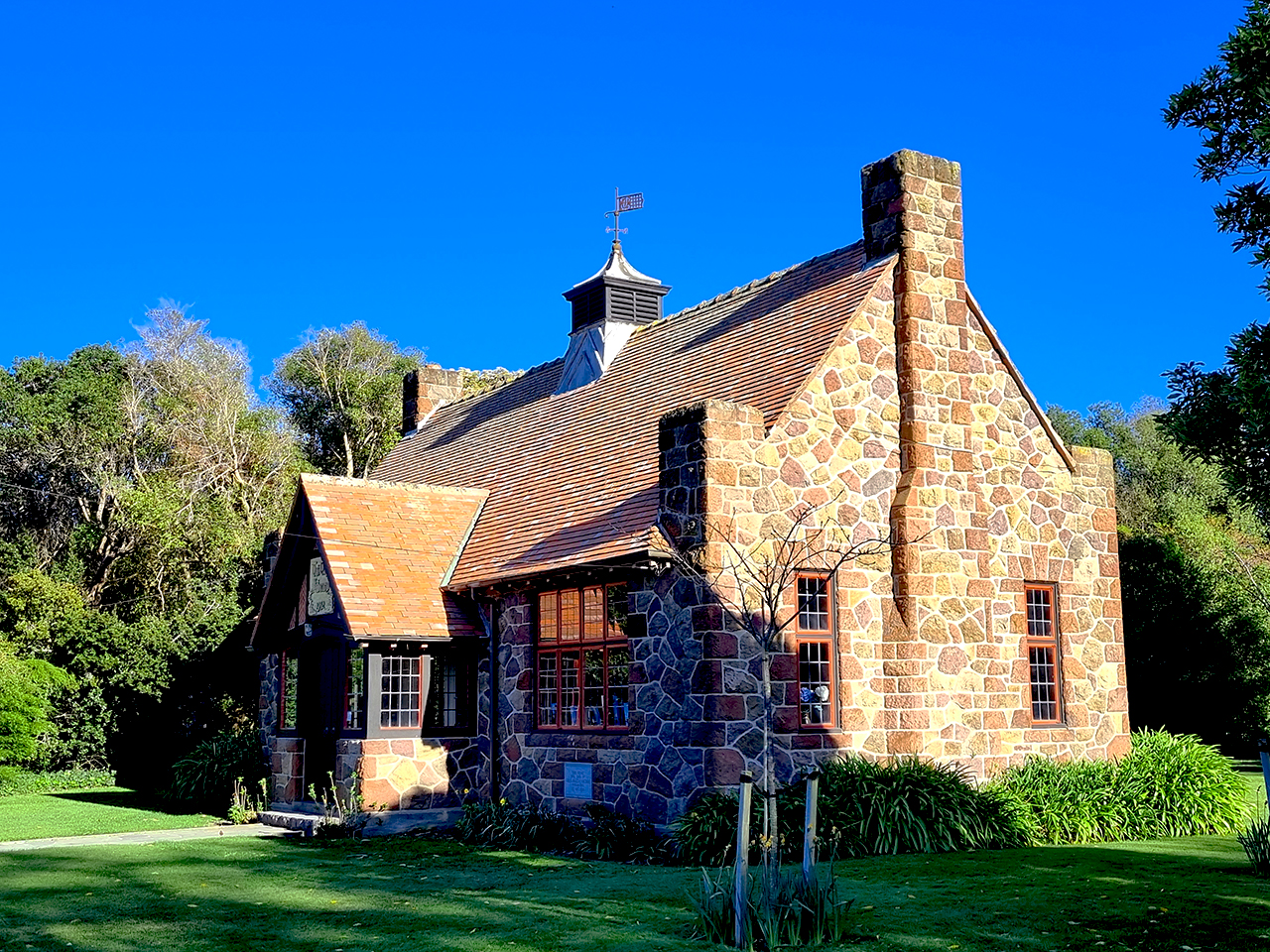
The architect of the library, Wood, had been influenced by the Arts and Crafts movement occurring in England during his time there. Both the library and neighbouring St Paul's, which was also opened in 1932, reflect this influence through their scale, their association with the surrounding landscape and their use of local materials. Both buildings utilise the distinctive reddish stone quarried from Otahuna, and had tiled roofs. So successful was Wood in conveying the feeling of vernacular England architecture that Bledisloe said at the opening that it was difficult for him to realise that he was not at home in Gloucestershire.
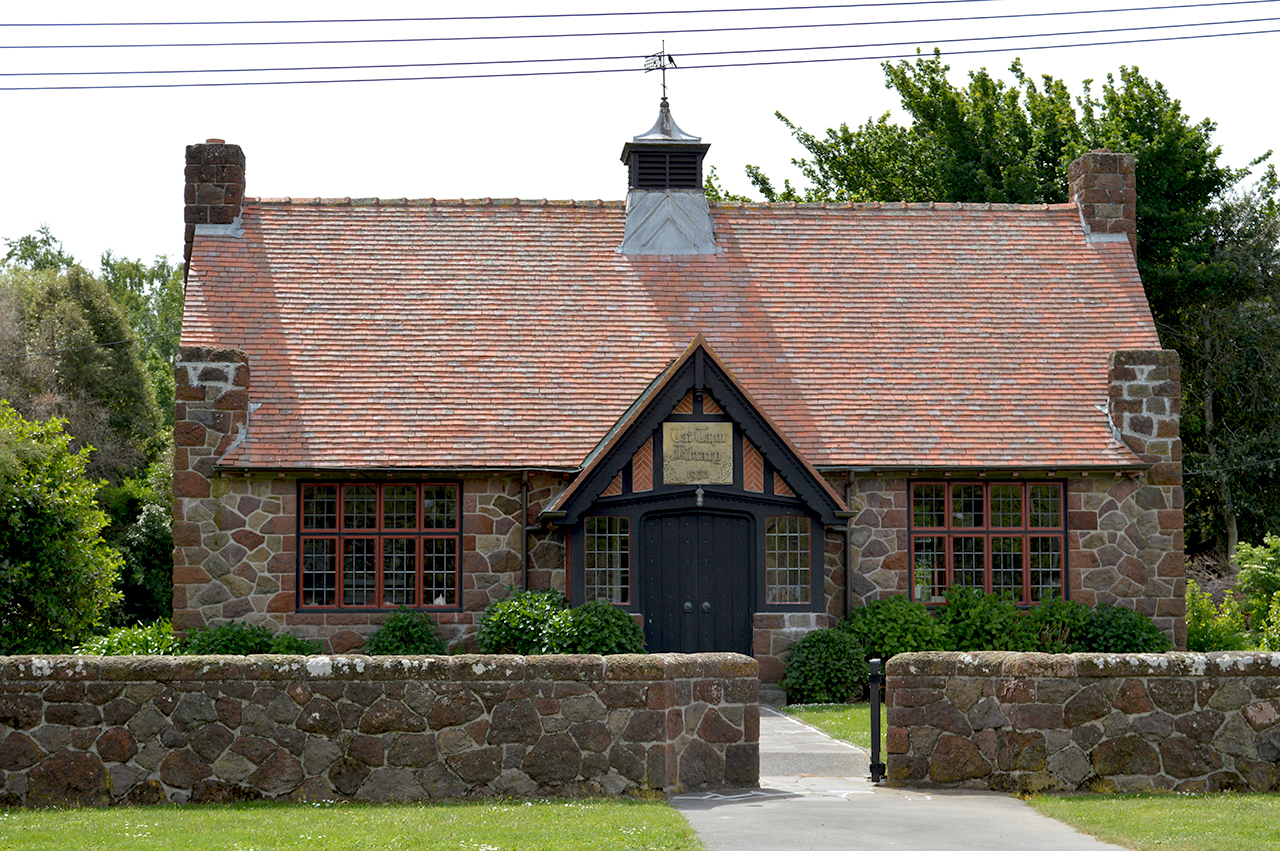
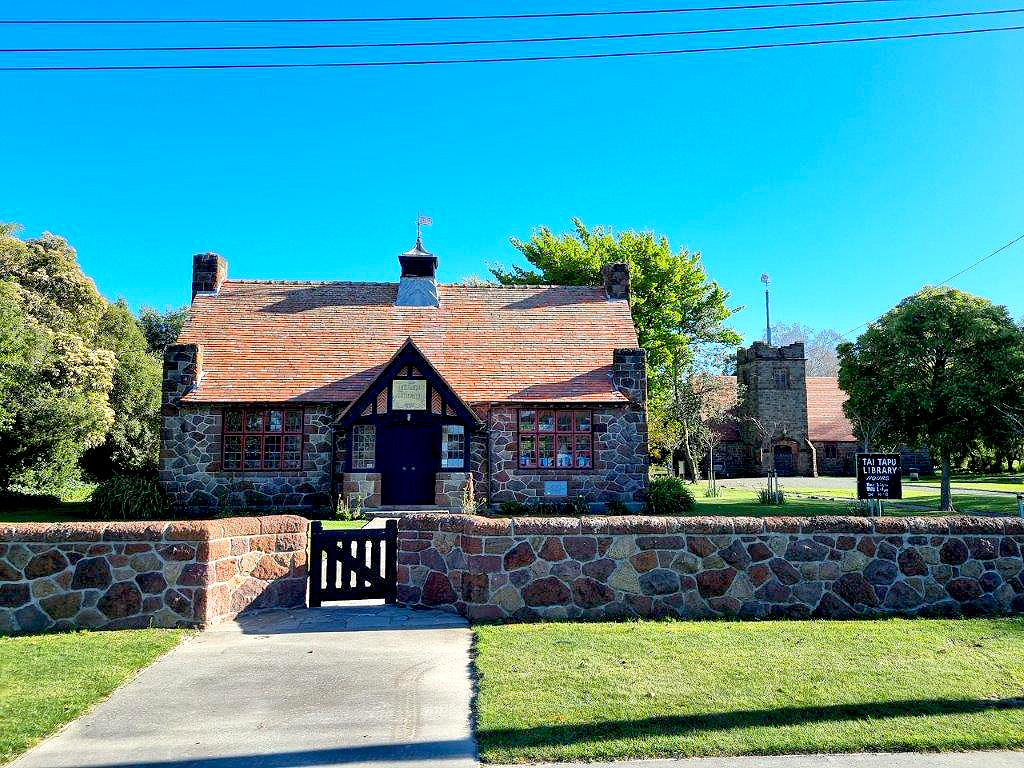
The library is a simple rectangular single-storey building, with a gabled entrance porch located in the centre of the front facade. A wooden ventilator is located on the roof directly above the porch. Under the gable is a stone plaque with the name of the library, the date of its opening and two groups of daffodils carved on it. It is possible that this was carved by the noted local carver Frederick Gurnsey, who often worked with Wood and had just been engaged in the carvings for St Paul's Church.
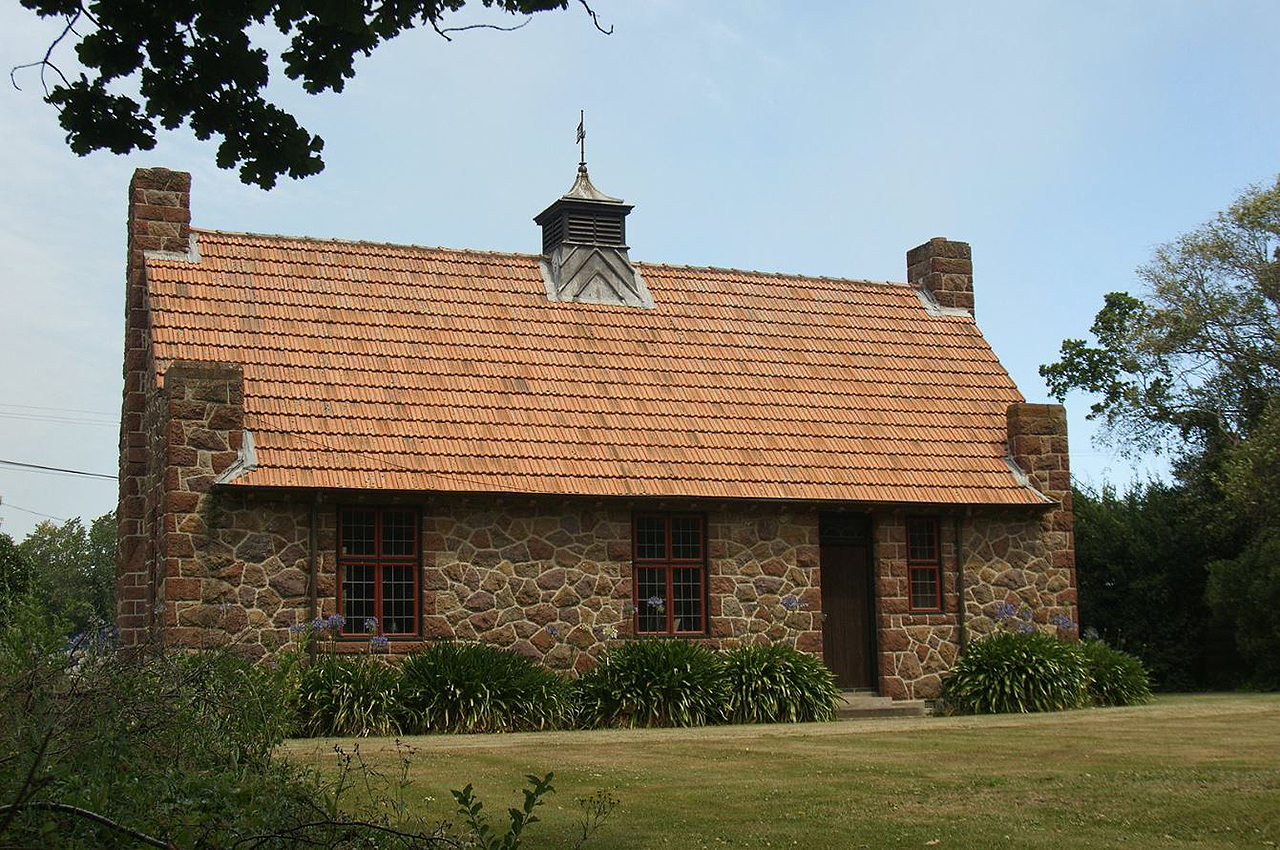
The building was lit by leadlight casement windows. At the time the library opened it consisted of one main room and two smaller rooms. These are panelled in rimu, the same timber from which the furniture was made. Both water and electricity were laid on and fireplaces installed at either end of the main room. The stone wall surrounding the library was built at the same time and from the same Otahuna stone.
Today the Tai Tapu Library continues to function as a small library. It is closely associated with Sir Heaton Rhodes, politician, landowner and philanthropist, and also with his head gardener, Alfred Lowe. The use of the Otahuna daffodils to raise funds for the library is an acknowledged part of the estate's history, with funds raised from the flowers and 'Daffodil Days' also being donated to various good causes around the region. The building itself is a fine example of Wood's Arts and Crafts-influenced architecture and, alongside St Paul's, shows how effectively he could design both secular and sacred buildings in the same materials but to quite different ends. His little red library, set in verdant surroundings, remains a distinctive part of Tai Tapu's townscape.

List Entry Information
Status
Listed
List Entry Status
Historic Place Category 1
Access
Able to Visit
List Number
4394
Date Entered
16th November 1989
Date of Effect
16th November 1989
City/District Council
Selwyn District
Region
Canterbury Region
Legal description
Lot 2 DP 10165 Blk VI Halswell SD
Status
Listed
List Entry Status
Historic Place Category 1
Access
Able to Visit
List Number
4394
Date Entered
16th November 1989
Date of Effect
16th November 1989
City/District Council
Selwyn District
Region
Canterbury Region
Legal description
Lot 2 DP 10165 Blk VI Halswell SD
Why is this place significant?
Historic Significance
Historical Significance or Value Tai Tapu Library and the adjacent St Paul's Church are visible reminders of the largesse of Sir Heaton Rhodes. Tai Tapu had a long association with the Rhodes family, one of the most notable of the South Island run holding families.
Physical Significance
ARCHITECTURAL QUALITY: Cecil Wood's sensitive handling of local stone and his attention to detail have long been appreciated, and the library and nearby Anglican church at Tai Tapu are considered to be among the finest of Cecil Wood's works. The church and library reveal Wood's thorough understanding of the Arts and Crafts style and the way in which this understanding enabled him to design secular and sacred buildings which complement each other. Together with St Paul's Church (1930-1), which stands on the adjacent property, the library is an important architectural asset to the township. TOWNSCAPE/LANDMARK VALUE: The library is a small building which sits comfortably within the rural environment of Tai Tapu. The building's domestic scale and attractive garden setting make it an appealing work in its own right but seen in conjunction with St Paul's it makes an even more significant contribution to the architectural character of the township.
Why is this place significant?
Historic Significance
Historical Significance or Value Tai Tapu Library and the adjacent St Paul's Church are visible reminders of the largesse of Sir Heaton Rhodes. Tai Tapu had a long association with the Rhodes family, one of the most notable of the South Island run holding families.
Physical Significance
ARCHITECTURAL QUALITY: Cecil Wood's sensitive handling of local stone and his attention to detail have long been appreciated, and the library and nearby Anglican church at Tai Tapu are considered to be among the finest of Cecil Wood's works. The church and library reveal Wood's thorough understanding of the Arts and Crafts style and the way in which this understanding enabled him to design secular and sacred buildings which complement each other. Together with St Paul's Church (1930-1), which stands on the adjacent property, the library is an important architectural asset to the township. TOWNSCAPE/LANDMARK VALUE: The library is a small building which sits comfortably within the rural environment of Tai Tapu. The building's domestic scale and attractive garden setting make it an appealing work in its own right but seen in conjunction with St Paul's it makes an even more significant contribution to the architectural character of the township.
Construction Professional
Name
Wood, Cecil Walter
Type
Architect
Biography
Born in Christchurch, Wood (1878-1947) was articled to the local architect Frederick Strouts between 1894 and 1899. He worked for a short time as a draughtsman with the firm Clarkson and Ballantyne before travelling to England in 1901. Here Wood was exposed to a high quality of architectural design in the Edwardian Free Style, and was employed by two leading Edwardian architects Robert Weir Shultz and Leonard Stokes. In 1907 Wood returned to New Zealand to take up partnership with Samuel Hurst Seager. The partnership lasted for only one year for Wood set up his own practice in 1908. The years 1908-1915 were dominated by domestic commissions, but it was also during this time that he began his association with Christ's College, which included such commissions as Hare Memorial Library (1915), the Memorial Dining Hall (1923-5), Jacob's House (1931) and Open Air Classrooms (1932). During the 1920s Wood's practice began to expand and a Georgian influence can be seen in such works as Weston House Park Terrace (1923-4) and Bishopscourt (1926-7). A short lived partnership in 1927 with R S D Harman allowed Wood to travel to the United States while another in 1937 with Paul Pascoe allowed him to travel to England, Europe and the United States without neglecting his practice. During this second trip he made preparations for the design of St Paul's Anglican Cathedral in Wellington, which was erected after his death. During his life Wood had made a substantial contribution to the architecture of Christchurch, having an enthusiasm for both European and American styles.
Construction Details
Start Year
1931
Finish Year
1932
Type
Original Construction
Description
Foundation stone laid 19 December 1931. Formally opened 12 August 1932
Type
Modification
Description
Tiles on western side of roof replaced by Marseille tiles at some stage
Construction Materials
Local rubble stone quarried from the Otahuna estate; tiled roof, leadlight casement windows and interior panelling of rimu.
Notable Features
The wall surrounding the library was built at the same time and from the same stone. Wood's exemplary use of local stone, and outstanding design are the library's most outstanding features. The stone plaque above the door, presumably carved by F.G. Gurnsey who frequently collaborated with Wood, is also noteworthy for the way in which it reminds the viewer of the unusual circumstance of the building's erection and is an example of high quality craftsmanship so much a part of Arts and Crafts architecture.
Construction Professional
Name
Wood, Cecil Walter
Type
Architect
Biography
Born in Christchurch, Wood (1878-1947) was articled to the local architect Frederick Strouts between 1894 and 1899. He worked for a short time as a draughtsman with the firm Clarkson and Ballantyne before travelling to England in 1901. Here Wood was exposed to a high quality of architectural design in the Edwardian Free Style, and was employed by two leading Edwardian architects Robert Weir Shultz and Leonard Stokes. In 1907 Wood returned to New Zealand to take up partnership with Samuel Hurst Seager. The partnership lasted for only one year for Wood set up his own practice in 1908. The years 1908-1915 were dominated by domestic commissions, but it was also during this time that he began his association with Christ's College, which included such commissions as Hare Memorial Library (1915), the Memorial Dining Hall (1923-5), Jacob's House (1931) and Open Air Classrooms (1932). During the 1920s Wood's practice began to expand and a Georgian influence can be seen in such works as Weston House Park Terrace (1923-4) and Bishopscourt (1926-7). A short lived partnership in 1927 with R S D Harman allowed Wood to travel to the United States while another in 1937 with Paul Pascoe allowed him to travel to England, Europe and the United States without neglecting his practice. During this second trip he made preparations for the design of St Paul's Anglican Cathedral in Wellington, which was erected after his death. During his life Wood had made a substantial contribution to the architecture of Christchurch, having an enthusiasm for both European and American styles.
Construction Details
Start Year
1931
Finish Year
1932
Type
Original Construction
Description
Foundation stone laid 19 December 1931. Formally opened 12 August 1932
Type
Modification
Description
Tiles on western side of roof replaced by Marseille tiles at some stage
Construction Materials
Local rubble stone quarried from the Otahuna estate; tiled roof, leadlight casement windows and interior panelling of rimu.
Notable Features
The wall surrounding the library was built at the same time and from the same stone. Wood's exemplary use of local stone, and outstanding design are the library's most outstanding features. The stone plaque above the door, presumably carved by F.G. Gurnsey who frequently collaborated with Wood, is also noteworthy for the way in which it reminds the viewer of the unusual circumstance of the building's erection and is an example of high quality craftsmanship so much a part of Arts and Crafts architecture.
Tai Tapu's first library was a wooden structure erected about 1880 on land donated by Robert Rhodes, Sir Heaton Rhodes' father. Rhodes junior settled in the district in 1895, taking up residence on the Otahuna estate in a house designed for him by Frederick Strouts, the architect with whom Wood served his articles. At the same time as the house was completed A.E. Lowe became Otahuna's head gardener and he developed one of the most outstanding gardens in the province before his death in the mid 1920s. Lowe had trained at Kew Gardens in London, and was an expert at the hybridisation of narcissi, so the estate gardens became known for their brilliant displays of daffodils in the spring. In the early 1920s Rhodes and Lowe decided that the money raised from the sale of Otahuna's daffodils should be used to build a new library in Tai Tapu, and at the time of his death Lowe had raised £1400 in this way. Rhodes donated the land on which the building was to stand and on December 19 1931 he laid the foundation stone for it; Webb's tender of £1478 having been accepted a month earlier. On August 12 1932 the new library was opened by Lord Bledisloe, Governor-General; the first time a vice regal visit had been made to the town. Sir Heaton Rhodes was a second-generation member of the Rhodes family, a prominent early settler family in New Zealand. Robert Rhodes and his brothers were particularly important in the early development of the provinces of Canterbury and South Canterbury through their extensive run holdings. Sir Heaton Rhodes was the Member of Parliament for Ellesmere district between 1899 and 1925.
Cecil Walter WOOD (1878-1947) Architect N.T. WEBB, Contractor L. WENDELBORN, Mason ARCHITECTURAL DESCRIPTION: The library is a small rectangular building, symmetrical about a gabled entrance porch which provides access to the library and two ancillary rooms. Designed in the Arts and Crafts style the building is constructed from local stone which is randomly laid. At each corner of the building the stonework breaks through the line of the gabled roof with the visual effect of anchoring the building to the ground on which it stands. Stone chimney stacks, one at each end of the building, also enliven the roof surface, complemented by a wooden ventilator set directly above the porch. Large leadlight casement windows light the internal spaces, with the bookshelves in the main room arranged to accommodate the fenestration. The entrance porch is also well lit, and above its outer door a stone plaque bearing the name and date of the building also bears a carving depicting daffodils, a visible reminder of the building's link with Sir Heaton Rhode's estate, Otahuna, which was renowned for its daffodils. The stone wall in front of the library is contemporary with it and is also constructed from local stone. MODIFICATIONS: None
Historical and Associated Iwi / Hapū / Whānau
Completion Date
14th August 2002
Report Written By
Melanie Lovell-Smith
Information Sources
Christchurch Press
Ogilvie, 1991
Gordon Ogilvie, The Port Hills of Christchurch, Auckland, 1991
Rice, 2001
Geoffrey Rice, Heaton Rhodes of Otahuna: the Illustrated Biography, Christchurch, 2001
Stacpoole, 1972
John Stacpoole and Peter Beaven, 'Architecture 1820-1970', Wellington, 1972
Star Midweek
Star Midweek
Strongman, 1984
Thelma Strongman, The Gardens of Canterbury: A History, Wellington, 1984
Press
Press, 17 May 1915, p.9.
Cattell, 1985
J. Cattell, Historic Buildings of Canterbury and South Canterbury - A Register of Classified Buildings, Publishing Division of Government Printing Office, Wellington, 1985
Other Information
This historic place was registered under the Historic Places Act 1980. This report includes the text from the original Building Classification Committee report considered by the NZHPT Board at the time of registration. Please note that entry on the New Zealand Heritage List/Rarangi Korero identifies only the heritage values of the property concerned, and should not be construed as advice on the state of the property, or as a comment of its soundness or safety, including in regard to earthquake risk, safety in the event of fire, or insanitary conditions.
Historical and Associated Iwi / Hapū / Whānau
Completion Date
14th August 2002
Report Written By
Melanie Lovell-Smith
Information Sources
Christchurch Press
Ogilvie, 1991
Gordon Ogilvie, The Port Hills of Christchurch, Auckland, 1991
Rice, 2001
Geoffrey Rice, Heaton Rhodes of Otahuna: the Illustrated Biography, Christchurch, 2001
Stacpoole, 1972
John Stacpoole and Peter Beaven, 'Architecture 1820-1970', Wellington, 1972
Star Midweek
Star Midweek
Strongman, 1984
Thelma Strongman, The Gardens of Canterbury: A History, Wellington, 1984
Press
Press, 17 May 1915, p.9.
Cattell, 1985
J. Cattell, Historic Buildings of Canterbury and South Canterbury - A Register of Classified Buildings, Publishing Division of Government Printing Office, Wellington, 1985
Other Information
This historic place was registered under the Historic Places Act 1980. This report includes the text from the original Building Classification Committee report considered by the NZHPT Board at the time of registration. Please note that entry on the New Zealand Heritage List/Rarangi Korero identifies only the heritage values of the property concerned, and should not be construed as advice on the state of the property, or as a comment of its soundness or safety, including in regard to earthquake risk, safety in the event of fire, or insanitary conditions.
Current Usages
Uses: Civic Facilities
Specific Usage: Library
Former Usages
General Usage: Civic Facilities
Specific Usage: Library
Current Usages
Uses: Civic Facilities
Specific Usage: Library
Former Usages
General Usage: Civic Facilities
Specific Usage: Library
Location
Stay up to date with Heritage this month

