Māori Settlement of Te Upoko o te Ika a Māui and the Establishment of Pipitea Pā
The Māori history and settlement of Te Upoko o te Ika a Māui reflects many changes and waves of migration over hundreds of years. The famed Polynesian explorer Kupe visited the area and ‘left a heritage of names which are still in use today’. Descendents of the rangatira Tara (son of Whātonga of the Kurahaupo waka) later settled in Wellington and the harbour was named after him. Around the seventeenth century the Ngāi Tara people were joined by Ngāti Ira who had migrated south from the Hawke’s Bay. Other iwi also occupied parts of the region including Rāngitane, Ngāti Kahungunu, Ngāti Māmoe and Ngāi Tahu. Taranaki iwi migrated south to the region in the early nineteenth century with Ngāti Mūtunga and Ngāti Tama including Te Whanganui-a-Tara in their settlement. They occupied Pipitea Pā at the southern end of Haukawakawa.
Pipitea Pā was one of the larger pā located around Te Whanganui-a-Tara and it was a thriving community, well-resourced due to the nearby harbour and foreshore, waterways such as Pipitea Stream (referred to as the ‘lifeblood of the pā’) and surrounding fertile lands. Kaimoana was abundant, as were birds (both seabirds and forest birds) and other resources such as pūhā which grew along the streams. Extensive gardens also spread across the area later developed into Parliament and the Botanical Gardens.
The pā was named for the visible pipi beds located below the pā (subsequently destroyed by the 1848 and 1855 earthquakes). When Ngāti Mūtunga migrated again to Chatham Islands/ Wharekauri/ Rekohu in 1835, they renounced their rights to the land by pānui (notice) to their Te Āti Awa kin and Te Matehou (Ngāti Hāmua) then occupied the pā. Three small kāinga were located nearby: Pakuao, Tiakiwai and Raurimu. Pakuao was located near the intersection of Thorndon Quay and Tinakori Road; Tiakiwai was further south along Thorndon Quay (near to what is now 191 Thorndon Quay) and Raurimu was situated close to the corner of Hobson Street and Fitzherbert Terrace. There were burial grounds at Kaiota, where the Parliamentary Library is now situated. The whole Pipitea area was extremely dynamic with intensive use and settlement by Māori.
The area around Pipitea was renamed Thorndon following the establishment of Port Nicholson by the New Zealand Company in 1840 and became ‘the heart of the new colonial settlement’. The company divided the land into town acres, even though it had not been sold by Māori. At this time, Pipitea Pā was occupied by the various hapū of Te Āti Awa, Ngāti Tama, Taranaki and Ngāti Ruanui.
Origins of St Paul’s Church and St Paul’s School (1852)
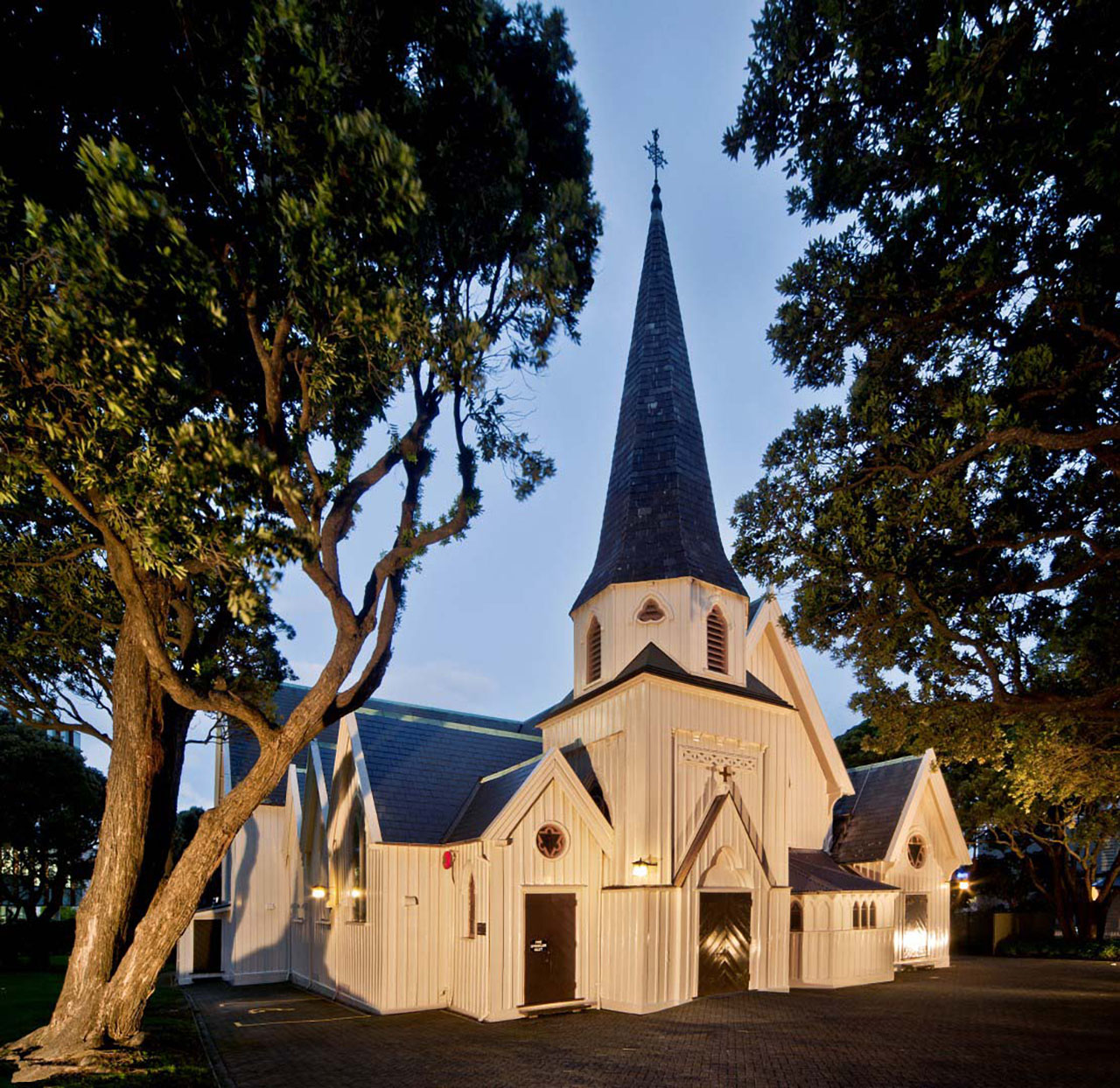
Thorndon became the seat of government and was also home to the Anglican Church in Wellington. Although missionary work with Māori had already begun through the Church Missionary Society (CMS) in 1814, European settlement strengthened the commitment to Christianity and the requirement for places of worship. The first religious services held in Wellington were Presbyterian, and in Thorndon, Wellington’s first Anglican church dedicated to St Paul, was built in 1844 on the Government Reserve (now Parliament Grounds).
A meeting of Church of England members was held in May 1851 and a declaration was made that it was ‘the duty of the Anglican Church to provide for all their children a complete course of religious education by means of primary and secondary schools’. It was consequently decided that both Te Aro and Thorndon would have a school and the Church of England Education Society was soon formed to manage the Anglican Church’s educational affairs. Governor Sir George Grey was a member of the society, and when enough money had been raised through subscriptions he gave a section on Sydney Street for the school.
This section was part of Town Section 514 (Native Reserve) and nearly 150 years later, the 1997 Wellington Tenths Trust Tribunal found that the Crown had been very casual in its treatment of Native Reserves in the early decades of Wellington’s colonial settlement, appropriating them for projects with ‘little or no close connection to Māori’ such as the Sydney Street school. In 1844 for example, the Thorndon Barracks and parade ground were erected on the cultivation grounds associated with Raurimu (urban tenths reserves), and in 1847 Wellington’s first hospital, the Colonial Hospital, was built on a tenths reserve (Town Acre 584) at what is now Wellington Girls’ College. Further lands were subsequently taken for a hospital endowment in 1851, including the Thorndon Barracks site. Indeed, many of the 23 acres of urban tenths reserves appropriated by the Crown in Te Whanganui-a-Tara for hospital, educational and religious endowments in 1851 and 1853 were in Thorndon. These reserves were taken without full consultation with the Māori beneficial owners, nor indeed their consent.
Some compensation was paid to Māori beneficiaries in the 1870s but this was later found to be woefully inadequate. It wasn’t until 2008 that the Port Nicholson (Taranaki Whānui ki Te Upoko o Te Ika) Deed of Settlement and subsequent 2009 settlement legislation provided cultural, financial and commercial redress for the Crown’s breaches of Treaty of Waitangi obligations, including their compulsory acquisition and endowment of Taranaki Whānui ki Te Upoko o Te Ika lands for public purposes.
St Paul’s Schoolroom was opened by Bishop Selwyn in January 1852, despite being unfinished, and was officially opened on 5 April 1852 with Mr Wadsworth as the master in charge of 35 pupils, both boys and girls. The growing school was maintained by subscriptions of members of the Church of England Education Society, church collections, and occasionally other ‘entertainments’. Mr Edward Toomath replaced Wadsworth as master in 1853, but it was Mr William Mowbray’s leadership from 1859 that had the greatest influence, with the school becoming informally known as ‘Mowbray’s school’. Mowbray oversaw the school’s 1873 transition into a state-run facility (which became known as Thorndon School) and its subsequent move to its current Turnbull Street site in 1880.
The former Sydney Street school building was thereafter used as a day school, Sunday school and as a meeting place for local elections and for community groups such as the Wellington Teachers Association and the Thorndon Bowling Club. A range of events was held there too, from ‘rummage sales’ to lectures and concerts. It was unfortunately destroyed by a fire in 1895, along with the three libraries it housed for the Sunday school, St Paul’s Young Men’s Club and Reverend C.A. Tisdall.
Rebuilding of St Paul’s Schoolroom
St Paul’s Parish developed plans to rebuild a new school on the same site and had an initial proposal to provide accommodation for the kindergarten, Sunday School and St Paul’s Club at the cost of £1959. Parishioners reconsidered this proposal in May 1897 though, and resolved instead to authorise the erection of a timber school building, with the architect to ‘allow for the future addition of a gymnasium and boys’ club’. Architect Frederick de Jersey Clere was the Anglican’s Church’s diocesan architect and his firm Clere, Fitzgerald, and Richmond was engaged to design the building. The actual design was drafted by John Sydney Swan (1874-1936) though who was newly articled to Clere.
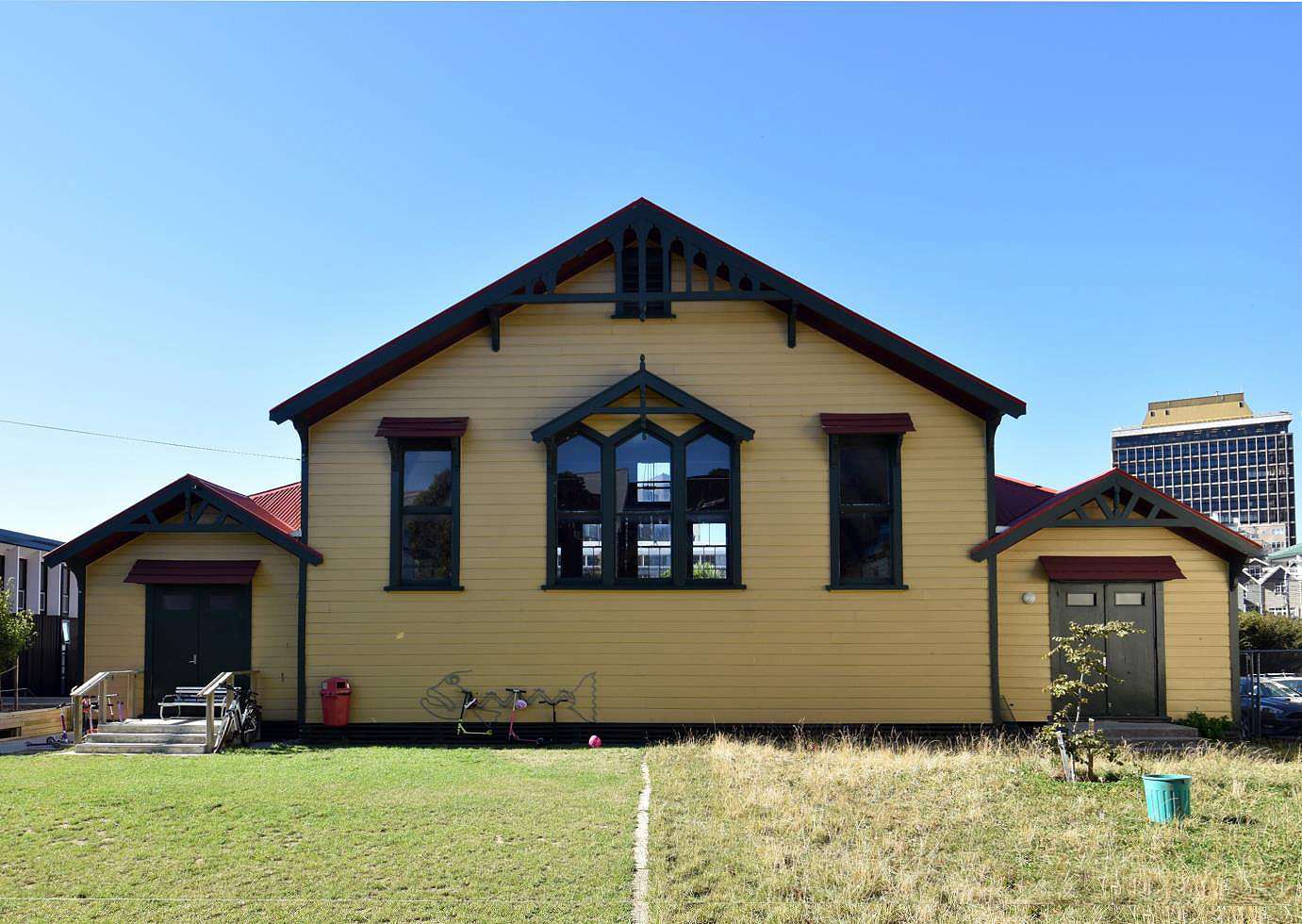
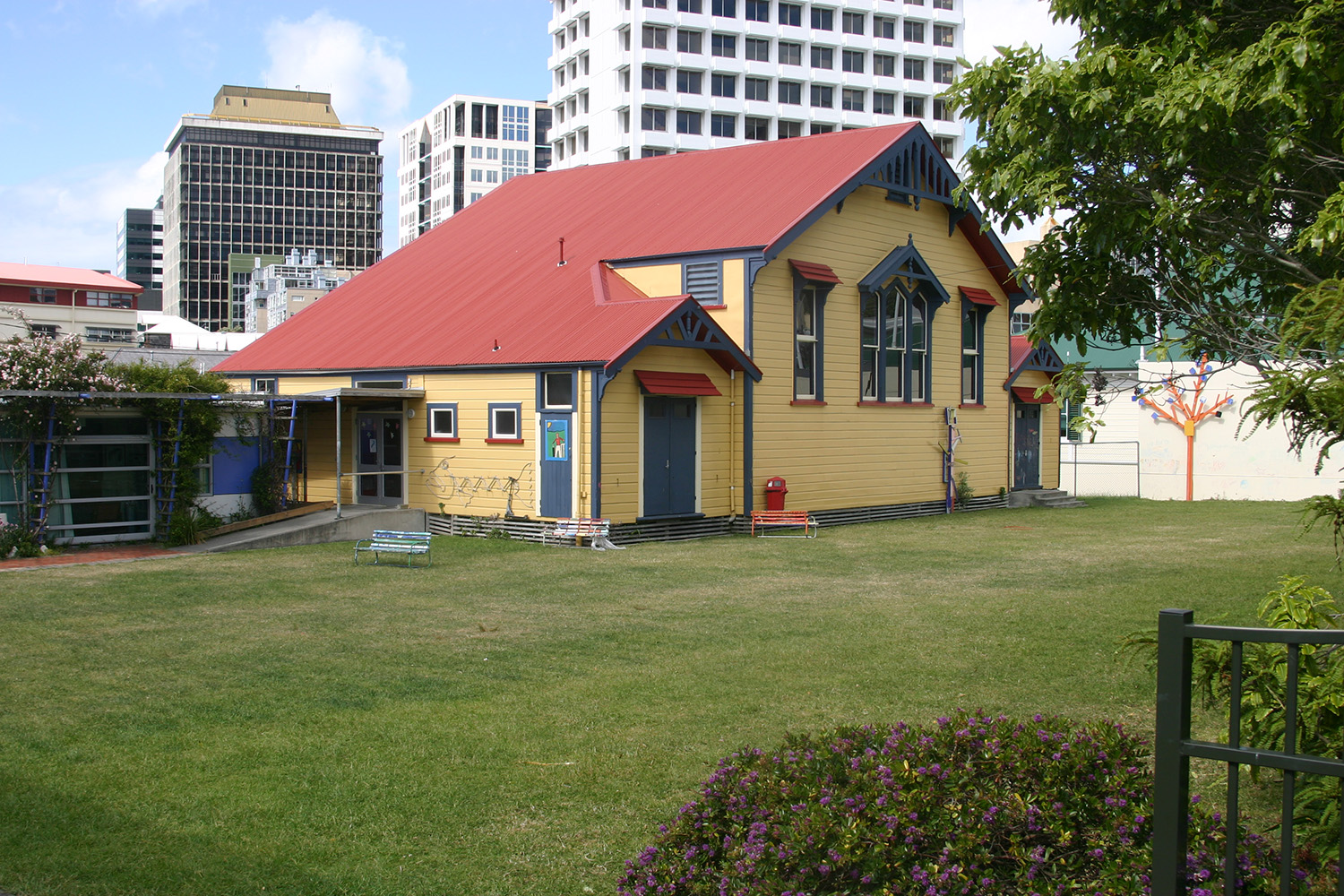
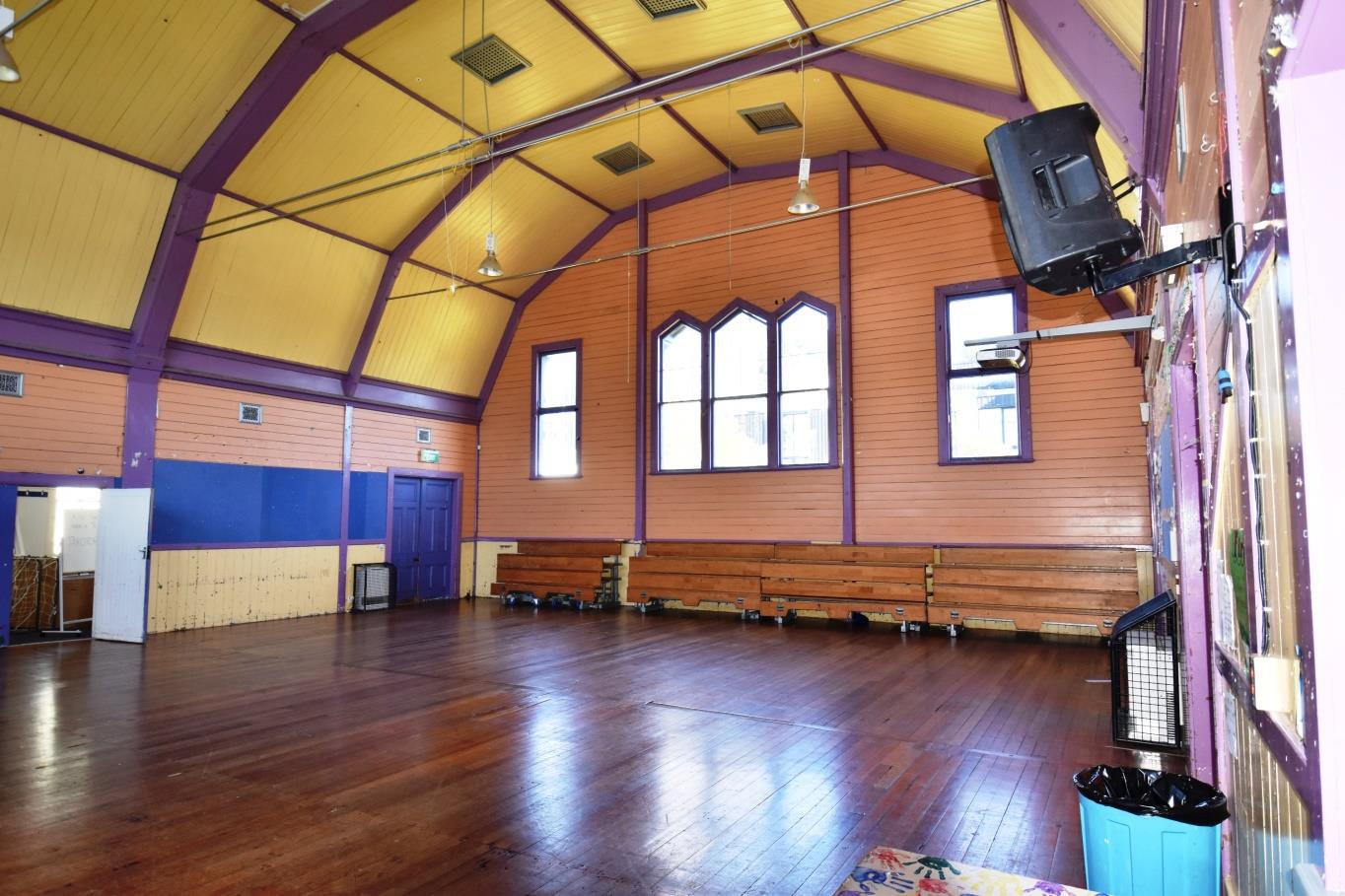
Swan’s design was for a building with a main gabled section flanked by ‘lean-tos’ either side. The central section contained the main school room measuring 63 foot (19.2. metres) by 40 foot (12.2 metres) which was fitted with a deep stage at its southern end, and the two lean-tos housed five smaller classrooms. Two of these smaller classrooms were fitted so that they could be used as dressing-rooms and another was reportedly fitted with ‘gas cooking apparatus for refreshments’. Toilets were located to the rear of the eastern lean-to. The building cost approximately £1200 and was constructed by Messrs. Clark and Thompson. It featured timber piles, frame and sheathing and native timbers were used throughout.
St Paul’s Schoolroom was officially opened by the Bishop of Wellington, Bishop Wallis, on 23 December 1897, with afternoon proceedings following by an evening concert. Bishop Wallis was effusive in his compliments on the new building - he didn’t think there could be ‘a brighter building, or one more apt for the purpose for which it was built. Those who were at the service must have noticed how excellent the hall was for hearing in’. The new building was primarily for educational purposes, but ‘when not required for Sunday or day school it would be let for entertainments and meetings’.
In late 1898 Swan drew up the additional plans for a gymnasium and club rooms for the St Paul’s Young Men’s Club, to be located on the schoolroom site, and fundraising commenced. The building was erected by Messrs. Clark and Thompson in April 1899, with the annual report of the Vestry of St Paul’s Parish stating that ‘a gymnasium and class and reading rooms have been added to the Sydney-street School building, providing accommodation for the St Paul’s Club, entirely apart from the main building’. The Vestry’s report additionally stated that the schoolroom itself ‘continued to let well for concerts, meetings and entertainments’, and this is clearly demonstrated by newspaper advertisements and reports from the late 1890s. In May 1898 for example, ethnologist and then Surveyor-General Stephenson Percy Smith gave a lecture on Polynesian history to a large crowd at St Paul’s Schoolroom. There are also several references to Native Land Court hearings being held in the ‘Sydney Street Schoolroom’ (as St Paul’s Schoolroom was also known) though these cannot definitively be associated with St Paul’s Schoolroom. Earlier Native Land Court hearings were held in the capacious Primitive Methodist Church Schoolroom on the opposite side of Sydney Street, also referred to as the ‘Sydney Street Schoolroom’.
The schoolroom remained a popular community venue into the early twentieth century. In December 1902, Katherine Mansfield appeared in a fundraising concert at the ‘Sydney Street Schoolroom’, and it has been suggested that the building was the setting for her short story ‘The First Ball’. In July 1908 the newly formed 18th Wellington Diocesan Synod commenced business meetings in the schoolroom. By 1910 the immediate environs surrounding St Paul’s Schoolroom had changed dramatically - Sydney Street had effectively been cut in half as a result of the construction of the new parliamentary buildings, following the ‘great fire’ of 1907 which tore through the earlier wooden buildings. St Paul’s Schoolroom was located on what would later become ‘Sydney Street East’.
Conversion of St Paul’s Schoolroom into the Sydney Street Soldiers Club
Between October 1914 and November 1918 St Paul’s Schoolroom was home to the Sydney Street Soldiers’ Club. The club was primarily set up to organise entertainment for the Main Body awaiting overseas departure from Wellington. The club’s founding by a group of local women was also motivated though by the realisation that many lonely soldiers, unfamiliar with the city, had no other suitable place of leisure. One report noted that the lonely soldier ‘unless he be a very strong-minded man, will meet questionable women if he doesn’t meet good ones…Thank God, the women of Wellington sensed the situation in 1914, and organised the Sydney Street Club’. At this time, soldiers’ clubs were being set up across New Zealand, initiated by community respect and concern for soldiers' wellbeing.
In July 1915 there was a meeting to gather support for a permanent soldiers’ club at Sydney Street. It was unanimously decided that, ‘although some of the Defence authorities were unsympathetic, the Sydney Street Schoolroom should be rented and a club established’. Dame Christina Massey (wife of Prime Minister William Massey) became president of the club’s organising committee. Different women's organisations were allocated to be ‘hostesses’ on a different day each month. The facilities in the Sydney Street Soldiers’ Club included a billiard table, piano, easy chairs, writing tables, and the tearoom was supplied through donations from around the country.
Tens of thousands of soldiers visited the Sydney Street Soldiers’ Club over its four years of operation. The women running the club ‘prepared their musical programmes, cut the huge pile of sandwiches, boiled eggs and infused the tea for thousands of soldiers hankering after a change from the camp bread and jam, and the seemingly-necessary monotony of the army stew’. Of special interest were the monthly dance socials, described as ‘delightfully decorous’, and the Christmas and New Year periods were always particularly busy.
Conversion to Sydney Street Hospital
The Spanish flu had reached New Zealand by November 1918 and Reverend Samuel Robertson Orr, Minister of St Andrew’s Presbyterian Church on The Terrace, took immediate action, both forming and chairing the Wellington North Epidemic Committee. Due to overcapacity at existing Wellington medical facilities, two temporary hospitals were set up in Thorndon, under the direction of Major McCristell of the Army Ordnance Corps. One of the hospitals was situated in the two storied manual training block of Thorndon Normal School, and the other in St Paul’s Schoolroom, the latter becoming known as ‘Sydney Street Hospital’.
Sydney Street Hospital had 41 beds and was run by notable New Zealand medical practitioner Dr Elizabeth Gunn with Nurse Luke and the help of local volunteers. Despite their formidable efforts, 49 deaths were recorded at the Sydney Street Hospital which closed its doors on 11 December 1918. Across New Zealand, the Spanish flu claimed approximately 9000 lives, including 757 from Wellington.
Reversion to a Community Hall
After the pandemic St Paul’s Schoolroom (Former) reverted once again to a community hall and regular notices ran in the Evening Post advertising the building’s availability for meetings and ‘entertainments’. In 1924 an electrical substation was erected by the Wellington City Council on part of the schoolroom site, but the building remained in use as a community hall. In 1931 for example, the Two-garment Society used the schoolroom as a collection and distribution centre for parcels to help ‘“keep the cold out” and bodies warm’ after the St Paul’s gymnasium/club rooms which they usually used were badly damaged in a fire in December 1930, along with the society’s sacks and notices. The Ngāti Poneke Māori Mission also held several bazaars in the schoolroom which featured Māori entertainment and numerous stalls selling a variety of goods. It was also the venue for regular sporting events including Wellington regional badminton and table tennis tournaments.
In 1943 the land and schoolroom were taken by proclamation for public works purposes, but again this did not affect the former schoolroom’s ongoing use as a community hall. The National Orchestra (New Zealand Symphony Orchestra) used the building for rehearsals for their recording of Monsieur Beaucaire in November 1960 and St Paul’s Parish also used the space for various meetings until the late 1960s, including Diocesan Synod sessions.
Ministry of Works Acquisition
The Ministry of Works took the building over in 1971, after which time it became a civil engineering draughting office and then a systems laboratory. It is possibly during this Ministry of Works era that changes were made to the building such as removal of the stage at the southern end of the schoolroom; erection of a double height wall across the building, north of which a mezzanine space was added; and adaption of the two lean-to portions into kitchen, cloakroom and toilet areas.
The future of St Paul’s Schoolroom appeared under threat in the 1980s with the development of a proposed National Art Gallery and High Court in the vicinity in 1984 and 1988 respectively. With the former project, the Dean of Wellington Cathedral of St Paul’s, the very reverend James Thomas, proposed relocating the schoolroom to the west side of St Paul’s Cathedral. His idea was for the building to become a hall and chapel available for community use, noting that its then use by Loaves and Fishes precluded wider community use. Neither of these development projects came to fruition though (the High Court was built further down Molesworth Street) and St Paul’s Schoolroom remained in situ. Following the restructuring of the public service in the late 1980s, the land and building were managed by Government Property Services, who later leased the building to the Thorndon Apostolic Church for a peppercorn rental of $1 per annum. In 1990 the New Zealand Historic Places Trust classified St Paul’s Schoolroom as a ‘C’ building which merited preservation and in 1993 Sydney Street East was renamed Kate Sheppard Place, in honour of her role as leader of New Zealand’s suffrage movement, for the centenary of women gaining the vote. The Thorndon Apostolic Church appears to have vacated the schoolroom by February 1996.
Private Ownership and Relocation
In 1997 Land Information New Zealand offered the St Paul’s Schoolroom property back to the Anglican Church as original owners, after determining that the property was surplus to Crown requirements. The Anglican Church decided against purchasing the property and it was acquired by Kate Sheppard Investments who were interested in the land’s development potential.
Kate Sheppard Investments did not wish to retain the schoolroom and offered to donate it to Thorndon School and pay for the relocation costs. The then New Zealand Historic Places Trust and the Thorndon Society supported the relocation of the Category 2 historic place. Both organisations understood that relocation was the only alternative to demolition. They additionally recognised the historical link between the schoolroom and Thorndon School, noting that relocation ‘will provide some continuity of cultural heritage value’.
The schoolroom was cut east-west into three sections and on Sunday 21 February 1999 two of the sections were relocated to Thorndon School, where they were re-joined on the building’s new site at the Murphy Street end of school. Only the front and rear sections were relocated to Thorndon School due to concerns about how much of the school’s limited green space would be taken up by the full size of the hall. It is understood that the two central bays of the hall were thereafter disposed of. The Ministry of Education contributed half the cost of re-piling and reconnection of services to the building on its new site. The southern and western additions were in poor condition and were both demolished prior to the building’s relocation.
The original Kate Sheppard Place site was initially levelled for a carpark and archaeological authority was issued to cover the possibility that archaeological material associated with the St Paul’s Schoolroom had survived beneath the carpark. Nothing was found during monitoring of the earthworks and Environment House was subsequently erected on the site, opening in 2005.
Conversion to Thorndon School Hall
Following relocation to Thorndon School, St Paul’s Schoolroom was repurposed as the school’s hall and a period costume ‘Ball in the Hall’ was held in November 1999 to raise funds to cover the building’s renovation. A conservation plan was also prepared by Frances Robinson Architects to guide the building’s refurbishment and ongoing maintenance. This work has included addition of a kitchen and toilets in the eastern lean-to (2005); re-roofing (2010); installation of solar panels (2014); and earthquake strengthening (2019).
A major redevelopment project was undertaken at Thorndon School /Te Kura o Pipitea from 2017-2019 but it was careful to ensure a respectful separation between the new buildings and the former St Paul’s Schoolroom. The redevelopment was subsequently awarded a 2020 NZIA Wellington Architecture Award – Education. In 2021, St Paul’s Schoolroom (Former) remains an integral part of the Thorndon School / Te Kuri o Pipitea campus. In addition to its primary role as the school hall, the building is the venue for the school’s after school care and holiday programmes. It is also occasionally used as a performance or meeting venue by the local Thorndon community and nearby government departments, and as a polling venue during General Elections.
In 2021, 170 years on from the Crown’s original acquisition of part of a native reserve for the construction of St Paul’s Schoolroom on Sydney Street, the land beneath Thorndon School/ Te Kuri o Pipitea is currently in the process of being acquired by the Port Nicholson Settlement Block Trust. The Tai Hekenga Consortium is negotiating to purchase the land using the sale and leaseback mechanism provided as part of the financial and commercial redress package under the Port Nicholson Block (Taranaki Whānui ki Te Upoko o Te Ika) Claims Settlement Act 2009 and associated deeds of settlement (2008, 2018).