DonateMembershipVisit Heritage
  • Tūrangawaewae
    Places
  • Tira Māori
    Māori Heritage
  • Poutairangahia
    Archaeology
  • Rauemi
    Resources
  • Mō Tātou
    About Us
  • New Zealand Heritage List
  • Nominate and submit
  • Explore the List
  • National Historic Landmarks
  • Plaques
  • Rainbow List Project
  • Lost heritage
  • Visit Heritage
  • Our properties
  • Turnbull House Project
  • Collections
  • Shop
  • Tohu Whenua
  • Tira Māori
  • Conserving Māori heritage
  • Marae built heritage
  • Māori heritage on the List
  • Hinemihi—Te Hokinga Mai
  • What is archaeology?
  • Is there a site on my property?
  • What are my legal requirements?
  • Affecting an archaeological site
  • Declaring an archaeological site
  • Archaeology FAQs
  • Archaeology Digital Library
  • Archaeology guidelines and templates
  • Resources
  • Funding
  • Publications
  • Sustainable management guides
  • Disaster recovery
  • Podcasts & digital resources
  • Education Hub
  • Conservation plans
  • About
  • Board
  • Māori Heritage Council
  • Senior Staff
  • Offices
  • Contact us
  • Careers
  • Covenants
  • Fast-track
  • Corporate documents
  • Currently consulting on
  • Our submissions
  • News
  • Covid-19 response
Quick links
Rārangi Kōrero | The List
Explore the List
National Historic Landmarks
Ngā Manawhenua o Aotearoa me ōna Kōrero Tūturu
Quick links
Tapuwae
A Vision for Places of Māori Heritage
Funding for Māori Heritage
Resources
Quick links
Archaeological Authority Portal
Applying for an archaeological authority
Archaeology FAQs
Browse the most frequently asked questions about archaeological authorities and the archaeological process.
Quick links
Quick links
News
News Keep up to date with Heritage New Zealand Pouhere Taonga
Membership
Membership Find out more and sign up today
DonateMembershipVisit Heritage
  • Tūrangawaewae
    Places
  • Tira Māori
    Māori Heritage
  • Poutairangahia
    Archaeology
  • Rauemi
    Resources
  • Mō Tātou
    About Us
  • New Zealand Heritage List
  • Nominate and submit
  • Explore the List
  • National Historic Landmarks
  • Plaques
  • Rainbow List Project
  • Lost heritage
  • Visit Heritage
  • Our properties
  • Turnbull House Project
  • Collections
  • Shop
  • Tohu Whenua
  • Tira Māori
  • Conserving Māori heritage
  • Marae built heritage
  • Māori heritage on the List
  • Hinemihi—Te Hokinga Mai
  • What is archaeology?
  • Is there a site on my property?
  • What are my legal requirements?
  • Affecting an archaeological site
  • Declaring an archaeological site
  • Archaeology FAQs
  • Archaeology Digital Library
  • Archaeology guidelines and templates
  • Resources
  • Funding
  • Publications
  • Sustainable management guides
  • Disaster recovery
  • Podcasts & digital resources
  • Education Hub
  • Conservation plans
  • About
  • Board
  • Māori Heritage Council
  • Senior Staff
  • Offices
  • Contact us
  • Careers
  • Covenants
  • Fast-track
  • Corporate documents
  • Currently consulting on
  • Our submissions
  • News
  • Covid-19 response
Quick links
Rārangi Kōrero | The List
Explore the List
National Historic Landmarks
Ngā Manawhenua o Aotearoa me ōna Kōrero Tūturu
Quick links
Tapuwae
A Vision for Places of Māori Heritage
Funding for Māori Heritage
Resources
Quick links
Archaeological Authority Portal
Applying for an archaeological authority
Archaeology FAQs
Browse the most frequently asked questions about archaeological authorities and the archaeological process.
Quick links
Quick links
News
News Keep up to date with Heritage New Zealand Pouhere Taonga
Membership
Membership Find out more and sign up today
  • Places
  • Nominate and submit
  • National Historic Landmarks
  • Places
  • Nominate and submit
  • National Historic Landmarks
  • Tira Māori
  • Conserving Māori heritage
  • Marae built heritage
  • Tira Māori
  • Conserving Māori heritage
  • Marae built heritage
  • Archaeological authorities
  • Archaeology Digital Library
  • Archaeological authorities
  • Archaeology Digital Library
  • All resources
  • Publications
  • Funding
  • All resources
  • Publications
  • Funding
  • FAQs
  • FAQs
Follow us on:
Places
  • Places
  • Nominate and submit
  • National Historic Landmarks
Tira Māori
  • Tira Māori
  • Conserving Māori heritage
  • Marae built heritage
Archaeology
  • Archaeological authorities
  • Archaeology Digital Library
Resources
  • All resources
  • Publications
  • Funding
FAQs
  • FAQs
Follow us on
HomePrivacyTerms and conditionsAbout this site
© Heritage New Zealand Pouhere Taonga 2026.
 
Hunterville Post Office (Former)

10 Bruce Street, HUNTERVILLE

Private

Historic Place Category 1

List No. 4429

Quick links:
List GalleryLocationDetails
Completed in 1903, the Hunterville Post Office is one of the most important historic buildings in the Hunterville district and a fine example of Edwardian Baroque public architecture.

The first post office in Hunterville had opened in 1885. During the 1890s the role of the Postal and Telegraph Department expanded. Not only did the volume of mail it carried increase, but it also offered a far greater range of government services, such as a savings bank and the acceptance of licence fees, taxes, and local body rates. By the early 1900s the department had adopted a policy of erecting substantial brick buildings in well-established towns.

For Hunterville the arrival of the North Island Main Trunk railway line and the provision of a station ensured its place on the map. In 1902 the Architectural Branch of the Public Works Department prepared plans for a post office more fitted to the town's new status and desire for a permanent image. The new building with its elaborate motifs was designed in the Edwardian Baroque style favoured by the Government Architect, John Campbell (1857-1942). Some of Campbell's better known designs include Wellington's Public Trust Building (1905-1909) and the Auckland Chief Post Office (1911). The contract for the new post office was let to Zajonskowski Bros of Marton, and the contract was completed in October 1903. The ground floor of the two-storey building contained the various services offered and the upper-storey served as the postmaster's residence. The kitchen was in a lean-to at the back of the building. The post office continued to serve the community until 19 May 1989 when, as a consequence of the corporatisation of the New Zealand Post Office, it was closed. The building was then sold and converted into a private residence.

The importance attached to the Hunterville Post Office is reflected in the relatively ornate design of the building, and its impressive presence on the street. It was one of many public buildings erected at this time to standard designs under the direction of the Government Architect, John Campbell, and constructed by the Public Works Department and private contractors. It exemplified the growing presence of the government in the rural sector at a time when communications were improving rapidly and the Postal and Telegraph Department was at the forefront of the provision of a great many essential government services.
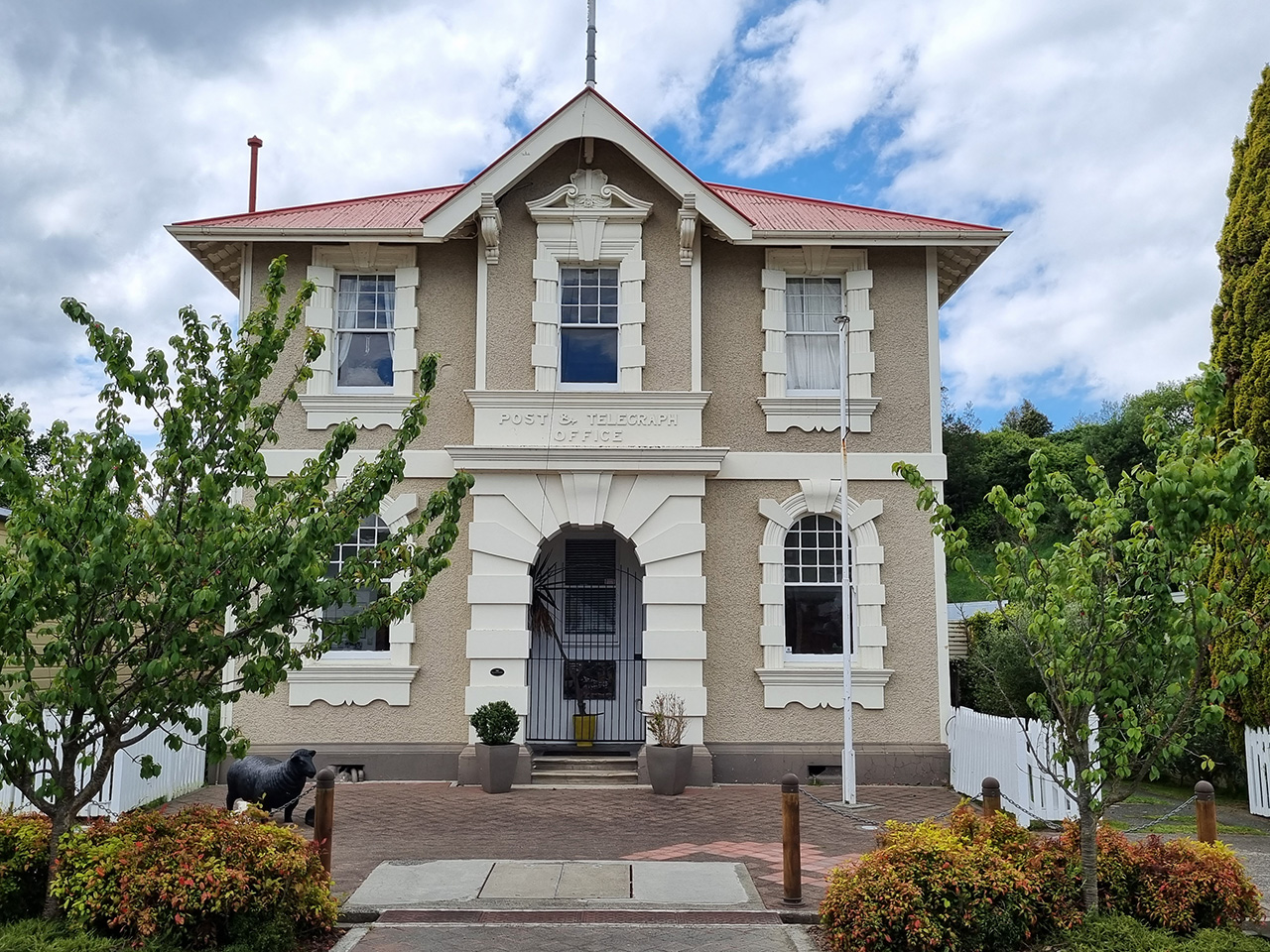
Hunterville Post Office (Former), Hunterville | C Horwell | 06/11/2023 | Heritage New Zealand Pouhere Taonga
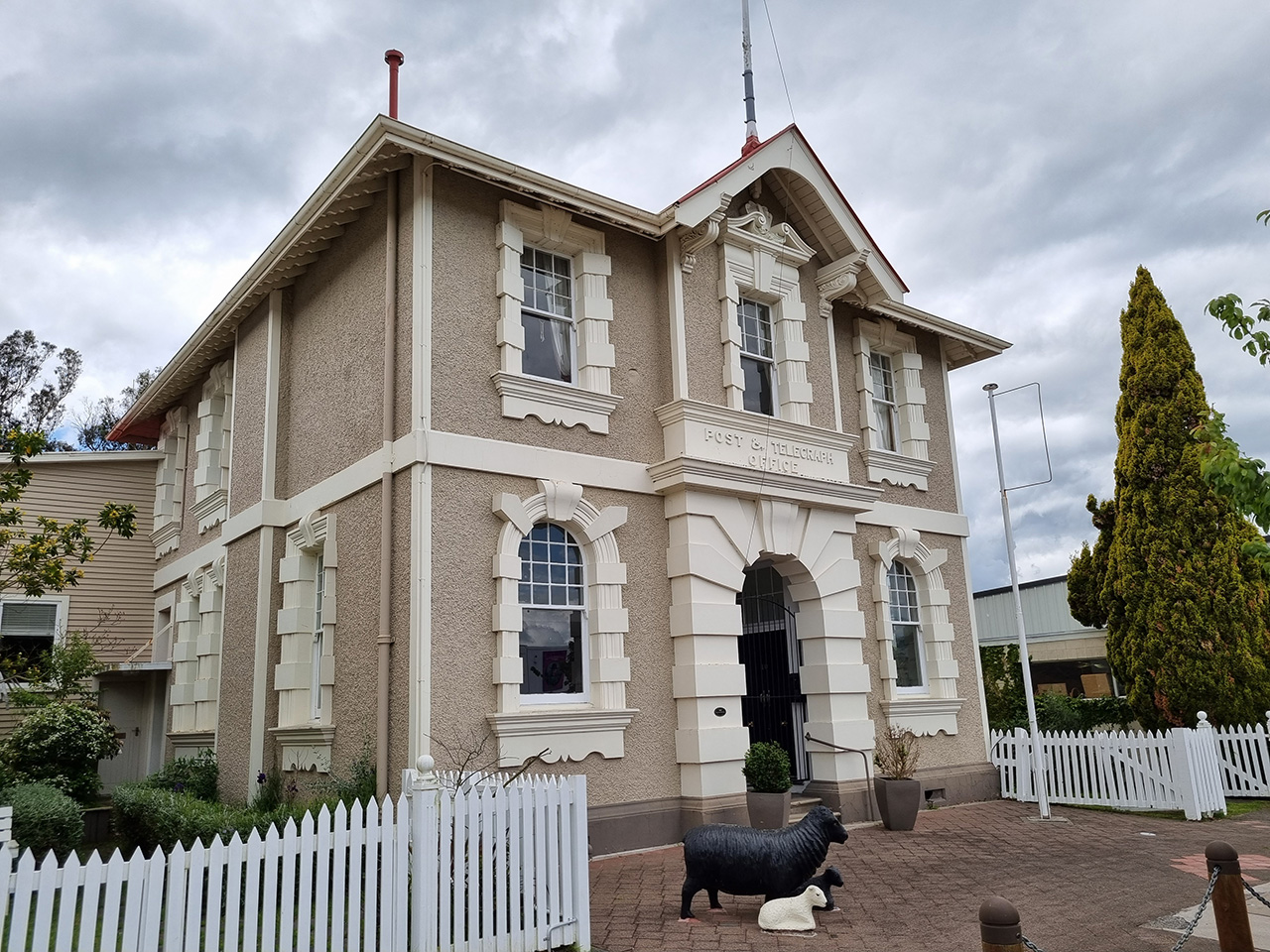


List Entry Information

Overview

Status
Listed

List Entry Status
Historic Place Category 1

Access
Private/No Public Access

List Number
4429

Date Entered
28th June 1990

Date of Effect
28th June 1990

City/District Council
Rangitīkei District

Region
Horizons (Manawatū-Whanganui) Region

Legal description

Sec 259 Township of Hunterville

Detailed List Entry
Significance

Historic Significance

Historical Significance or Value The former Hunterville Post Office served the Hunterville community for over 80 years and was associated with the development of the town and surrounding area.

Physical Significance

ARCHITECTURAL QUALITY: Campbell and the Public Works Department were responsible for the design of many post office buildings between the turn of the century and World War 1. For this reason, the former Hunterville Post Office cannot be considered in isolation. Under John Campbell a standardised post office style emerged. It showed a transition from Queen Anne to Edwardian Baroque with exuberant designs of the early 1900s maturing to a more restrained Baroque in the second decade of the century. While the grandeur of the post offices varied with scale, the former Hunterville Post Office is representative of those which appeared in many small towns and suburban areas throughout New Zealand. While these buildings are not identical they incorporate standardised elements. Campbell's series of post offices are a relatively early example of standardisation of design in New Zealand public buildings. TOWNSCAPE/LANDMARK VALUE: The Edwardian Baroque character and symmetry of the former post office give it a formality that is rare in Hunterville public buildings. It is the dominant element in the streetscape.

Construction Professional

Name

Campbell, John

Type

Architect

Biography

John Campbell (1857-1942) served his articles under John Gordon (c1835-1912) in Glasgow. He arrived in Dunedin in 1882 and after a brief period as a draughtsman with Mason and Wales joined the Dunedin branch of the Public Works Department in 1883. His first known work, an unbuilt design for the Dunedin Railway Station, reveals an early interest in Baroque architecture. In November 1888 Campbell was transferred to Wellington where in 1889 he took up the position of draughtsman in charge of the Public Buildings Division of the Public Works Department. He remained in charge of the design of government buildings throughout New Zealand until his retirement in 1922, becoming in 1909 the first person to hold the position of Government Architect. Government architecture designed under his aegis evidences a change in style from Queen Anne to Edwardian Baroque. His best-known Queen Anne design is the Dunedin Police Station (1895-8), modelled on Richard Norman Shaw's New Scotland Yard (1887-90). Among his most exuberant Edwardian Baroque buildings is the Public Trust Office, Wellington (1905-09). Although Campbell designed the Dunedin Law Courts (1899-1902) in the Gothic style with a Scottish Baronial inflection, he established Edwardian Baroque as the government style for police stations, courthouses and post offices throughout New Zealand. In 1911 Campbell won the nation-wide architectural competition for the design of Parliament Buildings, Wellington. Although only partially completed, Parliament House is the crowning achievement of Campbell's career.

Construction Details

Start Year

1903

Finish Year

1904

Type

Original Construction

Start Year

1902

Type

Designed

Description

Plans prepared by office of the Government Architect and approved by John Campbell.

Construction Materials

Concrete foundations. Plastered brick external walls. Central bearing internal brick walls at ground level, otherwise timber framed. Corrugated galvanised iron roof.

Historical Narrative

DESCRIPTION: A spate of post office building activity followed the advancement of the North Island Main Trunk railway line through the central North Island early this century. The line was completed in 1908 and led to a regular mail service by train. The post office building boom was the lifeblood of the Architectural Branch of the Public Works Department from the turn of the century to World War I. Built 1902-03 the former Hunterville Post Office served the Hunterville community until 19 May 1989 when as a consequence of corporatisation of the New Zealand Post Office, it was closed and sold to the present owner.

Physical Description

It is two-storeyed with a hipped roof and central gable. The central bay of the street façade projects slightly and has a dominant rusticated archway with highly decorative window mouldings and a pediment, corbels at the gable ends and the Post and Telegraph insignia. On each side of the central bay there is a round-headed window at ground floor level and a square headed one on the first floor, all with decorative mouldings and aprons. The simple form of the building belies the complexity of its plan. Public spaces are located on the ground floor, where informal planning reflects the flow of business and communications while the upper floor consists of domestic quarters. There the rooms are formally arranged as in a Victorian or Edwardian residence, opening off a central corridor. Attached to the rear of the building is a one-storey lean-to housing kitchen, scullery and dining room distinct from the public areas. MODIFICATIONS: Date unknown: unsympathetic timber framed extension on the west side.

Reference

Information Sources

Appendices to the Journals of the House of Representatives (AJHR)

Appendices to the Journals of the House of Representatives

Archives New Zealand (Wgtn)

Archives New Zealand (Wellington)

McLintock, 1966

An Encyclopedia of New Zealand, Government Printer, Wellington, 1966

Richardson, 1988

Peter Richardson, 'An Architecture of Empire: The Government Buildings of John Campbell in New Zealand', MA Thesis, University of Canterbury, 1988

Robinson, 1964

Howard Robinson, A History of the Post Office in New Zealand, RE Owen, Government Printer, Wellington, 1964

Report Written By

This historic place was registered under the Historic Places Act 1980. This report includes the text from the original Building Classification Committee report considered by the NZHPT Board at the time of registration. Please note that entry on the New Zealand Heritage List/Rarangi Korero identifies only the heritage values of the property concerned, and should not be construed as advice on the state of the property, or as a comment of its soundness or safety, including in regard to earthquake risk, safety in the event of fire, or insanitary conditions.

Further Information

Current Usages

Uses: Accommodation

Specific Usage: House

Former Usages

General Usage:: Communication

Specific Usage: Post Office

Themes

Web Links

Overview

Status

Listed

List Entry Status

Historic Place Category 1

Access

Private/No Public Access

List Number

4429

Date Entered

28th June 1990

Date of Effect

28th June 1990

City/District Council

Rangitīkei District

Region

Horizons (Manawatū-Whanganui) Region

Legal description

Sec 259 Township of Hunterville

Status

Listed

List Entry Status

Historic Place Category 1

Access

Private/No Public Access

List Number

4429

Date Entered

28th June 1990

Date of Effect

28th June 1990

City/District Council

Rangitīkei District

Region

Horizons (Manawatū-Whanganui) Region

Legal description

Sec 259 Township of Hunterville

Significance

Why is this place significant?

Historic Significance

Historical Significance or Value The former Hunterville Post Office served the Hunterville community for over 80 years and was associated with the development of the town and surrounding area.

Physical Significance

ARCHITECTURAL QUALITY: Campbell and the Public Works Department were responsible for the design of many post office buildings between the turn of the century and World War 1. For this reason, the former Hunterville Post Office cannot be considered in isolation. Under John Campbell a standardised post office style emerged. It showed a transition from Queen Anne to Edwardian Baroque with exuberant designs of the early 1900s maturing to a more restrained Baroque in the second decade of the century. While the grandeur of the post offices varied with scale, the former Hunterville Post Office is representative of those which appeared in many small towns and suburban areas throughout New Zealand. While these buildings are not identical they incorporate standardised elements. Campbell's series of post offices are a relatively early example of standardisation of design in New Zealand public buildings. TOWNSCAPE/LANDMARK VALUE: The Edwardian Baroque character and symmetry of the former post office give it a formality that is rare in Hunterville public buildings. It is the dominant element in the streetscape.

Why is this place significant?

Historic Significance

Historical Significance or Value The former Hunterville Post Office served the Hunterville community for over 80 years and was associated with the development of the town and surrounding area.

Physical Significance

ARCHITECTURAL QUALITY: Campbell and the Public Works Department were responsible for the design of many post office buildings between the turn of the century and World War 1. For this reason, the former Hunterville Post Office cannot be considered in isolation. Under John Campbell a standardised post office style emerged. It showed a transition from Queen Anne to Edwardian Baroque with exuberant designs of the early 1900s maturing to a more restrained Baroque in the second decade of the century. While the grandeur of the post offices varied with scale, the former Hunterville Post Office is representative of those which appeared in many small towns and suburban areas throughout New Zealand. While these buildings are not identical they incorporate standardised elements. Campbell's series of post offices are a relatively early example of standardisation of design in New Zealand public buildings. TOWNSCAPE/LANDMARK VALUE: The Edwardian Baroque character and symmetry of the former post office give it a formality that is rare in Hunterville public buildings. It is the dominant element in the streetscape.

Construction Information

Construction Professional

Name

Campbell, John

Type

Architect

Biography

John Campbell (1857-1942) served his articles under John Gordon (c1835-1912) in Glasgow. He arrived in Dunedin in 1882 and after a brief period as a draughtsman with Mason and Wales joined the Dunedin branch of the Public Works Department in 1883. His first known work, an unbuilt design for the Dunedin Railway Station, reveals an early interest in Baroque architecture. In November 1888 Campbell was transferred to Wellington where in 1889 he took up the position of draughtsman in charge of the Public Buildings Division of the Public Works Department. He remained in charge of the design of government buildings throughout New Zealand until his retirement in 1922, becoming in 1909 the first person to hold the position of Government Architect. Government architecture designed under his aegis evidences a change in style from Queen Anne to Edwardian Baroque. His best-known Queen Anne design is the Dunedin Police Station (1895-8), modelled on Richard Norman Shaw's New Scotland Yard (1887-90). Among his most exuberant Edwardian Baroque buildings is the Public Trust Office, Wellington (1905-09). Although Campbell designed the Dunedin Law Courts (1899-1902) in the Gothic style with a Scottish Baronial inflection, he established Edwardian Baroque as the government style for police stations, courthouses and post offices throughout New Zealand. In 1911 Campbell won the nation-wide architectural competition for the design of Parliament Buildings, Wellington. Although only partially completed, Parliament House is the crowning achievement of Campbell's career.

Construction Details

Start Year

1903

Finish Year

1904

Type

Original Construction

Start Year

1902

Type

Designed

Description

Plans prepared by office of the Government Architect and approved by John Campbell.

Construction Materials

Concrete foundations. Plastered brick external walls. Central bearing internal brick walls at ground level, otherwise timber framed. Corrugated galvanised iron roof.

Construction Professional

Name

Campbell, John

Type

Architect

Biography

John Campbell (1857-1942) served his articles under John Gordon (c1835-1912) in Glasgow. He arrived in Dunedin in 1882 and after a brief period as a draughtsman with Mason and Wales joined the Dunedin branch of the Public Works Department in 1883. His first known work, an unbuilt design for the Dunedin Railway Station, reveals an early interest in Baroque architecture. In November 1888 Campbell was transferred to Wellington where in 1889 he took up the position of draughtsman in charge of the Public Buildings Division of the Public Works Department. He remained in charge of the design of government buildings throughout New Zealand until his retirement in 1922, becoming in 1909 the first person to hold the position of Government Architect. Government architecture designed under his aegis evidences a change in style from Queen Anne to Edwardian Baroque. His best-known Queen Anne design is the Dunedin Police Station (1895-8), modelled on Richard Norman Shaw's New Scotland Yard (1887-90). Among his most exuberant Edwardian Baroque buildings is the Public Trust Office, Wellington (1905-09). Although Campbell designed the Dunedin Law Courts (1899-1902) in the Gothic style with a Scottish Baronial inflection, he established Edwardian Baroque as the government style for police stations, courthouses and post offices throughout New Zealand. In 1911 Campbell won the nation-wide architectural competition for the design of Parliament Buildings, Wellington. Although only partially completed, Parliament House is the crowning achievement of Campbell's career.

Construction Details

Start Year

1903

Finish Year

1904

Type

Original Construction

Start Year

1902

Type

Designed

Description

Plans prepared by office of the Government Architect and approved by John Campbell.

Construction Materials

Concrete foundations. Plastered brick external walls. Central bearing internal brick walls at ground level, otherwise timber framed. Corrugated galvanised iron roof.

Historical Narrative

DESCRIPTION: A spate of post office building activity followed the advancement of the North Island Main Trunk railway line through the central North Island early this century. The line was completed in 1908 and led to a regular mail service by train. The post office building boom was the lifeblood of the Architectural Branch of the Public Works Department from the turn of the century to World War I. Built 1902-03 the former Hunterville Post Office served the Hunterville community until 19 May 1989 when as a consequence of corporatisation of the New Zealand Post Office, it was closed and sold to the present owner.

DESCRIPTION: A spate of post office building activity followed the advancement of the North Island Main Trunk railway line through the central North Island early this century. The line was completed in 1908 and led to a regular mail service by train. The post office building boom was the lifeblood of the Architectural Branch of the Public Works Department from the turn of the century to World War I. Built 1902-03 the former Hunterville Post Office served the Hunterville community until 19 May 1989 when as a consequence of corporatisation of the New Zealand Post Office, it was closed and sold to the present owner.

Physical Description

It is two-storeyed with a hipped roof and central gable. The central bay of the street façade projects slightly and has a dominant rusticated archway with highly decorative window mouldings and a pediment, corbels at the gable ends and the Post and Telegraph insignia. On each side of the central bay there is a round-headed window at ground floor level and a square headed one on the first floor, all with decorative mouldings and aprons. The simple form of the building belies the complexity of its plan. Public spaces are located on the ground floor, where informal planning reflects the flow of business and communications while the upper floor consists of domestic quarters. There the rooms are formally arranged as in a Victorian or Edwardian residence, opening off a central corridor. Attached to the rear of the building is a one-storey lean-to housing kitchen, scullery and dining room distinct from the public areas. MODIFICATIONS: Date unknown: unsympathetic timber framed extension on the west side.

It is two-storeyed with a hipped roof and central gable. The central bay of the street façade projects slightly and has a dominant rusticated archway with highly decorative window mouldings and a pediment, corbels at the gable ends and the Post and Telegraph insignia. On each side of the central bay there is a round-headed window at ground floor level and a square headed one on the first floor, all with decorative mouldings and aprons. The simple form of the building belies the complexity of its plan. Public spaces are located on the ground floor, where informal planning reflects the flow of business and communications while the upper floor consists of domestic quarters. There the rooms are formally arranged as in a Victorian or Edwardian residence, opening off a central corridor. Attached to the rear of the building is a one-storey lean-to housing kitchen, scullery and dining room distinct from the public areas. MODIFICATIONS: Date unknown: unsympathetic timber framed extension on the west side.

Reference

Historical and Associated Iwi / Hapū / Whānau

Information Sources

Appendices to the Journals of the House of Representatives (AJHR)

Appendices to the Journals of the House of Representatives

Archives New Zealand (Wgtn)

Archives New Zealand (Wellington)

McLintock, 1966

An Encyclopedia of New Zealand, Government Printer, Wellington, 1966

Richardson, 1988

Peter Richardson, 'An Architecture of Empire: The Government Buildings of John Campbell in New Zealand', MA Thesis, University of Canterbury, 1988

Robinson, 1964

Howard Robinson, A History of the Post Office in New Zealand, RE Owen, Government Printer, Wellington, 1964

Other Information

This historic place was registered under the Historic Places Act 1980. This report includes the text from the original Building Classification Committee report considered by the NZHPT Board at the time of registration. Please note that entry on the New Zealand Heritage List/Rarangi Korero identifies only the heritage values of the property concerned, and should not be construed as advice on the state of the property, or as a comment of its soundness or safety, including in regard to earthquake risk, safety in the event of fire, or insanitary conditions.

Historical and Associated Iwi / Hapū / Whānau

Information Sources

Appendices to the Journals of the House of Representatives (AJHR)

Appendices to the Journals of the House of Representatives

Archives New Zealand (Wgtn)

Archives New Zealand (Wellington)

McLintock, 1966

An Encyclopedia of New Zealand, Government Printer, Wellington, 1966

Richardson, 1988

Peter Richardson, 'An Architecture of Empire: The Government Buildings of John Campbell in New Zealand', MA Thesis, University of Canterbury, 1988

Robinson, 1964

Howard Robinson, A History of the Post Office in New Zealand, RE Owen, Government Printer, Wellington, 1964

Other Information

This historic place was registered under the Historic Places Act 1980. This report includes the text from the original Building Classification Committee report considered by the NZHPT Board at the time of registration. Please note that entry on the New Zealand Heritage List/Rarangi Korero identifies only the heritage values of the property concerned, and should not be construed as advice on the state of the property, or as a comment of its soundness or safety, including in regard to earthquake risk, safety in the event of fire, or insanitary conditions.

Further Information

Current Usages

Uses: Accommodation

Specific Usage: House

Former Usages

General Usage: Communication

Specific Usage: Post Office

Current Usages

Uses: Accommodation

Specific Usage: House

Former Usages

General Usage: Communication

Specific Usage: Post Office

Location

Loading
Stay up to date with Heritage this month