Quick links


Quick links
Quick links
Quick links
Quick links
Quick links
Wakefield Street and Symonds Street, Wakefield Street Reserve, AUCKLAND
Public
Historic Place Category 2
List No. 4493
List Entry Information
Status
Listed
List Entry Status
Historic Place Category 2
Access
Able to Visit
List Number
4493
Date Entered
24th June 2005
Date of Effect
24th June 2005
City/District Council
Auckland Council
Region
Auckland Council
Extent of List Entry
Registration includes part of the land shown in RT NA44A/619 (as shown on Map C in Appendix 4 of registration report), and the monument, its fittings and fixtures, thereon. The area of registration extends one metre beyond the outer edge of the lowermost step in all directions.
Legal description
Pt Lot 2 DP 86367 (RT NA44A/619), North Auckland Land District
Why is this place significant?
Cultural Significance
It is socially significant as a place of remembrance about the New Zealand Wars and later on, as a focus for protest.
Historic Significance
Historical Significance or Value The Memorial has historical value for its association with the Victoria League, and for reflecting past attitudes to conflict, race relations, colonialism and commemoration in New Zealand.
Physical Significance
The New Zealand Wars Memorial has aesthetic value for its artistic qualities and its visual impact on the Symonds Street streetscape, which is enhanced by its reserve setting.
Why is this place Category 1 / Category 2?
Detail Of Assessed Criteria
(a) The extent to which the place reflects important or representative aspects of New Zealand history The New Zealand Wars Memorial reflects important aspects of New Zealand history, notably early twentieth-century attitudes towards colonial conflict. (b) The association of the place with events, persons, or ideas of importance in New Zealand history The place is associated with events of importance in New Zealand history, particularly the New Zealand Wars. (f) The potential of the place for public education The memorial has considerable potential for public education as a public monument that graphically conveys information about New Zealand history in both visual and written form. It is situated in a public reserve close to two major universities, and on a major thoroughfare in the city centre. (h) The symbolic or commemorative value of the place The place has strong commemorative value, actively remembering men who fought in the New Zealand Wars. (k) The extent to which the place forms part of a wider historical and cultural complex or historical and cultural landscape The memorial is part of an important historical and cultural landscape in the Symonds Street area. In particular, it is one of several significant historic places in the area that is closely connected to the New Zealand Wars. These include the Albert Barracks Wall 1846-52 (NZHPT Register # 12, Category I), the former Government House 1855-56 (NZHPT Register # 105, Category I), the former Supreme Court 1865-68 (NZHPT Register # 17, Category I) and the Symonds Street Cemetery (where many soldiers from the New Zealand Wars are buried).
Construction Professional
Name
Macklin, T.Eyre
Type
Sculptor
Biography
No biography is currently available for this construction professional
Name
Burgess, Roderick
Type
Sculptor
Biography
Sculptor 2004- Register number 4493
Name
W.Parkinson & Co.
Type
Sculptor
Biography
Stonemason
Construction Details
Start Year
1912
Type
Designed
Description
April - August 1912
Start Year
1919
Finish Year
1920
Type
Original Construction
Type
Modification
Description
Palm branch removed from statue sometime before October 1981 (date unknown)
Start Year
1981
Type
Modification
Description
Figure tarred and feathered and pulled off its feet in August 1981. Statue restored at a cost of $2,000 and reinstated
Start Year
1981
Type
Modification
Description
Head removed in October 1981. Council subsequently removed statue for restoration
Start Year
2004
Type
Modification
Description
Statue reinstated with a new head in August 2004
Construction Materials
Takaka marble obelisk, with bronze cast statue.
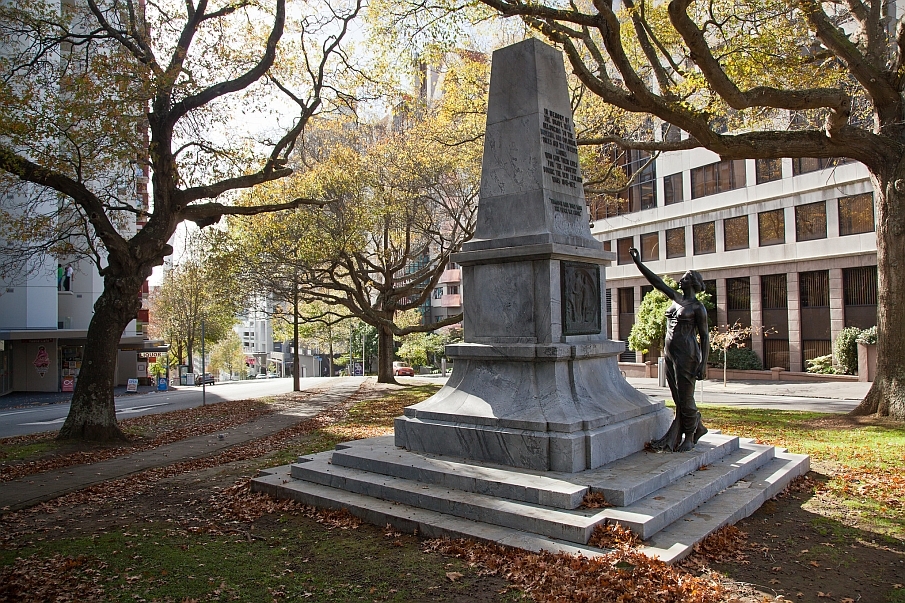
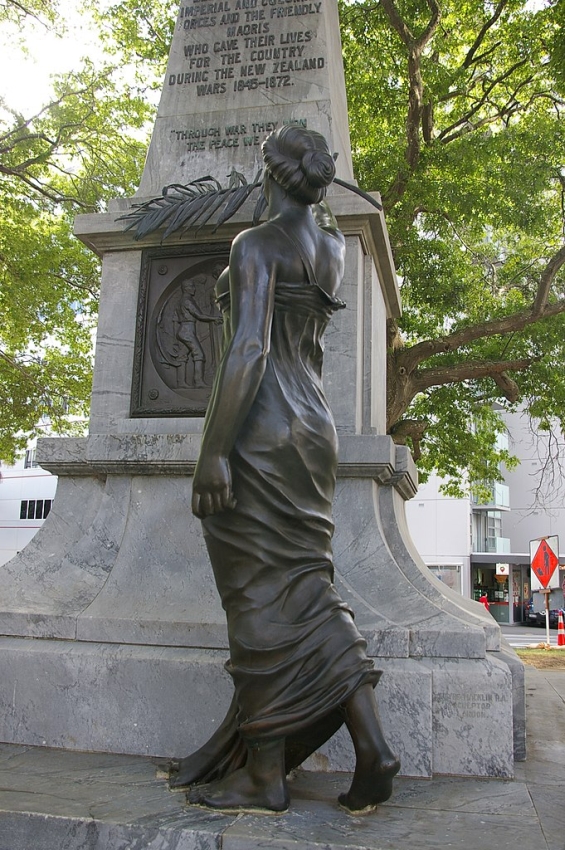
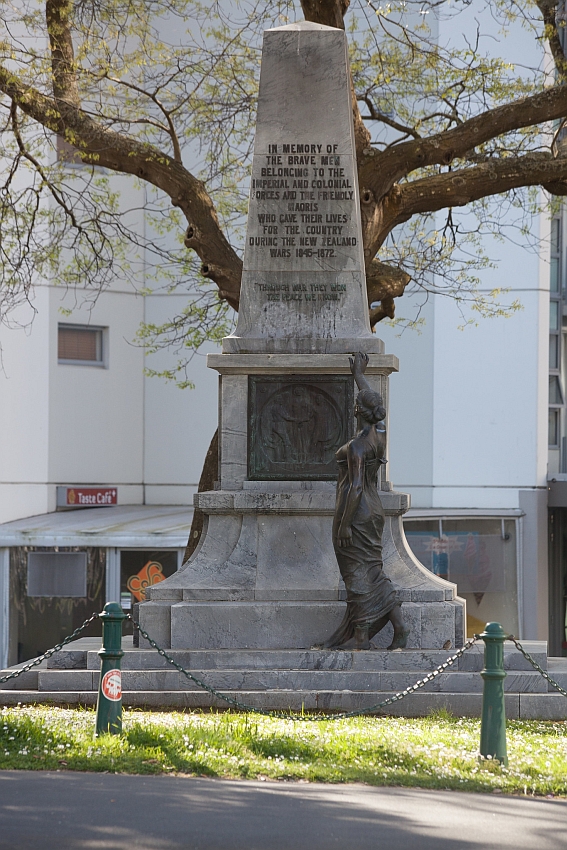
The New Zealand Wars Memorial is located in the Wakefield Street Reserve, on the corner of Wakefield Street and Symonds Street in the southern part of Auckland's Central Business District. The reserve is triangular in shape, with Wakefield Street bounding it on two sides and Symonds Street on the third. It is approximately 1000 m² in area. The monument is situated in the middle of the reserve and is surrounded by mature trees. The monument consists of a short obelisk mounted on a square plinth, with a life-size bronze statue of a female figure at the base of the monument on its eastern side. Both the plinth and statue stand on top of three shallow steps. The plinth is set in concrete at ground level, and is surrounded by the steps on all four sides. The obelisk and plinth are constructed of grey and white Takaka marble. An inscription on the elevation of the obelisk facing Symonds Street reads: 'In memory of the brave men belonging to the Imperial and Colonial forces and the friendly Maoris who gave their lives for the country during the N.Z. Wars 1845 - 72. Through war they won the peace we know'. A bronze plaque (790 mm²) on the plinth beneath the inscription is entitled 'Peace'. The plaque depicts a Pakeha male (wearing a shirt, trousers and boots) shaking hands with a Maori male (wearing a pendant and traditional skirt), both enclosed within the wings of a female angel. Another bronze plaque (also 790 mm²) on the side facing Wakefield Street is entitled 'Onwards'. It depicts a Maori figure (wearing a feather cloak and traditional skirt) holding a spear, and a female figure in classical drapery holding the New Zealand flag. The female rests a hand on the New Zealand crest. Above the crest a lion rampant holds the Union Jack. A 1.8m (6 foot) bronze-cast female figure stands on the top step (on the Symonds Street side), dressed in classical drapery below the breasts. The left hand holds a New Zealand flag, which trails down over the steps. The right hand is extended up towards the obelisk. Inscribed on the bottom of the statue is 'E. Groult Fondeur Paris. H. Lecouty Paris - C'. The statue originally held a long palm branch in its right hand. The date of the removal of the palm is unknown, but it was sometime before 1981. The head of the statue was removed in 1981. The rest of the statue was subsequently removed from the monument for restoration. In August 2004, the statue was returned to the monument with a new head. The head was modelled in clay and recast in silicon bronze by sculptor Roderick Burgess.
The New Zealand Wars Memorial is located in the Wakefield Street Reserve, on the corner of Wakefield Street and Symonds Street in the southern part of Auckland's Central Business District. The reserve is triangular in shape, with Wakefield Street bounding it on two sides and Symonds Street on the third. It is approximately 1000 m² in area. The monument is situated in the middle of the reserve and is surrounded by mature trees. The monument consists of a short obelisk mounted on a square plinth, with a life-size bronze statue of a female figure at the base of the monument on its eastern side. Both the plinth and statue stand on top of three shallow steps. The plinth is set in concrete at ground level, and is surrounded by the steps on all four sides. The obelisk and plinth are constructed of grey and white Takaka marble. An inscription on the elevation of the obelisk facing Symonds Street reads: 'In memory of the brave men belonging to the Imperial and Colonial forces and the friendly Maoris who gave their lives for the country during the N.Z. Wars 1845 - 72. Through war they won the peace we know'. A bronze plaque (790 mm²) on the plinth beneath the inscription is entitled 'Peace'. The plaque depicts a Pakeha male (wearing a shirt, trousers and boots) shaking hands with a Maori male (wearing a pendant and traditional skirt), both enclosed within the wings of a female angel. Another bronze plaque (also 790 mm²) on the side facing Wakefield Street is entitled 'Onwards'. It depicts a Maori figure (wearing a feather cloak and traditional skirt) holding a spear, and a female figure in classical drapery holding the New Zealand flag. The female rests a hand on the New Zealand crest. Above the crest a lion rampant holds the Union Jack. A 1.8m (6 foot) bronze-cast female figure stands on the top step (on the Symonds Street side), dressed in classical drapery below the breasts. The left hand holds a New Zealand flag, which trails down over the steps. The right hand is extended up towards the obelisk. Inscribed on the bottom of the statue is 'E. Groult Fondeur Paris. H. Lecouty Paris - C'. The statue originally held a long palm branch in its right hand. The date of the removal of the palm is unknown, but it was sometime before 1981. The head of the statue was removed in 1981. The rest of the statue was subsequently removed from the monument for restoration. In August 2004, the statue was returned to the monument with a new head. The head was modelled in clay and recast in silicon bronze by sculptor Roderick Burgess.
Historical and Associated Iwi / Hapū / Whānau
Information Sources
Auckland Public Libraries
Auckland Public Libraries
Auckland Weekly News
Auckland Weekly News
Woodward, 1972
Robin Woodward, 'Public Sculptures in Auckland, 1895 - 1971', MA Thesis, University of Auckland, 1972
MacLean, 1990
Chris MacLean and Jock Phillips, The Sorrow and the Pride: New Zealand War Memorials, Wellington, 1990
Maslen, 1985
Shona Maslen, The Victoria League for Commonwealth Friendship in Auckland: A Further 25 Years, Auckland, 1985
New Zealand Herald
New Zealand Herald, 12 July 1932, p. 6; 28 September 1933, p. 6.
Simmonds, 1960
Alma N. Simmonds, Fifty Years of the Victoria League in Auckland, New Zealand: 1910 - 1960, Golden Jubilee Year, Auckland, 1960
Other Information
A fully referenced registration report is available from the NZHPT Northern Region Office Please note that entry on the New Zealand Heritage List/Rarangi Korero identifies only the heritage values of the property concerned, and should not be construed as advice on the state of the property, or as a comment of its soundness or safety, including in regard to earthquake risk, safety in the event of fire, or insanitary conditions.
Current Usages
Uses: Commemoration
Specific Usage: Memorial - New Zealand Wars
Former Usages
General Usage: Commemoration
Specific Usage: Memorial - New Zealand Wars
Themes
War Memorial
New Zealand Wars
Of Significance to Maori
Current Usages
Uses: Commemoration
Specific Usage: Memorial - New Zealand Wars
Former Usages
General Usage: Commemoration
Specific Usage: Memorial - New Zealand Wars
Themes
War Memorial
New Zealand Wars
Of Significance to Maori
Get the latest heritage news, features and events delivered
straight to your inbox.