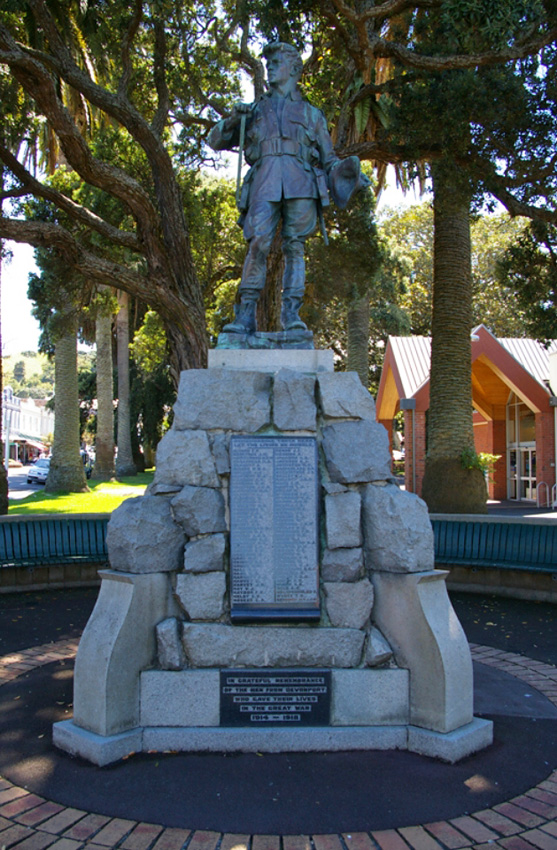
Unveiled by Lord Jellicoe in 1924, the First World War Memorial in Devonport commemorates soldiers from Devonport who died in both the First and Second World Wars (1914-1918 and 1939-1945). Incorporating the sculpture of a soldier of unusual, informal design, it was erected on Victoria Road - Devonport's main commercial thoroughfare - alongside Windsor Reserve, the site of the settlement's first naval base. The Reserve was also the location of the Council Chambers from 1887 until the early 1950s. The monument was one of many memorials built in communities throughout New Zealand following the First World War. As noted by historians Chris Maclean and Jock Phillips, the memorials served as surrogate tombs for families of New Zealanders buried in overseas graves, and commemorated the achievements of all those who lost their lives.
Devonport's military connections
Devonport had strong connections with military service from the beginning of European settlement in the area. An ammunition depot and naval stores were established in Devonport (then known as Flagstaff) in 1841, the same year that the land was purchased by the Crown from Ngati Paoa. During the 1800s, Windsor Reserve was known as the Naval Reserve and was used as a landing place for naval vessels. Towards the end of the century, the navy moved to nearby Calliope Point where the current naval base was established.
During the Russian Scare of 1885, fortifications and gun batteries were built at Mt Victoria, Fort Takapuna and North Head in Devonport, as well as at Fort Bastion and Fort Resolution on the south side of Waitemata Harbour. The fortifications were adapted and modernised during the First and Second World Wars. During periods of tension, such as wartime, the batteries were fully manned.
A history of commemoration had already been established before the construction of the First World War Memorial. The Coronation Sea Wall erected by the Borough Council in 1902 along the waterfront southeast of Windsor Reserve incorporates an inscription to 'Peace in South Africa' at the end of the Second Boer War (1899-1902), as well as commemorating the coronation of Edward VII in the same year. A further memorial in the form of a fountain was erected in Windsor Reserve the following year to commemorate the two men from the district who had fallen in the conflict, the first in which New Zealand volunteers served overseas.
Construction of the First World War Memorial
In June 1919, the Devonport Borough Council decided to hold a public meeting to discuss erecting a memorial to the soldiers who had died in the First World War. A newspaper report of the meeting noted that the idea of a war memorial had been 'in the air for some time' in the Devonport community. The first public meeting was held on 14 August 1919 at the Parish Hall, at which a management committee was elected, consisting of council members and local residents. The meeting was attended by about 100 residents. At the meeting a number of suggestions were made about possible structures for the memorial, including a library and gymnasium, a public hall, a Corinthian column and an astronomical observatory on Mt Victoria. The Mayor stressed that the greatest consideration should be given to the residents whose sons had gone to the front.
At the following meeting, in September 1919, the Devonport Memorial Statue Committee decided to erect a memorial of 'monumental design' rather than one of a 'utilitarian nature' in accordance with the wishes of some members of the committee who had lost sons in the war. The committee also decided to erect the monument in the vicinity of Marine Square, which one member described as 'the gateway to the north'. In addition to the main memorial, the committee resolved to erect a memorial in the Public School grounds, which was subsequently unveiled in December 1921.
A public competition for the design of the main memorial was held, won by Frank Lynch in March 1922. Lynch's winning design had been created the previous year. Lynch, who was based in Auckland, designed a bronze statue of a New Zealand soldier in military uniform. He was paid £570 for the work. Another casting of Lynch's statue was also used for the Masterton Memorial. Most of the funds for the Devonport memorial had been raised through public subscriptions.
The statue was cast by A.B. Burton at the Thames Ditton foundry in London, at a cost of £414. It had arrived in New Zealand by April 1923. The New Zealand Shipping Company carried the statue free of charge and the Auckland Harbour Board also made financial concessions.
By the time the statue had arrived in New Zealand, the committee had run out of funds from public subscriptions. The Committee began campaigning straight away. After several months it had procured sufficient funds from further donations from the local community, along with a £250 grant from the Devonport Borough Council.
The decision over the design for the base took more than six months, as there was some controversy over the form it should take. Eventually, in October 1923, a design by a local company Messrs. McNab and Mason was selected, which was the cheapest of the four designs submitted. The company began constructing the monument in the same month.
In the meantime, there had been considerable controversy over a suitable location for the memorial. There were many residents, including the Mayor, who supported the current site for the memorial next to the Council chambers. However, there were also a number of supporters of other locations, including Marine Square and another position in Windsor Reserve on the waterfront. There were still petitions to change the location of the memorial after construction had begun on the site near the Council chambers.
Unveiling of the First World War Memorial
The First World War Memorial was unveiled on 13 April 1924, by the Governor General, Viscount Jellicoe (1859-1935). It was one of the last public ceremonies attended in New Zealand by Lord Jellicoe, who completed his term of office soon afterwards. An admirer of New Zealand's staunchly loyal attitude to empire, Lord Jellicoe had been First Sea Lord of the British Admiralty for a year from December 1916 and assumed office as Governor General of New Zealand in September 1920. The ceremony was attended by an estimated crowd of 4000 to 5000 people, with Victoria Road and part of King Edward Parade closed off to accommodate the crowds.
The Mayor of Devonport, Mr. T. Lamont, presided over the ceremony. It was also attended by several military personnel, politicians including Sir Maui Pomare and Hon. C.J. Parr, and church dignitaries, including the Bishop of Auckland, Rt Rev. A. W. Averill.
Addresses were made by the Mayor, Sir Maui Pomare (on 'behalf of the Native Races'), the Hon. C.J. Parr ('on behalf of Cabinet') and Lord Jellicoe. Lord Jellicoe commented on the quality of the New Zealand soldiers and how ready they were to serve the Empire. 'I hope' he said, 'that this memorial, which tells to all so great a tale of heroism, self-sacrifice and loyalty, will forever be guarded as a sacred trust by the people of Devonport'.
The next-of kin of the soldiers killed in the war were provided with seats. Officers and men were inspected by Lord Jellicoe. A number of groups paraded, including the Devonport Senior Cadets, girl guides, boy scouts and sea scouts, parties of HMS Chatham and Philomel, local friendly societies, Sunday School children, members of the RNVR and veterans. Music was provided by the Devonport Boys' Brass Band. At the end of the ceremony the next of kin and various societies laid wreaths on the monument.
The memorial was formally handed over to the Devonport Borough Council on 25 May 1925.
The unusual soldier figure on the memorial drew comment from the public from the very beginning. Unlike most First World War memorials in New Zealand, the figure attempted to portray a New Zealand soldier in a lifelike manner. Most New Zealand communities had ordered soldier figures from Italian firms, which delivered mass-produced statues. Lynch himself commented in a letter to the Prime Minister in 1924 that 'we have, studded throughout New Zealand, presentments of supposed New Zealand soldiers utterly without type or character'.
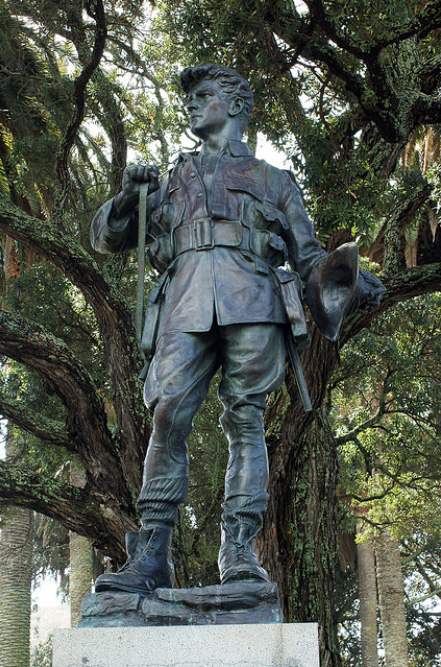
The Devonport statue is described as being distinctly New Zealand, with a 'strong bony' New Zealand face and informal attire, with shoelaces undone and hat in hand. Lynch reportedly commented about his soldier ... 'As he leaves his unfinished job, he takes a last look back at the heights, and doffs his hat to the memory of his dead "cobbers"'. The soldier apparently represented a Gallipoli soldier, and therefore wears clothes from various branches of the military service, including cavalry trousers, infantry boots and an Australian hat. Historians Maclean and Phillips summed up the statue: 'Instead of the stiff stance and blank stares of the mail-order soldier, we have a digger in trench kit about to evacuate from Gallipoli... The result is a genuine effort to capture the personality and distinctiveness of the Kiwi soldier... The mythology of the New Zealand soldier, who failed on the spit-and-polish but was heroic in battle, finds realisation in bronze.'
Lynch apparently used his brother, Joseph, as the model for the soldier, although one fellow student who attended art school with Lynch believed that he was the model.
The memorial continued to draw comment from the public in later years, becoming known as the 'untidy soldier'.
Subsequent history
The monument continued to be a focal point for commemorations in the community after its construction. The Duke and Duchess of York were welcomed to Devonport next to the memorial at the time of their visit in 1927. A photograph of the monument published in 1936 suggests that it was the site of ANZAC Day commemorations during the inter-war period. Following the Second World War, plaques were added to the east and west elevations of the memorial, commemorating the many local men who had died in the conflict. An additional plaque was added to the south side of the memorial in 1999, commemorating the men who left New Zealand to fight in the Second Boer War. This was installed by the Returned Services Association as a way marking the beginning of New Zealand's involvement in overseas conflicts. The memorial continues to be the focus for commemorative services held in Devonport on ANZAC Day (25 April).
Devonport's military connections
Devonport had strong connections with military service from the beginning of European settlement in the area. An ammunition depot and naval stores were established in Devonport (then known as Flagstaff) in 1841, the same year that the land was purchased by the Crown from Ngati Paoa. During the 1800s, Windsor Reserve was known as the Naval Reserve and was used as a landing place for naval vessels. Towards the end of the century, the navy moved to nearby Calliope Point where the current naval base was established.
During the Russian Scare of 1885, fortifications and gun batteries were built at Mt Victoria, Fort Takapuna and North Head in Devonport, as well as at Fort Bastion and Fort Resolution on the south side of Waitemata Harbour. The fortifications were adapted and modernised during the First and Second World Wars. During periods of tension, such as wartime, the batteries were fully manned.
A history of commemoration had already been established before the construction of the First World War Memorial. The Coronation Sea Wall erected by the Borough Council in 1902 along the waterfront southeast of Windsor Reserve incorporates an inscription to 'Peace in South Africa' at the end of the Second Boer War (1899-1902), as well as commemorating the coronation of Edward VII in the same year. A further memorial in the form of a fountain was erected in Windsor Reserve the following year to commemorate the two men from the district who had fallen in the conflict, the first in which New Zealand volunteers served overseas.
Construction of the First World War Memorial
In June 1919, the Devonport Borough Council decided to hold a public meeting to discuss erecting a memorial to the soldiers who had died in the First World War. A newspaper report of the meeting noted that the idea of a war memorial had been 'in the air for some time' in the Devonport community. The first public meeting was held on 14 August 1919 at the Parish Hall, at which a management committee was elected, consisting of council members and local residents. The meeting was attended by about 100 residents. At the meeting a number of suggestions were made about possible structures for the memorial, including a library and gymnasium, a public hall, a Corinthian column and an astronomical observatory on Mt Victoria. The Mayor stressed that the greatest consideration should be given to the residents whose sons had gone to the front.
At the following meeting, in September 1919, the Devonport Memorial Statue Committee decided to erect a memorial of 'monumental design' rather than one of a 'utilitarian nature' in accordance with the wishes of some members of the committee who had lost sons in the war. The committee also decided to erect the monument in the vicinity of Marine Square, which one member described as 'the gateway to the north'. In addition to the main memorial, the committee resolved to erect a memorial in the Public School grounds, which was subsequently unveiled in December 1921.
A public competition for the design of the main memorial was held, won by Frank Lynch in March 1922. Lynch's winning design had been created the previous year. Lynch, who was based in Auckland, designed a bronze statue of a New Zealand soldier in military uniform. He was paid £570 for the work. Another casting of Lynch's statue was also used for the Masterton Memorial. Most of the funds for the Devonport memorial had been raised through public subscriptions.
The statue was cast by A.B. Burton at the Thames Ditton foundry in London, at a cost of £414. It had arrived in New Zealand by April 1923. The New Zealand Shipping Company carried the statue free of charge and the Auckland Harbour Board also made financial concessions.
By the time the statue had arrived in New Zealand, the committee had run out of funds from public subscriptions. The Committee began campaigning straight away. After several months it had procured sufficient funds from further donations from the local community, along with a £250 grant from the Devonport Borough Council.
The decision over the design for the base took more than six months, as there was some controversy over the form it should take. Eventually, in October 1923, a design by a local company Messrs. McNab and Mason was selected, which was the cheapest of the four designs submitted. The company began constructing the monument in the same month.
In the meantime, there had been considerable controversy over a suitable location for the memorial. There were many residents, including the Mayor, who supported the current site for the memorial next to the Council chambers. However, there were also a number of supporters of other locations, including Marine Square and another position in Windsor Reserve on the waterfront. There were still petitions to change the location of the memorial after construction had begun on the site near the Council chambers.
Unveiling of the First World War Memorial
The First World War Memorial was unveiled on 13 April 1924, by the Governor General, Viscount Jellicoe (1859-1935). It was one of the last public ceremonies attended in New Zealand by Lord Jellicoe, who completed his term of office soon afterwards. An admirer of New Zealand's staunchly loyal attitude to empire, Lord Jellicoe had been First Sea Lord of the British Admiralty for a year from December 1916 and assumed office as Governor General of New Zealand in September 1920. The ceremony was attended by an estimated crowd of 4000 to 5000 people, with Victoria Road and part of King Edward Parade closed off to accommodate the crowds.
The Mayor of Devonport, Mr. T. Lamont, presided over the ceremony. It was also attended by several military personnel, politicians including Sir Maui Pomare and Hon. C.J. Parr, and church dignitaries, including the Bishop of Auckland, Rt Rev. A. W. Averill.
Addresses were made by the Mayor, Sir Maui Pomare (on 'behalf of the Native Races'), the Hon. C.J. Parr ('on behalf of Cabinet') and Lord Jellicoe. Lord Jellicoe commented on the quality of the New Zealand soldiers and how ready they were to serve the Empire. 'I hope' he said, 'that this memorial, which tells to all so great a tale of heroism, self-sacrifice and loyalty, will forever be guarded as a sacred trust by the people of Devonport'.
The next-of kin of the soldiers killed in the war were provided with seats. Officers and men were inspected by Lord Jellicoe. A number of groups paraded, including the Devonport Senior Cadets, girl guides, boy scouts and sea scouts, parties of HMS Chatham and Philomel, local friendly societies, Sunday School children, members of the RNVR and veterans. Music was provided by the Devonport Boys' Brass Band. At the end of the ceremony the next of kin and various societies laid wreaths on the monument.
The memorial was formally handed over to the Devonport Borough Council on 25 May 1925.
The unusual soldier figure on the memorial drew comment from the public from the very beginning. Unlike most First World War memorials in New Zealand, the figure attempted to portray a New Zealand soldier in a lifelike manner. Most New Zealand communities had ordered soldier figures from Italian firms, which delivered mass-produced statues. Lynch himself commented in a letter to the Prime Minister in 1924 that 'we have, studded throughout New Zealand, presentments of supposed New Zealand soldiers utterly without type or character'.
The Devonport statue is described as being distinctly New Zealand, with a 'strong bony' New Zealand face and informal attire, with shoelaces undone and hat in hand. Lynch reportedly commented about his soldier ... 'As he leaves his unfinished job, he takes a last look back at the heights, and doffs his hat to the memory of his dead "cobbers"'. The soldier apparently represented a Gallipoli soldier, and therefore wears clothes from various branches of the military service, including cavalry trousers, infantry boots and an Australian hat. Historians Maclean and Phillips summed up the statue: 'Instead of the stiff stance and blank stares of the mail-order soldier, we have a digger in trench kit about to evacuate from Gallipoli... The result is a genuine effort to capture the personality and distinctiveness of the Kiwi soldier... The mythology of the New Zealand soldier, who failed on the spit-and-polish but was heroic in battle, finds realisation in bronze.'
Lynch apparently used his brother, Joseph, as the model for the soldier, although one fellow student who attended art school with Lynch believed that he was the model.
The memorial continued to draw comment from the public in later years, becoming known as the 'untidy soldier'.
Subsequent history
The monument continued to be a focal point for commemorations in the community after its construction. The Duke and Duchess of York were welcomed to Devonport next to the memorial at the time of their visit in 1927. A photograph of the monument published in 1936 suggests that it was the site of ANZAC Day commemorations during the inter-war period. Following the Second World War, plaques were added to the east and west elevations of the memorial, commemorating the many local men who had died in the conflict. An additional plaque was added to the south side of the memorial in 1999, commemorating the men who left New Zealand to fight in the Second Boer War. This was installed by the Returned Services Association as a way marking the beginning of New Zealand's involvement in overseas conflicts. The memorial continues to be the focus for commemorative services held in Devonport on ANZAC Day (25 April).