

Devonport was an early centre of Maori settlement, which became a British naval station after formal colonisation in 1840. Later developing as a prosperous seaside resort and suburb, Devonport’s reticulated power was initially derived from gas produced locally by the Auckland Gas Company. In 1913, Devonport ratepayers accepted a proposal by an Auckland-based entrepreneur, David M. Davis, to provide rival electric power for lighting, cooking and heating. Davis’ company, the Electricity Supply Corporation, erected an electric power station on Church Street to generate reticulated electricity for up to 1600 homes.
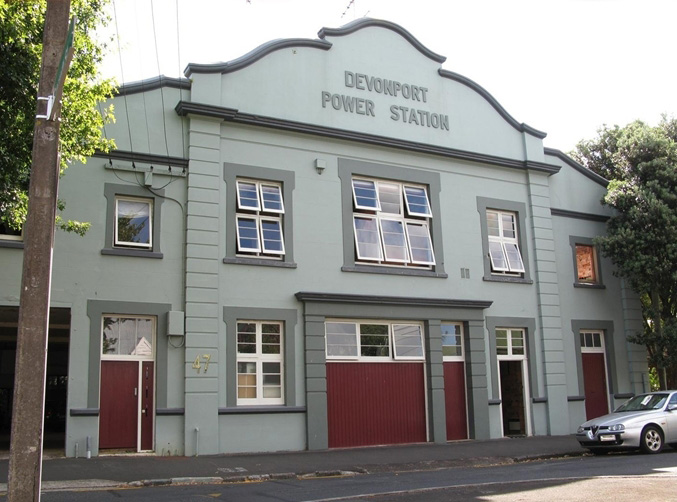
The power station was constructed as a large brick building with a slate roof. Incorporating a distinctive Free Classical façade, it is said to have been designed by W. Robinson. Its interior evidently contained a large central area with flanking rooms on either side, accommodating imported plant from Europe that was initially delayed in its arrival by the outbreak of the First World War (1914-18). It may have been operational by September 1915, when the company provided free electricity to an event to raise money for the Devonport Convalescent Home for wounded soldiers.
Production relied on a DC (direct current) generator powered by reciprocal gas engines, which were in turn powered by coal gas. Subsequent expansion of provision included street lighting for the Borough (1916) and electrified sewage pumps (1917). In 1922, Devonport ratepayers voted to allow the Borough Council to purchase the business and install further plant. Two years later, however, creation of the Waitemata Electric Power Board (WEPB) across the broader region facilitated the supply of AC (alternating current) power from the state grid at a much cheaper cost. The WEPB purchased the Devonport Power Station from the Council for use as a standby in 1927, and closed it down the following year. In 1932-3, the building was used as a kitchen and depot by the Devonport Welfare Association, providing relief to the needy during the Great Depression.
From 1933 to circa 1980, the structure was re-used as a laundry. Initially occupied by the Marine Bagwash Company, it was used by the Northern Laundry Company and the North Shore Dry Cleaning Company from 1941. While men worked in a washing department, women undertook machine ironing in an ironing room. In the late 1980s, the building was converted into apartments through the insertion of internal partitions and some modifications to the earlier fabric. The building remains (2013) in private residential use.
List Entry Information
Status
Listed
List Entry Status
Historic Place Category 2
Access
Private/No Public Access
List Number
4519
Date Entered
27th June 2013
Date of Effect
27th June 2013
City/District Council
Auckland Council
Region
Auckland Council
Extent of List Entry
Extent includes the land described as Lot 3 DP 47726 and Pt Allot 17A Sec 2 Parish of Takapuna (RT NA74A/678), and DP 127389 (RTs NA74A/677, NA87A/104, NA87A/105), North Auckland Land District, and the building known as Devonport Power Station (Former) thereon. (Refer to map in Appendix 1 of the registration report for further information).
Legal description
Lot 3 DP 47726 and Pt Allot 17A Sec 2 Parish of Takapuna (RT NA74A/678), and DP 127389 (RTs NA74A/677, NA87A/104, NA87A/105), North Auckland Land District
Location Description
NZTM Easting: 1760639.0 E; NZTM Northing: 5922871.0 N (taken from approximate centre of site).
Status
Listed
List Entry Status
Historic Place Category 2
Access
Private/No Public Access
List Number
4519
Date Entered
27th June 2013
Date of Effect
27th June 2013
City/District Council
Auckland Council
Region
Auckland Council
Extent of List Entry
Extent includes the land described as Lot 3 DP 47726 and Pt Allot 17A Sec 2 Parish of Takapuna (RT NA74A/678), and DP 127389 (RTs NA74A/677, NA87A/104, NA87A/105), North Auckland Land District, and the building known as Devonport Power Station (Former) thereon. (Refer to map in Appendix 1 of the registration report for further information).
Legal description
Lot 3 DP 47726 and Pt Allot 17A Sec 2 Parish of Takapuna (RT NA74A/678), and DP 127389 (RTs NA74A/677, NA87A/104, NA87A/105), North Auckland Land District
Location Description
NZTM Easting: 1760639.0 E; NZTM Northing: 5922871.0 N (taken from approximate centre of site).
Why is this place significant?
Cultural Significance
Social Significance or Value: The place has social significance for the substantial impact it made on the everyday lives of Devonport’s citizens between 1915 and 1928, a time when the suburb was the largest settlement on Auckland’s North Shore. Electricity revolutionised many aspects of life, including work practices, domestic tasks, forms of entertainment and communications. At Devonport, it specifically provided for cooking, lighting and heating; and also enabled street lighting and efficient sewage disposal. The place also has social significance for its connections with the provision of welfare during the Great Depression, when the building served as a kitchen and depot to assist the poor and needy. It also has value for reflecting attitudes to hygiene: for nearly 50 years from 1933, the building was used for washing and dry cleaning laundry at a time when many homes lacked suitable facilities. Work practices carried out in the building during this period characterised the separate gender roles found commonly in mid twentieth-century New Zealand.
Historic Significance
Historical Significance or Value The Devonport Power Station (Former) is important for its close connections with the earliest public electricity scheme on Auckland’s North Shore. It reflects the rise of reticulated electricity schemes in early twentieth-century New Zealand, which transformed the lives of many citizens. Created by the Electricity Supply Corporation (NZ) Limited, it particularly demonstrates the involvement of private enterprise in such schemes before regional electricity boards were established to purchase hydro-electric and other power from the state. Its subsequent use by Devonport Borough Council and then the Waitemata Electric Power Board in the 1920s also reflects the importance of both local government and regional bodies in electricity provision during this period. The Devonport Power Station (Former) has connections with other significant historical developments and events, being affected by the outbreak of hostilities in First World War (1914-18) and the impacts of the Great Depression in the 1930s.
Physical Significance
Aesthetic Significance or Value: The Devonport Power Station has aesthetic significance for its distinctive and elegant façade to Church Street, which includes a parapet of unusual design, rusticated pilasters and lettering that proclaims its original function. Its significance is enhanced by the contribution it makes to the visual character of a streetscape that is notable for its well-preserved and well-presented structures of late nineteenth- and early twentieth-century date. Architectural Significance or Value: The Devonport Power Station has architectural significance as a rare and distinctive surviving example of an early electric power station building in Auckland. Of Free Classical style, it is also important as an uncommon surviving example of a building linked with electric power generation in Auckland that reflects architectural preferences for such structures before the widespread adoption of Art Deco (and Moderne) design from the 1920s onwards. It can be regarded as an architectural statement that celebrated the arrival of electricity in Devonport, and the new status that this utility conferred on the Borough. The building can be considered significant for its ability to demonstrate the beginnings of a transition to Stripped Classical design - an architectural style that was popular for commercial buildings in the Inter-War years. Technological Significance or Value: The place has technological significance for its association with the generation of DC (direct current) electricity for reticulation in a limited area. The place is also associated with the change to AC (alternating current) power, which gained precedence as a part of an integrated and homogenous national system.
Why is this place Category 1 / Category 2?
Detail Of Assessed Criteria
(a) The extent to which the place reflects important or representative aspects of New Zealand history: The place is significant for demonstrating the earliest provision of reticulated electricity on Auckland’s North Shore. It reflects the particular popularity of electricity-generating schemes in New Zealand during the second decade of the twentieth century, and the rapid growth in electricity consumers during this period. It illustrates the involvement of private enterprise in many generating schemes, and also the increasing tendency for this to be superseded by publicly-controlled provision. It reflects the comparative lateness with which Auckland took up electricity generation for its citizens, in contrast with some other centres. The creation of the power station building within a largely residentially area demonstrates the pragmatic approaches to urban planning that prevailed before alternative concepts were introduced under the Town Planning Act 1926. (b) The association of the place with events, persons, or ideas of importance in New Zealand history: The place is closely associated with a variety of bodies or institutions of significance on Auckland’s North Shore. These include the earliest providers of reticulated electricity to the general public - the Electricity Supply Corporation (NZ) Limited. The place was subsequently owned and operated by the Devonport Borough Council and then the Waitemata Electric Power Board. Significant individuals with close associations to the place include B.H. Goldsmith, who had previously been in charge of the Napier Power Station and was later to become manager of the Taranaki Power Board. The building has connections with the First World War through impacts on its opening by the delayed arrival of plant. It also supplied free electricity to a fundraising event for the Devonport Convalescent Home for wounded soldiers. The place has close associations with the Great Depression, having been used as a kitchen and a depot for the poor and needy in 1932-3. This was operated by a local body, the Devonport Welfare Association. The place was later occupied by laundry and dry cleaning companies, at least one of which serviced an area extending as far north as Warkworth. (e) The community association with, or public esteem for, the place: The place has some community association through its ownership during the 1920s by Devonport Borough Council, a purchase authorised by a vote of local ratepayers. From 1915 to 1927-8, it formed a key local amenity, providing power for cooking, lighting and heating to a large number of homes in the district. It also provided power for street lighting, sewage pumping and other functions of value to the community. (g) The technical accomplishment or value, or design of the place: The place has value for its distinctive Free Classical design, which can be seen as celebrating the arrival of electricity in Devonport, and the new status that this utility conferred on the Borough. The place is also important for reflecting the architectural design of electric power stations in Auckland prior to the widespread adoption of Art Deco (and Moderne) style from the 1920s onwards. (j) The importance of identifying rare types of historic places: The place is significant as a rare surviving example of an early electric power station in Auckland. Its construction pre-dates the creation of regional electricity boards, which distributed power purchased from the state grid from 1918 onwards. (k) The extent to which the place forms part of a wider historical and cultural complex or historical and cultural landscape: The place forms a notable part of a historic landscape in Devonport, which is important as a well-preserved nineteenth- and early twentieth-century seaside resort and suburb. It has particular significance as part of an archaeological, historical and traditional landscape that encompasses Takarunga / Mt Victoria and its associated foreshore, which demonstrates Devonport’s development from early human arrival to recent times. The place is also significant for its immediate contribution to the Church Street landscape. The latter remains a well-preserved thoroughfare incorporating residential and other structures that reflect Devonport’s historical development from the nineteenth century onwards.
Why is this place significant?
Cultural Significance
Social Significance or Value: The place has social significance for the substantial impact it made on the everyday lives of Devonport’s citizens between 1915 and 1928, a time when the suburb was the largest settlement on Auckland’s North Shore. Electricity revolutionised many aspects of life, including work practices, domestic tasks, forms of entertainment and communications. At Devonport, it specifically provided for cooking, lighting and heating; and also enabled street lighting and efficient sewage disposal. The place also has social significance for its connections with the provision of welfare during the Great Depression, when the building served as a kitchen and depot to assist the poor and needy. It also has value for reflecting attitudes to hygiene: for nearly 50 years from 1933, the building was used for washing and dry cleaning laundry at a time when many homes lacked suitable facilities. Work practices carried out in the building during this period characterised the separate gender roles found commonly in mid twentieth-century New Zealand.
Historic Significance
Historical Significance or Value The Devonport Power Station (Former) is important for its close connections with the earliest public electricity scheme on Auckland’s North Shore. It reflects the rise of reticulated electricity schemes in early twentieth-century New Zealand, which transformed the lives of many citizens. Created by the Electricity Supply Corporation (NZ) Limited, it particularly demonstrates the involvement of private enterprise in such schemes before regional electricity boards were established to purchase hydro-electric and other power from the state. Its subsequent use by Devonport Borough Council and then the Waitemata Electric Power Board in the 1920s also reflects the importance of both local government and regional bodies in electricity provision during this period. The Devonport Power Station (Former) has connections with other significant historical developments and events, being affected by the outbreak of hostilities in First World War (1914-18) and the impacts of the Great Depression in the 1930s.
Physical Significance
Aesthetic Significance or Value: The Devonport Power Station has aesthetic significance for its distinctive and elegant façade to Church Street, which includes a parapet of unusual design, rusticated pilasters and lettering that proclaims its original function. Its significance is enhanced by the contribution it makes to the visual character of a streetscape that is notable for its well-preserved and well-presented structures of late nineteenth- and early twentieth-century date. Architectural Significance or Value: The Devonport Power Station has architectural significance as a rare and distinctive surviving example of an early electric power station building in Auckland. Of Free Classical style, it is also important as an uncommon surviving example of a building linked with electric power generation in Auckland that reflects architectural preferences for such structures before the widespread adoption of Art Deco (and Moderne) design from the 1920s onwards. It can be regarded as an architectural statement that celebrated the arrival of electricity in Devonport, and the new status that this utility conferred on the Borough. The building can be considered significant for its ability to demonstrate the beginnings of a transition to Stripped Classical design - an architectural style that was popular for commercial buildings in the Inter-War years. Technological Significance or Value: The place has technological significance for its association with the generation of DC (direct current) electricity for reticulation in a limited area. The place is also associated with the change to AC (alternating current) power, which gained precedence as a part of an integrated and homogenous national system.
Why is this place Category 1 / Category 2?
Detail Of Assessed Criteria
(a) The extent to which the place reflects important or representative aspects of New Zealand history: The place is significant for demonstrating the earliest provision of reticulated electricity on Auckland’s North Shore. It reflects the particular popularity of electricity-generating schemes in New Zealand during the second decade of the twentieth century, and the rapid growth in electricity consumers during this period. It illustrates the involvement of private enterprise in many generating schemes, and also the increasing tendency for this to be superseded by publicly-controlled provision. It reflects the comparative lateness with which Auckland took up electricity generation for its citizens, in contrast with some other centres. The creation of the power station building within a largely residentially area demonstrates the pragmatic approaches to urban planning that prevailed before alternative concepts were introduced under the Town Planning Act 1926. (b) The association of the place with events, persons, or ideas of importance in New Zealand history: The place is closely associated with a variety of bodies or institutions of significance on Auckland’s North Shore. These include the earliest providers of reticulated electricity to the general public - the Electricity Supply Corporation (NZ) Limited. The place was subsequently owned and operated by the Devonport Borough Council and then the Waitemata Electric Power Board. Significant individuals with close associations to the place include B.H. Goldsmith, who had previously been in charge of the Napier Power Station and was later to become manager of the Taranaki Power Board. The building has connections with the First World War through impacts on its opening by the delayed arrival of plant. It also supplied free electricity to a fundraising event for the Devonport Convalescent Home for wounded soldiers. The place has close associations with the Great Depression, having been used as a kitchen and a depot for the poor and needy in 1932-3. This was operated by a local body, the Devonport Welfare Association. The place was later occupied by laundry and dry cleaning companies, at least one of which serviced an area extending as far north as Warkworth. (e) The community association with, or public esteem for, the place: The place has some community association through its ownership during the 1920s by Devonport Borough Council, a purchase authorised by a vote of local ratepayers. From 1915 to 1927-8, it formed a key local amenity, providing power for cooking, lighting and heating to a large number of homes in the district. It also provided power for street lighting, sewage pumping and other functions of value to the community. (g) The technical accomplishment or value, or design of the place: The place has value for its distinctive Free Classical design, which can be seen as celebrating the arrival of electricity in Devonport, and the new status that this utility conferred on the Borough. The place is also important for reflecting the architectural design of electric power stations in Auckland prior to the widespread adoption of Art Deco (and Moderne) style from the 1920s onwards. (j) The importance of identifying rare types of historic places: The place is significant as a rare surviving example of an early electric power station in Auckland. Its construction pre-dates the creation of regional electricity boards, which distributed power purchased from the state grid from 1918 onwards. (k) The extent to which the place forms part of a wider historical and cultural complex or historical and cultural landscape: The place forms a notable part of a historic landscape in Devonport, which is important as a well-preserved nineteenth- and early twentieth-century seaside resort and suburb. It has particular significance as part of an archaeological, historical and traditional landscape that encompasses Takarunga / Mt Victoria and its associated foreshore, which demonstrates Devonport’s development from early human arrival to recent times. The place is also significant for its immediate contribution to the Church Street landscape. The latter remains a well-preserved thoroughfare incorporating residential and other structures that reflect Devonport’s historical development from the nineteenth century onwards.
Construction Details
Start Year
1914
Finish Year
1915
Type
Original Construction
Start Year
1928
Type
Modification
Description
Removal of plant
Start Year
1933
Type
Modification
Description
Conversion to laundry
Start Year
1947
startYearCirca
Type
Addition
Description
Addition of rear lean-to
Type
Modification
Description
Replacement of slate roof cladding with corrugated asbestos
Period
No Date
Type
Modification
Description
Conversion to three residential units, including: addition of internal divisions including upper floor levels; removal of roof cladding to accommodate upper-floor patios; conversion of two windows in the front elevation to doorways; and filling in of tanks beneath internal concrete floor
Period
Late 1980s
Start Year
2011
Type
Partial Demolition
Description
Demolition of circa 1947 rear lean-to, and replacement by a two-storey extension
Construction Materials
Brick with timber roof frame, corrugated asbestos roof cladding and concrete footings
Construction Details
Start Year
1914
Finish Year
1915
Type
Original Construction
Start Year
1928
Type
Modification
Description
Removal of plant
Start Year
1933
Type
Modification
Description
Conversion to laundry
Start Year
1947
startYearCirca
Type
Addition
Description
Addition of rear lean-to
Type
Modification
Description
Replacement of slate roof cladding with corrugated asbestos
Period
No Date
Type
Modification
Description
Conversion to three residential units, including: addition of internal divisions including upper floor levels; removal of roof cladding to accommodate upper-floor patios; conversion of two windows in the front elevation to doorways; and filling in of tanks beneath internal concrete floor
Period
Late 1980s
Start Year
2011
Type
Partial Demolition
Description
Demolition of circa 1947 rear lean-to, and replacement by a two-storey extension
Construction Materials
Brick with timber roof frame, corrugated asbestos roof cladding and concrete footings
Early history of the site: The northern shores of the Waitemata Harbour are of significance to several iwi, having been explored and occupied since early human arrival in New Zealand. According to oral tradition, the Arawa canoe under the navigator chief Tama Te Kapua investigated the Waitemata. The Tainui canoe also landed at Te Hau Kapua (Torpedo Bay) in present-day Devonport before travelling to its eventual heartland in the Waikato. People are already said to have been living at Te Hau Kapua at the time that the Tainui canoe visited. Physical evidence of very early settlement has been found on the foreshore, where adzes were manufactured on stone working floors. Recorded horticultural features in the Maunga Uika (North Head), Takarunga (Mt Victoria) and Takararo (Mt Cambria) vicinity, and evidence of terraces, pits and midden, indicate that Maori occupied the volcanic cones in later times. The area now occupied by Church Street lay between Takarunga and Takararo, and was overlooked by another settlement near the foreshore at Te Kurae-a-Tura (Duder’s Hill). Following Ngapuhi incursions in the 1820s, much of the North Shore was depopulated, assisting its purchase by the British Crown after formal colonisation in 1840. A small Maori settlement at Te Hau Kapua remained until 1863. The grave of Eruera Maihi Patuone (d.1872), a Hokianga chief with close Ngati Paoa associations, lies on the northwest side of Takarunga in the Mt Victoria Cemetery. Subsequently described by the government as a 'warm friend of Europeans, supporter of the Queen's laws, and Peacemaker', Patuone was a signatory of the Declaration of the Independence of New Zealand in 1836 - which requested British protection - and the Treaty of Waitangi in 1840. Patuone spent the last two decades of his life at Devonport, where his funeral was attended by 500 mourners, both Maori and Pakeha, in 1872. Devonport emerged as a colonial settlement with its use as a British naval station from the 1840s - the first to be established in New Zealand. The latter included a signal station on the top of Takarunga / Mt Victoria. Crown land in the area was subdivided into suburban farms in 1850 and subsequently offered for sale. Although Devonport was subject to speculation and land subdivision in the 1860s, large-scale development emerged primarily during the economic boom of the 1870s and 1880s. With the establishment of good quality ferry services to and from Auckland, Devonport became a well-established residential suburb and significant seaside resort. The site on which the Devonport Power Station was constructed lay within Allotment 17A, which was issued as a Crown Grant in 1853. By December 1864, the site - located in the southern part of the Allotment - contained a house and garden. This was associated with expanding settlement that was centred on the wharf at the foot of Church Street (then known as Great North Road). After subdivision of the allotment, the site formed part of Lots 1 and 2, which were successively owned by Short (1868), Somerfield (1869), Mrs Durance (1880) and Fisher (1905). By the second decade of the twentieth century, the property was occupied by John St. Clair, solicitor. In 1914, an agreement between St.Clair and the Electricity Supply Corporation (NZ) Limited allowed part of the land to be taken for the construction of an electric power station fronting Church Street. Construction of the Devonport Power Station (1914-15): The power station was to form the centrepiece of a privately-run scheme to supply electricity to Devonport Borough. This was the first to provide public electricity on Auckland’s North Shore. Reticulated power in the district had previously been confined to gas, which had been produced in Devonport by the Auckland Gas Company since 1883. Early proposals for the local generation of electricity included a suggestion in 1907 by a Mr Fenn. Impetus gathered with preparations in Auckland for a large coal-fired station on King’s Wharf (opened in 1913), which risked placing Devonport at a disadvantage as a desirable residential and commercial centre in comparison with other Auckland suburbs. The earliest electricity scheme in Auckland had previously opened at the municipal destructor plant in 1908, reticulating a small number of consumers. Auckland, including the North Shore, lagged behind other parts of the country in the provision of electricity. In the first two decades of the twentieth century, small electricity generating plants serving restricted areas proliferated throughout New Zealand. Schemes were run either by private companies or local authorities, with the latter becoming particularly popular in the second decade of the century. Growing interest in the use of electric power led to a nationwide increase in electricity consumers from 17,000 in 1912 to 45,000 in 1916. At this time, almost one third of dwellings nationally were lit by electricity; only proportions in the United States of America and Canada were higher. Electricity transformed the lives of many citizens, revolutionising work practices, domestic tasks, forms of entertainment and communications. In October 1912, Devonport Borough Council invited applications for the supply of electricity to the district. A tender by David M. Davis, an Auckland-based entrepreneur, offered to provide electric power for lighting, cooking and heating, with the option of supplying energy for traction - such as trams - at a later date. After considerable debate, a poll of local ratepayers in April 1913 confirmed that supply should be undertaken by private enterprise rather than by the municipality due to the large financial outlay involved. Davis subsequently established the Electricity Supply Corporation (N.Z.) Ltd. to raise the necessary capital. A fellow investor was William John Bray (1862-1931), who had formerly been the publican of Devonport’s Esplanade Hotel. The company secured a similar agreement for a scheme at Tamaki West. The Devonport Power Station was intended to service some 1600 homes within an area of roughly one square mile. The cost of the works - including the site, poles, cables, power and generating plant and building - was initially estimated to be approximately £10,000. The Church Street site may have been chosen for its central position within the Borough and its proximity to the Council’s works depot. A determining factor is also likely to have been a local water source which was capable of providing 28,000 gallons daily from a small bore. The power station was to be erected in a predominantly residential neighbourhood in spite of potential noise and pollution, indicating a pragmatic approach to urban planning prior to alternative concepts introduced by the Town Planning Act 1926. Excavation work was reported to be underway and nearing completion in December 1914. The power house was constructed as a large single-storey, brick building with a diamond slate roof. The edifice can be regarded as an architectural statement that celebrated the arrival of electricity in Devonport, and the new status that this utility conferred on the Borough. A sense of monumentality was conveyed through the use of pilasters and distinctive, ogee-curved parapets on its plastered, Church Street façade. Of Free Classical style, the building’s restrained detailing indicates that it may have been influenced by the emerging Stripped Classical design – popular in the Inter-War years. Internally, the building’s rectangular floor plan evidently encompassed a large central area that was open to a high, gabled roof, with narrower rooms on either side. The building’s architect is said to have been W. Robinson. Completion of the facility was affected by the outbreak of the First World War in late 1914. Plant and equipment that had been ordered from Europe were delayed by hostilities, but on their way by March 1915. The power house was operational by August 1915. In the following month, the company provided free electricity to an event at Devonport parish hall organised by the Devonport Women’s War Relief Assistance Association. This was to raise funds for the Devonport Convalescent Home for wounded soldiers. A small staff included chief engineer, B.H. Goldsmith, who had previously been in charge of the Napier Power Station and was later to become manager of the Taranaki Power Board. Goldsmith was temporarily replaced in 1917-18 while undertaking military service as part of the Fortieth Reinforcements. Electricity production at the plant relied on a DC (direct current) generator powered by reciprocal gas engines. The latter were in turn powered by coal gas. Subsequent expansion of provision included street lighting in the Borough in December 1916 and electrified sewage pumps in 1917. Production is considered to have stimulated local industrial activity, including sawmilling on the Devonport waterfront. In spite of these successes, the Electrical Supply Corporation struggled financially. Between 1916 and 1921, it lost nearly £7,000. In 1922, Devonport ratepayers voted to raise £40,000 so that the Borough Council could purchase the business and install further plant. By this time, citizens evidently saw the power station as an essential civic amenity. Public ownership (1922-1933): After municipal purchase, Devonport Council enlarged the network to encompass a pumping station at Takapuna. Due to the limited capacity of DC power to travel extended distances, additional plant was required to generate AC (alternating current) power and to tie this in to the still-operational DC system. In 1923 a new engineer-manager, L.C.H. Sparrow, recommended ‘installation of a rotary converter, to cost about £2000, a water-cooling system for the new main engine, the rebuilding of the power house wall, and the purchase of a motor truck for the electricity department’s use.’ A further £21,000 was invested. Municipal ownership occurred during a period of growing central government involvement in electricity production and management. This included the purchase and construction of large hydro-electric generating plants, and the establishment of regional electricity boards to buy power from the state under the Electric-power Boards Act 1918. A move towards a nationally integrated and homogenous system using AC current was envisaged. In 1924, the Waitemata Electricity Power Board (WEPB) was created to service areas to the north and west of Auckland. Although Devonport Borough Council initially resisted attempts to join the WEPB network, it was estimated that electricity produced by the Devonport Power Station cost more than twice that distributed by regional boards. In 1926, Devonport Council agreed to amalgamate its service with that of the WEPB. Conversion of the Borough to AC power via the regional network took until the following year. The WEPB formally purchased the power station in 1927 and operated it only occasionally, as a standby. In late 1928, the building’s plant was removed and offered for scrap or conversion due to its antiquated nature. Other equipment to be sold included an overhead crane and a benzene engine. The power station stood empty for a few years, until the Great Depression. In 1932, the WEPB was asked to allow the Devonport unemployed to use the building as a shelter and recreation rooms. The WEPB granted the request on condition that the Devonport Borough Council would be responsible for the building, which the Council accepted. A local organisation, the Devonport Welfare Association, created a depot and kitchen in the building by June 1932. According to a contemporary account, gas and electric stoves - the latter installed by the WEPB - enabled cooking and the making of preserves and soup to feed the needy over winter. In 1933, the depot supplied wood, vegetables, meat and boots to 174 relief workers before closing for the season at the end of September. Relief programmes for the unemployed were run by the Devonport Council. Use as a laundry (1933-c.1980) and conversion to apartments (late 1980s): In late 1933, the property was purchased by a laundry company, Marine Suburbs Bagwash Limited. The business is likely to have been attracted to the site by ready access to the former power station’s water source. Water supply was a major issue in Devonport: by 1940, the Council was supplementing its main source from Lake Pupuke by buying 5,000 gallons a day from Auckland City Council. Another laundry, Northern Bagwash run by Meiklejohn and Sons, operated in the same street. In 1941 D.R. Meiklejohn purchased the lease of the former power station, after which both the Northern Laundry Company and the North Shore Dry Cleaning Company appear to have operated from the structure. North Shore Dry Cleaning evidently serviced a wide area, taking orders from as far north as Warkworth. Work activities in the building during the mid-1940s appear to have been gendered. At Northern Laundry, machine ironing was undertaken by women in an ironing room, while high-speed dryers were operated by male workers in a washing department. In 1946, Northern Laundry applied to add a rear lean-to, providing separate accommodation for lunch, dressing and rest rooms for male and female employees. This structure was evidently erected sometime after early 1947. Re-roofing is likely to have involved the replacement of an original slate roof with corrugated asbestos. In 1974 the building incorporated a washing area and coal-fired boiler in its southern room, and an office and a drying and pressing room in its central space. Dry cleaning took place in its northern room. The property remained in use as a laundry and dry cleaners until circa 1980, after which the structure was purchased by a potter, W.R. Farland. In the late 1980s, the building was converted into three apartments. At this time internal divisions, including upper floor levels, were inserted; parts of the roof cladding above the north room of the building were removed to accommodate first-floor patios; and two windows in the front elevation were modified to create doorways. Tanks beneath the concrete floor were also infilled. In 2011, the 1940s rear lean-to was replaced by a two-storey addition occupying a similar footprint, and a small 1980s bridge to a rear garden was also rebuilt. The building remains in use (2013) as private apartments.
Early history of the site: The northern shores of the Waitemata Harbour are of significance to several iwi, having been explored and occupied since early human arrival in New Zealand. According to oral tradition, the Arawa canoe under the navigator chief Tama Te Kapua investigated the Waitemata. The Tainui canoe also landed at Te Hau Kapua (Torpedo Bay) in present-day Devonport before travelling to its eventual heartland in the Waikato. People are already said to have been living at Te Hau Kapua at the time that the Tainui canoe visited. Physical evidence of very early settlement has been found on the foreshore, where adzes were manufactured on stone working floors. Recorded horticultural features in the Maunga Uika (North Head), Takarunga (Mt Victoria) and Takararo (Mt Cambria) vicinity, and evidence of terraces, pits and midden, indicate that Maori occupied the volcanic cones in later times. The area now occupied by Church Street lay between Takarunga and Takararo, and was overlooked by another settlement near the foreshore at Te Kurae-a-Tura (Duder’s Hill). Following Ngapuhi incursions in the 1820s, much of the North Shore was depopulated, assisting its purchase by the British Crown after formal colonisation in 1840. A small Maori settlement at Te Hau Kapua remained until 1863. The grave of Eruera Maihi Patuone (d.1872), a Hokianga chief with close Ngati Paoa associations, lies on the northwest side of Takarunga in the Mt Victoria Cemetery. Subsequently described by the government as a 'warm friend of Europeans, supporter of the Queen's laws, and Peacemaker', Patuone was a signatory of the Declaration of the Independence of New Zealand in 1836 - which requested British protection - and the Treaty of Waitangi in 1840. Patuone spent the last two decades of his life at Devonport, where his funeral was attended by 500 mourners, both Maori and Pakeha, in 1872. Devonport emerged as a colonial settlement with its use as a British naval station from the 1840s - the first to be established in New Zealand. The latter included a signal station on the top of Takarunga / Mt Victoria. Crown land in the area was subdivided into suburban farms in 1850 and subsequently offered for sale. Although Devonport was subject to speculation and land subdivision in the 1860s, large-scale development emerged primarily during the economic boom of the 1870s and 1880s. With the establishment of good quality ferry services to and from Auckland, Devonport became a well-established residential suburb and significant seaside resort. The site on which the Devonport Power Station was constructed lay within Allotment 17A, which was issued as a Crown Grant in 1853. By December 1864, the site - located in the southern part of the Allotment - contained a house and garden. This was associated with expanding settlement that was centred on the wharf at the foot of Church Street (then known as Great North Road). After subdivision of the allotment, the site formed part of Lots 1 and 2, which were successively owned by Short (1868), Somerfield (1869), Mrs Durance (1880) and Fisher (1905). By the second decade of the twentieth century, the property was occupied by John St. Clair, solicitor. In 1914, an agreement between St.Clair and the Electricity Supply Corporation (NZ) Limited allowed part of the land to be taken for the construction of an electric power station fronting Church Street. Construction of the Devonport Power Station (1914-15): The power station was to form the centrepiece of a privately-run scheme to supply electricity to Devonport Borough. This was the first to provide public electricity on Auckland’s North Shore. Reticulated power in the district had previously been confined to gas, which had been produced in Devonport by the Auckland Gas Company since 1883. Early proposals for the local generation of electricity included a suggestion in 1907 by a Mr Fenn. Impetus gathered with preparations in Auckland for a large coal-fired station on King’s Wharf (opened in 1913), which risked placing Devonport at a disadvantage as a desirable residential and commercial centre in comparison with other Auckland suburbs. The earliest electricity scheme in Auckland had previously opened at the municipal destructor plant in 1908, reticulating a small number of consumers. Auckland, including the North Shore, lagged behind other parts of the country in the provision of electricity. In the first two decades of the twentieth century, small electricity generating plants serving restricted areas proliferated throughout New Zealand. Schemes were run either by private companies or local authorities, with the latter becoming particularly popular in the second decade of the century. Growing interest in the use of electric power led to a nationwide increase in electricity consumers from 17,000 in 1912 to 45,000 in 1916. At this time, almost one third of dwellings nationally were lit by electricity; only proportions in the United States of America and Canada were higher. Electricity transformed the lives of many citizens, revolutionising work practices, domestic tasks, forms of entertainment and communications. In October 1912, Devonport Borough Council invited applications for the supply of electricity to the district. A tender by David M. Davis, an Auckland-based entrepreneur, offered to provide electric power for lighting, cooking and heating, with the option of supplying energy for traction - such as trams - at a later date. After considerable debate, a poll of local ratepayers in April 1913 confirmed that supply should be undertaken by private enterprise rather than by the municipality due to the large financial outlay involved. Davis subsequently established the Electricity Supply Corporation (N.Z.) Ltd. to raise the necessary capital. A fellow investor was William John Bray (1862-1931), who had formerly been the publican of Devonport’s Esplanade Hotel. The company secured a similar agreement for a scheme at Tamaki West. The Devonport Power Station was intended to service some 1600 homes within an area of roughly one square mile. The cost of the works - including the site, poles, cables, power and generating plant and building - was initially estimated to be approximately £10,000. The Church Street site may have been chosen for its central position within the Borough and its proximity to the Council’s works depot. A determining factor is also likely to have been a local water source which was capable of providing 28,000 gallons daily from a small bore. The power station was to be erected in a predominantly residential neighbourhood in spite of potential noise and pollution, indicating a pragmatic approach to urban planning prior to alternative concepts introduced by the Town Planning Act 1926. Excavation work was reported to be underway and nearing completion in December 1914. The power house was constructed as a large single-storey, brick building with a diamond slate roof. The edifice can be regarded as an architectural statement that celebrated the arrival of electricity in Devonport, and the new status that this utility conferred on the Borough. A sense of monumentality was conveyed through the use of pilasters and distinctive, ogee-curved parapets on its plastered, Church Street façade. Of Free Classical style, the building’s restrained detailing indicates that it may have been influenced by the emerging Stripped Classical design – popular in the Inter-War years. Internally, the building’s rectangular floor plan evidently encompassed a large central area that was open to a high, gabled roof, with narrower rooms on either side. The building’s architect is said to have been W. Robinson. Completion of the facility was affected by the outbreak of the First World War in late 1914. Plant and equipment that had been ordered from Europe were delayed by hostilities, but on their way by March 1915. The power house was operational by August 1915. In the following month, the company provided free electricity to an event at Devonport parish hall organised by the Devonport Women’s War Relief Assistance Association. This was to raise funds for the Devonport Convalescent Home for wounded soldiers. A small staff included chief engineer, B.H. Goldsmith, who had previously been in charge of the Napier Power Station and was later to become manager of the Taranaki Power Board. Goldsmith was temporarily replaced in 1917-18 while undertaking military service as part of the Fortieth Reinforcements. Electricity production at the plant relied on a DC (direct current) generator powered by reciprocal gas engines. The latter were in turn powered by coal gas. Subsequent expansion of provision included street lighting in the Borough in December 1916 and electrified sewage pumps in 1917. Production is considered to have stimulated local industrial activity, including sawmilling on the Devonport waterfront. In spite of these successes, the Electrical Supply Corporation struggled financially. Between 1916 and 1921, it lost nearly £7,000. In 1922, Devonport ratepayers voted to raise £40,000 so that the Borough Council could purchase the business and install further plant. By this time, citizens evidently saw the power station as an essential civic amenity. Public ownership (1922-1933): After municipal purchase, Devonport Council enlarged the network to encompass a pumping station at Takapuna. Due to the limited capacity of DC power to travel extended distances, additional plant was required to generate AC (alternating current) power and to tie this in to the still-operational DC system. In 1923 a new engineer-manager, L.C.H. Sparrow, recommended ‘installation of a rotary converter, to cost about £2000, a water-cooling system for the new main engine, the rebuilding of the power house wall, and the purchase of a motor truck for the electricity department’s use.’ A further £21,000 was invested. Municipal ownership occurred during a period of growing central government involvement in electricity production and management. This included the purchase and construction of large hydro-electric generating plants, and the establishment of regional electricity boards to buy power from the state under the Electric-power Boards Act 1918. A move towards a nationally integrated and homogenous system using AC current was envisaged. In 1924, the Waitemata Electricity Power Board (WEPB) was created to service areas to the north and west of Auckland. Although Devonport Borough Council initially resisted attempts to join the WEPB network, it was estimated that electricity produced by the Devonport Power Station cost more than twice that distributed by regional boards. In 1926, Devonport Council agreed to amalgamate its service with that of the WEPB. Conversion of the Borough to AC power via the regional network took until the following year. The WEPB formally purchased the power station in 1927 and operated it only occasionally, as a standby. In late 1928, the building’s plant was removed and offered for scrap or conversion due to its antiquated nature. Other equipment to be sold included an overhead crane and a benzene engine. The power station stood empty for a few years, until the Great Depression. In 1932, the WEPB was asked to allow the Devonport unemployed to use the building as a shelter and recreation rooms. The WEPB granted the request on condition that the Devonport Borough Council would be responsible for the building, which the Council accepted. A local organisation, the Devonport Welfare Association, created a depot and kitchen in the building by June 1932. According to a contemporary account, gas and electric stoves - the latter installed by the WEPB - enabled cooking and the making of preserves and soup to feed the needy over winter. In 1933, the depot supplied wood, vegetables, meat and boots to 174 relief workers before closing for the season at the end of September. Relief programmes for the unemployed were run by the Devonport Council. Use as a laundry (1933-c.1980) and conversion to apartments (late 1980s): In late 1933, the property was purchased by a laundry company, Marine Suburbs Bagwash Limited. The business is likely to have been attracted to the site by ready access to the former power station’s water source. Water supply was a major issue in Devonport: by 1940, the Council was supplementing its main source from Lake Pupuke by buying 5,000 gallons a day from Auckland City Council. Another laundry, Northern Bagwash run by Meiklejohn and Sons, operated in the same street. In 1941 D.R. Meiklejohn purchased the lease of the former power station, after which both the Northern Laundry Company and the North Shore Dry Cleaning Company appear to have operated from the structure. North Shore Dry Cleaning evidently serviced a wide area, taking orders from as far north as Warkworth. Work activities in the building during the mid-1940s appear to have been gendered. At Northern Laundry, machine ironing was undertaken by women in an ironing room, while high-speed dryers were operated by male workers in a washing department. In 1946, Northern Laundry applied to add a rear lean-to, providing separate accommodation for lunch, dressing and rest rooms for male and female employees. This structure was evidently erected sometime after early 1947. Re-roofing is likely to have involved the replacement of an original slate roof with corrugated asbestos. In 1974 the building incorporated a washing area and coal-fired boiler in its southern room, and an office and a drying and pressing room in its central space. Dry cleaning took place in its northern room. The property remained in use as a laundry and dry cleaners until circa 1980, after which the structure was purchased by a potter, W.R. Farland. In the late 1980s, the building was converted into three apartments. At this time internal divisions, including upper floor levels, were inserted; parts of the roof cladding above the north room of the building were removed to accommodate first-floor patios; and two windows in the front elevation were modified to create doorways. Tanks beneath the concrete floor were also infilled. In 2011, the 1940s rear lean-to was replaced by a two-storey addition occupying a similar footprint, and a small 1980s bridge to a rear garden was also rebuilt. The building remains in use (2013) as private apartments.
Construction Professionals: Architects: Possibly W. Robinson (1914-15 building) Builders: Unknown Current Description: Context: The Devonport Power Station (Former) is located in the eastern part of Devonport, a marine suburb on Auckland’s North Shore. Devonport is noted for its well-preserved late nineteenth- and early twentieth-century buildings, as well as other historic landscape elements including several volcanic cones. The power station site lies at the eastern base of Takarunga / Mt Victoria, a historically important site that was variously used as a pa, a colonial signal station and fort. Respective remnants of these activities include pits and terraces, a signalman’s cottage, and a well-preserved ‘disappearing gun’ erected in 1899. The hill also accommodates a late nineteenth-century underground reservoir, said to be one of the earliest constructed in Auckland, and the remnants of a Second War World camp. To the east of the power station site, Takararo / Mt Cambria retains more limited evidence for use as a pa, having been extensively quarried. The former power station is situated in Church Street, an old-established thoroughfare in Devonport. The street is characterised by a high proportion of surviving nineteenth- and early twentieth-century buildings, which convey the density of late nineteenth- and early twentieth-century residential and commercial occupation that characterised this part of the suburb. Nearby registered historic places include the Holy Trinity Church (Category 2 historic place; Register no. 504) and the Watson Memorial (Category 2 historic place; Register no. 4517). A number of other historic structures in the locality, including the Masonic Hotel at the corner of Church Street and King Edward Parade, have additionally been recognised by Council scheduling. Site: The site consists of a rectangular property on the west side of Church Street, opposite Cracroft Street. The brick power station building covers most of the land. The building directly fronts onto the pavement of Church Street, and extends to the site boundaries to the north and south. At its western end, the structure has been cut in to the base of Takarunga / Mt Victoria. A small open area to the west of the building has been similarly cut into the slope, albeit at a higher level. Building exterior: The main building consists of a large brick structure, which is essentially rectangular in plan. It has an ornamental façade of Free Classical design to Church Street, and more utilitarian side and rear walls. The building incorporates a gabled roof clad with corrugated asbestos, which is concealed behind a raised parapet on the Church Street elevation. The structure also contains a recent lean-to at the rear. The main elevation is of broadly symmetrical appearance, incorporating decorative accents on its skyline and contrasting textures. Its comparatively restrained detailing can be seen to reflect the beginnings of a transition from Free Classical design to the Stripped Classical style that characterised commercial buildings during the Inter-War period. Vertically divided into three sections, the elevation is plastered and incorporates a dominant central element delineated at each end by rusticated pilasters. Flanking wings are bookended with similar features. The elevation is surmounted by a parapet of distinctive design that incorporates a stepped arrangement of coped ogee curves, which sweep down elegantly from a high central point to each end of the elevation. A central pediment contains the lettering ‘Devonport Power Station’. The elevation features a large number of casement windows, many of which are wider than the more commonplace double-hung sash apertures of the period. Smaller openings in an upper level of the flanking wings have had their original joinery replaced or removed. At ground floor level, a large central portal incorporates both a wide doorway and a narrow flanking entrance. The portal has rusticated pilasters which terminate at a projecting cornice. Other entrances include a wide doorway near the south end, and a narrower door to the north wing. Two further doorways in the elevation have been converted from original windows. Side elevations consist of exposed brick with plain piers. Most of the latter are 5.4m high. Windows between the piers have concrete lintels. The walls are of English Garden Wall bond. The gabled rear wall incorporates an unusual, cross-shaped aperture near its apex which originally supplied additional ventilation. The rear lean-to consists of a two-storey brick structure. Parts of the roof accommodate dormer and recessed windows on the south side, and open patios or terraces on the north. Building interior: The interior incorporates three apartments, each of at least two-storey design. These are located in the central and northern sections of the building. The southern part, accessed from a wide entrance on Church Street, encompasses a roofed, common area. Individual apartments have been created by adding internal partitions, including upper storey levels, to pre-existing brick walls. Apartment spaces at ground-floor level are variously ascribed to courtyard, studio, workshop, parking, foyer or utility usage. Above, split floor levels are specific to each apartment and vary throughout the three-unit complex. These contain living, utility and bedroom spaces, and also provide access to roof decks or patios on the north side of the building. An extension to the westernmost apartment in 2011 provided for a guest bedroom, storage space and office at ground floor level, with a sunroom and covered verandah above. Comparisons: The oldest known electric power station to survive in Auckland is the Power Generator Building, built in 1907-8 as part of the former Auckland Municipal Destructor and Depot (Register no. 7664; Category 1 historic place). A much larger municipal power station at King’s Wharf, Auckland, officially opened in 1913 to the replace that in the Destructor complex, was demolished after being decommissioned. The former Devonport Power Station is considered to be the earliest electric power station for public reticulation on Auckland’s North Shore. A powerhouse that provided electricity to a manager’s house as well as the industrial works at Chelsea Sugar Refinery in 1896 was replaced by a surviving structure in circa 1910 (Register no. 7792; Category 1 historic place). Like the 1907-8 Power Generator Building and the circa 1910 Chelsea powerhouse, the Devonport Power Station’s architecture pre-dates the advent of Art Deco design, a style that commonly influenced the appearance of electricity-related buildings in Auckland from the 1920s onwards - for example, at the headquarters of the Auckland Electric Power Board in Queen Street (Register no. 4470; Category 1 historic place) erected in 1928-30; and the former Auckland Electric Power Board Substation in Epsom (1930; Register no. 4509, Cat 2). The former Devonport Power Station can be considered a rare surviving example of an electric power station building in Auckland linked with public supply from the first two decades of the twentieth century; and an uncommon surviving example of a building connected with electric power generation in Auckland that reflects architectural preferences for such structures before the widespread adoption of Art Deco (and, later, Moderne) design from the 1920s onwards.
Construction Professionals: Architects: Possibly W. Robinson (1914-15 building) Builders: Unknown Current Description: Context: The Devonport Power Station (Former) is located in the eastern part of Devonport, a marine suburb on Auckland’s North Shore. Devonport is noted for its well-preserved late nineteenth- and early twentieth-century buildings, as well as other historic landscape elements including several volcanic cones. The power station site lies at the eastern base of Takarunga / Mt Victoria, a historically important site that was variously used as a pa, a colonial signal station and fort. Respective remnants of these activities include pits and terraces, a signalman’s cottage, and a well-preserved ‘disappearing gun’ erected in 1899. The hill also accommodates a late nineteenth-century underground reservoir, said to be one of the earliest constructed in Auckland, and the remnants of a Second War World camp. To the east of the power station site, Takararo / Mt Cambria retains more limited evidence for use as a pa, having been extensively quarried. The former power station is situated in Church Street, an old-established thoroughfare in Devonport. The street is characterised by a high proportion of surviving nineteenth- and early twentieth-century buildings, which convey the density of late nineteenth- and early twentieth-century residential and commercial occupation that characterised this part of the suburb. Nearby registered historic places include the Holy Trinity Church (Category 2 historic place; Register no. 504) and the Watson Memorial (Category 2 historic place; Register no. 4517). A number of other historic structures in the locality, including the Masonic Hotel at the corner of Church Street and King Edward Parade, have additionally been recognised by Council scheduling. Site: The site consists of a rectangular property on the west side of Church Street, opposite Cracroft Street. The brick power station building covers most of the land. The building directly fronts onto the pavement of Church Street, and extends to the site boundaries to the north and south. At its western end, the structure has been cut in to the base of Takarunga / Mt Victoria. A small open area to the west of the building has been similarly cut into the slope, albeit at a higher level. Building exterior: The main building consists of a large brick structure, which is essentially rectangular in plan. It has an ornamental façade of Free Classical design to Church Street, and more utilitarian side and rear walls. The building incorporates a gabled roof clad with corrugated asbestos, which is concealed behind a raised parapet on the Church Street elevation. The structure also contains a recent lean-to at the rear. The main elevation is of broadly symmetrical appearance, incorporating decorative accents on its skyline and contrasting textures. Its comparatively restrained detailing can be seen to reflect the beginnings of a transition from Free Classical design to the Stripped Classical style that characterised commercial buildings during the Inter-War period. Vertically divided into three sections, the elevation is plastered and incorporates a dominant central element delineated at each end by rusticated pilasters. Flanking wings are bookended with similar features. The elevation is surmounted by a parapet of distinctive design that incorporates a stepped arrangement of coped ogee curves, which sweep down elegantly from a high central point to each end of the elevation. A central pediment contains the lettering ‘Devonport Power Station’. The elevation features a large number of casement windows, many of which are wider than the more commonplace double-hung sash apertures of the period. Smaller openings in an upper level of the flanking wings have had their original joinery replaced or removed. At ground floor level, a large central portal incorporates both a wide doorway and a narrow flanking entrance. The portal has rusticated pilasters which terminate at a projecting cornice. Other entrances include a wide doorway near the south end, and a narrower door to the north wing. Two further doorways in the elevation have been converted from original windows. Side elevations consist of exposed brick with plain piers. Most of the latter are 5.4m high. Windows between the piers have concrete lintels. The walls are of English Garden Wall bond. The gabled rear wall incorporates an unusual, cross-shaped aperture near its apex which originally supplied additional ventilation. The rear lean-to consists of a two-storey brick structure. Parts of the roof accommodate dormer and recessed windows on the south side, and open patios or terraces on the north. Building interior: The interior incorporates three apartments, each of at least two-storey design. These are located in the central and northern sections of the building. The southern part, accessed from a wide entrance on Church Street, encompasses a roofed, common area. Individual apartments have been created by adding internal partitions, including upper storey levels, to pre-existing brick walls. Apartment spaces at ground-floor level are variously ascribed to courtyard, studio, workshop, parking, foyer or utility usage. Above, split floor levels are specific to each apartment and vary throughout the three-unit complex. These contain living, utility and bedroom spaces, and also provide access to roof decks or patios on the north side of the building. An extension to the westernmost apartment in 2011 provided for a guest bedroom, storage space and office at ground floor level, with a sunroom and covered verandah above. Comparisons: The oldest known electric power station to survive in Auckland is the Power Generator Building, built in 1907-8 as part of the former Auckland Municipal Destructor and Depot (Register no. 7664; Category 1 historic place). A much larger municipal power station at King’s Wharf, Auckland, officially opened in 1913 to the replace that in the Destructor complex, was demolished after being decommissioned. The former Devonport Power Station is considered to be the earliest electric power station for public reticulation on Auckland’s North Shore. A powerhouse that provided electricity to a manager’s house as well as the industrial works at Chelsea Sugar Refinery in 1896 was replaced by a surviving structure in circa 1910 (Register no. 7792; Category 1 historic place). Like the 1907-8 Power Generator Building and the circa 1910 Chelsea powerhouse, the Devonport Power Station’s architecture pre-dates the advent of Art Deco design, a style that commonly influenced the appearance of electricity-related buildings in Auckland from the 1920s onwards - for example, at the headquarters of the Auckland Electric Power Board in Queen Street (Register no. 4470; Category 1 historic place) erected in 1928-30; and the former Auckland Electric Power Board Substation in Epsom (1930; Register no. 4509, Cat 2). The former Devonport Power Station can be considered a rare surviving example of an electric power station building in Auckland linked with public supply from the first two decades of the twentieth century; and an uncommon surviving example of a building connected with electric power generation in Auckland that reflects architectural preferences for such structures before the widespread adoption of Art Deco (and, later, Moderne) design from the 1920s onwards.
Historical and Associated Iwi / Hapū / Whānau
Completion Date
14th June 2013
Report Written By
Martin Jones
Information Sources
Bush, 1971
G .W. A. Bush, 'Decently and In Order: The Government of the City of Auckland 1840-1971', Auckland, 1971
Howard, 1981
Grant Howard, The Navy in New Zealand: An Illustrated History, Wellington, 1981
Martin, 1998
J. Martin, People, politics and power stations: electric power generation in New Zealand 1880-1998, Wellington, 1998
Simmons, 1987
David Simmons, Maori Auckland, including Maori Place Names of Auckland. Collected by George Graham, Auckland, 1987
Moon, 2007
Paul Moon, The Struggle for Tamaki Makaurau: The Maori Occupation of Auckland to 1820, Auckland, 2007
Smith, 1975
P.G. Smith, Northwards March the Pylons: A Short History of the First Fifty Years of the Waitemata Electric Power Board, Takapuna, 1975
Other Information
A fully referenced registration report is available from the Northern Region office of NZHPT. Please note that entry on the New Zealand Heritage List/Rarangi Korero identifies only the heritage values of the property concerned, and should not be construed as advice on the state of the property, or as a comment of its soundness or safety, including in regard to earthquake risk, safety in the event of fire, or insanitary conditions.
Historical and Associated Iwi / Hapū / Whānau
Completion Date
14th June 2013
Report Written By
Martin Jones
Information Sources
Bush, 1971
G .W. A. Bush, 'Decently and In Order: The Government of the City of Auckland 1840-1971', Auckland, 1971
Howard, 1981
Grant Howard, The Navy in New Zealand: An Illustrated History, Wellington, 1981
Martin, 1998
J. Martin, People, politics and power stations: electric power generation in New Zealand 1880-1998, Wellington, 1998
Simmons, 1987
David Simmons, Maori Auckland, including Maori Place Names of Auckland. Collected by George Graham, Auckland, 1987
Moon, 2007
Paul Moon, The Struggle for Tamaki Makaurau: The Maori Occupation of Auckland to 1820, Auckland, 2007
Smith, 1975
P.G. Smith, Northwards March the Pylons: A Short History of the First Fifty Years of the Waitemata Electric Power Board, Takapuna, 1975
Other Information
A fully referenced registration report is available from the Northern Region office of NZHPT. Please note that entry on the New Zealand Heritage List/Rarangi Korero identifies only the heritage values of the property concerned, and should not be construed as advice on the state of the property, or as a comment of its soundness or safety, including in regard to earthquake risk, safety in the event of fire, or insanitary conditions.
Current Usages
Uses: Accommodation
Specific Usage: Complex of flats
Former Usages
General Usage: Civic Facilities
Specific Usage: Welfare Services/Charitable Aid
General Usage: Trade
Specific Usage: Laundry
General Usage: Utilities
Specific Usage: Electricity Power Station
Current Usages
Uses: Accommodation
Specific Usage: Complex of flats
Former Usages
General Usage: Civic Facilities
Specific Usage: Welfare Services/Charitable Aid
General Usage: Trade
Specific Usage: Laundry
General Usage: Utilities
Specific Usage: Electricity Power Station
Location
Sign up to hear more
Get the latest heritage news, features and events delivered
straight to your inbox.
