

Higher Thought traces its origins to an American-based philosophical movement, 'New Thought', that gained popularity in the late nineteenth century. Higher Thought/New Thought involved a rejection of the old aspects of Christian theology that dwelt on sin, distress and suffering; and embraced instead the mental-healing movement which emphasised new life and light, and pointed the way to the mastery of all sorrow and suffering.
The 'father' of New Thought, Phineas Parkhurst Quimby (1802-1866), practised a spiritual science or 'science of life and happiness', which considered that physical, mental and spiritual health was interlinked. He treated physical ailments using techniques that emphasised spiritual well-being, which he believed mirrored the healing methods of Jesus. Over time his approach was adopted by many other spiritual healers who sprang up in the United States. Other names associated with New Thought are Mary Baker Eddy (founder of Christian Science), and the transcendentalist writers Henry David Thoreau and Ralph Waldo Emerson. The movement also had links with new European psychological theories, particularly those of Carl Jung.
The first New Thought convention under that name was held in Boston in 1899. During those sessions, The International Metaphysical League was formed. At the League's second convention in New York the following year, an unnamed New Zealander was one of the vice-presidents to the executive board. An International New Thought Alliance was formed in 1914 as an umbrella organisation. In 1918, vice-presidents of the Alliance outside North America included two New Zealanders: a Mr M. Walker of Auckland, and a Mrs Marie Barrie of Marlborough. Mr Walker was present at the Higher Thought Temple opening ceremony in Auckland in 1928.
The New Thought movement was introduced to New Zealand in 1905 by New Zealander Philip O'Bryen Hoare. References to the 're-establishment of the Centre in 1922' suggest that there were periods when the organisation was less than active, and meetings in Auckland over twenty years evidently failed to find a permanent home. The consecration of the Higher Thought Temple in Wellington (now Union) Street in March 1928 was consequently a milestone in the history of the Centre of Higher Thought in Auckland. The building was constructed by the Craig Brothers to a design by Henry Robinson. Both had previously been involved in the construction of the local headquarters of the Theosophical Society in Queen Street, Auckland (Theosophical Society Hall, NZHPT registration # 2650, Category II historic place), where Robinson was a member of the congregation. Robinson's design for the Higher Thought Temple may have been inspired by the work of American architect Louis Sullivan (1856-1929), many of whose buildings featured similar grand arches. Sullivan believed that in order to have an architecture commensurate with the society he hoped would develop, it was necessary to supersede outmoded traditions and rules made for other eras and societies. Sullivan's architectural philosophy and the tenets of Higher Thought/New Thought both reflect the development of modern philosophies befitting the 'New Age' of humanity, which many considered to be emerging in the early twentieth century.
Constructed just before the start of the Great Depression, the Temple's hall had seating for 184 with a further 86 seats in the gallery. The society's president of the time, Thomas W. M. Silcock, an accountant by profession, and his wife Hilda Grace Silcock were instrumental in establishing the Temple. Mrs Silcock, as the President of the Women's Progressive Club of New Zealand, conducted courses at the High Thought Temple on matters such as the cosmology of number; and (through her Sol-Ra Ministry) provided instruction on correct diet, the harmonising of colour and other matters necessary for those seeking a 'glorious, radiant, prosperous life'.
The new Temple was reported to be the first institution of its type built in New Zealand. The Radiant Hall, constructed in Christchurch in 1928 by baking powder magnate Thomas Edmond, however also illustrates increasing interest in the broader New Thought philosophy in New Zealand during the 1920s. Radiant Hall, a building in the Spanish Mission Style, survives today as the Repertory Theatre, 144-148 Kilmore Street West (NZHPT registration # 1919, Category II historic place). Both buildings reflect the comparatively high profile of alternative spirituality philosophies in New Zealand since its inception as a colony. It has been argued that this phenomenon can be attributed to aspects such as the relative weakness of Established churches, and the preponderance of immigration by individuals or families rather than larger communities with retained cultural identities.
Higher Thought New Zealand was incorporated in 1930 and remains an incorporated society. The Auckland Body is remembered for its generosity towards small specialised groups who sought health for themselves and others, or to spiritual aspiration groups committed to higher thought who did not have a temple of their own. The building was purchased in the 1980s by the Builders of the Adytum (BOTA), a Qabalistic Church that holds services every second Sunday and has weekly study evenings. The New Zealand order of BOTA is recognised as one of the most important venues of the Western Mystery Teaching tradition in the Southern Hemisphere. Its leader, the Rev. William Chesterman (1907-2003), was contemporaneously president of Higher Thought New Zealand and leader of the New Zealand Chapter of BOTA, and had helped put BOTA on a strong footing at its headquarters in Los Angeles after the death of its leader Ann Davies in 1975. Chesterman had previously been associated with Alistair Wallace, a long-time leader of the Havelock North Temple of the Golden Dawn, whose activities were known as The Havelock Work. Chesterman had become involved in this movement through architect James Walter Chapman-Taylor (1878-1958), who was closely associated with Theosophy and Anthroposophy and built the Havelock North Temple of the Golden Dawn 'Whare Ra'.
List Entry Information
Status
Listed
List Entry Status
Historic Place Category 2
Access
Private/No Public Access
List Number
4540
Date Entered
24th June 2005
Date of Effect
24th June 2005
City/District Council
Auckland Council
Region
Auckland Council
Extent of List Entry
Registration includes all of the land in RT NA86D/450 and the building, it fittings and fixtures thereon. The fixtures include a George Croft organ. The proposed registration also includes the chattels named on page 3 of the registration report.
Legal description
Lot 2 DP 18143 (RT NA86D/450), North Auckland Land District
Status
Listed
List Entry Status
Historic Place Category 2
Access
Private/No Public Access
List Number
4540
Date Entered
24th June 2005
Date of Effect
24th June 2005
City/District Council
Auckland Council
Region
Auckland Council
Extent of List Entry
Registration includes all of the land in RT NA86D/450 and the building, it fittings and fixtures thereon. The fixtures include a George Croft organ. The proposed registration also includes the chattels named on page 3 of the registration report.
Legal description
Lot 2 DP 18143 (RT NA86D/450), North Auckland Land District
Why is this place significant?
Historic Significance
Historical Significance or Value The place has historical significance as the earliest church associated with the Higher Thought movement to be erected in New Zealand, and is of spiritual value as a place of study and spiritual healing, a use continued by the building's current owners.
Physical Significance
The Higher Thought Temple has considerable aesthetic value for its simple, dignified design, and intact interior that incorporates a timbered vestibule, decorative glasswork, and a light spacious hall. The Temple has architectural significance as an unusual survival of a church that reflects Higher Thought ideas in its design.
Why is this place Category 1 / Category 2?
Detail Of Assessed Criteria
(a) The extent to which the place reflects important or representative aspects of New Zealand history The Higher Thought Temple reflects the development of alternative religious philosophies in New Zealand, particularly the New Thought movement. Alternative religious philosophies have been considered to be a particularly prominent aspect of New Zealand's culture since European colonisation. (j) The importance of identifying rare types of historic places The building is a rare, and possibly the only, example of a Higher Thought church in New Zealand.
Why is this place significant?
Historic Significance
Historical Significance or Value The place has historical significance as the earliest church associated with the Higher Thought movement to be erected in New Zealand, and is of spiritual value as a place of study and spiritual healing, a use continued by the building's current owners.
Physical Significance
The Higher Thought Temple has considerable aesthetic value for its simple, dignified design, and intact interior that incorporates a timbered vestibule, decorative glasswork, and a light spacious hall. The Temple has architectural significance as an unusual survival of a church that reflects Higher Thought ideas in its design.
Why is this place Category 1 / Category 2?
Detail Of Assessed Criteria
(a) The extent to which the place reflects important or representative aspects of New Zealand history The Higher Thought Temple reflects the development of alternative religious philosophies in New Zealand, particularly the New Thought movement. Alternative religious philosophies have been considered to be a particularly prominent aspect of New Zealand's culture since European colonisation. (j) The importance of identifying rare types of historic places The building is a rare, and possibly the only, example of a Higher Thought church in New Zealand.
Construction Professional
Name
Robinson, Henry.F
Type
Architect
Biography
No biography is currently available for this construction professional
Name
Craig Brothers
Type
Builder
Biography
No biography is currently available for this construction professional
Construction Details
Start Year
1927
Type
Designed
Description
June 1927
Start Year
1927
Finish Year
1928
Type
Original Construction
Type
Modification
Description
Door and stairway added to provide access to kitchen from the hall (rather than off the side of the platform) - George Croft organ installed - Lavatory pans and hand-basins replaced
Type
Modification
Description
Two rows of pews removed from back of gallery; two built-in storage cupboards added - Half-height walls built behind the third row of pews
Type
Modification
Description
Iron security grille at the base of the main entry steps removed - New security gates installed at the top of the steps
Construction Materials
Brick and reinforced concrete, and concrete foundations.
Notable Features
Chattels: Timber chair with arms, barley-twist legs and carved circular motif on back-rest 2 circular-seat chairs Timber lectern/pulpit with painted rising sun and two stars Organ stool Altar table 6 timber pews (two in hall, four in gallery)
Construction Professional
Name
Robinson, Henry.F
Type
Architect
Biography
No biography is currently available for this construction professional
Name
Craig Brothers
Type
Builder
Biography
No biography is currently available for this construction professional
Construction Details
Start Year
1927
Type
Designed
Description
June 1927
Start Year
1927
Finish Year
1928
Type
Original Construction
Type
Modification
Description
Door and stairway added to provide access to kitchen from the hall (rather than off the side of the platform) - George Croft organ installed - Lavatory pans and hand-basins replaced
Type
Modification
Description
Two rows of pews removed from back of gallery; two built-in storage cupboards added - Half-height walls built behind the third row of pews
Type
Modification
Description
Iron security grille at the base of the main entry steps removed - New security gates installed at the top of the steps
Construction Materials
Brick and reinforced concrete, and concrete foundations.
Notable Features
Chattels: Timber chair with arms, barley-twist legs and carved circular motif on back-rest 2 circular-seat chairs Timber lectern/pulpit with painted rising sun and two stars Organ stool Altar table 6 timber pews (two in hall, four in gallery)
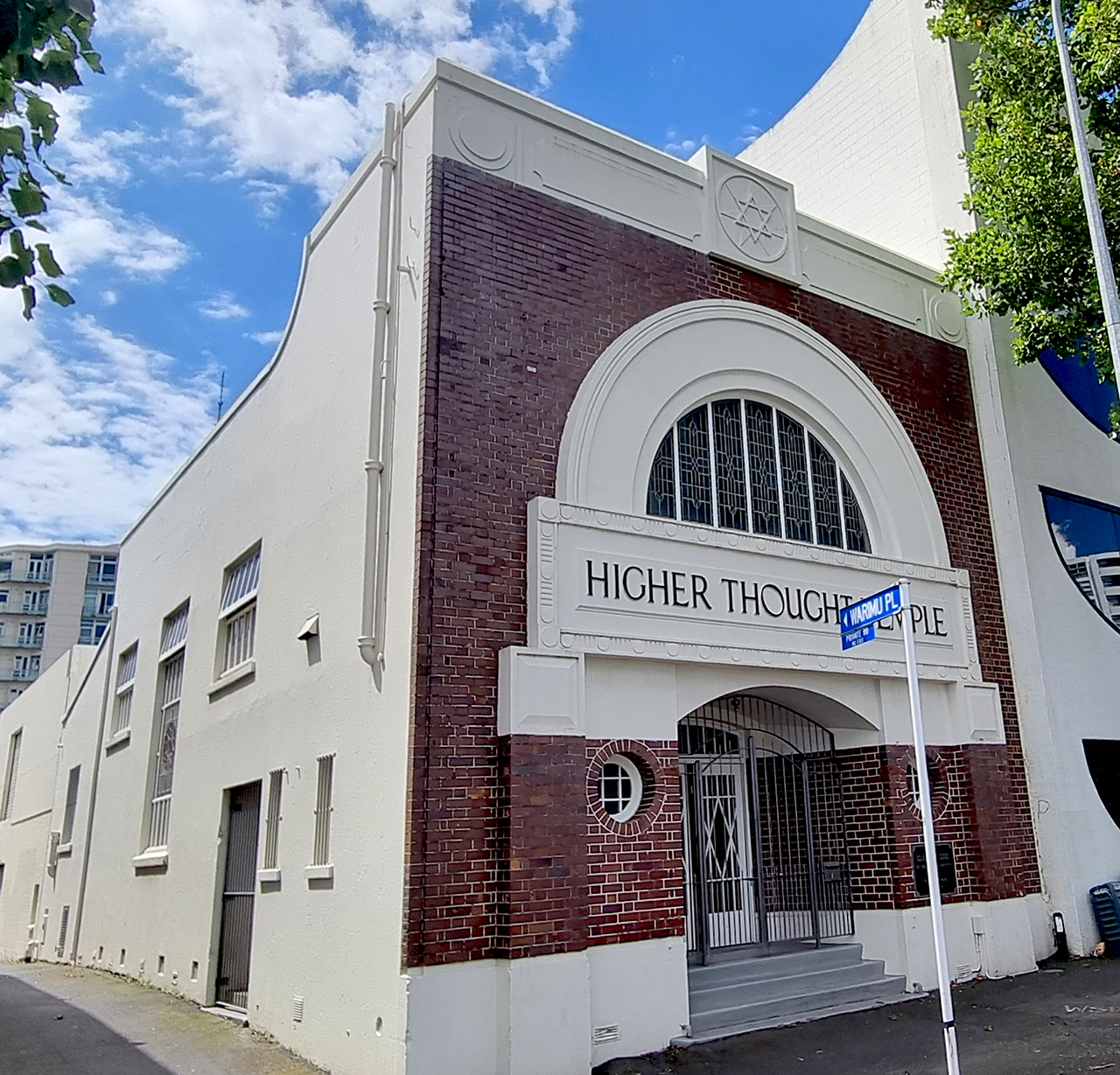
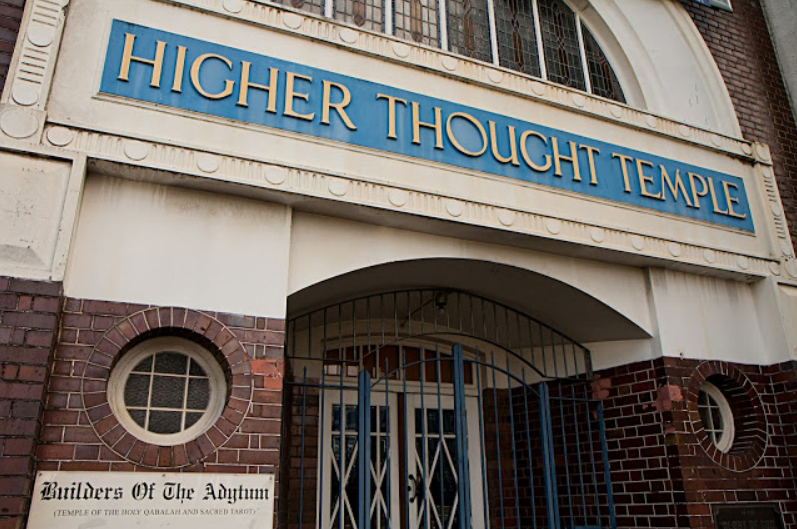
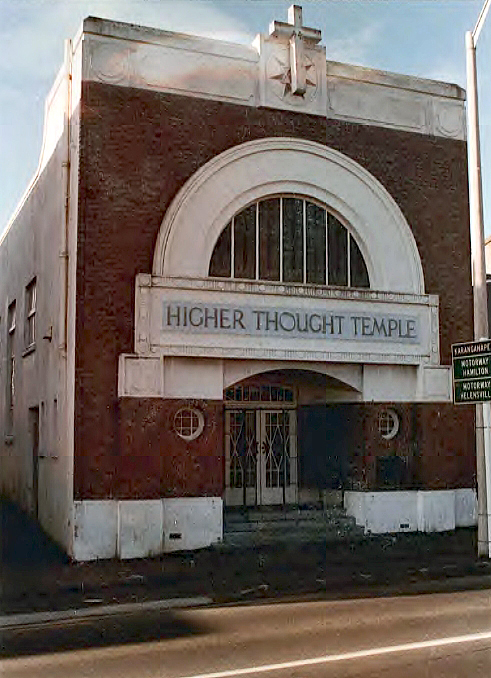
The Higher Thought Temple lies in the western part of Auckland's Central Business District, in a block bordered by Hobson and Nelson Streets. The building occupies the whole of a 171m² site on the northern side of Union (formerly Wellington) Street. Its main façade on Union Street directly adjoins the street pavement, while its western elevation fronts onto Warimu Place, a narrow service lane that links Union and Hobson Streets. The southern side of Union Street, opposite the site, is occupied by the main central city access ramps for the southern and north-western motorways. The Higher Thought Temple is a familiar sight to motorists exiting the motorways at this point, as the interchange contributes a measure of visual open space as a foreground to the building. Influenced by aspects of 'modern' early twentieth-century design, the building is rectangular in plan. Its simple but imposing façade on Union Street is of glazed brick with plaster detailing. This elevation incorporates a large central arch, articulating a recessed entrance at ground floor level and a semi-circular leadlight window above. Between the door and the window is a broad horizontal fascia bearing the words 'Higher Thought Temple.' The top of the façade is concealed by a permanent advertising hoarding, but includes a low parapet that also extends a quarter of the length of the elevation fronting Warimu Place. The roof is of low-gabled type. The western and northern elevations are faced with rendered brick. The former bears a tall window, with a leadlight inset featuring a Star of David. The symbol is set against a seven-pointed star enclosed by a circle, which in turn is set against a cross. Components of this emblem are found inside the building and probably also as a centrepiece on the Union Street parapet, concealed beneath the current hoarding. A centrally-located, louvred monitor on either side of the roof ridge provides ventilation for the hall. The building interior retains its original spaces and features substantially intact. It incorporates a richly timbered vestibule at its southern end, toilet and washroom facilities leading from the vestibule, a hall occupying the main bulk of the building, and a small platform with vestry and kitchen rooms behind at the northern end of the structure. Stairways on either side of the vestibule lead to an upstairs gallery. This contains more recent built-in cupboards at the rear, and three rows of original pews facing the platform. The building contains numerous decorative and other details. Linoleum on the vestibule floor and leadlights in the doors to the hall bear the Star of David emblem mentioned above. Each of the toilet facilities receives natural light from a circular window. The hall has a high stud, a beam and plaster ceiling, and leadlight windows with stained glass details. The entablature above the platform at the northern end of the hall bears the words 'Know Thyself' - a major tenet of Higher Thought philosophy. A George Croft organ provides an impressive background to the dais. Access to the small kitchen and vestry behind the platform is by means of internal doors and short flights of steps at the north-western and north-eastern corners of the hall respectively. The kitchen has a simple, built-in dresser.
The Higher Thought Temple lies in the western part of Auckland's Central Business District, in a block bordered by Hobson and Nelson Streets. The building occupies the whole of a 171m² site on the northern side of Union (formerly Wellington) Street. Its main façade on Union Street directly adjoins the street pavement, while its western elevation fronts onto Warimu Place, a narrow service lane that links Union and Hobson Streets. The southern side of Union Street, opposite the site, is occupied by the main central city access ramps for the southern and north-western motorways. The Higher Thought Temple is a familiar sight to motorists exiting the motorways at this point, as the interchange contributes a measure of visual open space as a foreground to the building. Influenced by aspects of 'modern' early twentieth-century design, the building is rectangular in plan. Its simple but imposing façade on Union Street is of glazed brick with plaster detailing. This elevation incorporates a large central arch, articulating a recessed entrance at ground floor level and a semi-circular leadlight window above. Between the door and the window is a broad horizontal fascia bearing the words 'Higher Thought Temple.' The top of the façade is concealed by a permanent advertising hoarding, but includes a low parapet that also extends a quarter of the length of the elevation fronting Warimu Place. The roof is of low-gabled type. The western and northern elevations are faced with rendered brick. The former bears a tall window, with a leadlight inset featuring a Star of David. The symbol is set against a seven-pointed star enclosed by a circle, which in turn is set against a cross. Components of this emblem are found inside the building and probably also as a centrepiece on the Union Street parapet, concealed beneath the current hoarding. A centrally-located, louvred monitor on either side of the roof ridge provides ventilation for the hall. The building interior retains its original spaces and features substantially intact. It incorporates a richly timbered vestibule at its southern end, toilet and washroom facilities leading from the vestibule, a hall occupying the main bulk of the building, and a small platform with vestry and kitchen rooms behind at the northern end of the structure. Stairways on either side of the vestibule lead to an upstairs gallery. This contains more recent built-in cupboards at the rear, and three rows of original pews facing the platform. The building contains numerous decorative and other details. Linoleum on the vestibule floor and leadlights in the doors to the hall bear the Star of David emblem mentioned above. Each of the toilet facilities receives natural light from a circular window. The hall has a high stud, a beam and plaster ceiling, and leadlight windows with stained glass details. The entablature above the platform at the northern end of the hall bears the words 'Know Thyself' - a major tenet of Higher Thought philosophy. A George Croft organ provides an impressive background to the dais. Access to the small kitchen and vestry behind the platform is by means of internal doors and short flights of steps at the north-western and north-eastern corners of the hall respectively. The kitchen has a simple, built-in dresser.
Historical and Associated Iwi / Hapū / Whānau
Information Sources
Auckland Star
Auckland Star
Donovan, 1985
Peter Donovan (ed.), Beliefs and Practices in New Zealand: A Directory, Palmerston North, 1985.
Dresser, 2001
Horatio Dresser, A History of the New Thought Movement, electronic publication, 2001, http://website.lineout.net/~newthought/ahotntm&.htm (original publication New York, 1919)
Ellwood, 1993
Robert S. Ellwood, Islands of the Dawn: The Story of Alternative Spirituality in New Zealand, Hawaii, 1993.
Sun
The Sun
Auckland City Council
Auckland City Council
Other Information
A fully referenced registration report is available from the NZHPT Northern Region Office Please note that entry on the New Zealand Heritage List/Rarangi Korero identifies only the heritage values of the property concerned, and should not be construed as advice on the state of the property, or as a comment of its soundness or safety, including in regard to earthquake risk, safety in the event of fire, or insanitary conditions.
Historical and Associated Iwi / Hapū / Whānau
Information Sources
Auckland Star
Auckland Star
Donovan, 1985
Peter Donovan (ed.), Beliefs and Practices in New Zealand: A Directory, Palmerston North, 1985.
Dresser, 2001
Horatio Dresser, A History of the New Thought Movement, electronic publication, 2001, http://website.lineout.net/~newthought/ahotntm&.htm (original publication New York, 1919)
Ellwood, 1993
Robert S. Ellwood, Islands of the Dawn: The Story of Alternative Spirituality in New Zealand, Hawaii, 1993.
Sun
The Sun
Auckland City Council
Auckland City Council
Other Information
A fully referenced registration report is available from the NZHPT Northern Region Office Please note that entry on the New Zealand Heritage List/Rarangi Korero identifies only the heritage values of the property concerned, and should not be construed as advice on the state of the property, or as a comment of its soundness or safety, including in regard to earthquake risk, safety in the event of fire, or insanitary conditions.
Current Usages
Uses: Religion
Specific Usage: Church
Former Usages
General Usage: Religion
Specific Usage: Church
Web Links
description: The Origins of Radiant Living' on http://www.nzhistory.net.nz
url: http://www.nzhistory.net.nz/culture/radiant-living/the-origins-of-radiant-living
Current Usages
Uses: Religion
Specific Usage: Church
Former Usages
General Usage: Religion
Specific Usage: Church
Web Links
description: The Origins of Radiant Living' on http://www.nzhistory.net.nz
url: http://www.nzhistory.net.nz/culture/radiant-living/the-origins-of-radiant-living
Location
Sign up to hear more
Get the latest heritage news, features and events delivered
straight to your inbox.
