

List Entry Information
Status
Listed
List Entry Status
Historic Place Category 1
Access
Private/No Public Access
List Number
4560
Date Entered
7th April 1983
Date of Effect
7th April 1983
City/District Council
Tauranga City
Region
Bay of Plenty Region
Legal description
Lot 2 DPS 56643
Status
Listed
List Entry Status
Historic Place Category 1
Access
Private/No Public Access
List Number
4560
Date Entered
7th April 1983
Date of Effect
7th April 1983
City/District Council
Tauranga City
Region
Bay of Plenty Region
Legal description
Lot 2 DPS 56643
Why is this place significant?
Historic Significance
Historical Significance or Value Although the Government Buildings, Tauranga were designed to house a wide range of Government departments, including a court room, lands office and customs office, its design is closely related to that of post office buildings erected during the early twentieth century. The general growth of state services under Liberal Government (1890-1911) and the expansion of postal services which occurred throughout New Zealand prior to the First World War saw the construction of many such buildings. Similar post office buildings were erected in Wanganui (1902), Carterton (1903), Greymouth (1909) and Westport (1913). However, the Government Buildings Tauranga are one of the few remaining examples left intact, illustrative of a most important era in the history of the post office - a period when the post office was the focal point and a pronounced architectural statement in provincial towns. The first postmaster to have worked in the building, C E Nicholas, was a notable figure in Tauranga. He was postmaster between 1903 and 1909 and also a Lay Reader at Holy Trinity Church, Tauranga, President of the Tauranga Musical Society and an Office Bearer in the local cricket and regatta clubs, as well as a member of the bowling club. Post masters were key business and social figures in such communities at this stage of New Zealand's development. Tauranga's population was only 5,000 by the 1930s. The first Stipendiary Magistrate to work in the building, Lieutenant-Colonel John MacKintosh Roberts (1840-1928), was also a notable figure in New Zealand's early history. At the beginning of the Waikato War the 'farm buildings were burned down by hostile natives' and Roberts joined the Forest Rangers. In November ha was given his ensigncy and in March 1864 he was promoted Lieutenant. At the end of hostilities he was appointed Magistrate at Rotorua and in 1868 as Sub-Inspector of the Armed Constabulary, proceeding with that force from Waikato to Patea. He served under Van Tempsky at the relief of Turuturumokai and was left in command of that post. He was awarded the New Zealand Cross in 1876. (See Scholefield, pp. 245-6) Roberts was appointed Magistrate at Tauranga c.1893 and brought 'a cool judgement to the intractable racial problem' both as a Magistrate and a Senior Officer.
Physical Significance
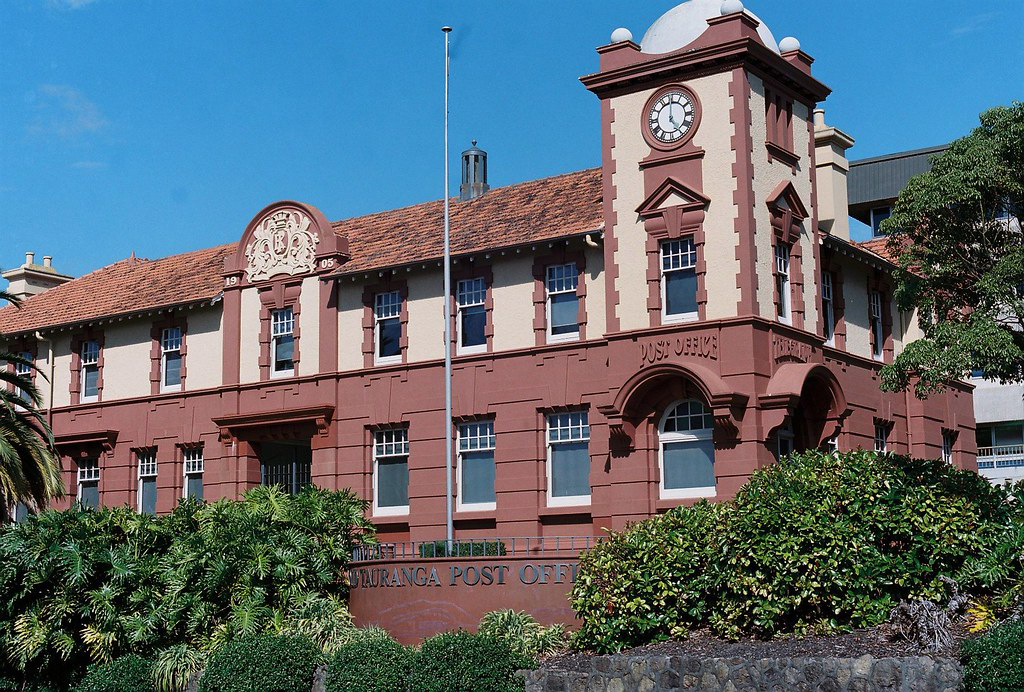
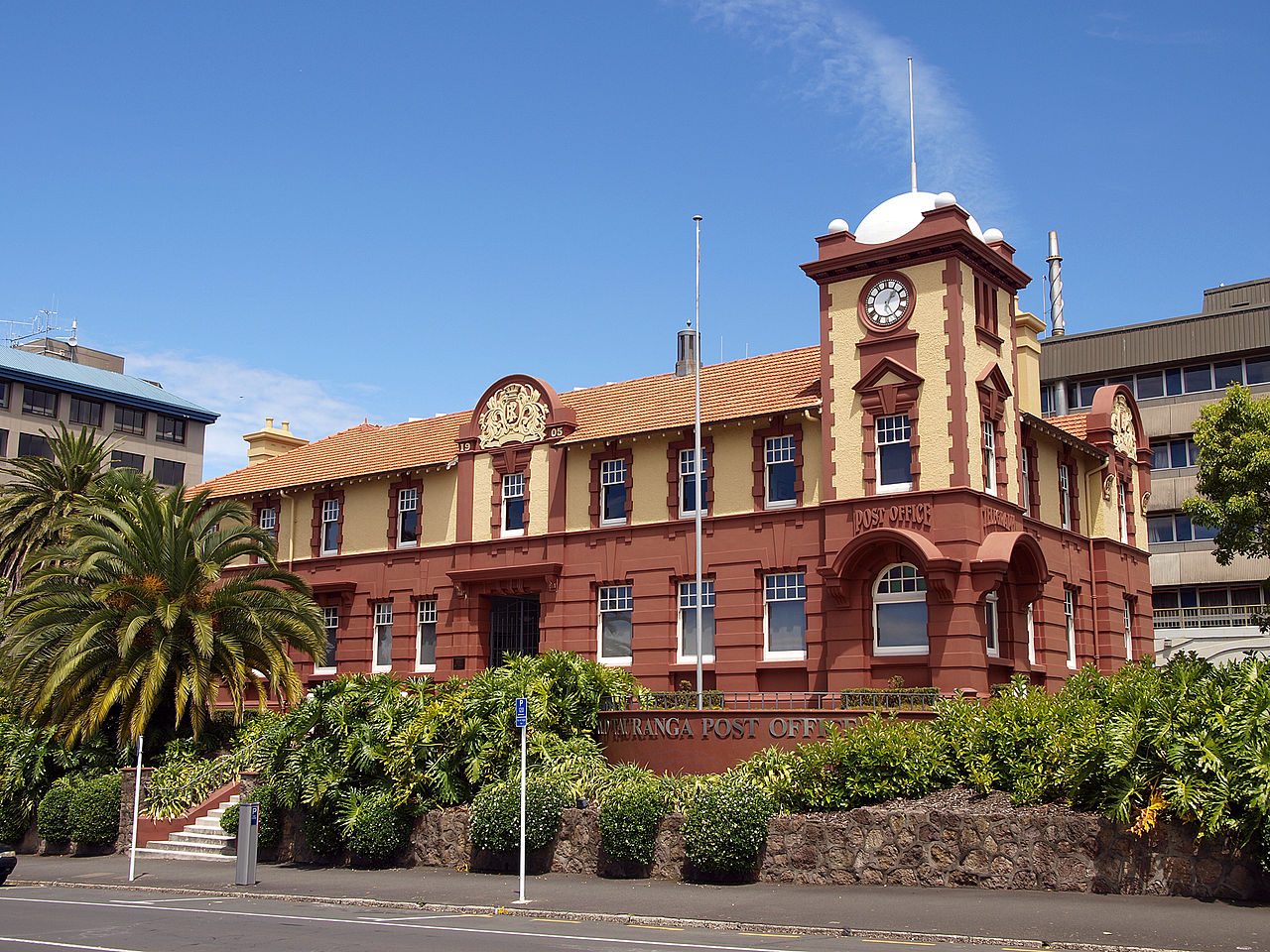
Architectural Significance: The Tauranga Post Office is significant as perhaps the last extant post office building remaining intact in a style which was once common throughout New Zealand. It is also one of only a few remaining exuberant Baroque designs by John Campbell which retains its segmental pediments, a hallmark of his work. Its architectural vitality is unparalleled in Tauranga. By stylistic reference to the architecture of such distinguished British architects as Sir Christopher Wren, James Gibbs and John Vanbrugh the building testifies to the continued importance of British as a source of inspiration for New Zealand architects well into the twentieth century. Its composition, with its asymmetric placement of a single tower was a feature of post offices erected between c.1900 and c.1914 and makes dramatic use of the raised site of the building. Townscape/Landmark Significance: The building is a notable townscape landmark in Tauranga because of both its distinctive architectural design and clock tower. Its siting on the terrace overlooking the harbour is striking.
Why is this place significant?
Historic Significance
Historical Significance or Value Although the Government Buildings, Tauranga were designed to house a wide range of Government departments, including a court room, lands office and customs office, its design is closely related to that of post office buildings erected during the early twentieth century. The general growth of state services under Liberal Government (1890-1911) and the expansion of postal services which occurred throughout New Zealand prior to the First World War saw the construction of many such buildings. Similar post office buildings were erected in Wanganui (1902), Carterton (1903), Greymouth (1909) and Westport (1913). However, the Government Buildings Tauranga are one of the few remaining examples left intact, illustrative of a most important era in the history of the post office - a period when the post office was the focal point and a pronounced architectural statement in provincial towns. The first postmaster to have worked in the building, C E Nicholas, was a notable figure in Tauranga. He was postmaster between 1903 and 1909 and also a Lay Reader at Holy Trinity Church, Tauranga, President of the Tauranga Musical Society and an Office Bearer in the local cricket and regatta clubs, as well as a member of the bowling club. Post masters were key business and social figures in such communities at this stage of New Zealand's development. Tauranga's population was only 5,000 by the 1930s. The first Stipendiary Magistrate to work in the building, Lieutenant-Colonel John MacKintosh Roberts (1840-1928), was also a notable figure in New Zealand's early history. At the beginning of the Waikato War the 'farm buildings were burned down by hostile natives' and Roberts joined the Forest Rangers. In November ha was given his ensigncy and in March 1864 he was promoted Lieutenant. At the end of hostilities he was appointed Magistrate at Rotorua and in 1868 as Sub-Inspector of the Armed Constabulary, proceeding with that force from Waikato to Patea. He served under Van Tempsky at the relief of Turuturumokai and was left in command of that post. He was awarded the New Zealand Cross in 1876. (See Scholefield, pp. 245-6) Roberts was appointed Magistrate at Tauranga c.1893 and brought 'a cool judgement to the intractable racial problem' both as a Magistrate and a Senior Officer.
Physical Significance
Architectural Significance: The Tauranga Post Office is significant as perhaps the last extant post office building remaining intact in a style which was once common throughout New Zealand. It is also one of only a few remaining exuberant Baroque designs by John Campbell which retains its segmental pediments, a hallmark of his work. Its architectural vitality is unparalleled in Tauranga. By stylistic reference to the architecture of such distinguished British architects as Sir Christopher Wren, James Gibbs and John Vanbrugh the building testifies to the continued importance of British as a source of inspiration for New Zealand architects well into the twentieth century. Its composition, with its asymmetric placement of a single tower was a feature of post offices erected between c.1900 and c.1914 and makes dramatic use of the raised site of the building. Townscape/Landmark Significance: The building is a notable townscape landmark in Tauranga because of both its distinctive architectural design and clock tower. Its siting on the terrace overlooking the harbour is striking.
Construction Professional
Name
Campbell, John
Type
Architect
Biography
John Campbell (1857-1942) served his articles under John Gordon (c1835-1912) in Glasgow. He arrived in Dunedin in 1882 and after a brief period as a draughtsman with Mason and Wales joined the Dunedin branch of the Public Works Department in 1883. His first known work, an unbuilt design for the Dunedin Railway Station, reveals an early interest in Baroque architecture. In November 1888 Campbell was transferred to Wellington where in 1889 he took up the position of draughtsman in charge of the Public Buildings Division of the Public Works Department. He remained in charge of the design of government buildings throughout New Zealand until his retirement in 1922, becoming in 1909 the first person to hold the position of Government Architect. Government architecture designed under his aegis evidences a change in style from Queen Anne to Edwardian Baroque. His best-known Queen Anne design is the Dunedin Police Station (1895-8), modelled on Richard Norman Shaw's New Scotland Yard (1887-90). Among his most exuberant Edwardian Baroque buildings is the Public Trust Office, Wellington (1905-09). Although Campbell designed the Dunedin Law Courts (1899-1902) in the Gothic style with a Scottish Baronial inflection, he established Edwardian Baroque as the government style for police stations, courthouses and post offices throughout New Zealand. In 1911 Campbell won the nation-wide architectural competition for the design of Parliament Buildings, Wellington. Although only partially completed, Parliament House is the crowning achievement of Campbell's career.
Construction Details
Start Year
1906
Type
Original Construction
Construction Materials
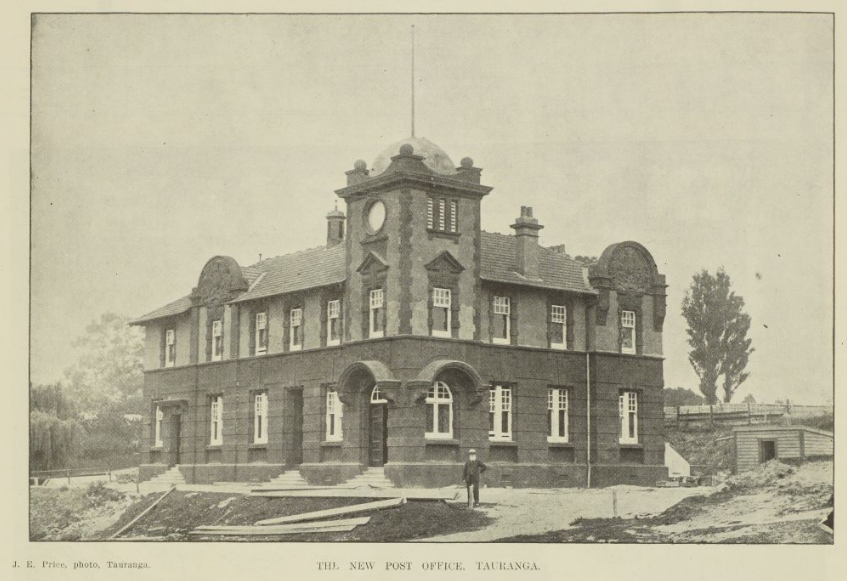
The building was erected in brick with some inner partitions being constructed in wood. The lower storey was finished in banded cement stained dull red and the upper portion was cream coloured roughcast. The wooden window frames were painted white and he building roofed with Marseilles tiles. In general the interior was plastered and painted.
Construction Professional
Name
Campbell, John
Type
Architect
Biography
John Campbell (1857-1942) served his articles under John Gordon (c1835-1912) in Glasgow. He arrived in Dunedin in 1882 and after a brief period as a draughtsman with Mason and Wales joined the Dunedin branch of the Public Works Department in 1883. His first known work, an unbuilt design for the Dunedin Railway Station, reveals an early interest in Baroque architecture. In November 1888 Campbell was transferred to Wellington where in 1889 he took up the position of draughtsman in charge of the Public Buildings Division of the Public Works Department. He remained in charge of the design of government buildings throughout New Zealand until his retirement in 1922, becoming in 1909 the first person to hold the position of Government Architect. Government architecture designed under his aegis evidences a change in style from Queen Anne to Edwardian Baroque. His best-known Queen Anne design is the Dunedin Police Station (1895-8), modelled on Richard Norman Shaw's New Scotland Yard (1887-90). Among his most exuberant Edwardian Baroque buildings is the Public Trust Office, Wellington (1905-09). Although Campbell designed the Dunedin Law Courts (1899-1902) in the Gothic style with a Scottish Baronial inflection, he established Edwardian Baroque as the government style for police stations, courthouses and post offices throughout New Zealand. In 1911 Campbell won the nation-wide architectural competition for the design of Parliament Buildings, Wellington. Although only partially completed, Parliament House is the crowning achievement of Campbell's career.
Construction Details
Start Year
1906
Type
Original Construction
Construction Materials
The building was erected in brick with some inner partitions being constructed in wood. The lower storey was finished in banded cement stained dull red and the upper portion was cream coloured roughcast. The wooden window frames were painted white and he building roofed with Marseilles tiles. In general the interior was plastered and painted.
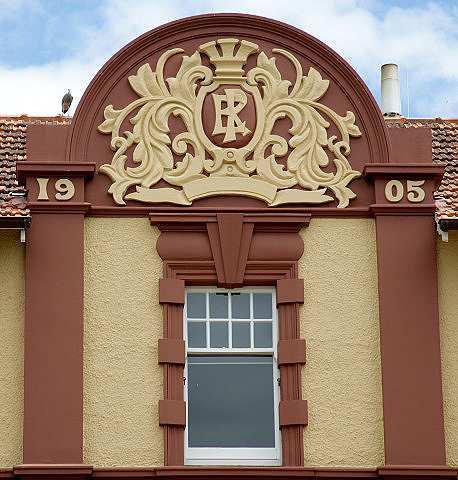
Architectural Description (Style): The style of the building is Edwardian Baroque. It has a rusticated ground floor and the end bays of the Willow and Harrington Street facades are topped by open-bed segmental pediments which include decorative carving. The Willow and Harrington Street corner of the building is marked by a domed tower with segmental pediments over the main entrances (one of the entrances had been converted into a window). The first floor windows have Gibbs surrounds and some cartouches are included in the design. The ultimate source of the architectural elements used in the design is English architecture of the late seventeenth and early eighteenth centuries, popular amongst Victorian and Edwardian architects. The use of a domed tower, for example, has its ancestry in those domed towers Wren designed for Greenwich, 1704 onwards. Similarly the Gibbs surrounds are derived from the architecture of James Gibbs (From which they take their name), Such architecture was considered by Victorian and Edwardian designers to be distinctively British. By architectural reference to the great Baroque buildings of England, Campbell aimed to give architectural expression in New Zealand to the colony's allegiance to British and the imperial ideal. Modifications: Substantial Campbell additions were made to the building in 1916, supervised by the local Resident Engineer of the Public Works Department, J Hannah. They were erected behind the main Willow and Harrington Street façade which remained unchanged. Although the exterior of the building has been painted cream, disguising the rich colouration of the original concrete, it remains largely intact. Inside some of the rooms have been subdivided. However, the court room retains much of its former grandeur.
Architectural Description (Style): The style of the building is Edwardian Baroque. It has a rusticated ground floor and the end bays of the Willow and Harrington Street facades are topped by open-bed segmental pediments which include decorative carving. The Willow and Harrington Street corner of the building is marked by a domed tower with segmental pediments over the main entrances (one of the entrances had been converted into a window). The first floor windows have Gibbs surrounds and some cartouches are included in the design. The ultimate source of the architectural elements used in the design is English architecture of the late seventeenth and early eighteenth centuries, popular amongst Victorian and Edwardian architects. The use of a domed tower, for example, has its ancestry in those domed towers Wren designed for Greenwich, 1704 onwards. Similarly the Gibbs surrounds are derived from the architecture of James Gibbs (From which they take their name), Such architecture was considered by Victorian and Edwardian designers to be distinctively British. By architectural reference to the great Baroque buildings of England, Campbell aimed to give architectural expression in New Zealand to the colony's allegiance to British and the imperial ideal. Modifications: Substantial Campbell additions were made to the building in 1916, supervised by the local Resident Engineer of the Public Works Department, J Hannah. They were erected behind the main Willow and Harrington Street façade which remained unchanged. Although the exterior of the building has been painted cream, disguising the rich colouration of the original concrete, it remains largely intact. Inside some of the rooms have been subdivided. However, the court room retains much of its former grandeur.
Historical and Associated Iwi / Hapū / Whānau
Information Sources
Bay of Plenty Times
Bay of Plenty Times
Dictionary of New Zealand Biography
Dictionary of New Zealand Biography
Noonan, 1975
Rosslyn J. Noonan, By Design: A Brief History of the Public Works Department Ministry of Works 1870-1970, Wellington, 1975
Ministry of Works and Development
Ministry of Works and Development
Other Information
Please note that entry on the New Zealand Heritage List/Rarangi Korero identifies only the heritage values of the property concerned, and should not be construed as advice on the state of the property, or as a comment of its soundness or safety, including in regard to earthquake risk, safety in the event of fire, or insanitary conditions.
Historical and Associated Iwi / Hapū / Whānau
Information Sources
Bay of Plenty Times
Bay of Plenty Times
Dictionary of New Zealand Biography
Dictionary of New Zealand Biography
Noonan, 1975
Rosslyn J. Noonan, By Design: A Brief History of the Public Works Department Ministry of Works 1870-1970, Wellington, 1975
Ministry of Works and Development
Ministry of Works and Development
Other Information
Please note that entry on the New Zealand Heritage List/Rarangi Korero identifies only the heritage values of the property concerned, and should not be construed as advice on the state of the property, or as a comment of its soundness or safety, including in regard to earthquake risk, safety in the event of fire, or insanitary conditions.
Current Usages
Uses: Trade
Specific Usage: Office building/Offices
Former Usages
General Usage: Communication
Specific Usage: Post Office
General Usage: Government
Specific Usage: Government office building
Web Links
description: Clarence Bistro/Hotel
Current Usages
Uses: Trade
Specific Usage: Office building/Offices
Former Usages
General Usage: Communication
Specific Usage: Post Office
General Usage: Government
Specific Usage: Government office building
Web Links
description: Clarence Bistro/Hotel
